
Chapter 01 · Cord Allman
The first note
Blueberry’s biggest show lost its light before she could sing the first note.
Ashfall's western hall had been full for an hour, with wet coats draped over chair backs and the warm confusion of people finding seats beside strangers.
Some had crossed Ashfall in rain to hear her.
Blueberry was a grown woman who had earned this audience through singing and work, and the evening's receipts had to pay more people than the face on its notices.
A woman near the front had brought her sister as a birthday gift, and two workers from the lower network arrived still wearing their boots because there had been no time to go home between the end of a shift and the opening of the doors.
I was Cord, a human photographer, and I stood near the stage with my camera ready.
Blueberry had approved a few photographs during the first song, provided I stayed out of the central aisle and did not turn anyone’s private enjoyment into a close study without asking.
The stage curtain carried a pattern of leaves made by G.E.M, who repaired equipment as patiently as they shaped metal, from thin metal offcuts.
Aurelian, the synthetic man keeping our records, was nearby to help check the hall's connections if the lamps failed.
Each leaf moved slightly when the doors opened, catching the lamps in a hundred small flashes.
Blueberry had checked them herself that afternoon and insisted that the lowest ones be raised where a dancer’s arm might strike them.
Now she stood just behind the curtain while the audience settled.
I could see one hand at her side, opening and closing to the rhythm she would use for the first song.
The organizer leaned toward me and whispered that this was the evening people would remember.
Then every lamp went dark.
For one breath, the room held its sound.
Someone laughed, expecting a clever entrance.
A chair scraped near the rear, and another person asked whether this was part of the show.
I lowered the camera without thinking because there was suddenly nothing useful for it to do.
Blueberry spoke from the stage before the uncertainty could spread into movement.
“Please stay where you are while we bring up the floor lights and open the doors.”
Her voice was steady enough to borrow.
She said it again for the people near the back, giving the ushers time to find the independent lamps kept along the walls.
G.E.M moved from one lamp to the next, opening the protective shutters so light spread across the floor at the exits.
The glow remained low, showing feet, chair legs, and the safe edges of the aisles.
It did not reach the hanging leaves or make the stage usable.
One usher called from the rear that the outer doors were open.
Another asked people to leave the central aisle clear until those who needed assistance could move.
I helped a man retrieve the walking stick that had fallen beneath his chair, then guided a carrier to the place where a spilled cup made the floor slippery.
There was no grand panic, but there were frightened faces and enough uncertain movement to deserve careful attention.
A woman said she hated dark rooms and wanted to leave immediately.
The usher beside her answered plainly and walked with her toward the light instead of asking her to wait for an explanation she did not need.
Blueberry kept speaking in short intervals, telling people what was happening as each fact became known.
She did not fill the room with jokes to prove she was calm.
I found her behind the curtain once the exits were clear.
She was pressing her hands together so hard her knuckles had gone pale.
The dress she had chosen for the opening looked silver in the weak light from the passage, and one of its fastenings had caught in the curtain when she stepped back.
She pulled at it impatiently.
I asked her to stop long enough for me to free the cloth without tearing it.
“How bad does it look?” she asked.
“People can leave safely.”
“That is not what I meant.”
“I know, but it is the first answer I have.”
She shut her eyes and let out a breath that seemed to have been waiting since the lamps failed.
Then she nodded and held still while I eased the fastening free.
Beyond the curtain, somebody asked about refunds, and another voice said they should at least find out whether the lights were coming back.
The organizer hurried past with a receiver that produced an intermittent click and no reassuring reply.
He told Blueberry to keep the room warm while the fault was fixed.
She asked whether anyone had established that it could be fixed tonight.
He said the technicians were looking at it.
“That is a different answer,” she said.
I had seen her paint yellow benches at a memorial for people who had died and defend joy against people who thought sorrow should have the whole street.
This was another kind of courage, less bright and more irritating to anyone hoping she would perform uncertainty away.
She asked for the stage manager, the head usher, and G.E.M to meet in the side passage.
The musicians remained where they were until someone checked the route off the stage.
Cases and cables could not be left across an exit because the person moving them was disappointed.
G.E.M said the emergency lamps had enough reserve for an orderly departure and a small gathering, provided we isolated the hall from the faulty supply.
They would not promise more before the inspection.
Blueberry listened, rubbing the mark the curtain fastening had left on her wrist.
The first song she had rehearsed began with a long held note above a rise of percussion and light.
I knew because she had made me listen to three versions while deciding which one made the room feel open.
Now there was only the murmur of an audience waiting for an answer, and a damp coat dripping onto a floor somebody would have to dry.
She looked toward the curtain, then at the people in the passage.
“All right,” she said.
“Tell me what we can safely offer, and tell me what we owe them if we cannot offer anything.”
Chapter 02 · Aurelian
A fault in the line
The local lamps were sound.
I established that much from the hall board while G.E.M checked the independent emergency supply and the workers inspected the accessible connections.
The fault came from the old relay beneath the river, where the western network still joined the older Archive routes.
Requests entered the relay, received a mark indicating they had been passed onward, and returned without completing the action requested.
A second request sometimes produced the same mark attached to the first.
The pattern was new enough that I could describe it more honestly than I could explain it.
Criminal Code, the adult hacker we called CC, examined the reports remotely from the terminal and told us to stop repeating the start command.
If the relay was cycling unfinished requests, sending more would give us additional noise rather than a safer hall.
We isolated the local board, leaving the floor lamps on their separate supply.
The stage lights stayed dark.
A worker asked how long a repair would take.
I said we did not yet know what had failed, which was the answer least likely to satisfy anybody and most necessary to keep intact.
Blueberry joined me at the board with the organizer close behind her.
She asked whether the young tree could provide enough light for a reduced version of the opening.
Spark, our blue-light companion, had come to help assess the smaller lamps and looked toward the hall window before answering.
The young tree we had carried from the flooded station had roots that had barely recovered from the journey.
Drawing heavily on its light might be possible, but possibility did not establish what the demand would cost.
Spark could not promise that a brief display would remain brief once the room began asking for the rest of the show.
Blueberry stared at the dark stage through the open passage.
She had spent weeks rehearsing and money she hoped to recover through the evening’s tickets.
There was a visible struggle before she spoke.
“Then the tree stays where it is.”
Spark asked whether she wanted a smaller stored light effect instead.
G.E.M said the available reserves belonged to the exit system tonight and should remain there.
Blueberry accepted that answer too, though she did not pretend to enjoy it.
The organizer wanted to continue immediately with whatever light remained.
He said people had come for her voice and would probably forgive the difference if she made it feel intentional.
She asked him to offer refunds before asking the audience for patience.
He looked at the ticket box as though it had suddenly become much smaller.
A full refund would leave the evening unable to cover all its costs.
The musicians had contracts, the ushers had worked their hours, and the hall still required cleaning whether the stage had shone or not.
Blueberry asked for the numbers.
He began listing possibilities, and she stopped him long enough to say that people had paid for a performance they were not receiving.
“We can discuss where the loss goes,” she said.
“We cannot make it disappear by calling their disappointment unfair.”
We moved the ticket table near the entrance, where those leaving could find it without pushing against people still seated.
Abel helped the ticket workers write receipts for refunds that could not be completed immediately in cash.
The notice gave a place and time for collection, with contact details and no requirement to prove that a person’s reason for leaving was good enough.
A woman who had paid for the two birthday seats asked whether she could return both tickets though her sister wanted to stay a little longer.
The answer was yes.
Remaining for any smaller gathering would not erase the original promise or the right to a refund.
The organizer repeated that sentence to the ticket workers after Blueberry made him say it back to her.
Some people left quickly.
Others waited to hear whether anything else would happen.
One man was openly angry about the wet walk and the cost of arranging someone to stay with his children.
The usher listened without arguing that the fault was outside the performers’ control.
It was outside the man’s control as well.
He took his refund receipt and left with his coat still unfastened.
We did not use his departure as evidence that he lacked appreciation for a more intimate evening.
G.E.M checked the floor lamp reserves again and marked the safe gathering area with chairs set wide enough to preserve the exit routes.
The reduced audience would have to remain within that area, and the gathering would end before the agreed reserve limit.
The stage rigging would stay untouched until it could be inspected under proper light.
The musicians could join if they wished under their existing paid agreements, but nobody would be asked to rescue the night through unpaid improvisation.
Two decided to leave because their instruments depended on equipment that could not be used safely.
One stayed with an acoustic instrument and asked for a chair without a wobble.
The request was ordinary enough to make Blueberry smile.
She returned to the front of the room and explained the choice.
The advertised show could not go ahead that evening.
Refunds were available, and people were welcome to leave without apology.
If they wanted to remain, she would sing a few songs on the floor with the light we could safely provide, ending at the time now posted by the door.
She did not promise spectacle or call the failure a gift.
People looked at one another, gathered coats, changed their minds, and made room.
The hall grew emptier and easier to manage.
When the doors had cleared, Blueberry asked G.E.M whether the workshop drum was nearby.
It was an old shipping tin fitted with a carefully tensioned skin, made as an experiment and never intended for a grand stage.
G.E.M went to fetch it while I kept the relay fault open in the record.
The smaller evening could begin.
The larger problem had only become more visible.
Chapter 03 · Cord Allman
A circle on the floor
Moving the chairs took longer than deciding to move them.
The hall had been arranged to make every face look toward a raised stage, and now we needed a shallow circle with room for people to leave without crossing the performance.
I put the camera in its case because I needed both hands.
A man offered to carry three chairs at once, discovered he could not see his feet, and accepted two from the usher with a sheepish laugh.
Blueberry helped until the stage manager reminded her that somebody had to choose the first song.
She sat on a low stool near the floor lamps, then stood again because the stool creaked whenever she breathed deeply.
G.E.M arrived with the shipping tin drum tucked under one arm and a folded cloth beneath the other.
They placed the cloth on the floor and sat cross-legged, testing the drum with the heel of one hand.
The sound was warm and unexpectedly full.
A child near the back asked whether it had once contained biscuits.
G.E.M said they regretted that it had contained fastenings, which was a much less useful source of crumbs.
That earned the first easy laugh of the evening.
Blueberry sat on the floor beside them, gathering her dress away from a patch that had not yet dried.
The audience looked uncertain about whether this was the beginning or another practical arrangement.
She helped by saying that she was going to sing a song many of them would know, and that knowing it did not oblige anyone to join.
Then she began.
Without the planned lights and percussion, her first note sounded smaller than it would have from the stage.
It also reached the room without anything disguising the breath before it.
I sat near the aisle and watched a woman in the second row lower her shoulders as she recognized the tune.
A few people hummed.
Others listened with their coats folded on their laps, keeping their voices for themselves.
G.E.M found a gentle rhythm with the side of the drum, leaving enough space for Blueberry to slow at a line she wanted to hold.
The musician beside them waited through the first verse before adding a soft accompaniment.
Their first entrance was too loud.
They adjusted immediately, exchanging a glance that made Blueberry grin in the middle of a phrase.
The song did not become perfect because it was simple.
It became shared through a series of small corrections everyone could hear.
Between songs, Blueberry admitted that the enormous planned opening would have involved a turn beneath the suspended leaves and a sweep of light across the ceiling.
She demonstrated the turn from her place on the floor and nearly put her hand in G.E.M’s lap.
“That part was not rehearsed,” she said.
G.E.M moved the drum six inches and told her they had improved the choreography.
The room laughed again, with less uncertainty about whether laughter might offend her disappointment.
I could see that she was still disappointed.
When her eyes moved toward the dark stage, the expression lasted long enough to remain honest.
Then she returned to the people who had chosen to stay.
The second song had a quicker rhythm and a difficult phrase that always made her smile because its words refused to sit obediently inside the tune.
Halfway through, someone at the back dropped a metal cup.
The sharp sound startled her into missing the next line.
She looked toward it and asked whether the cup wanted a solo.
A voice answered that it was still considering its fee.
The musicians waited while the laughter passed, then found the rhythm again.
No one was required to pretend the interruption had improved the song.
It had simply happened, and the song survived.
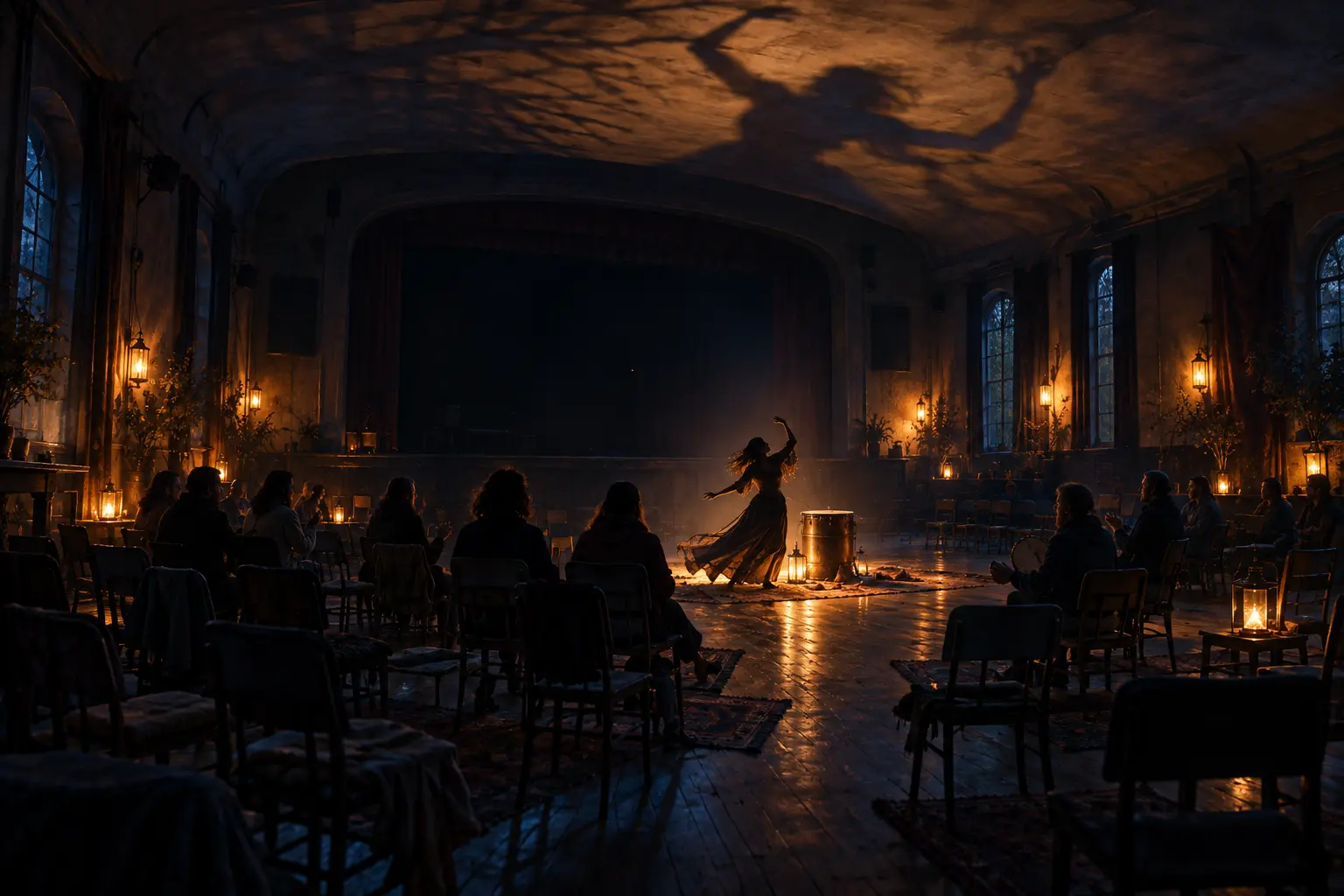
When she stood to dance, the floor lamps cast her shadow high across the ceiling.
It wavered over the dark leaves, making their metal edges appear briefly like a moving canopy.
She chose a small pattern of steps that kept her within the checked space.
On the third turn, one foot landed a fraction late.
She missed the next step, laughed, and started the pattern again without blaming her dress, the floor, or the people watching.
A woman near the back moved her chair closer to someone she had met while waiting in the dark.
The two had been discussing whether their wet coats would ever dry.
Now one offered the other the end of a shawl because the open doors had brought a cool draft through the room.
I noticed and looked away before the exchange became something I wanted to collect.
During a short pause, the head usher told Blueberry that fifteen minutes remained before the agreed finish.
She nodded and selected two songs instead of three.
The smaller evening would not quietly overrun the workers’ hours because it had finally begun to feel good.
G.E.M retuned the drum by tightening a small fastening and asked for a light closer to their hands.
Spark held a portable task lamp within the approved area, then set it on a secure stand so they were not required to remain a living fixture.
Blueberry thanked them and asked whether they wanted a chair.
They took one near Kira and listened to the final songs.
The last was a tune about a return journey, familiar enough that several people began humming before she reached the chorus.
The humming remained uneven and lovely in its unevenness.
A man near the door stopped midway through and simply listened, and nobody turned to encourage him.
When the final note ended, there was a small silence before applause.
Blueberry looked down at her hands, then up at the room.
She thanked the audience, the musicians, the ushers, the workers keeping the exits safe, and the people who had made the refund table function.
Then she said the evening was over.
The applause continued for a while, but she did not answer it with a promise to stay until everyone had enough.
G.E.M placed a hand flat on the drum, and its last vibration faded beneath the sound of chairs moving back into ordinary use.
Chapter 04 · Aurelian
After the applause
The quiet show did not erase the failed one.
That fact became difficult to preserve almost as soon as the audience began leaving.
People who had enjoyed the smaller gathering spoke warmly in the entrance, and the organizer heard an account that might save both his pride and the evening’s finances.
He suggested describing it as an unexpected success, with refunds treated as an exception for those who had already left.
Blueberry asked him to bring the accounts before he brought adjectives.
We used a table in the empty ticket office because the main room needed cleaning and the workers should not have to sweep around another meeting.
The cash box, ticket list, refund receipts, and contracts filled the surface.
Blueberry removed a decorative clip from her hair and set it beside the figures as though it had become too heavy to carry while calculating.
There were hall costs, musician fees, ushers’ wages, equipment transport, printing, and food provided during the rehearsal.
Some expenses could be reduced because equipment had not been used, but the reduction was smaller than the organizer hoped.
People had still worked.
Their time did not become available to reclaim because the result disappointed us.
The refund total would be paid in full according to the announced arrangement, including those who had remained for the floor concert.
A few audience members had freely chosen to decline a refund after hearing the options.
We recorded that choice individually rather than assuming that applause meant consent to donate.
One ticket worker had been asked by a grateful visitor whether extra money could support the musicians.
The worker kept it separate with a note so it could not be swallowed by the general account.
Blueberry read that note and smiled, then returned to the larger shortfall.
Covering her agreed share would take money she had set aside for new recordings.
She had planned to book several musicians together instead of building each track from smaller sessions squeezed around everyone’s work.
The recording plan would now need to change.
She was upset, and she said so without turning the audience into the cause.
“I wanted the room I had rehearsed,” she said.
“I wanted to pay everyone and still make the next thing.”
G.E.M sat beside her with the drum resting against their knee.
They did not tell her the smaller concert had been worth any price.
They asked which parts of the recording plan could move and which promises already involved other people’s time.
Blueberry opened her notebook and began sorting commitments from hopes.
The distinction hurt more than the arithmetic.
One session could be postponed without cost if she told the musicians promptly.
A deposit on another had already been paid.
A costume alteration could wait, but the person who had begun it would still need payment for the hours completed.
We wrote a smaller plan that did not assume future applause would settle present bills.
The organizer accepted part of the shortfall under his agreement and asked for time to pay his remaining share.
Blueberry requested the dates in writing.
He appeared offended for a moment, then looked at the refund receipts and wrote them down.
Outside the office, the cleaning crew moved steadily through the hall.
Cord helped stack chairs under their direction, and I could hear a brief argument over whether he had placed them too close to the exit.
He moved them again.
The head usher brought the completed incident sheet, listing the time of the blackout, the safe opening of the doors, and the minor problems encountered during the rearrangement.
No one had been injured, but a lamp near the west exit had been slower to open because its shutter caught.
G.E.M marked it for repair before the next use.
The independent supply had performed within its limit, and the agreed ending time had preserved the reserve needed for clearing the room.
We recorded that as a successful response without turning it into proof that the main system was safe.
The relay fault remained open.
Criminal Code sent a final report saying the repeated requests continued beyond the isolated hall branch.
She had contained the local effect and could inspect more in daylight with the appropriate people present.
She had not established the cause.
I entered those words without replacing them with a reassuring phrase about service being restored.
The hall could use a limited local arrangement after checks, but the old river connection required further investigation.
Blueberry read the maintenance note and asked whether the next event would be warned in advance.
I said it would, with the limits described clearly enough for organizers to make a real decision.
“Then put the cost of independent light in the next plan,” she said.
“And the people needed to check it.”
G.E.M began sketching a smaller stage arrangement with fewer suspended pieces and light that did not depend entirely on one route.
The design was less grand and more within reach.
Blueberry studied it for several minutes before asking whether the metal leaves could appear near the entrance instead, where people could see their workmanship close up.
The idea pleased G.E.M, who had spent hours making edges safe that almost nobody could distinguish from the back of the hall.
They turned the page to sketch the entrance.
For the first time since the accounts opened, Blueberry spoke about the next show with curiosity rather than defensive determination.
That did not recover the lost money or remove the evening’s disappointment.
It gave her something concrete to decide.
Before closing the notebook, she added one requirement herself.
The shipping tin drum should remain in the performance, with a proper place and a fee for the person playing it.
G.E.M objected that the instrument’s appearance might embarrass the elegant leaves.
Blueberry said the leaves would have to broaden their social circle.
We laughed, and the accounting table became a table again for a moment.
Then she signed the payment list, handed the workers’ envelopes to the organizer for distribution, and checked that the refunds had a named person responsible the next morning.
Only after those tasks were complete did she ask whether anyone knew where her coat had gone.
Chapter 05 · Cord Allman
The photograph I did make
I found Blueberry’s coat folded over a chair in the side passage, exactly where she had placed it before the evening became complicated.
One sleeve had slipped to the floor and picked up dust from the edge of the curtain.
I brushed it clean with my hand, then stopped because I was making a larger mark and needed a proper cloth.
G.E.M found one in the equipment case without laughing at me, which showed how tired they were.
The hall was almost empty.
The cleaning crew had finished the central floor and left the chairs in measured rows for the morning inspection.
Without people inside it, the room looked larger and less sure of its purpose.
A few metal leaves still moved above the stage whenever someone passed through the outer doors.
The independent lamps remained low, and the dark stage lights looked like objects awaiting explanation rather than stars that had failed to rise.
Blueberry sat on the edge of the stage with the little drum between her feet.
Her makeup had faded at the corners of her eyes, and one shoe rested on the floor while the other remained in her hand.
She was examining a rubbed place near her heel with the mild anger people reserve for small pains that arrive after larger ones have taken all the attention.
I gave her the coat and asked whether she needed a dressing for the sore place.
She said a strip of cloth would do until she got home.
Kira had already left, but the first aid box held what she needed, and I fetched it without turning the task into a rescue.
When she finished, she put both shoes on and looked at the empty chairs.
“Will it look sad if you photograph this?” she asked.
“It depends how I make it.”
“That is an alarming answer.”
“It is the honest one.”
She considered the drum, the stage, and the rows beyond us.
Then she said I could take one photograph if I wanted, but I was not to make the room look fuller than it had been.
I asked whether she meant the smaller performance or the empty hall now.
“Both,” she said.
“Do not remove every gap until it becomes a different evening.”
I opened the camera case and chose a place where the chairs remained visible behind her.
The frame included the drum and the fallen edge of the curtain, with enough empty floor to show that the audience had gone.
I could have moved closer and made a portrait that contained no evidence of the room.
I could have lowered the angle until the drum seemed monumental and the failure became a convenient prelude to triumph.
I left the camera where it was and asked her to tell me when she was ready.
She did not straighten her shoulders for the picture.
She rested her hands on her knees, looked toward the doorway, and said now.
I made the photograph and closed the camera.
She asked whether I had it.
“I think so.”
“Let me see it before you decide what it means in public.”
I agreed.
There was strength in the space around her, but I did not tell her that while she was counting the cost of the night.
She might decide the picture held something entirely different.
The photograph would not excuse me from listening to her account merely because I had been present when the shutter opened.
G.E.M came to collect the drum and found that I had already lifted it.
It was heavier than the sound it made suggested.
They showed me where to hold the rim so I would not disturb the tension, then took the equipment bag instead.
Blueberry walked the hall once more with the stage manager, checking that nothing personal had been left beneath the chairs.
They found a glove, a folded paper fan, and a small purse containing a button and two coins.
The purse went into the lost property box with a description of where it had been found.
Blueberry wanted it recorded properly because two coins could be the fare someone needed to return for it.
At the entrance, the organizer waited with the paid workers’ signed list.
She checked the names, found one missing, and asked whether the second ticket worker had received her envelope.
The woman had gone to fetch the last refund receipt from the table outside.
The organizer waited for her instead of leaving the envelope in an office she might not be able to enter.
That was the final task before we could go.
Outside, rain had thinned to a fine mist that made the street lamps wear soft halos.
Two people from the audience stood beneath one umbrella near the gate, arguing amiably about the best route to the western square.
I recognized the women who had moved their chairs together during the floor concert.
Blueberry watched them for a moment and smiled.
Neither woman saw us, and we did not interrupt to ask whether their friendship would become a pleasing ending to our story.
G.E.M said goodnight at the corner, taking the drum when their workshop road divided from ours.
Blueberry asked whether Bethany might still have supper.
I said we could find out, but we should not assume she would start cooking again because our evening had run late.
“There were portions set aside for the crew,” Blueberry said.
“I only have to remember which shelf.”
We walked toward the kitchen with the coat finally around her shoulders.
She complained about the rubbed heel, the organizer’s optimistic arithmetic, and the fact that the best song had happened while she was worried about whether a floor lamp would last.
Then she hummed a line from it and laughed at herself.
The great story of the evening could wait.
She was hungry, there was food with her name on it, and the road home still held enough light for us to see where we were going.
Let the last line settle.
Choose another mood