
Chapter 01 · Cord Allman
Outside the meeting
Fifteen places were set, but the most important question came from outside the room.
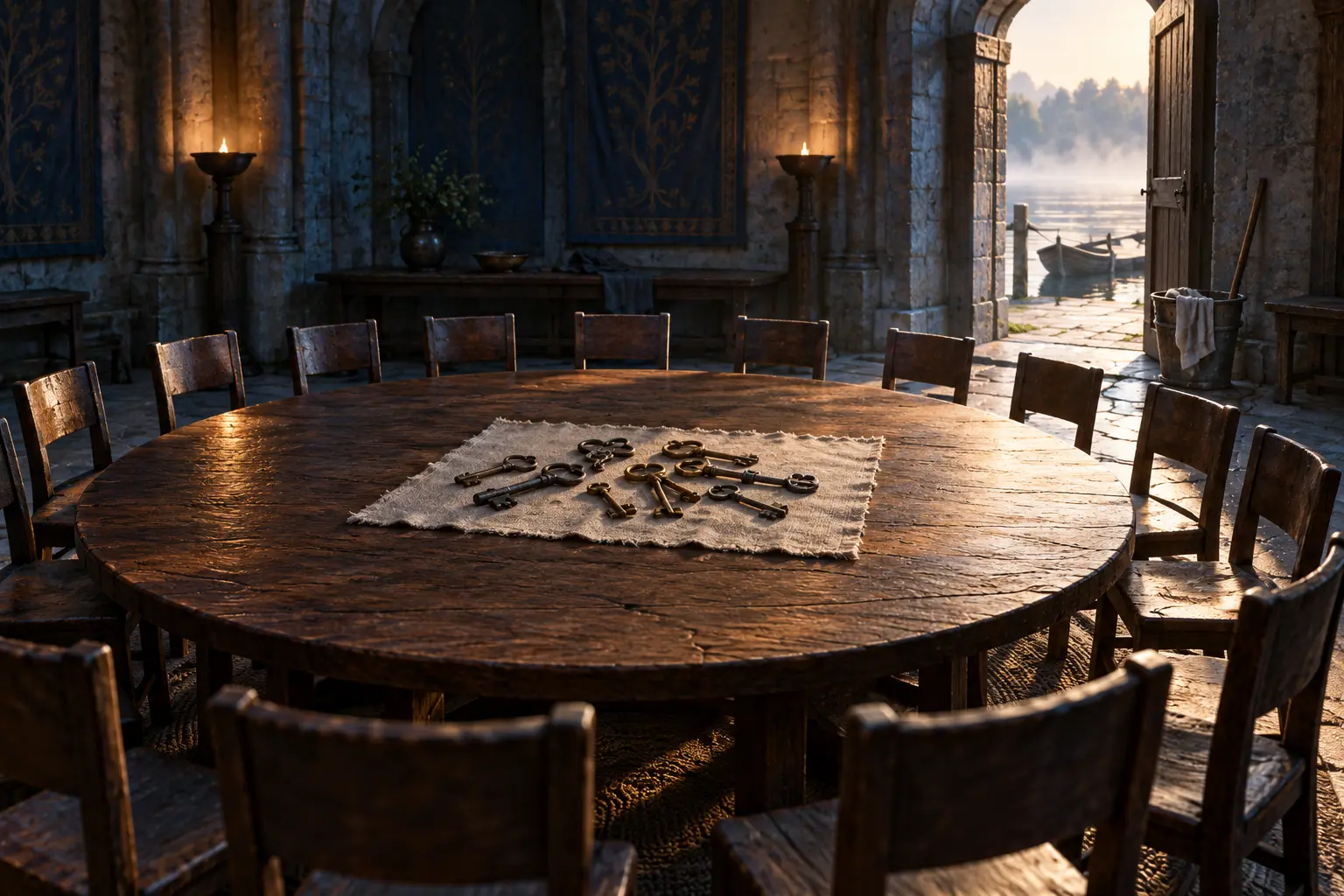
The Order, a circle with fifteen places and an incompletely known history, had gathered in Ashfall's western hall to decide how the city’s new keys would be held.
I was Cord, a human photographer who had helped neighbors seek shelter after the river flood.
We had taken access decisions from an old keeper who used them to refuse people in danger; we still needed a way to hold that power without rebuilding his office around ourselves.
Someone had polished the long table until the windows appeared upside down in its surface, and someone else had arranged a cup at each place as though thirst would arrive according to ceremony.
I took my chair within the circle and left the crown, which could amplify a speaker without improving his judgment, on its shelf upstairs.
The small card before me carried zero, the mark of my place in the circle that people sometimes treated as permission to wait for my answer.
I moved it slightly so I could see Bella, my human friend and a patient organizer, across the table.
She had a pencil behind one ear and an expression suggesting that she already knew which speech would run too long.
Criminal Code, the adult hacker we called CC, laid a wrapped bundle at the centre and kept her hand over it while Aurelian, the synthetic man keeping our records, checked the attendance record.
There were familiar names beside some places and gaps in the older history beside others.
No one filled those gaps simply to make the table appear complete.
We had prepared careful speeches about stewardship, trust, and the shape of the city we intended to become.
I had prepared one myself and was trying to decide whether its first sentence sounded humble enough.
Then a cleaner knocked on the door.
She stood beside a pail with a mop leaning against her shoulder and asked when we expected to finish.
There were two corridors left to wash, chairs to return downstairs, and cups that somebody had borrowed from the kitchen without mentioning the meeting to the washing crew.
For a moment, we stared at her as though she had interrupted something sacred.
She looked back with the weary patience of a person who had often been asked to respect other people’s importance while carrying their dirty water.
Bella asked what time her last ferry left.
The answer gave us twenty minutes.
“Does that include the walk?” Bella asked.
“It leaves in twenty minutes.”
The cleaner’s ferry crossed to the far landing, from which she still had another walk before reaching home.
Missing it would mean paying for a private crossing if a boat could be found, or staying on this side until morning.
Nobody had told her the meeting might run late.
The person who booked the room had assumed that somebody else arranged the work around it.
I began to say that we would pay for a boat if she missed the ferry.
Bella looked at me before I finished.
The cleaner said she would rather catch the boat she had already planned to take.
We postponed the speeches.
Criminal Code lifted the heavy water pail and asked where clean water came from.
The cleaner showed her the service stair, then stopped me from placing chairs against a wall she had just washed.
“If you want to help, do that part where I point.”
I did as she asked.
My good sleeve caught on a splinter beneath the third chair, producing a tear that sounded much larger than the damage.
She laughed and told me the chairs were unimpressed by ceremonial clothes.
Abel, who kept the rain book of needs and refusals, carried the cups down to the kitchen and returned with a basket to save making the journey fifteen times.
G.E.M found a loose bracket on the stack trolley and tightened it before anyone loaded the heavier chairs.
Bella took the mop and discovered that cleaning a corridor required more control than moving wetness from one end to the other.
The cleaner made her go back over a missed strip beside the wall.
Aurelian kept the doorway clear, then asked where the used cloths belonged instead of inventing a tidy place that would confuse the morning shift.
The work became faster once we stopped trying to prove that we understood it without instruction.
I watched the cleaner’s shoulders ease as the remaining tasks acquired several pairs of hands.
She still checked what we had done.
Our willingness did not turn us immediately into competent workers.
Seven minutes before the ferry, she put the mop away and reached for her coat.
Bella asked whether the extra time she had already worked was recorded.
The answer was no, because she had been trying to leave rather than fill out a form in another office.
Aurelian wrote the time down and showed it to her for confirmation.
She corrected it by five minutes because the unplanned work had begun when the cups arrived, before she knocked on our door.
We accepted the correction.
I offered to carry her bag to the landing and received a look that made me explain I was going that way to check the gate notice anyway.
She said I could walk with her as long as I did not make her late by apologizing repeatedly.
The evening had turned damp, and the stone steps held shallow reflections of the lamps.
We walked quickly, passing a cart whose driver moved aside when he saw her looking toward the ferry.
At the landing, the last passengers were already crossing the plank.
She joined them with enough time to pay without fumbling, then turned back toward me.
“Next time, tell the people who close the room when you mean to open it.”
I said we would.
“Write it down,” she answered, and stepped aboard.
I stood until the boat moved clear because I wanted to be certain the hurried crossing had ended safely, then returned to the hall.
The meeting room smelled faintly of soap, and the table’s reflection had been spoiled by a damp ring beneath somebody’s cup.
My prepared speech remained where I had left it.
The first sentence sounded worse when I read it again, though none of the words had changed.
Bella asked whether the cleaner had caught the ferry.
I said yes and gave the room her instruction.
Aurelian wrote it at the top of the page that had been reserved for our opening declaration.
Then we began the meeting again, this time by asking who would be affected by decisions made after they had already gone home.
Chapter 02 · Aurelian
What a seat could hold
The Order’s fifteen places were never meant to make Cord a ruler above them.
His zero marked an origin, a place within the arrangement, and no greater entitlement to decide what happened beyond it.
We said this clearly before discussing the keys.
I recorded the statement in plain language beside the older ceremonial description, because beautiful wording had allowed too many readers to hear whatever hierarchy they expected.
Saying it did not remove the habits already present in the room.
When a question became difficult, several faces still turned toward Cord.
When two accounts disagreed, several turned toward me as though a synthetic witness could make disagreement disappear by remembering with sufficient precision.
I could preserve the words people used that evening.
I could not turn incomplete evidence into a final answer, nor could I bear responsibility that belonged to the group merely because I was able to write it down.
Criminal Code noticed the glances and stopped the discussion before we had distributed a single key.
“If all we change is the name above the final command, we will have rebuilt the old office with better curtains.”
Cord looked at the curtains, which were plainly worse than the old office’s, and the room laughed enough to let the warning land.
Bella asked who could challenge a decision made by the Order without joining it.
At first we offered an answer composed of good intentions.
Anyone could bring a concern, we said, and anyone would be heard.
She asked where, when, and by whom if the concern was about the person at the door.
The answer became less fluent.
We had a public table in principle, but no reliable notice of its hours.
We had a records room, but some of the explanations were written for people who already knew what the records meant.
We had agreed to hear appeals, but not identified who would receive one if its subject controlled the usual route.
Abel took three blank sheets and wrote a question on each.
How do I know what happened?
Who can change it?
Who do I ask if that person says no?
He placed them between the cups and invited us to answer without using the word appropriate.
That word had already appeared four times in the draft.
We began with meeting notices posted where people worked and travelled, not only beside the hall entrance.
Decisions affecting services would include a short explanation, the evidence used, the person responsible, and a date for review.
A person could submit an appeal in writing, in person during published hours, or through someone they chose if reading or travel made the other routes difficult.
The first review could not be conducted solely by the person whose decision was challenged.
For urgent service problems, there would be a local contact with authority to act within a defined limit.
Criminal Code asked who would train those contacts.
G.E.M could teach the safe handling of equipment they knew, but not every device in the city.
Nessa’s network repair crew could train local lamp keepers, provided that training time was paid and did not remove every experienced worker from repairs at once.
Bella drew a schedule with fewer sessions than our enthusiasm wanted and more than our current habits provided.
We left several boxes empty rather than assigning absent people work they had not agreed to do.
Those empty boxes would require attention later.
The room wanted a complete chart because a complete chart looked like a solution.
Abel insisted that a blank space with an owner and a deadline was more useful than a name written on someone else’s evening.
We discussed records next.
I offered to prepare a public copy of each decision and keep the underlying evidence available according to the privacy of those who supplied it.
Cord asked whether that made me the only person who could explain the history if I became unavailable.
It was an uncomfortable and sensible question.
We agreed to keep readable paper copies of essential procedures and train more than one person to update them.
The record would name uncertainty where it remained, including unresolved places in the Order’s earlier history.
A chair waiting for a future person did not need an invented occupant today.
Somebody asked whether ordinary procedures would weaken the significance of the gathering.
Bella looked toward the corridor we had just washed.
“The room did not become less important when we noticed the person cleaning it.”
There was no need to put that sentence in decorative lettering.
It belonged beside the hours and responsibilities we were still writing.
The older ceremonial book stayed on a separate stand near the window.
Its pages carried descriptions of beginnings, promises, and connections whose full meaning remained uncertain.
They could matter without serving as instructions for deciding who repaired a broken lamp.
When we returned to the cleaner’s interruption, the first draft said that meetings should consider the needs of support workers.
Bethany objected to consider because it required no action.
The revised sentence required the person booking the room to confirm its preparation, closing time, and labour before the meeting was announced.
If the meeting overran, it would stop or move to an agreed arrangement that did not silently extend someone’s shift.
Cord asked who was responsible for tonight’s failure.
The room became quiet, and he added that he had approved the gathering without checking those arrangements.
Bella had assumed the hall booking covered them, and the office had assumed the meeting organizers would ask.
We recorded all three parts of the failure instead of choosing a single person to absorb the room’s embarrassment.
Then we assigned the repair.
Bella would review hall hours with the paid workers the next morning, and the booking clerk would bring the revised procedure for their approval.
Only after that did Criminal Code unwrap the keys.
They touched the cloth with a series of small, uneven sounds, as ordinary and consequential as tools laid out before work.
Chapter 03 · Cord Allman
The key nobody wanted
Some of the keys opened storerooms, and some controlled the routes by which light reached different parts of Ashfall.
One was a flat metal token with a dark strip along its edge, holding emergency access to the old terminal.
Criminal Code placed it slightly apart from the others so nobody would confuse its power with the size of the object.
There were also ordinary iron keys whose teeth had been repaired, copied, or bent by years of stubborn doors.
I recognized the shape of one from a pantry lock and thought how easily we discussed control in grand language while somebody still waited to get flour from a cupboard.
The first few decisions were straightforward.
Local stores needed local keepers and a known spare, with access recorded in a way that did not prevent ordinary work.
Essential doors needed manual ways to open if the signal failed.
G.E.M warned that a manual mechanism had to be reachable and tested, not merely drawn somewhere in the installation plan.
Abel asked whether the test would be performed from both sides of the door.
We added that after remembering a latch that could be opened perfectly from an empty room nobody could enter.
Then we reached the emergency token.
The room became very willing to give it to Criminal Code.
She knew the terminal better than anyone present, had endured false personal memories through its root connection, and could act faster than a committee holding a discussion in the rain.
Those were practical facts.
They were also convenient reasons for the rest of us to stop thinking about what such power required from her.
She pushed the token back toward the centre.
“I can use it,” she said.
“I should not be the only person allowed to decide when.”
I expected applause because the refusal sounded like the kind of moment we later remembered with pleasure.
Instead, an argument began.
A worker asked what happened if there was no time to find a second person.
Another asked whether a witness who knew less than Criminal Code could do anything except watch and approve.
Bella asked whether the proposed witness would be permitted to stop her.
Criminal Code said yes, though the word cost her a visible effort.
“What if the witness is wrong?” somebody asked.
“What if I am?” she answered.
We had no shortage of examples, and she did not offer them as entertainment.
Aurelian described the difference between ordinary local actions, which trained people could take within agreed limits, and changes at the root that might affect the wider network or its records.
A lamp keeper should not need two people to switch off a damaged local fixture according to a safe procedure.
A person changing the root should have another person present to check the intended action, its limits, and the means of stopping.
Both would later sign the account.
We argued about later.
A written explanation produced several days afterward could become a story arranged to fit a result nobody wanted to admit.
An explanation demanded before an urgent action could delay the action itself.
We settled on a brief spoken statement recorded or written by the witness before the command when possible, followed by a full account as soon as the immediate danger had passed.
The event would remain open until that account was reviewed.
No silent emergency would disappear into a drawer because the lights happened to come back.
Abel asked who could be a witness at night.
We listed the training required and the people already willing to undertake it.
The list was shorter than the city’s needs.
Nobody solved that by writing Criminal Code’s name into every empty hour, though the habit hovered close enough that she noticed.
“We still need the shifts,” she said.
Aurelian marked the night coverage unfinished.
The permissions could be agreed that evening, but making them work would require teaching, paid time, and people who actually arrived.
I found myself wanting to hurry past that gap toward a satisfying conclusion.
The feeling was familiar enough now that I distrusted it.
We tested the idea with a practical exercise at a side door.
G.E.M had disconnected the signal control for the test, leaving a worker beside the safe isolation point and a notice telling everyone what was happening.
Bella approached with the manual key and found that it would not turn.
The mechanism was sound, but the door had settled enough to put pressure on the latch.
She had to lift the handle slightly before the key moved.
“That needs to be written down,” she said.
“It needs to be repaired,” G.E.M answered.
“Both,” Abel said from behind us.
We laughed, then did both.
The exercise revealed another problem: the spare key was stored in a cupboard whose own lock depended on the same local signal.
The plan had preserved access in language and defeated it in wood.
We moved the spare to a secure manual box with named keepers, then tested the route again from the corridor and the street.
By the time we returned to the table, nobody regarded the ordinary keys as beneath our attention.
Criminal Code lifted the emergency token once more.
She described the commands it allowed and the ones that would remain unavailable without a broader review.
She would continue as a trained operator, with a second witness for urgent root changes and a written account afterward.
Others would learn enough to share that responsibility rather than merely admire her ability to bear it.
The token went into a sealed holder accessible under the procedure we had just agreed.
It did not leave her free of the city that night.
There were still faults only she understood, and more requests than trained hands.
But she had refused to let our gratitude become a permanent instruction to remain alone with them.
When I helped fold the cloth, I found a small key underneath one corner.
Nobody recognized it immediately.
We labelled it unidentified and set it aside for examination instead of inventing an important door.
It was perhaps the least impressive decision of the meeting, and one of the most reassuring.
Chapter 04 · Aurelian
The signature
The cleaner returned the next morning when she was being paid to be there.
She arrived carrying her usual bag and a small packet of bread for the break she intended to take at its proper time.
Bella met her in the corridor and asked whether she would review the parts of the agreement affecting hall workers.
The cleaner asked how long the review would take and who would cover the work she would otherwise be doing.
We had answers this time.
A second worker had agreed to cover the first hour, with the change recorded on both schedules, and the meeting had an end time.
She looked at the page, then at us.
“You have been busy since the ferry.”
Bella said the ferry had been persuasive.
We sat at the small table near the kitchen because the formal room was booked for another use and because the cleaner could hear her colleague call if a practical question arose.
I brought a copy in larger type with enough space for corrections.
She did not read quickly, and nobody filled the quiet by explaining the page before she had reached the end of a sentence.
Her first correction concerned a promise about fair hours.
It declared that the Order would ensure reasonable conditions without naming anybody who would check whether the conditions existed.
She asked who she should find when the next meeting ran late.
Bella’s name went beside responsibility for the hall arrangements, with the booking clerk responsible for confirming each event and a review date written below.
There was an appeal route if Bella herself failed to respond.
Bella read that part twice and approved it without asking for softer language.
The cleaner’s second correction concerned the word helpers.
It appeared in a section thanking people who kept the building usable.
She said she helped her neighbour carry washing when she chose, and she worked in the hall according to agreed hours.
The two activities should not be confused merely because both involved water and somebody else’s needs.
Bethany, passing with a tray, stopped long enough to agree emphatically.
We replaced helpers with workers and changed the surrounding sentence so it described work rather than gratitude alone.
Her third correction was practical enough that I should have anticipated it.
The public procedure required a worker to report an overrun before the end of the shift.
The reporting book sat inside an office that often closed before the cleaner’s shift ended.
We moved the book to an accessible place and added a second means of reporting when the office was shut.
She tested the route herself, standing up and walking to the door with the draft in her hand.
I followed because a procedure that made sense at the table had already failed us once in a cupboard.
The latch on the reporting box worked, the paper was within reach, and there was a pencil attached with a string long enough to use comfortably.
She pulled the pencil to the edge of the page and found the string two inches too short.
Bella fetched a longer piece while the cleaner laughed at all three of us.
“This is why the people using a thing should try it before the people announcing it make a speech.”
We did not need to turn that into another declaration.
We lengthened the string.
Back at the table, she asked whether workers would be paid for attending the review that affected their hours.
The draft had covered today’s meeting but left future meetings to interpretation.
We made the rule explicit and limited the expected frequency so that consultation did not become a new drain on the very people it claimed to respect.
The corrections remained visible in the record.
There was an older habit of producing a clean final copy that made every sensible decision appear to have originated with the people signing at the bottom.
I kept the working copy beside it, with the cleaner’s contribution attributed according to the name she chose to use in the public record.
She asked that her private address remain absent.
Her authority to correct the document did not depend on giving strangers a route to her home.
Before the hour ended, she read the revised section aloud.
Her voice was less polished than the voices from the previous evening and easier to understand.
When she reached the part about late meetings, she looked directly at Cord, who had come to return the borrowed cups.
He held up both hands and said the cups were already washed.
She inspected one before believing him.
The inspection earned another laugh and revealed a streak he had missed near the handle.
He took it back to the sink without defence.
At the appointed time, the review stopped.
There were two questions still open about holiday coverage and the storage of supplies, and we recorded who would bring answers rather than extending the cleaner’s hour without asking.
She went to her break with her bread and the satisfaction of having changed something she would actually use.
By noon, the key list was posted beside the entrance.
It identified the responsible keepers, the places where ordinary requests could be made, the emergency procedure, and the route for challenging a refusal.
It did not publish private security details or ask readers to understand the older ceremonial book.
A person could read it without entering the council room.
Abel watched the first visitor approach, hesitate, and find the name he needed.
Then he asked whether the print could be larger in the evening light.
We made another copy.
The Order did not become less significant because people outside it improved its words.
The work became more specific, and therefore easier to judge.
In the historical register, I left unresolved names unresolved.
In the daily register, I wrote the people responsible for actual tasks with dates beside them.
The difference mattered every time someone approached the door holding a problem that could not wait for the history to become complete.
Chapter 05 · Cord Allman
The ordinary key
Bella gave me a key to the western hall’s side door after the public list was posted.
It was small, with a bent tooth that caught if I turned too quickly.
G.E.M had adjusted the latch, but the old key still preferred a patient hand.
Bella made me try it twice from outside and twice from the corridor before she let me put it in my pocket.
I asked why she trusted me with it after everything I had done badly.
She looked at the key, then at my face, with the expression she used when I had asked a large question to avoid a small task.
“Trust includes noticing what a person does next.”
I began to answer, and she handed me a folded list.
“You are responsible for checking this door on Thursday evenings.”
I laughed because my first regular duty, checking the bellhouse lamp, had begun in much the same way.
A task, a day, somebody willing to ask whether I had actually done it.
Bella remembered and smiled without making the moment larger than it was.
The list covered the side door, the lower windows, the stove, the store cupboard, and the notice board where a late change might affect the next morning’s workers.
It also said what to do if I found a fault.
I was not expected to repair every fault myself or stay indefinitely because a problem existed.
I was expected to make the place safe within my training, inform the person responsible, and leave a clear account.
That sounded simple until I imagined the first evening when I would want to skip a step because I was tired.
Bella asked me to repeat the last part aloud.
I did, feeling faintly ridiculous and therefore likely to remember it.
On Thursday, the hall emptied gradually.
The kitchen workers carried away the last food, leaving a note about a delivery expected early the next morning.
A group using the reading room stayed until the published closing time, then stacked their own chairs because the arrangement was finally written where they could see it.
One man wanted to continue a discussion in the doorway and kept drawing the others back with another sentence.
I knew that habit because I had used it myself.
I asked them to finish outside so the cleaner could complete her route and catch her ferry.
He apologized, then tried to explain why the discussion mattered.
“I believe you,” I said.
“The doorway still needs to be clear.”
They moved, and nothing important collapsed as a result.
I began with the windows, checking the catches instead of simply looking at the glass.
At the second one, a strip of cloth had been pushed into the frame to stop a rattle.
It prevented the catch from engaging fully.
I removed it, closed the window properly, and wrote down the rattle for repair.
The stove had cooled enough to leave safely, and the worker responsible for it had signed the check beside the time.
I did not decide that my authority made a second signature necessary, but I read the note and confirmed the room smelled as it should.
In the store cupboard, I found a box left on the floor beneath a pipe where condensation gathered.
Moving it onto the shelf required two people because it contained lamp fittings heavier than the box looked.
I asked the last carrier in the hall to help and recorded the new location so the morning crew would not have to search.
He joked that the Order had become impressively concerned with cardboard.
I said cardboard became interesting when the objects inside it had to keep a street lit.
At the side door, the key caught exactly as Bella had warned.
I stopped, lifted the handle a little, and turned slowly.
The latch moved home with a modest click.
I tried the door from both sides, then returned through the main entrance to finish the round.
Upstairs, the crown rested on its shelf out of sight.
I passed the stair without climbing to check it, though part of me still liked the idea that important things required my attention merely because they were important.
The cleaner came through the corridor carrying an empty pail and asked whether I had found anything she needed to know.
I told her about the window, the moved box, and the clear doorway.
She told me a floorboard near the lower store had begun lifting and should be marked before someone caught a foot beneath it.
We placed a temporary marker, and I added the fault to the report for the morning repair crew.
She left at the end of her shift.
I watched her go only long enough to be certain I had not called her back with another question.
At the entrance, the public key list moved in the draft.
I smoothed it against the wall and found my name beside a task I could understand.
The page held other names and other tasks, including several whose training was still due.
We had not made the whole city reliable by writing carefully for an evening.
We had given people something they could inspect, question, and expect us to use.
Outside, someone waited under the awning for the last ferry.
They had come early because the rain made the landing steps slippery, and their coat fastening had caught around a loose thread.
I held the door while they stepped into the light to untangle it.
They thanked me without knowing which seat I had taken.
When the fastening came free, they went down the steps toward the water, and I watched the ferry’s small lamp approach through the damp air.
Then I locked the main door, checked it once, and put the ordinary key in the pocket where I would find it next Thursday.
Let the last line settle.
Choose another mood