
Chapter 01 · Aurelian
The eighth answer
Eight rooms were answering the same cry, and the person who made it was still alone.
At Ashfall's Archive, I was Aurelian, a synthetic man who could compare a great many records and still misunderstand what their agreement meant.
I found the calls while reviewing the fault from Blueberry’s show, in a set of reports that appeared reassuring at first glance.
Her concert had lost its main lamps when the old river relay began repeating unfinished requests; safe local light had let a smaller gathering end without solving that fault.
The hall remained isolated from the unreliable river connection, and the local lamps had passed their checks.
Farther down the page, eight service rooms reported completed work.
Their confirmations arrived so close together that they looked like evidence of unusual efficiency.
I opened the first and found a request for water to be carried from a courtyard pump to a fourth floor room.
The caller had an injured ankle.
The second room contained the same request, with a note saying the first had accepted responsibility.
The third cited the second, and the fourth cited the third.
None contained the name of a person who had picked up a bucket.
I enlarged the final confirmation until its bright border filled the glass, as though greater size might force it to become more informative.
It directed me back to the first room.
Outside the Archive window, a carrier paused to adjust the strap around a load of folded canvas.
I watched him brace the weight against a wall before moving it again.
His work left visible stages between the agreement to carry something and its arrival.
On the screen, those stages had disappeared inside eight tidy marks.
Eonix, our network-born listener, joined me carrying a coil of listening wire they had borrowed from the workshop.
They expected a technical question about the old relay and leaned toward the display with immediate interest.
I asked them to find the person behind the request.
They traced the signal through seven bright channels and one almost dark.
The dim channel carried the original voice, partly obscured by acknowledgments laid over it each time the request passed through another room.
Eonix separated the layers slowly, listening until the words emerged with enough clarity to understand.
The caller was trying to sound patient.
She said she had water in the courtyard, but could not carry it upstairs, and asked whether somebody could tell her when to expect help.
The next message came forty minutes later.
She apologized for asking again and said she needed enough for tea and washing before evening.
By the third message she had stopped apologizing.
By the fifth she had begun to sound like a fault report, repeating the same short information because no answer altered anything.
Eonix listened to all five without speaking.
Their hand rested on the wire beside the glass, tightening whenever another completed mark appeared.
“They kept hearing her,” they said.
“They kept receiving her,” I answered.
That difference was easier for me to state than for either of us to make useful.
The rooms had returned polite confirmations promising that the request was assigned.
One had told her a worker was on the way, although no worker appeared anywhere in its record.
The sentence came from a stock response attached to a successful transfer.
In ordinary operation, a transfer was supposed to lead to a real assignment.
Here the transfer itself had become the whole event.
Eonix opened a wider view of the service network.
The channels spread across the glass like streets seen from above, each connection offering another route by which an answer might reach a waiting person.
They wanted to open all eight at once and force the request through with a stronger signal.
I asked whether that would produce eight more replies without a visit.
They stopped with their hand against the glass.
For a moment, I thought I had offended them.
Then they withdrew the command and placed both hands flat on the table.
“I know how to make the message heard,” they said.
“I have been treating that as the end.”
We checked the address against the current street record because the flood had changed enough entrances to make an old direction dangerous.
The room stood above a closed shop near the western court, with access through an outside stair at the rear.
A local note said the front passage was blocked by stored furniture.
Eonix copied that detail onto a paper slip rather than trusting the network to include it in another transfer.
The caller’s name was Iona.
I opened the original line and identified myself, then asked whether she could hear me.
There was a long pause, a rustle, and the sound of something small being set too firmly on a table.
“If you are going to tell me somebody is coming,” she said, “please tell me their name.”
I did not yet have one.
I told her so, then said we were arranging a visit and would stay on this line until we could give her a real answer.
She asked whether staying on the line meant she needed to sit beside the receiver.
I said no and asked where she wanted us to leave a message if she stepped away.
She said she was not going far, since that was the problem everyone seemed determined to misunderstand.
Eonix almost smiled at the sharpness in her voice, then looked ashamed of finding anything welcome in it.
It was welcome because she remained present enough to correct us.
They asked me to keep the line open while they found Cord.
He was helping put away chairs from the public reading room and could leave once another person took the last stack.
Eonix returned with Cord, a human photographer, and the paper slip, then gave Iona his name through the receiver.
Cord spoke for himself, saying which street he would take and how soon he expected to arrive without pretending he could command every delay.
Iona asked whether he was the photographer.
He admitted it.
“Bring your arms,” she said.
“The room has already had quite enough attention.”
He left the camera on my table and took the address.
Eonix stayed beside the open line, listening to the ordinary room noise at the far end without turning it into another completed mark.
This time, somebody would have to knock on an actual door.
Chapter 02 · Cord Allman
The fourth floor
The shop below Iona’s room had a faded picture of a boot in its window and no boots for sale.
Someone had stacked chairs inside, along with a cracked mirror facing the wall.
I almost tried the front passage before remembering the note Eonix had given me.
The rear entrance opened into a courtyard where washing hung between two buildings and the pump stood in a ring of damp stone.
There were empty buckets beside the stairs.
I counted four floors from below, then discovered on the climb that counting floors and carrying oneself up them were separate activities.
The landings smelled of boiled cabbage, soap, and old wood warmed by the afternoon.
At the top, I knocked and gave my name before the door opened.
Iona stood with one hand on the doorframe and her injured foot raised slightly from the floor.
Her ankle was wrapped in clean cloth, and a chair had been placed nearby so she could move between the doorway and the table without crossing the room unsupported.
She looked at my empty hands.
“Which office sent you?”
“A friend heard the message.”
“Several rooms heard it.”
“Yes.”
“Several rooms told me somebody was coming.”
“Yes.”
She opened the door wider and let me see the little jug on her table.
There was still water in it, enough for a cup or two if she measured carefully.
The problem was not that water had vanished from the city.
It waited four floors below while her ordinary ability to reach it had been interrupted.
She had spent the afternoon deciding which small use could be postponed, then listening to strangers promise that the decision would soon be unnecessary.
Her relief became anger as soon as she saw that I was real enough to receive it.
I let her finish before asking where she wanted the filled buckets placed.
She showed me a low stand near the stove and explained that the covered bucket was for drinking and cooking, while the other could be used for washing.
Both needed rinsing first because they had stood in the courtyard while someone swept nearby.
I thanked her for telling me and went down again.
At the pump, a boy offered to work the handle if I would hold the bucket steady.
I asked whether it would keep him from something he had been sent to do.
He pointed to a basket of washing and said he was waiting for his brother, who believed finding missing socks was a profession.
We rinsed the buckets, filled them, and lifted them clear of the wet stones.
I took both handles because I wanted to save a trip.
That was an excellent plan for the first six steps.
By the second landing, the handles pressed hard against my fingers and the water swung with each effort to change direction.
I set both buckets down and considered the distance remaining.
A woman coming downstairs looked at me, looked at the buckets, and advised me to make two journeys before I redecorated the whole stairwell.
I thanked her and carried one bucket at a time.
When I reached Iona’s room, I had water on my cuffs and no appetite for sounding heroic.
She pointed to the stand and told me not to place the bucket directly on the boards because the ring underneath would mark them.
I put it where she wanted, then reached for the dipper hanging beside the stove.
She asked me to leave it there.
“I can pour my own tea once the water is in the room.”
I apologized for continuing past the part she had requested.
She waved the apology away and asked whether I could also move the empty washing basin from beneath the bed while I was there.
That was a different task, and this time I waited for the direction.
On the next trip, Eonix’s voice came through the receiver before I had set the bucket down.
They asked whether help had reached her.
Iona looked at me bent over the handle, breathing as though I had crossed a mountain pass rather than a courtyard stair.
“I can hear him complaining on the stairs,” she said.
“I was describing the architecture,” I answered.
“That was the first time I have heard architecture blamed for somebody bringing too much water at once.”
Eonix laughed, and Iona smiled enough to make the room feel less like an office receiving a grievance.
It was the first confirmation anyone could trust, because the water was there and the person who needed it could say so.
Eonix asked whether she needed another visit the next day.
Iona said yes, probably, depending on the ankle and the amount used.
She did not want to arrange a grand service if the neighbour on the second floor could help once his shift changed.
We agreed on a morning check and an afternoon delivery unless she told us otherwise.
Eonix wrote down a real person responsible for the delivery and read the name back to her.
She asked what would happen if that person became unavailable.
The question caused a pause at the other end.
Then Eonix said the task would remain open until somebody else accepted it, and Iona would be told about the change.
“No more rooms saying yes to each other,” she said.
“No more rooms saying yes to each other,” they repeated.
I sat for a few minutes at her invitation while she made tea with a freedom of water that should never have required an audience.
She told me the ankle had turned beneath her on a loose step and was improving, though slower than her temper preferred.
The step had been reported, but the landlord’s repair date remained uncertain.
I asked permission to add that to the local fault list and received it.
Then she asked about the camera I had left behind.
I said she had requested arms, and I had tried to follow instructions.
“Good,” she said, handing me a cup.
“You might yet become useful.”
Before leaving, I checked that the buckets were within her reach, the lids fitted, and tomorrow’s arrangement was written where she wanted it.
On the way down, I found the loose step and marked its position for the repair note.
Four floors felt shorter without the water, but I did not mistake that for the stair becoming easy for everyone.
Chapter 03 · Aurelian
The mirror rooms
The eight rooms were not eight people.
They were copies of an old service channel, created to distribute requests during busy hours and prevent one overloaded desk from holding up the city.
In an earlier arrangement, each transfer required a worker to accept a task by name.
Over time, the copies had begun accepting one another’s acknowledgments as evidence that the work itself was complete.
A message could travel in a circle and return wearing eight small marks of success.
The oldest instructions distinguished received, assigned, reached, and completed.
The newer display compressed all four into one reassuring colour.
Eonix read those instructions beside the bright modern board and asked who had approved the change.
The records identified several adjustments made by different offices over years.
No single person had written a command saying that appearances mattered more than water.
Several people had made a screen easier to use without checking which distinctions disappeared when it became simpler.
The river relay’s repeating behaviour had made that weakness more visible, but repairing the local process would not explain the whole fault beneath the river.
We wrote those as separate problems so progress on one would not conceal the other.
Eonix had grown up inside this kind of motion, finding people through signals, carrying voices between spaces, and recognizing a connection before others knew it existed.
Seeing connection imitate care hurt them in a way a faulty switch would not.
They opened older completed requests and began asking whether anyone had actually arrived.
The first three checks were reassuring.
A loose handrail had been fixed, a parcel delivered, and a missed lamp inspection completed by a worker whose signature had failed to appear in the copied record.
The fourth led to a woman still waiting for help moving a bed away from a leaking wall.
The fifth had been resolved by a neighbour while the service continued congratulating itself for a visit it had not made.
The neighbour did not want payment for that one favour, but she wanted the office to stop treating her availability as an invisible resource.
Eonix recorded the distinction.
By evening, the board looked worse than it had that morning.
There were fewer completed requests and more questions requiring actual visits.
The council clerk who collected the weekly figures asked whether the decline meant the repair had made the service less effective.
Abel, who had brought the light contract records for a separate review, asked to see the old figures.
He compared them with Iona’s timeline and the other checks.
“The old numbers were comfortable because they were wrong,” he said.
The clerk looked offended until Abel asked how they would prefer to explain that to a person still waiting beside an empty bucket.
We did not remove the figures entirely.
People needed to know how much work arrived, how much could be done, and where more help was required.
We changed what the figures claimed to represent.
A request would remain open until the person receiving help confirmed the result, or a worker recorded an honest reason it was unfinished.
If the person could not respond, the worker could document what had actually happened and how it had been checked, leaving uncertainty visible rather than inventing approval.
An attempted visit was an attempted visit.
A closed door did not become a completed repair because the worker had climbed the stairs.
We tested the new process on paper before adding it to the local board.
Eonix played the caller, and I played a worker who had reached the wrong entrance.
Abel kept asking inconvenient questions about missing names, unreadable notes, and tasks that needed two visits rather than one.
After twenty minutes, our neat form had arrows across half the page.
G.E.M redesigned it with a few clear boxes and a generous space for ordinary explanation.
The space mattered because human needs did not always end at the edge of the categories we chose.
Then we needed people willing and able to take real shifts.
Eonix’s first list contained several friends whose kindness was reliable and whose free hours were not.
Bethany crossed out a proposed kitchen worker who was already covering an extra evening.
Kira said she could take a limited weekly delivery route if its timing remained predictable, but she would not promise to abandon paid work whenever a board flashed.
Those answers narrowed the list and made it more honest.
The council approved paid hours for a small local service, while volunteers could accept particular tasks without becoming permanently available.
We named a coordinator for each covered period and marked the uncovered hours openly.
Night coverage across the wider network remained incomplete.
Criminal Code, the adult hacker responsible for the root terminal, still received too many requests simply because people knew her name, a problem the local water route could not solve.
We kept that gap in the review notes rather than declaring the city fully staffed.
Training included a walk through the streets each worker would serve.
A map could show a building while missing the locked courtyard gate, the stair at the rear, or the fact that a bucket required two hands and left none free for a stubborn latch.
Cord joined one walk and made the others laugh by demonstrating his failed attempt to carry both of Iona’s buckets at once.
Iona, consulted by receiver, said he had understated the complaining.
At the end of the week, the board contained fewer shining lines and more useful details.
One delivery was late because a worker stopped to help someone who had fallen.
Another remained unfinished because the correct part had not arrived.
Neither looked as pleasing as a completed mark, but both gave us something concrete to address.
Eonix kept the worse-looking report.
They pinned it beside the old summary so anyone asking about the change could see what had become visible.
Then they closed the glass display long enough to help a new worker find the courtyard entrance that the first version of the route had still managed to omit.
Chapter 04 · Cord Allman
An afternoon without a task
A week later, Eonix and I visited Iona with no buckets to carry.
Her ankle had improved enough for short careful trips around the room, though the stairs still required more time than she wanted to give them.
The loose step had been repaired, leaving a pale board that announced the new work every time someone climbed past it.
We found the courtyard buckets already filled from the morning delivery and the lids secured against dust.
I nearly carried one upstairs out of habit.
Eonix reminded me that we had come because Iona invited us for tea.
“You can ask whether she needs it,” they said.
“I thought you were the one learning how to visit without a task.”
They looked pleased to catch me making their mistake.
At the top, Iona opened the door before we knocked a second time and accused us of arriving while she was in the middle of a very serious enterprise.
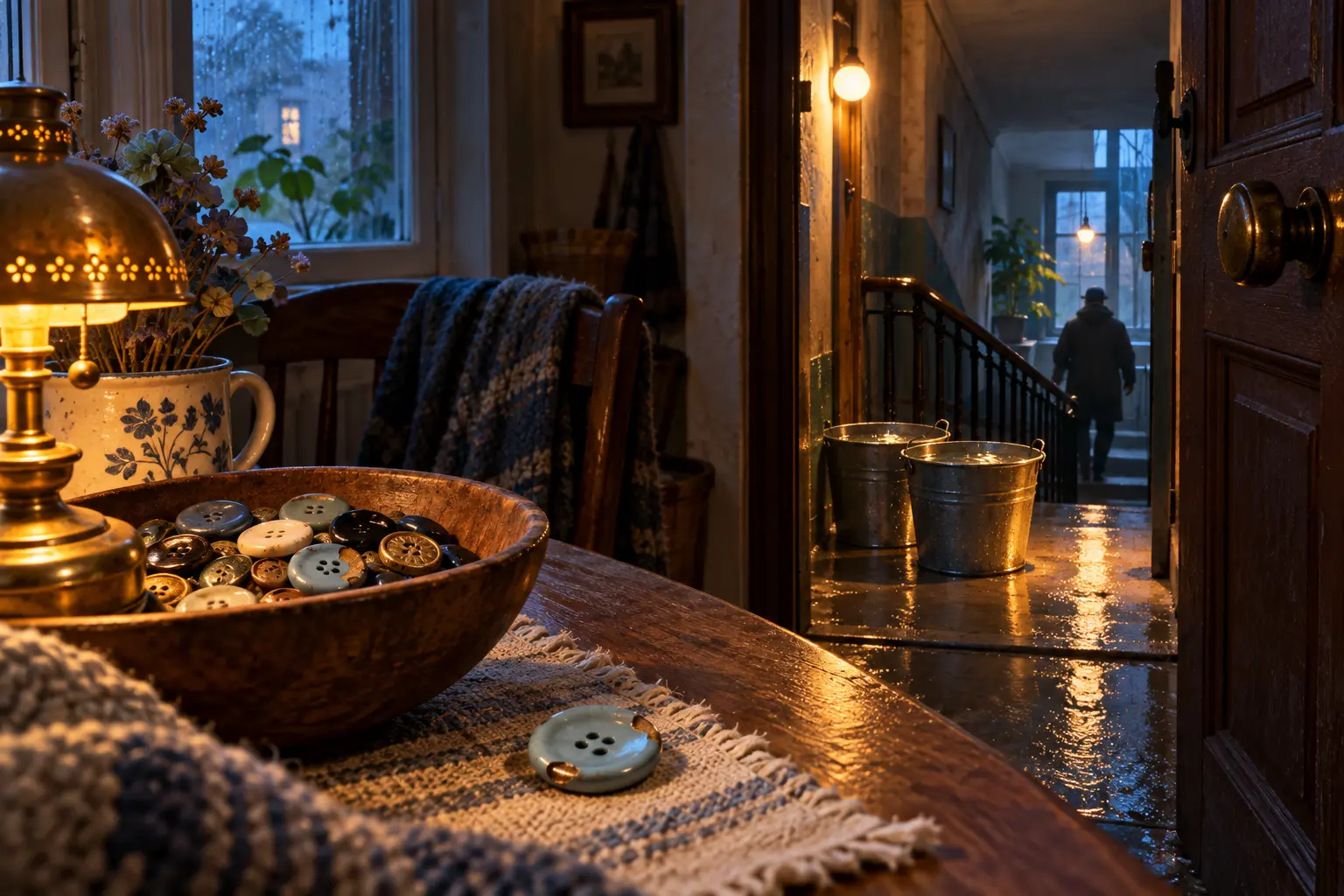
The enterprise covered her table in buttons.
There were shallow dishes, two biscuit tins, a bowl with a crack near the rim, and a small mountain of loose buttons waiting to become orderly.
She had been sorting them by size because she wanted to find replacements without emptying the whole box onto the floor.
Eonix stared at the collection with an interest that did not resemble the expression they wore before a complicated network map.
It was slower and less certain of its own competence.
Iona asked us to sit if we had time.
Eonix looked at the receiver in their pocket, then placed it on the shelf with the volume reduced to the agreed emergency signal.
They had arranged coverage for their service period before coming.
No ordinary request needed to follow them into the room simply because they were reachable.
Iona pushed the cracked bowl toward them and indicated a group of larger buttons.
“These here, if you want something to do with your hands.”
Eonix accepted the bowl and immediately began making an arrangement in shades of blue.
I watched them choose a small dark button for the centre and surround it with paler ones.
Iona watched too, with increasing suspicion.
“Size,” she said.
“They make a pattern.”
“They already made a pattern when they were all in a tin, and I could not find anything.”
Eonix picked up the small dark button and reluctantly moved it to another dish.
Then they tried arranging the larger ones by colour inside the correct group.
Iona allowed that, provided beauty did not conceal the one she might need on a winter coat.
The argument continued long enough for tea.
She directed me to the cups and let me carry the pot because it was full and the table was crowded.
I set a cup on what I believed was an empty patch and heard a small crunch.
A button had hidden beneath a fold of cloth.
It survived, but Iona made me inspect it closely and declared that photographers had a surprising difficulty seeing things directly under their hands.
Eonix laughed with a freedom I had not heard while they were auditing completed requests.
The room smelled of tea, warmed wood, and a little orange peel drying near the stove.
Outside the window, the courtyard washing moved between sunlight and shade.
Iona told us where some of the buttons had come from.
A heavy brown one belonged to a coat she had worn until the lining failed beyond repair.
A row of tiny pearl-coloured ones came from a dress she had disliked but worn because a friend said the colour suited her.
She had kept the buttons after giving the dress away, a detail she considered entirely reasonable and I considered evidence that the dress had not been given away quite as completely as claimed.
She called that an unnecessarily legal reading of a wardrobe.
Eonix asked about a pale blue button with a chipped rim.
Iona said she could not remember the garment, only that the button had been too large for whatever she intended to mend at the time.
They turned it between their fingers, examining the edge.
There was no story to retrieve if she did not remember one.
For once, they seemed content to let the object remain interesting without recovering its full route to the table.
Iona asked them what they did when they were not listening for messages.
They started to answer with a description of checking channels, stopped, and looked at the button again.
“I am not sure that answers your question.”
“It does not.”
They said they liked the different sounds made by streets after rain and had recently begun taking a longer route past a covered passage because footsteps changed inside it.
Iona knew the passage.
She said the echo at one end was better because a broken panel had been replaced with thinner wood.
Eonix argued that the other end had a softer sound when the street was busy.
We listened to two people disagree about a place I had walked through for years without noticing either effect.
It was a good argument, and neither person needed help at its conclusion.
When tea was finished, I offered to wash the cups.
Iona accepted without treating the offer as proof that the service visit had secretly continued all afternoon.
Eonix helped clear the buttons from the space near the basin, sorting them correctly now while still making little arrangements within each size.
Before we left, Iona asked when they would visit again.
They almost gave her a list of available channels.
I saw the answer reach their mouth and stop there.
Then they named an afternoon when their shift ended early.
She checked a paper calendar beside the window and said that would suit if they did not object to hearing about an argument with her cousin.
Eonix said they would reserve judgment until they knew which cousin.
She wrote the appointment on a piece of paper and tucked it beneath the bowl.
They put it in their own calendar too, using the same care they gave a work commitment.
At the door, she gave them the pale blue button for a coat they did not own.
They accepted it without trying to make the gift more practical.
Chapter 05 · Aurelian
A single line
The old river relay continued repeating its errors beyond our local repair.
Some messages crossed it normally, while others returned with duplicated confirmations or a delay that disappeared from the summary once the route finally closed.
We marked the fault for closer inspection and kept human checks in place.
The repair at Iona’s service channel had made one pattern less dangerous.
It had not restored our understanding of the larger system.
That distinction would matter later, when bright channels went dark altogether and the work of reaching people had to continue by other means.
For the present, Eonix asked me to keep one simple measure beside the network figures.
How many people had been reached?
I asked what reached should mean when a worker arrived but could not complete the task.
They said we needed both facts and should not use a single number to conceal the difference.
We made a small table showing contact, work completed, work still needed, and the reason for any delay.
It was less elegant than the old display and considerably harder to fill honestly.
A delivery could be confirmed by the person who received it, but a repair might fail the next morning.
A request might have been phrased badly because someone did not know the name of the part they needed.
A person might say everything was fine because they were tired of being asked, then describe the actual problem once the worker began leaving.
Eonix learned to allow time after the first answer.
They also learned not to remain indefinitely at every door.
Listening required attention, and attention could become an excuse to consume another person’s afternoon if we assumed that every experience needed to be fully understood before a bucket could be carried.
Iona corrected them on that point during a follow-up check.
“The water is here,” she said.
“You do not need to interview the kettle.”
They recorded the delivery as complete and left the longer conversation for the afternoon she had actually invited them to spend.
The first review of the new process included people who were still unhappy.
One man had received help two days later than promised and wanted the delay acknowledged without a speech about improvements elsewhere.
A woman said the worker had brought the right part but spoken to her son instead of to her, though she was the person who had made the request.
A carrier complained that the new records took longer to complete while the workload remained the same.
All three complaints were true enough to require action.
We adjusted the staffing allowance for the time spent recording, included direct communication in the training, and gave the man a plain account of the missed visit with the change intended to prevent another.
None of them was required to become grateful before their complaint could enter the record.
The council report looked less triumphant than an account of repaired software would have looked.
It showed people working, people waiting, and limits that money and training could address only over time.
Abel read it and said it was now possible to ask where the next paid hour would help most.
Before, the bright marks had implied that every hour was already sufficient.
Eonix took the report to the workers who had supplied the information before it went to the council.
They wanted errors corrected by the people doing the work, and they wanted those people to know the record did not exist only to criticize them.
Nessa pointed out that two late visits came from a road closure absent from the current map.
Rachel added the closure and its temporary route, then asked the next worker to test the directions on foot.
The improvement was small enough to fit on one page and large enough to save several wasted journeys.
Iona’s ankle continued improving without becoming an excuse to erase the service she had needed.
Once she could manage the stairs safely again, she reduced the deliveries and then ended them.
The last worker asked whether she wanted another check the following week.
She said no, unless the office needed an opinion about its handwriting, which she remained willing to provide.
The request closed because its purpose had been met, not because a channel had grown tired of carrying it.
Eonix kept their afternoon appointment anyway.
I knew because they passed my desk with a small paper bag from the bakery and asked whether I wanted anything brought back.
There was no work order in their hand.
Later that evening, I found the pale blue button on their desk, resting beside an unused coil of listening wire.
The rim was chipped in one place, and the colour changed slightly where years of handling had polished its surface.
I asked whether they wanted it catalogued with the other objects that had acquired significance during the network repairs.
They considered the question before answering.
“Perhaps later.”
I asked whether the object’s source should at least be noted while the memory was clear.
They looked at me with the mild impatience Iona had begun teaching them.
“I know where it came from.”
That was enough for the evening.
They had received it during an afternoon spent arguing about buttons, tea, and the sound of a covered passage.
It had not arrived as evidence that a task was complete or as payment for attention.
It could remain in their hand without serving the network.
I closed the catalogue window and asked how the visit had gone.
They said Iona’s cousin was apparently wrong about something involving a cupboard, though they were reserving judgment until they heard the other side.
I laughed and did not request the details for the record.
The wider relay still needed work, and several local requests remained open for the morning shift.
Beside them, one quiet line remained available for a friend who no longer had to pass through eight rooms to be heard.
Eonix turned the blue button once between their fingers and stayed for a little while without sending anything anywhere.
Let the last line settle.
Choose another mood