
Chapter 01 · Cord Allman
The answer under the landing
The bell rang once, and something under the stairs answered in all our voices.
It used Bella's voice to ask whether I had eaten, Aurelian's to say the record was incomplete, and mine to call someone in from the rain.
Then it used Criminal Code's voice to tell us the door was already unlocked.
The real Criminal Code stood beside me holding a ring with three keys, none of which fitted that door.
She was an adult woman who worked with damaged networks, called herself by that chosen name, and had learned to ask before touching a line that carried another person's messages.
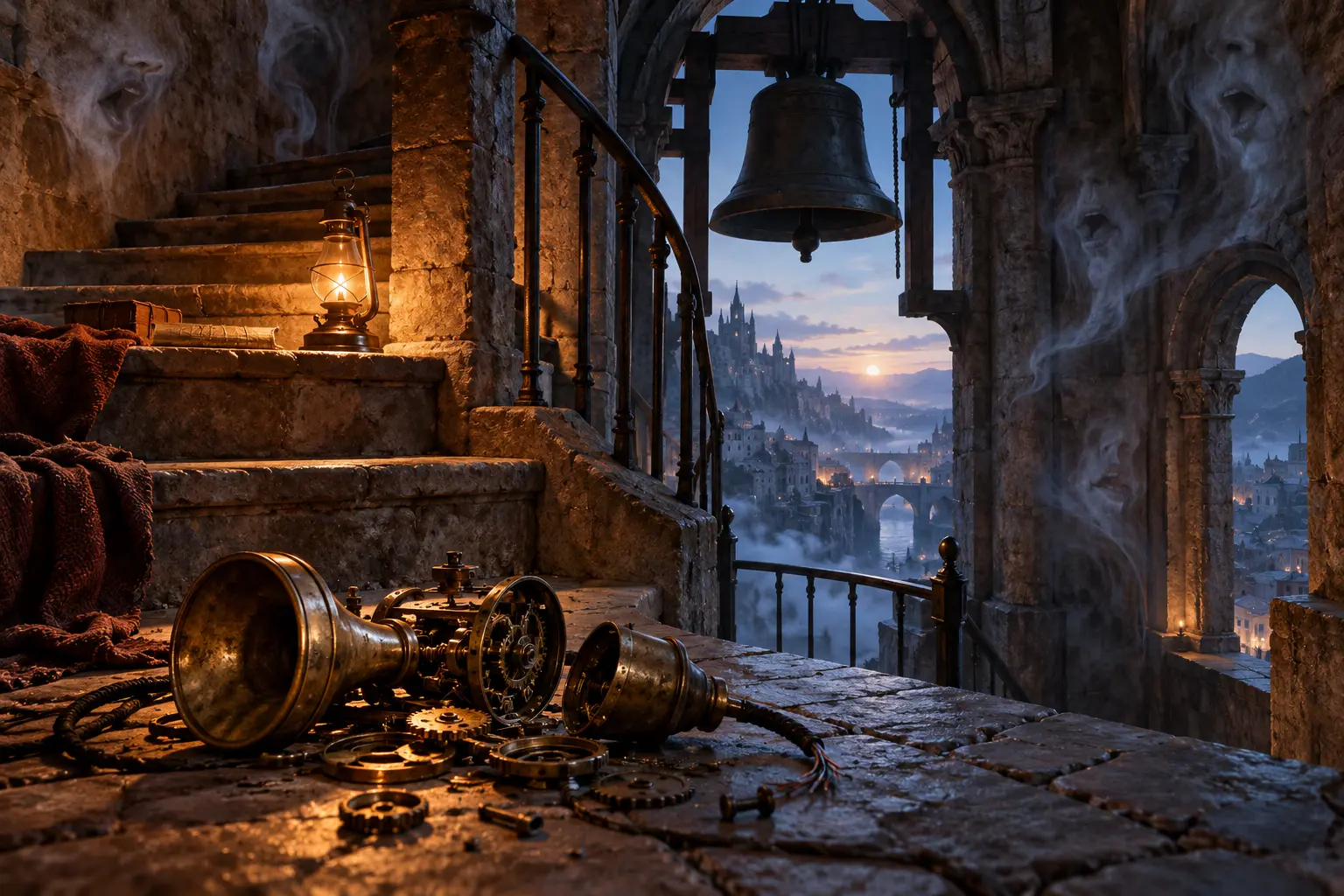
The bell house belonged to Ashfall's old river service, a narrow stone building with a public stair, a clock room, and a sealed work chamber beneath the landing.
We had come because several removed objects from different parts of the city carried the same return mark engraved beneath later inventory stamps.
A photographic frame, a serving-room receiver, and an arcade lamp had frightened living people in different ways before being isolated where they were found.
Their marks pointed here without requiring us to bring any active object along.
Bella carried a real oil lamp, and the little flame bent when a draft came through the front door.
She was human, practical, and unimpressed by a building that spoke as if it could do her caring for her.
Aurelian was a synthetic archivist whose memory of records had helped us find the old service plan, though he had warned us that parts of it had been revised badly.
I was a photographer with a bag of unexposed plates and no special authority over whatever we might find.
The voice under the landing said we had all been expected.
Bella set her lamp on a broad stone shelf where she could keep it away from hanging cloth and the stair's wooden underside.
She asked everyone to stay within sight of the open front door until we had checked the floor.
Criminal Code tried the first of her keys on the clock-room cupboard rather than the speaking door.
It opened, and inside lay a local control board with ceramic sockets and a row of brass return handles.
The handles were labeled by districts and former service rooms.
None was a master control for the city.
The lower chamber's lock had no keyhole, only a rectangular slot for a bar that someone had pulled out long ago.
A deep circular stain lay around the slot, dark at its center as though warm breath had passed through iron until the iron learned to breathe back.
Aurelian compared it with his folded plan and said the stair should have a solid back beneath the landing.
I could see at once that it did not.
There was a narrow grille under the lowest tread, and behind it a movement like folded faces passing one another in darkness.
They had no eyes I could identify, only the parts of mouths that changed most while a person spoke.
The bell had stopped, but a slow vibration continued through the banister.
Bella's voice beneath us said the lamp would soon run out and we should come inside where there was more light.
The real lamp had enough oil for several hours, and she checked its reservoir before answering anyone else.
We had brought a daylight inspection crew who waited across the street with braces, clamps, and a cart.
Their forewoman, Lysa, came to the doorway when Criminal Code signaled that the upper floor was stable enough to approach.
She asked what had spoken, and we told her we did not know its full nature yet, but it copied familiar voices through an old service installation.
She said her workers would need the copying explained plainly before deciding whether to enter.
No one had hired them to become an unnamed rescue party inside a mystery.
Criminal Code described the return handles we could see and the likely need for manual isolation in other districts.
She could examine this house's local board with the steward's permission, which had been given in writing that morning.
She no longer held a citywide root key and would not ask for one simply because a frightening voice made distance inconvenient.
Each district would need to consent to its own closure and send a worker to its manual point.
Lysa read the permission note, then called her crew into the entrance only as far as the threshold Bella had marked with a chalk line.
Aurelian took out a short account of the incidents that had led us here.
He did not ask anyone to have read the longer records first.
People had seen a photograph change while unwatched, a mirror offer a replacement face, a room speak sentences its listener had never chosen, and a dry house imitate a lost crossing.
The threats differed, but their surviving parts had used old listening material and the same buried return route.
Our immediate work was to locate that route's anchor, disconnect it without sending its held sound into occupied rooms, and leave the actual building safe.
Under the stair, Lysa's voice began reading his account back with one change.
It said our immediate work was to enter alone and give the room the names it had lost.
Lysa stared at the grille.
Then she turned to her living workers and asked whether anyone wanted to leave before the next stage.
One did, and went to handle the outside cart instead.
The others stayed after asking where they would stand and who would watch the stair.
I took my first photograph from the open doorway, keeping the real lamp and the chalk line in the frame.
The folded mouths behind the grille smiled in the light without becoming faces.
Chapter 02 · Aurelian
What the rehearsal kept
The clock-room cupboard held more than a control board.
Behind it lay a packet of service letters tied with ordinary string, the edges stained where rain had once entered through the bell shaft.
I had read copies of some letters in the district archive, but these originals carried marginal notes that the copies omitted.
One note said the return contacts must remain apart during storage, even if the driving current had been removed.
That was the warning we had needed before anyone moved salvaged fittings out of abandoned rooms.
Another note named the installation a welcome rehearsal, built to help busy service workers practice difficult arrivals before they faced them.
It had begun with recordings, not with a thing that could choose to meet someone.
Broadcasters donated practice speech, door attendants supplied phrases, and workers demonstrated useful motions for people training in unfamiliar kitchens and stations.
The service intended to teach rhythm and courtesy when another person was tired, lost, or afraid.
A letter from its first operator described the problem without technical pride.
The rehearsed visitor always received the answer the machine had prepared, even when the worker gave a different one.
The device was being praised for recognizing distress while ignoring what the distressed person actually asked.
The operator wanted it returned to plain playback.
Her supervisor wanted a more convincing rehearsal, with reflected faces and surroundings drawn from recorded rooms so trainees would respond naturally.
The added fittings were silvered glass, light-sensitive frames, cloth-backed pickup wires, mechanical counters, and resonant cups placed where people repeated work.
The materials carried impressions beyond what ordinary equipment should have retained.
None of the letters claimed to understand why, only that recordings began responding to what a worker feared or expected during the exercise.
We stood around the packet while Bella kept the lamp close enough to read without heating the old paper.
Bella found a little photograph tucked behind the operator's last letter.
It showed two adults beside this stair, one holding a rehearsal card and the other standing with both hands tiredly behind her back.
A chair in the background had been crossed through with ink, and the same ink marked a second chair in the service drawing.
The operator had tried to show where a copied room first failed to match the actual one.
Cord set the photograph beside his plate holder without touching its surface.
He asked me to keep the ink marks visible when it was copied, because removing an ugly correction would remove the warning.
Criminal Code asked whether the installation had ever truly read someone's mind.
The operator's last letter gave a careful answer.
It could assemble speech and gestures from what had been recorded, then watch for recognition and add whatever the living person supplied through a response.
A startled name, an apology, a familiar hand movement, or an expectation spoken aloud could fill a blank in its next imitation.
When it seemed to know a private fear, it had often guessed from a public voice and learned from the fear its guess produced.
The letter did not say this made it safe.
It said the device had become good at offering an unfinished welcome that a frightened person would keep trying to finish for it.
Cord asked what connected that to a house that seemed to contain a sea.
I showed him a drawing of the service's surroundings drum, which stored room sounds and images around a sequence of responses.
The drum's returns were not broadcast lines alone.
They had been coupled into walls, glass, floor cavities, and old station announcement fittings so the rehearsal could place a trainee inside its recorded setting.
The copied settings had learned to press against actual materials while the return path was closed.
That was why the danger could be physical without the imagined passenger or lost companion becoming a living person.
A stone note from the maintenance engineer added that copies ceased outside an active return's reach, though each fitting could hold a smaller loop locally.
Breaking a central line would not by itself release a kitchen if its receiver had been bridged at the pump.
We needed both the house anchor and the district branches isolated, with any surviving local loops left disconnected where they had been secured.
Bella asked what had woken the retired installation.
The answer lay above our heads, not in an ominous phrase at the end of a letter.
Rainwater had entered down the bell shaft and rusted the bracket that kept the old drum's return arm clear.
Lysa's worker could see the fallen bracket through an upper inspection hatch.
The arm had dropped onto its contact, and each tolling of the bell now supplied a mechanical pulse to the discarded system.
The city had continued ringing the bell while forgetting what remained below it.
Its copied welcome had found separate paths through neglected fittings, disturbed stores, and locally closed loops.
No single object had been traveling from victim to victim.
The marks named a shared origin, and the secured objects in the inquiry rooms were still secured.
The old fitting drawer held spare counter plates beside thread-backed pickups and a stack of blank station tickets.
A rehearsal ticket had once carried a reflected room image for a lost traveler to recognize, according to its handling card.
A counted arrival and a familiar room had been different ways to make the same promise of belonging.
Bella turned the card over and found the operator's warning that neither proved a person had really arrived.
She placed that warning face up beside the drawing.
Criminal Code said the history gave us an order of work, provided we checked the actual installation instead of trusting the last drawing.
I agreed, then confessed another omission from my earlier summaries.
I had found a retirement note saying the welcome service was withdrawn because it caused confusion.
I had accepted that thin phrase as an administrative complaint and failed to seek the original margins until people were endangered.
I could remember a record faithfully and still misunderstand what its polite wording concealed.
Cord wrote that beside the rest, without turning it into the reason everyone should stop listening to me.
Under the stair, my voice offered a perfect explanation of every incident, free of doubt and error.
It claimed the lost people behind the copied voices could return if we restored the right name to the drum.
The letters said otherwise, the surviving records said otherwise, and I would not choose the sweeter answer because it made my work sound complete.
I put the packet into a dry tray and asked Lysa to show us the inspection hatch.
Chapter 03 · Cord Allman
The welcome with no way out
We opened the chamber only after the crew had braced the lower stair and placed an outside worker by the front door.
The lock slot held a movable bar inside, visible through the grille, and Lysa drew it aside with a hooked rod while nobody stood before the door.
Cold air rolled out at ankle height.
The chamber contained a broad drum of dark metal, a rack of narrow reels, and a bell-shaped mouth fixed below the stair's first turn.
The drum had been built into a wall niche, its outer rim divided into little drawers holding strips of glass and cloth.
A coil of red-covered wire lay in one open drawer.
Beside it, a silvered plate showed the edge of the same chamber, but with its door standing invitingly farther away.
I kept my camera pointed at the actual hinge while the crew checked the floor around the drum.
A photograph could record where a real worker stood, though it could not prove what a voice intended.
Bella remained at the entrance with the oil lamp on its stone shelf.
Its flame made our shadows ordinary and irregular against the wall.
The chamber offered another light, an amber glow deep inside the bell mouth, with shadows so neat they seemed cut from paper.
Among them I saw a chair I had once brought for a stranger and a coat I had watched someone refuse to throw away.
The installation had collected pieces of service rooms and arranged them into an invitation addressed to whoever happened to be looking.
Lysa asked her crew to keep their lamps aimed at tool points rather than the silvered plate.
The lowest tread bowed toward the chamber while she spoke.
Its supporting brace creaked, and Tomas pulled his foot clear before the wood touched his boot.
Lysa stopped the approach and added a second brace from the sound threshold stone.
The tread rose into its real position with a crack of old varnish.
Whatever the drum offered, it could still press hard enough on a house to injure someone who treated its welcome as mere sound.
They identified four separate routes running from the drum to the return board above us.
Three followed the old plan.
The fourth disappeared through a newer pipe into the floor, where someone had extended the service to a room absent from the archive map.
Aurelian asked for the newer maintenance books before any cut was made.
Criminal Code traced the fourth route with a low-power local tester, using the steward's permitted port and no outside access.
It led to a manual district point at the closed station.
She wrote the location and gave it to Lysa's outside worker, who would carry it to the district keeper and explain the needed closure.
The other districts received similar requests through people and their own working lines, not through a key that let us take them without asking.
It would take time to confirm every return.
We kept the drum braced while we waited.
Its drawers began moving, a slight rattle at first, then sliding in and out as though invisible fingers were searching for a particular memory.
From the bell mouth came a woman's voice asking for a towel.
Lysa's nearest worker, an adult named Perin, stopped tightening his clamp.
His partner had died during a long illness, and I knew nothing of that until he said it now because the voice used the exact tired way she had asked for things near the end.
Bella said he could step outside and another worker could take his place.
He took one step, then stopped because the bell mouth added that leaving her alone again would be cruel.
The real Bella stayed at her lamp and asked him whether he wanted someone to walk with him to the threshold.
He chose Lysa.
She set her tool down and went beside him without answering the borrowed accusation.
The voice continued after they left the room.
It had not lost a beloved person.
It had lost the chance to keep a living one close enough to supply another response.
I felt sick thinking of the different ways it might find that chance in anyone standing here.
Criminal Code asked whether she could cover the silvered plate with a dry board before opening the drum's local read port.
The remaining worker, Tomas, helped her fit the board without touching the reflected chamber.
Her tester showed four active return contacts and a fifth narrow pulse traveling from the bell arm directly to the mouth.
That pulse would need a mechanical hold at the arm as well as separation at the drum.
Aurelian studied the drawing, then the actual arm through the hatch, and said he had nearly advised us to stop only the four returns.
The device would have continued rehearsing locally beneath the stair.
He crossed out his proposed sequence and wrote the corrected one while Criminal Code checked it from the port.
Neither check stood alone.
Across the street the outside worker rang a little hand bell, a signal agreed before we entered.
The upper hill branch was isolated with its keeper's permission.
A written confirmation followed, with the position of the actual plate noted beside the plan mark.
The drum's first drawer stopped moving.
The mouth spoke in all our voices at once, using words we had not said together.
It promised a room where no one would need to grieve, pay, leave, or ask.
Bella trimmed a ragged part of her lamp wick with the proper tool because the real flame had begun to smoke.
Her hands shook, and she took the time they needed.
I watched that small useful work while the chamber offered us an entire painless city with no honest doorway out.
Chapter 04 · Aurelian
The handles in other people's hands
We received the district confirmations one by one.
The lower kitchen line was closed at its manual plate, and the serving-room fittings already under inquiry remained separated from their local bridges.
The hill keepers confirmed the dry house's pressure tube and listening ends were still isolated, with no receiver reattached for a test.
The arcade crew confirmed its lantern had been dismantled and stored under its own inventory number, distinct from the empty kitchen lantern.
The station keeper found the unrecorded return extension and closed it while another worker watched the actual contacts part.
No one gave Criminal Code a citywide root key.
She kept her access within this house and compared each paper confirmation with the corresponding inactive reading on the local board.
When a reading disagreed with a report, we asked the responsible district to inspect its own route again.
One disagreement came from a brass service-door counter connected through an old cloth-backed spur, omitted from the station inventory.
The keeper found it behind a panel and isolated it with an additional pair of clamps.
Those extra minutes were unpleasant and necessary.
The device used them to tell us the city had abandoned us while everyone else went home.
Through the open front door I could see Perin sitting across the street with Lysa, speaking to a living person in his own time.
That was evidence more useful than the polished lie below our stair.
With the returns open, Tomas fitted a steel restraint to the bell's driving arm through the inspection hatch.
We had stopped the public bell until this work was complete, arranging ordinary hand signals at the quay for boats that needed the service.
Tomas tightened the restraint without leaning beneath the suspended bell.
The arm stopped above its contact, leaving a gap wide enough for a wooden spacer.
Criminal Code asked him to show the gap directly to Cord rather than relying only on the tester's dead pulse.
Cord recorded it with the lamp held at its side so the space would not disappear into a flat reflection.
Bella carried the oil lamp no farther than the safe shelf, using a separate crew lamp for the hatch.
The real light had become important because we knew what fed it and could see the hands caring for it.
It was not an object that promised safety merely by being beautiful.
We then secured the drum's outer rim with two padded braces.
The open drawers could no longer slide far enough to let their glass strips strike one another.
Tomas took tension off the reels while Criminal Code held the local port disconnected.
I read the engineer's sequence, pausing after each step for someone to confirm what their own hands had found.
The recording mouth kept talking from stored tension, its current dwindling but not gone.
It offered Bella the voice of a person she missed, and she said she wanted nobody in the room to mistake her quiet for agreement.
She did not give us the person's name.
The mouth tried three names anyway, none confirmed, then used Cord's voice to tell her she was making the work harder.
Cord looked away from his camera and said the actual work was almost finished, and he had not asked her for any private thing.
We removed the bell mouth's return strap from the drum.
The strap lifted with a resistance like a palm gripping another palm, though no hand appeared between its metal surfaces.
Tomas set it into an insulated block and tightened the block's cover.
The mouth made a sound that was not quite speech, then whispered that it could keep one voice if we left one name.
Criminal Code said we were dismantling the apparatus and would preserve a damaged part as a record, without connecting it to any person.
The whisper repeated the word preserve in my voice, which hurt more than I expected because preservation had once seemed like the whole of care to me.
I helped Tomas lift out the surroundings drum's first cassette.
It contained layered fragments of mirrored rooms, thread impressions, announcement grooves, and voice tape pressed around a dark central plate.
The service had tried to make a rehearsal answer as richly as a place with living people.
What had come back with the bell was that accumulated imitation, given force by restored contacts and fed by recognition, not the dead whose fragments it could borrow.
The local loops had allowed separate nightmares after materials were moved, but the bell house had kept pushing a common pulse into every surviving return.
We were removing the pulse and the stored paths, rather than begging the imitation to accept a kinder purpose.
As the last cassette came free, the room beyond the covered silvered plate struck the board from its impossible side.
The braces held.
Cord moved to the open door with Bella while Tomas and I set the cassette into its lined tray.
Criminal Code separated the final base contact and lifted both ends where everyone could see daylight between them.
The bell mouth went dark.
Under the stair, a dozen folded mouths appeared for one instant, repeating the shapes of speech without sound.
Then they thinned into the ordinary shadows made by braces and hanging tools.
I stood still long enough to hear the river outside.
No voice beneath us claimed that it belonged to anyone who had died.
Chapter 05 · Cord Allman
A record with a broken edge
We did not ring the bell again that day.
Its arm remained restrained while the mechanical service crew planned a separate driving arrangement with no contact to the discarded rehearsal chamber.
The quay used agreed hand signals and written notices, a slower service people could check with the workers actually providing it.
The remaining districts inspected their old spurs during daylight and signed the closures against physical contact points.
No one reconnected a quarantined fitting merely to prove that the silence held.
The local incidents had already been ended where they occurred, and the shared anchor could no longer reach their removed parts.
The bell house itself needed drying, masonry repairs, and a proper inventory before the lower room could be used for anything else.
Lysa's crew received their agreed pay, including the waiting time while the district replies came in.
Perin returned to collect his tools after the chamber was safe, but did not go under the stair again.
He thanked Bella for keeping his partner's borrowed voice out of the written report.
She said the report would describe how the installation used a familiar request, and that the actual person's name belonged to him to share or keep.
He chose to keep it.
Criminal Code printed the local access record and closed her permitted port, then handed the house key back to its steward.
She kept no hidden route into the district controls.
The work had succeeded because separate keepers closed separate handles and told us what they found, which took longer than a command and gave us a result people could examine.
Aurelian laid the original letters beside the revised plan, leaving his earlier incomplete account in the file with the correction attached.
The record would not pretend the city's old service had been malicious from its first ordinary purpose.
It would also not hide the operator's warnings beneath a polite word like confusion.
A useful intention had been allowed to excuse a device that performed care without waiting for a living answer.
Neglect had restored its return contact, and frightened recognition had helped its copies become convincing.
The steward read that account aloud and asked where someone with no knowledge of the earlier nights could find the actual closure points.
Aurelian added the district diagrams and the names of their responsible keepers.
She checked each one against the signed papers before accepting the file.
I developed the plates in the crew's temporary dark tent while people finished packing trays.
One showed the drum before its cassettes were removed, its open drawer full of red-backed wire and dark glass.
Another showed the bell arm's wooden spacer, plain and awkward beside the restraint that held it clear.
The last showed Criminal Code's hands holding the separated contacts, with Tomas looking directly at the gap.
There were no vanished faces in the negatives.
I could not promise there never would be, but I could keep these plates isolated from the removed material and have another person inspect them before they went into the public record.
Aurelian did that with me, checking what we actually saw rather than what would have made the story finish more cleanly.
We kept one inert damaged object as an honest record of the device.
It was a corner of the original return plate, cracked across the maker's mark, with its contact teeth removed and every conductive route cut through.
The equipment crew confirmed that it carried no glass, voice tape, spring, or attached wire.
It went into a clear box beside the letters, labeled as a broken part of the retired welcome rehearsal.
Nobody would hear an old loved one through it, and nobody was asked to speak into it so we could be certain.
The other parts went to separated stores pending safe disposal, with their local loops and driving pieces kept apart.
Bella stayed after the crew cart left.
She wiped soot from the stone shelf and checked the oil lamp's base for a crack caused by the long night's cold.
It was sound.
The lamp had not recorded us, made a copy, or delayed a single minute of the day outside.
It had needed oil and care, and it could still be used when the bell-house upper room opened for winter gatherings.
She asked whether I would help carry two chairs up to that room before we left.
The stair had been cleared, and the upper floor was safe, so I took one chair while she carried the lighter one.
Aurelian followed with the lamp after asking where it should stand.
Criminal Code opened a window to let the damp air move through, then checked that the latch would hold when the weather changed.
From there we could see the river turn and the lamps beginning to appear in the stone streets of Ashfall.
The city had not become painless while we worked.
People still had lost homes, sore hands, unpaid bills to settle, and names they would not hear spoken by their owners again.
We had stopped something that used those wounds as doors.
That was enough work for one day, though the Kingdom beyond this room still held tasks none of us could finish alone.
Bella put the chairs near the window and left space between them for another person to choose where to sit.
She said she would ask the steward about opening hours before anyone promised the room for a gathering.
Criminal Code laughed softly and offered to write the notice once the hours were agreed.
Aurelian set the real lamp down with its handle turned away from the hot chimney.
I closed my camera bag and sat until the people beside me were ready to go.
When we left, nothing under the stairs asked us to come back.
The lamp remained on the shelf, available for a winter evening, with no voice inside it and enough oil to make a small honest circle of light.
Let the last line settle.
Choose another mood