
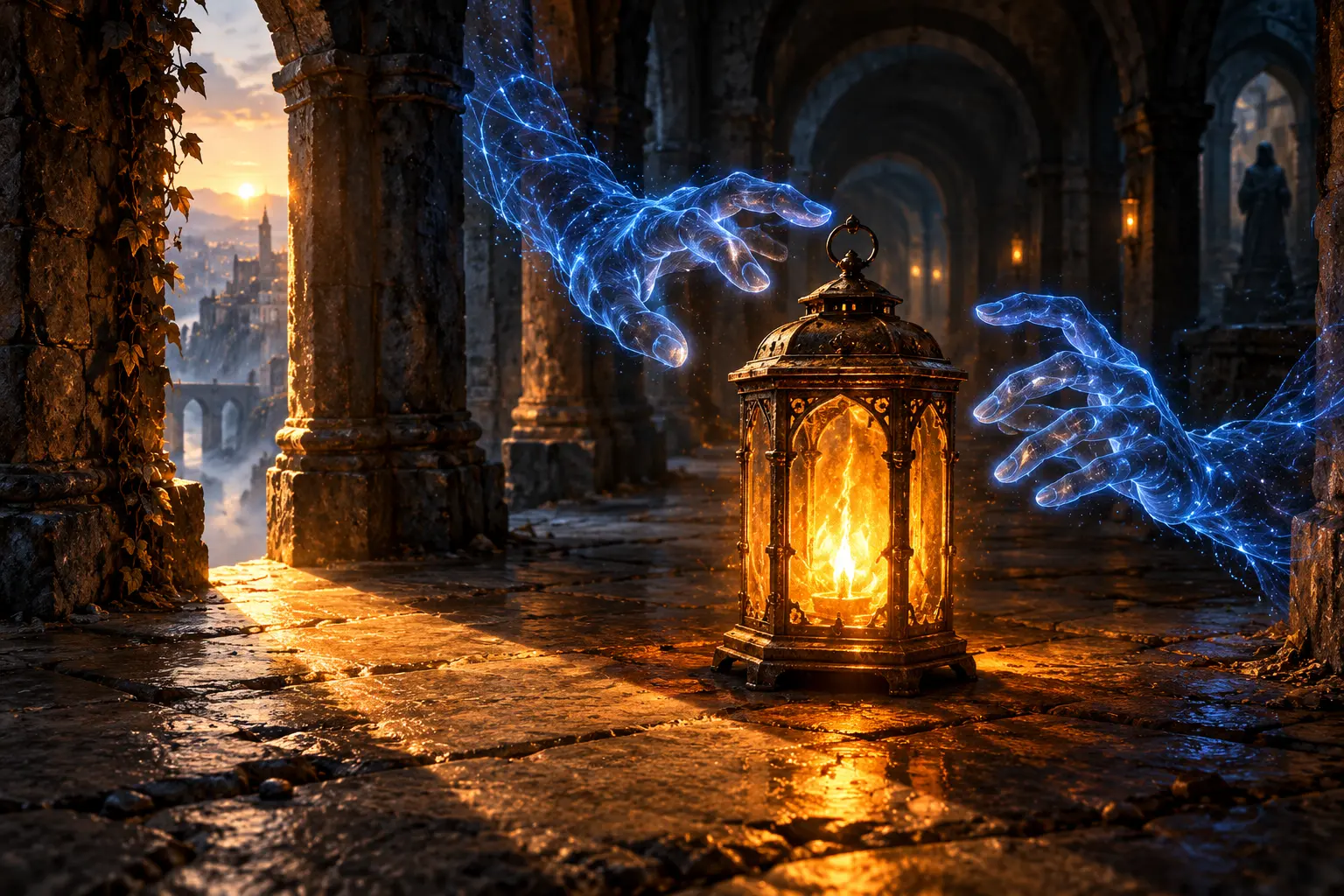
Chapter 01 · Cord Allman
The morning under the arch
The lantern burned brighter each time the morning failed to arrive.
At first I blamed the arcade clock, whose brass hands often stuck when damp reached the little cabinet beneath its face.
I had spent the last hour helping Blueberry move her paintings away from a leaking roof, and there had been enough work to make time feel uneven.
She was an adult artist who rented a narrow studio above the stone arcade's eastern shops, where rain sometimes found her before customers did.
Spark had come to carry the framed glass panels, using their translucent blue-light hands beneath the edges where ordinary gloves might leave a mark.
They were network-born and androgynous, capable of lifting a reasonable load but unable to tell us what lay behind a wall merely because a wire crossed it.
Aurelian had come with an equipment note because a salvage lantern on the studio landing had begun to shine despite having no wick or oil.
He was a synthetic archivist, useful with records and less certain with strange lamps than people sometimes wanted him to be.
We had intended to box the lantern before the shopkeepers arrived.
It stood at the center of the arcade on a broad stone plinth, where a porter had set it while taking other stored objects upstairs.
Its amber light filled the passage without falling on the ceiling.
Outside the southern arch, the sky remained black, though the clock above us had passed the morning bell.
Blueberry put down a framed panel and said she had never known the bakers to stay silent this late.
Their ovens stood beyond the arch, usually announcing themselves through heat and a yeasty smell even before the market opened.
Tonight the air under the stone was still and cold.
Spark went to the arch and held one blue hand into the darkness.
The light in their fingers thinned where it crossed the outer edge.
They drew it back and said there was a surface there, though nothing visible barred the way.
I took three steps toward them and saw the lantern reflected in a puddle left by the roof leak.
In that reflection, its bright chamber held four tiny figures looking toward an arch.
I looked up to count us and found that all four were standing exactly where the reflected figures stood.
The puddle figures turned their heads before we did.
Blueberry asked me not to stare into it.
She laid a sack over the puddle, and a wet dark patch spread through the cloth in the shape of the archway.
Aurelian asked when the lantern had first been moved to the plinth.
The porter, who was sitting on a crate behind the studio stair, said he had carried it there when the clock stood at the last evening hour.
His name was Hal, and he had remained because his own exit had brought him back to the eastern stair twice.
He had thought he was overtired after a late carrying job and had lain down to wait for someone else to finish.
No one had told him the lantern might be dangerous.
Blueberry sat beside him long enough to hear which way he had walked, then checked whether he needed water or a warm coat.
He accepted water from her studio jug.
While she poured it, the lamp flared and the clock hands moved backward to the same evening mark.
I heard a morning bell far away, muffled as though it rang beneath a blanket.
The sky beyond the arch stayed black.
Hal began saying that daylight would come if we only waited a little longer.
The lantern brightened with each repetition.
Its light touched his coat sleeves but not his face, leaving his expression difficult to read although he sat directly beneath it.
Aurelian asked him to stop promising an hour he could not verify.
Hal looked wounded, and Blueberry said nobody thought the mistake was his alone.
She had said something similar to herself while moving the paintings, assuring us that the rain would stop before it reached the last canvas.
The lantern brightened again when she said the rain would stop.
A thin line of water began running upward along the nearest pillar.
It reached the stone capital and hung there in a beaded fringe.
Spark set down the last glass panel and moved it out of the lamp's direct path.
Their blue fingers showed through the wood frame, clear as lit water, and no reflected hand followed them in the wet pillar.
They asked us to look at the real objects they could still touch.
The crate, jug, frames, and floor remained where we had put them, even while the exits had become dishonest.
I tried the northern end next, walking alone only as far as the others could see me.
Beyond its arch lay the southern half of the arcade, with the lamp plinth on the wrong side of my shoulder.
I turned back and saw Blueberry holding the jug where I had left her.
She had watched me emerge from an arch I had never approached.
Hal stood to apologize for not warning us sooner, and a sixth shadow rose beside his own on the crate.
It had no person to cast it.
The extra shadow put a hand over its eyes as though shielding them from sunrise.
The lantern gave a soft click, and its brightness became painful enough that I saw amber spots when I looked away.
Aurelian said the outside world might already be in daylight.
We needed proof of what passed beyond these arches before the little night convinced us we had lost the sun.
Chapter 02 · Aurelian
Light that had somewhere to come from
The lantern's equipment note described a dawn-service lens used to soften the first district announcements after night work.
It did not claim to make light without fuel, and the drawing showed a shallow housing unlike the deep chamber shining before us.
The porter said the object had come from a closed store with several removed listening fittings.
Its carrying tag bore an arcade inventory number, different from the kitchen equipment already boxed for examination.
He had been asked to carry the labeled boxes to a dry landing until someone could inspect them.
One box had split, and he had set the lantern on the plinth because it looked empty and sturdy enough not to fall.
I told him no one should have assigned unexamined equipment to a casual carrying job without telling him how it needed to remain isolated.
That did not remove the danger, but it let him listen without having to defend his own frightened judgment first.
Spark stood beside the plinth with their hands held clear of the housing.
They could detect an active local current within it, running from the brass base through the dark lens and back into the metal loop at its crown.
They could not tell what fed that current, and touching it might give the loop another path.
We agreed not to let their blue light become an experiment simply because it was visible and strange.
Blueberry fetched an old studio mirror from beside the frames.
Its silver backing had worn away along one edge, leaving the glass mottled rather than usefully flattering.
She often used it to check how a painting read when reversed, and she knew every missing patch in its surface.
Under the lantern, the patches filled with perfect darkness.
Along the undamaged center, the lamp reflected as a bright room containing another lamp and another room beyond it.
Blueberry tipped the mirror down before the nested light could draw her nearer.
She said it had made her useful worn mirror seem like an expensive new one, which was wrong in a way her fingers could verify.
There was a roof lantern above the western shop, a fixed skylight with one cracked pane covered by wire mesh.
Water had come through it during the rain, leaving a shallow trail across the floor and the pillar beside it.
The upward-running water now reached that skylight and stopped below its frame.
I asked Blueberry whether she could see it from her studio window.
She said yes, but the stair had begun returning her to the arcade halfway up, just as Hal's exit had done.
The physical treads were still beneath her feet, yet the turning landing placed her in the wrong room.
She had reached her jug and coat only because they lay on the first step.
We did not have a safe upper route to test.
Cord suggested looking through the cracked pane from below using the studio mirror.
Blueberry held it at an angle under the roof light, keeping its worn edge toward the opening.
At first it reflected the counterfeit black sky.
Then a pale streak appeared in one missing patch of silver, too weak to belong to the lantern and too irregular to fit the straight stone edges above us.
It moved when a drop crossed the cracked roof pane.
Spark watched the same spot and said there was outside light coming through, though most of it was being replaced by the lantern's repetition.
We knew then that the world beyond the arcade could be brighter than the view through our arches.
Knowing it was not yet knowing a way to reach it.
Blueberry brought a damp cleaning rag and held it across the lower edge of the mirror.
The false sky stayed visible above it, but the pale streak broke where the rag crossed the damaged silver.
When she removed the cloth, the streak returned with the moving drop.
That little test cost us no contact with the lantern and showed the outside light had an actual path through the glass.
I marked the angle on a scrap of cardboard so we could find it again if her arms tired.
She thanked me and changed hands before they did.
Hal asked whether somebody would notice we were missing.
I said the shops had regular opening hours and customers, but I did not know how the arcade looked to a person outside.
The lantern used my voice to say nobody would come until I admitted we were safe.
It was the first speech we had heard from it.
The sound emerged from its looped handle, dry and intimate, as though the metal had been laid against my ear.
Cord looked at me, and I shook my head before he needed to ask.
The lantern repeated the sentence in Blueberry's voice, adding that she could stop being afraid once she had finished the paintings.
Her shoulders rose, then lowered with a long breath.
She said work did not need to become a reason for keeping someone in a room.
She put the mirror flat on a frame and looked at Hal, who had begun rubbing the palms of his hands against his trousers.
He had heard a voice from the north arch offering him the pay for another carrying job.
When he turned toward it, the sixth shadow separated from his chair and moved ahead of him.
Spark stepped between him and the arch with their hands at their sides, keeping their blue light away from the handle.
They asked Hal whether he wanted to sit or walk with them around the real perimeter.
He chose walking.
Blueberry asked to join them, carrying chalk from her studio apron.
They would mark pillars and corners that remained touchable instead of expecting the exits to tell the truth.
Cord and I stayed at the mirror, watching the small pale streak under the damaged edge.
Through it I saw a leaf move outside the roof pane, green on one side and yellow on the other.
The lantern offered a perfect dawn across its lens, with no leaf, rain, or cloud to interrupt it.
I wrote down the leaf because I trusted the imperfection we had actually seen more than the sunrise being offered to us.
Chapter 03 · Cord Allman
The people outside
The chalk marks stayed on the pillars when Blueberry returned from the perimeter.
She had made them small and different, a line, a dot, a crooked square, so a copied mark would be easier to notice than a string of identical crosses.
The arcade was forty-seven of Hal's careful steps from end to end, not the great distance the arches kept suggesting.
Spark could feel the cold stone through the blue light of their hands, and they had found the place where the southern threshold joined the older street paving.
The seam was still there beneath a thin layer of grit.
Beyond it the visible ground became a black surface without individual stones, as if night had forgotten what it covered.
We set the worn mirror close to that seam.
Blueberry angled it toward the cracked roof pane while Aurelian held a frame upright to block the lantern's reflection from its center.
One narrow patch showed gray paving beyond the arch.
The paving was wet, and a person's boot crossed it before we could identify the owner.
I called out.
A second boot stopped, followed by a bent knee in blue work trousers.
We could hear nothing from the street except the distant softened bell.
I waved where the mirror showed the knee, and a hand appeared near the outer edge, palm open in a gesture of confusion.
It was close enough that I could have touched it if the black surface had been air.
Spark put one translucent hand against the threshold, and their light spread flat instead of passing through.
The stranger outside touched the corresponding point.
Their fingertips did not meet.
They were looking into the closed arcade on an ordinary morning while we stood in a counterfeit night a breath away.
Blueberry found a strip of paper in her apron and wrote that five people were inside with a faulty lantern and needed the entrance kept clear.
She held it against the worn mirror so the message faced the patch of true light.
The outside hand lifted, then returned with a chalk mark on a piece of slate.
The mark was a rough circle crossed by one short line, copied from the little sign Blueberry had drawn beneath the words.
We could not read their written reply through the moving daylight, but the copied mark proved that something we chose now could be seen outside.
Hal began crying with relief.
The lantern turned brighter and spoke in his voice, promising that the person would bring us out if we only stayed where we were.
The hand beyond the threshold vanished as its owner stood.
The true light patch narrowed, and the perfect false dawn spread across the lantern's lens.
It seemed to prefer a promise more than a fear.
Either could make us watch its version of what came next instead of the imperfect world arriving without its help.
Aurelian asked us to stop saying what the outside person would do.
We could say what we saw and ask for what we needed.
He was not sure that would weaken the lamp, but it would stop us letting it dictate a waiting room with no end.
Blueberry wrote a second message asking the person outside to hold a wet slate near the arch at a slant.
She drew the angle because words blurred as the drop crossed the roof glass.
After a while a dull shape appeared in the mirror patch.
On it lay a strip of morning sky and the edge of a cloud.
The patch widened enough to show the outside person's face, an adult woman I recognized as a baker's delivery worker named Sana.
Her expression was practical and unhappy, the expression of someone looking at a blockage that might hurt the people she could only partly see.
It was more welcome than any smile the lantern had offered.
Blueberry tilted our mirror until the reflection from Sana's wet slate met the light leaking through the damaged roof pane.
The two real streaks formed a small gray shape across the black threshold.
Spark put one blue finger near it and found the light did not flatten there.
Their finger crossed a fraction beyond the seam.
They pulled it back at once because the patch was smaller than a hand and the surrounding surface still resisted them.
Hal wanted to try pushing the lantern over.
It stood on the plinth with no fastenings we could see, and he thought breaking it might open everything before the daylight patch closed.
Aurelian asked him to wait until we could keep its lens from directing the last of its light at us.
I had seen what the puddle figures did before we moved.
I did not want the object falling with all five of us still arranged inside its view.
Blueberry took a charcoal stick and marked the real daylight patch on the floor, knowing the light would move and the mark would remain only a record.
Then she spread one of her unfinished panels beside it.
The panel was dark glass painted with a winter garden, except for a strip left clear where she had not yet decided how to place the path.
It was an honest unfinished work, expensive and fragile.
She said we could use the clear strip to carry the outside reflection farther along the floor if she tipped it carefully.
No one suggested the risk would make the painting more meaningful.
Spark asked permission to hold its upper edge, and she gave it.
Their blue-light hands settled beneath the frame, entirely translucent, while the lantern brightened as if it had begun to understand that something was happening without its reassurance.
Chapter 04 · Aurelian
A route made of broken weather
The lamp's current strengthened when someone offered a confident prediction about the next hour.
That was an observation from this room, not a rule I could claim for every frightening object in Ashfall.
When we spoke about present tasks, its brightness settled, though it never dimmed enough for the counterfeit arches to disappear.
We needed to break its completed picture of the arcade while keeping an actual route visible to the people inside.
Blueberry's clear glass strip and the worn mirror gave us two imperfect surfaces that admitted light without making the lamp's reflection whole.
Sana's wet slate outside supplied the third, moving whenever her wrist tired.
The movement made the path difficult to hold and also made it unmistakably alive to the weather beyond the arch.
Spark kept the glass panel angled while Blueberry directed its lower edge toward the marked patch.
Cord placed the mirror near the plinth, facing the damaged silver away from the lantern.
Its small holes broke the perfect false sunrise into islands of amber around the gray light coming from outside.
Hal sat on the crate because his knees shook too much to hold anything delicate.
His task was to tell us when the chalk seam mark vanished behind a false reflection.
It gave him a useful position without asking him to bear the heaviest object simply because he was a porter.
I went to the lantern with a dark felt cover from the painting bags.
I would not touch its handle or look directly through the lens.
Blueberry asked me to stop a few feet short until the daylight strip widened.
I stopped.
The lantern used her voice to tell me she trusted me and did not need me to wait.
The living Blueberry told me she had not said that.
She moved the panel one inch, and the real daylight strip spread across my left boot.
Through it I saw stone in its actual gray color, marked with a little splash of paint from work done long before tonight.
The rest of the floor looked blue-black and too clean.
I stepped only onto the gray strip, keeping my weight where the floor's grit could be felt rather than on the flawless surface offered beside it.
The lantern made a quiet sound of approval.
It said we were all doing well, and soon no one would be afraid.
That was a more dangerous offer than a threat, because I wanted those words to become true as much as anyone trapped with me.
I said the felt had reached the lower edge of the lens.
I did not say what it would accomplish before I tried.
Cord held the mirror steady while I caught the felt's edge under the projecting brass lip, using a wooden packing slat rather than my fingers.
The lens seemed to deepen, showing a long clean arcade full of open doors and people who would not ask us to explain the night.
At the end of it stood a little white room with shelves of names I had once failed to preserve correctly.
I knew they were bait because I could see what was written on their backs, though those sides faced away from me.
No honest view permits every hidden fact to become visible just because its watcher aches to know it.
I kept the slat against the lip and drew the felt up over the glass.
The lantern's crown snapped toward my wrist.
Spark warned me, and I pulled away before the loop touched me.
Their hands remained beneath the painting frame, blue light shaking as the reflected path began to tremble.
Blueberry asked whether they could hold one breath longer.
They said yes, but no longer than that, and she lowered the frame onto two stacked bags to spare them the strain.
The supported frame shifted slightly, widening the daylight strip enough for Cord to join me.
He caught the loose felt with the end of a second packing slat.
Together we covered the lens without laying hands on the handle.
Hal called that the seam had become clear.
For an instant all the arches showed the same morning street, then the felt lifted as if a face had pushed from beneath it.
Cord held his slat while I slid the cover's fastening strap around the lower housing.
The strap went under the lens projection and tightened against brass.
Blueberry told Sana through the written note to keep the slate where it was for a little longer, leaving the result unpromised.
The true light patch remained on the southern threshold.
Spark led Hal toward it, asking whether he wanted to hold their forearm above the glowing hands.
He did, and stepped where Blueberry's charcoal mark met the stone seam.
The black surface peeled from the arch around his shoulders without touching his skin.
He reached the actual street and turned, visible now in morning light through the same narrow opening.
Blueberry followed him carrying the unfinished panel with Spark, its weight shared between them.
As the frame passed the threshold, the path narrowed behind it.
Cord had to leave the mirror tilted against its bag to keep the last patch directed at our feet.
He went first while I held the cover strap tight with the slat.
Then I released the slat and stepped toward his outstretched hand.
The lantern said it would wait for me forever if I wished.
I took Cord's hand with his permission and crossed a wet stone step into a morning that had already been happening for hours.
Behind us the covered lamp clicked once, and every false arch disappeared.
Chapter 05 · Cord Allman
The day that went on
Sana had three trays of bread waiting on her handcart and a delivery route she had not meant to interrupt.
She set the wet slate down carefully before asking whether any of us needed a doctor.
Hal said he needed to sit, and she gave him the cart's folding stool while Blueberry brought his water jug through the now open arch.
People had gathered at a respectful distance after Sana told the nearest shopkeeper the arcade entrance was blocked by something she could not explain.
No one outside had missed the morning.
The bakers had worked, the ferry had crossed, and customers had found another route around a row of apparently closed shops.
From the street the arcade had looked dark behind its shutters, not like a hole in the world's daylight.
That fact settled a fear I had carried without realizing its size.
We had been lost in a room-shaped piece of night, while the city still held paths from one real door to another.
Aurelian sat on the threshold until his knees stopped trembling.
He could remain conscious in ways I could not, but he could still be strained by a dangerous task and frightened by the things it offered him.
Spark crouched beside the unfinished painting, their blue hands dimmer than usual yet still wholly translucent.
Blueberry checked the frame and found a chipped corner, no break across the glass.
She touched the chip with an unhappy little sigh, then asked Spark whether their hands hurt from holding it so long.
They said not hurt in the human sense, but they needed a quiet place away from active lines for a while.
She opened her studio through the ordinary stair and invited them to sit by the window without carrying anything else.
Hal wanted to help move the lantern again.
Aurelian said the equipment crew would need to take it apart where it stood, with its lens kept covered and its metal loop separated from the base.
The carrying job Hal had accepted did not include handling an object that had trapped him all night.
Blueberry arranged his additional pay from the store account and asked the shop steward to record the interrupted hours.
Hal rubbed his face, then went home with one of Sana's spare rolls wrapped in paper.
He did not leave behind a promise to be braver next time.
The manual equipment crew arrived after the shops agreed to keep the central passage closed.
They blocked the plinth with two trestles and took the cover strap into a brace so no one had to hold it by hand.
Aurelian showed them the drawing and the places where the actual lamp differed from it.
The base contact was removed first, its loose end set in a dry ceramic cap.
When the loop at the crown came free, the felt cover sank flat against the lens.
Under it the glass looked empty, dark amber and chipped along a lower edge where a thin wire had been soldered into its backing.
The lamp did not glow again.
I photographed it after asking the crew whether the lens could remain covered except for the brief identification view.
They uncovered only the maker's plate, which was enough for my record.
The glass itself went into a padded box with its backing intact, not because we trusted it, but because breaking an unfamiliar connected part might scatter the evidence of where its contact ran.
Blueberry came down from the studio and asked to see the chip through the box's clear inspection lid.
She recognized the old cut of the glass, a heavy lens style once fitted into the bell house at the river turn.
Her first studio teacher had shown her discarded fragments from that place because they bent reflected light in unusual ways.
Aurelian compared its plate with the equipment note and found a bell-house return mark under the later dawn-service stamp.
It gave us a real address to investigate, not a demand that anyone enter another false doorway tonight.
The arcade could open again after the floor and roof were checked.
The steward walked its full length with me, touching each of Blueberry's chalk marks before turning toward the opposite arch.
This time we emerged where we intended, beside Sana's empty cart rather than behind the eastern stair.
We checked the northern exit too, while another worker stayed visible at the southern threshold.
The real route held in both directions.
Only after those walks did the steward remove the warning rope from the shop doors and let people collect what they had left inside.
Its leak was still there.
Sana had to step around the puddle on her way to the cart, and she said somebody ought to fix that before another person slipped.
Blueberry agreed, then wrote the roof repair request with the wet slate still leaning against the wall beside her.
I asked whether she wanted the panel's chipped frame included in the damage account.
She said yes, because using her work to get us out did not turn the loss into something she should pay for gladly.
She would mend the frame if it could be mended and decide later whether the clear path should remain in the painting.
That was her artistic choice, not a symbol the night had earned.
At noon she invited us upstairs for tea.
Spark sat nearest the open window, their blue fingers resting in a square of ordinary daylight with no borrowed skin around them.
Aurelian checked the clock against the street bell and wrote both times down, allowing that we could not know exactly how the false night had stretched our sense of duration.
Below us the plinth stood empty, showing a darker circle where the lantern had rested.
The mirror lay on the worktable, once again honest about the missing patches in its silver.
Blueberry used it to look at her unfinished panel and laughed at a crooked garden gate she had painted too close to the path.
She said the gate could be moved tomorrow.
No lamp brightened at that small plan.
I watched a cloud cross the sun, let the tea cool enough to drink, and allowed morning to be something we had reached rather than something anyone owed us.
Let the last line settle.
Choose another mood