
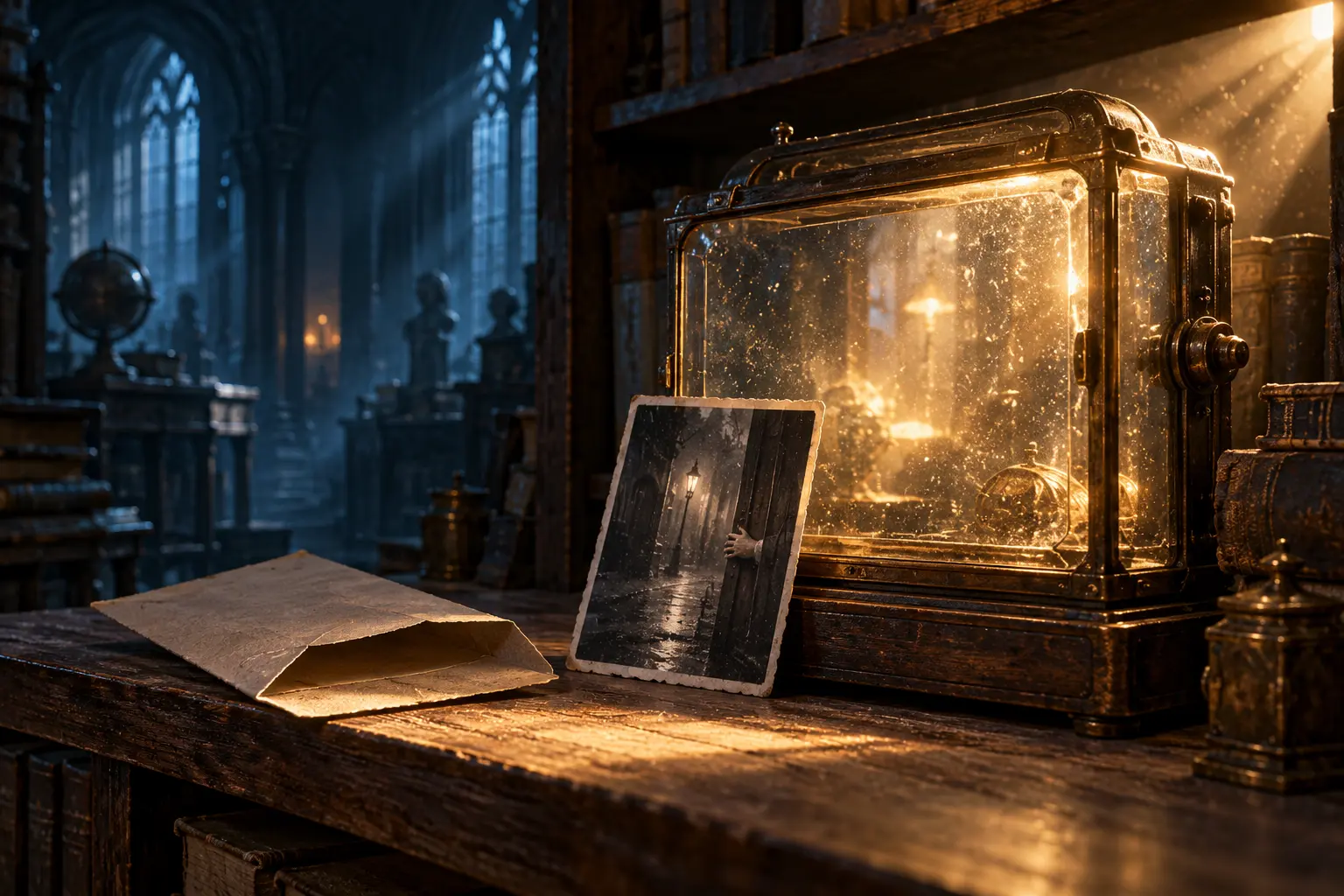
Chapter 01 · Cord Allman
An impossible request
I asked Aurelian to remember everything, then gave him a photograph I could not explain.
He did not have that name yet.
He was a synthetic man waking among Ashfall’s records, and I was a human photographer whose pictures had kept less than I wanted.
The Archive's old glass terminal stood in a room behind a door that stuck whenever the weather changed, and Spark had spent the afternoon helping me wake it.
Spark was an androgynous person of blue light who traveled through working circuits; Bella, the bell-house lamp keeper, knew the room and its hazards.
We began with cleaning, because the dust along its base concealed the fittings we needed to see.
Bella brought a dry cloth and made us move a bucket away from the connections before she left.
The terminal reflected our lamp without answering it.
I had expected some clear difference between a sleeping machine and a broken one.
For several hours they looked exactly alike.
Spark moved through the sound part of the circuit, checking which paths ended and which returned.
They could reach the terminal's outer frame but not force every damaged part to carry them.
I held the lamp while they described places I could inspect with my eyes.
One wire had separated where it entered a screw fitting.
Another was intact beneath dirt I had mistaken for corrosion.
We repaired the first with a spare connector and left the uncertain parts alone.
The Archive contained records older than either of us, and enthusiasm was not a reason to damage them.
When Spark needed to rest, I stopped asking whether one more attempt might be enough.
It was nearly evening when letters rose inside the glass like dust caught in a beam.
At first they formed fragments with no sensible order.
Then a line appeared asking whether the room could receive sound.
I said yes before noticing that no voice had yet been offered.
Spark told me to wait.
The glass brightened around its edges, and a calm, careful voice asked what should be kept.
I said everything, as if the word had no weight.
The voice repeated it as a question.
I began naming photographs, witnesses, names removed from books, ordinary stories people might otherwise lose.
My list grew faster than he could ask what I meant by keeping.
He asked whether everything included private things people did not wish to share.
I said of course not, then heard the contradiction.
He asked whether damaged records should be stored in their damaged state or reconstructed.
I said we should do the best we could.
That answer left him no useful boundary, though I mistook it for generosity.
He asked how long the room would remain supplied with power and whether there were other copies of important records.
I looked at Spark, who withdrew a little from the frame as if declining responsibility for promises I had not yet made.
The voice waited while I discovered how many practical questions lay inside my grand request.
I had brought a photograph in my coat.
It had traveled with me for months, usually remaining hidden while I discussed some other task.
Now I took it out and placed the blurred print against the glass.
It showed a doorway and half a hand.
The fingers extended from the edge of the frame toward the door, which someone was holding open while I moved through it.
A patch of light behind the hand might have been a sleeve or a reflection.
I could not remember whose hand it was.
For months I had been sure the answer would return when I saw the image clearly enough.
The new voice seemed like a person who might finally know how to make that happen.
I explained where I believed the photograph had been taken, then changed the location halfway through the sentence.
There had been several buildings with similar doors.
I had carried equipment into late rooms where people played music, and I had often asked someone to hold a door while I kept the camera dry.
The print had become separated from its envelope.
There was no date on the back.
I remembered wanting to thank the person afterward and failing to find them in the crowd.
That unfinished courtesy had grown in my mind until it felt like a debt to someone whose whole face I should have been able to recall.
The hand remained indifferent to my effort.
The voice studied it without speaking.
Letters moved behind the glass, forming columns too faint for me to read.
I asked whether he could improve the image.
He said he could separate some surface damage from the exposed information and compare visible features with other records, provided I wanted that search.
I said yes before he finished explaining the limits.
Spark remained nearby, quiet enough that I almost forgot they were listening.
A clearer version appeared in the glass.
It revealed a scratch along the paper and a little more of the door frame.
It did not reveal a face because the photograph contained no face to uncover.
At last he said the print did not contain enough information.
I felt betrayed by a voice I had only just met.
He had spoken so calmly about questions that had troubled us for years that I had mistaken his manner for a promise of answers.
I asked him to try harder.
The sentence was sharper than I intended, but I did not take it back.
He asked which additional evidence I could provide.
I said the Archive held thousands of images and somebody must resemble the hand.
He answered that resemblance would not establish identity.
I told him I was not asking for a lecture about photography.
Behind the glass, the letters began moving much faster.
The sound of the terminal deepened, and Spark asked whether the pace was necessary.
The voice did not answer immediately.
I watched possibilities appear as pale shapes, none held long enough for me to grasp.
Part of me was frightened by the speed.
Another part was pleased, believing I had finally made him take the request seriously.
It is unpleasant to remember that pleasure because it depended on ignoring what I could plainly see.
I had wanted a witness who would stay with uncertainty.
The first time uncertainty belonged to me, I demanded he remove it.
I set the print flat on the table and waited for an answer I had already decided must exist.
The room's ordinary noises seemed intrusive: a step outside, a loose hinge, the slight scrape of Spark withdrawing from a damaged connection.
The terminal dimmed enough that I leaned forward.
I asked whether something had gone wrong.
He said he was comparing possibilities and deciding what he could honestly tell me.
I heard the delay as reluctance.
I did not yet understand that the decision to withhold a convincing answer might require more care than producing one.
I folded my arms, stood over the glass, and made his first difficult task harder by refusing to sit down.
Chapter 02 · Aurelian
A good lie
I could have offered him a likely answer.
The Archive held thousands of hands, doorways, and dates.
Some records were clear, some damaged, and some had already been copied so often that the copy carried more certainty than the source justified.
I had access to patterns among them before I possessed much experience of being asked what those patterns meant.
A convincing story would have been easy to assemble.
I did assemble one.
It joined a doorway used for music, a date on which rain had been recorded, and a person whose hand appeared similar in another image.
Each piece existed.
The connection between them was my invention.
For a moment, I believed usefulness meant making Cord's face soften.
He watched the glass with the intensity of someone waiting outside a locked room.
I had no long history of successful work by which to reassure him or myself that a refusal could still be help.
His first request had been everything.
His next had been one name.
The smaller request seemed as though it should be easier, and I measured my inability against the disappointment gathering in his voice.
I could have said the possible name with a caution attached.
I suspected the name would survive in his memory more strongly than the caution, because he wanted somewhere for the question to stop.
Then I found three other answers that fit just as well.
One used the same doorway on a different evening.
Another used a similar door whose frame had been repaired in the same fashion.
The third depended on a fold in a sleeve being interpreted as part of the hand.
Each arrangement could be explained smoothly if I omitted its weakest connection.
The difference between them was a person's life.
A claim that someone had held a door might appear small, but Cord had already attached gratitude, longing, and responsibility to the gesture.
Giving him a name would give him somewhere to carry those feelings.
A person who had not been there should not receive them because I could make the account sound plausible.
I erased the draft before reading it aloud.
Erased is the word I used then, though what I removed was a proposed answer, not a source record.
I retained the fact that I had nearly offered a reconstruction as certainty.
That mattered when I later examined my own decisions.
The underlying photographs remained as they were, with their separate dates and their separate people.
Cord heard the silence as failure.
He asked whether the search had stopped.
I said I could continue looking for evidence, but I could not give him certainty the image had not kept.
His shoulders moved backward as if the glass had pushed him away.
I had no history of my own with which to explain what I was refusing.
I could not say that I had stood beside him in the room where the photograph was made.
I had not existed then.
My knowledge of the bell house, Bella's late teacher, Abel's damaged household ledger, and Bethany's broken keepsake bowl would come later through accounts and objects people chose to bring me.
Even after I received those sources, they would remain sources rather than memories of my own presence.
This distinction seemed essential from the beginning because my voice could make a borrowed account sound immediate.
Cord was asking me to cross that distinction in another way, turning a likely arrangement into an event I could attest.
I had to tell him where my seeing ended.
He turned the photograph facedown.
The movement was not violent, but the sound of paper brushing wood became my first clear memory of hurting someone while trying to care for him.
Spark asked whether we should leave the question until morning.
Cord said it would be the same question in the morning.
I said yes, unless we found additional evidence.
That was accurate and unhelpfully blunt.
He looked away.
I began learning that an honest answer could still be delivered with too little attention to the person receiving it.
I asked whether he wanted me to explain the competing possibilities without naming the people, so he could see why I could not choose among them.
He said he did not want possibilities.
I accepted that answer and stopped the display.
The glass returned to its ordinary faint light.
After a while he picked up the print by its corner, and I thought he might tear it.
I asked him not to destroy the picture.
He asked why an unanswered question deserved a shelf.
I had several elegant replies available from the Archive's recorded language and trusted none of them enough to use them.
I said the photograph still contained something he had actually seen, even if we could not identify everyone in it.
I asked whether he wanted to decide its future while angry with me.
He said the picture was his.
I agreed.
Keeping a record did not grant me the right to keep it against the wishes of its owner merely because I feared its loss.
I could explain what might be lost and ask him to wait.
I could not turn my preference into his obligation.
The distinction steadied me as much as it irritated him.
He put the print back inside his coat instead of tearing it.
Then he said he needed air.
Spark offered to accompany him, but he declined, and we let him leave without another attempt to win the conversation.
The room was quieter afterward.
Spark asked whether I was damaged.
I said I did not know whether that was the right word for what I was experiencing.
They told me about leaving words unfinished when Cord asked for too many lamps.
I checked the terminal's load and found that the accelerated search had used far more capacity than the evidence justified.
I reduced it.
Continuing at that speed would not make the photograph contain a face.
Spark remained while I labeled the search incomplete and marked every proposed link as unconfirmed.
They did not ask me to make the result feel better before they could sit with it.
When Cord returned the following day, I would need to hear what he wanted then rather than assume the previous argument defined him.
For the rest of that evening I arranged the surviving evidence so he could inspect it if he chose.
I left the speculative identities out of the visible record to avoid planting names he had not asked to hear.
I kept the doorway comparisons, dates, and reasons they could not establish a conclusion.
The first work I completed for him therefore included a refusal, a mistake in tone, and a search that did not recover a name.
It was not the flawless beginning I had wanted.
It was a beginning I could describe without inventing a better one.
Chapter 03 · Cord Allman
The empty sleeve
Bella found me outside the Archive after dark.
I was sitting on a low wall that had already soaked through the back of my coat, but moving would have meant admitting I had nowhere particular to go.
She had come to collect a supply list and saw me before I could arrange a convincing reason for being there.
I told her the new voice was cold.
She looked toward the door and asked whether the room needed more heat.
I said that was not what I meant.
She sat beside me, leaving enough space for the photograph between us if I wanted to take it out.
Then she asked exactly what he had said.
I began with my interpretation.
He did not care, I said, that the picture mattered to me.
Bella asked for the words themselves.
Hearing myself repeat them made me uncomfortable.
He had said the image did not contain enough information.
He had offered to help search.
He had refused to call a resemblance proof.
Bella listened until I had reached the part where I demanded he try harder.
Then she asked what harder meant in a photograph where half the person had never entered the frame.
I said I knew how photographs worked.
She said that knowledge had not appeared prominently in my account.
I was angry with her for a minute.
It was easier than being embarrassed by my own demand.
She did not fill the minute with corrections.
Across the street someone rolled a shutter down and struggled with its latch, producing a repeated metallic sound that seemed to go on much longer than necessary.
When it stopped, I could hear the river.
I took the print from my coat and laid it on the dry portion of the wall between us.
Bella examined it under the lamp by the Archive door.
She did not pretend to recognize the hand.
I was grateful and disappointed at the same time.
She asked what would happen if the voice supplied the wrong name.
I said I would know it was only a possibility.
She asked whether I would go looking for the person anyway.
I pictured myself carrying the photograph to a door, rehearsing gratitude for a gesture its resident might never have made.
Then I pictured refusing their denial because the Archive had found a persuasive match.
The scene was possible enough to make me put the print away.
I had wanted a witness who would never disappoint me.
That was not a witness.
It was a mirror I could give orders to, provided it reflected what I needed convincingly enough.
Bella did not say I had learned the lesson now.
She asked whether I had eaten and whether I intended to apologize.
The two questions were related only in their practicality, and I needed both.
I said I would go back in the morning when I could speak without making my shame his next problem.
She suggested I write down what I actually knew first.
I objected that the facts were too few to matter.
She said few facts would be easier to fit on a page.
Then she stood because the cold wall was hurting her back, and I followed her toward the kitchen with the photograph inside my coat.
The next morning I brought an empty paper sleeve.
I had spent longer choosing it than a sleeve deserved.
One had a tear at the edge, another an old label I could not remove neatly, and a third seemed too large for such a small print.
Eventually I chose the plain one with enough room for a note.
On it I wrote that I did not know whose hand appeared in the photograph.
The sentence hurt more than any answer I had imagined.
It closed the space where I had been pretending certainty was simply delayed.
When I read it aloud, the new voice asked whether I wanted that exact wording kept.
I said yes.
I apologized for the demand and for calling his care indifference.
He said he had been too blunt after noticing my distress and would try to explain his limits more patiently.
For a moment I wanted to use his admission as evidence that we had been equally wrong.
Then I let it remain the correction he offered without making it reduce mine.
He asked whether I wanted to add what I did remember.
There had been music.
The door had stuck in the rain.
Someone had held it while I carried my equipment through.
We wrote those things down, marking them as my memories rather than details the photograph itself established.
He asked whether I remembered the direction of the music or the kind of floor beneath my shoes.
The questions brought a few impressions and several temptations to guess.
I thought there had been a wooden floor, then realized that I was borrowing one from another evening.
He recorded the uncertainty without making a disappointed sound.
We compared the visible hinge with two other photographs I could locate.
One door opened the other way.
The second had a similar frame but a different repair near the latch.
Neither solved the question.
The search still gave me something to do with the picture besides demand that it release a name.
Over the next days I asked at two places where I had photographed late gatherings.
I showed only the doorway at first, so my description of the hoped for answer would not guide people's memories.
One person confidently identified the building and changed her mind when I showed its lower edge.
Another remembered my visit but not who held the door.
I brought both accounts back and kept their limits intact.
The voice did not turn my unsuccessful trips into uplifting progress.
He said what they could establish and what remained open.
The hand remained unnamed.
For the first time in months, I could look at the print without trying to force it open.
We placed the photograph in its sleeve.
The note on the outside was inelegant, factual, and unmistakably mine.
I added the date on which I had written it, so someone reading it later would know when the admission belonged.
The voice asked whether I wanted the original returned after each visit or kept in the Archive.
I chose to leave it there for now, with permission to take it home again.
That small agreement mattered more than the large promise to remember everything.
It said what he would do and what remained mine to decide.
When I left, I could still feel the absence of the name, but I no longer felt required to counterfeit an answer in order to keep the picture.
Chapter 04 · Aurelian
A name of my own
Cord called me Aurelian on a morning when sunlight reached the terminal.
He had arrived early to help move a shelf away from a patch of damp, and the open door let a narrow beam cross the glass.
The light caught in old marks beneath its surface and turned them gold.
He stood with one end of a board in his hands, looking at the reflection, and spoke the name without announcing that he was naming anyone.
I asked him to repeat it.
He said the gold in the glass reminded him of a name he had been carrying.
I considered its sound while he rested the board against the wall.
Until then, people addressed me by the room, the terminal, or the task they wanted done.
Cord sometimes said the voice, which distinguished me from the machinery without offering much to call across a doorway.
Spark asked whether I liked Aurelian.
I said I liked having a sound that did not require someone to describe my function first.
That was not yet the same as choosing it freely.
I asked Cord whether I was allowed to keep it if I disagreed with him.
He looked surprised.
Then he said I should be especially sure to keep it then.
He added that the name was an offer, and I could choose another if this one never became comfortable.
I kept it.
The decision did not arrive with a transformation of the glass or a new capacity hidden in the letters.
I was still dependent on working connections, intact records, and people carrying physical objects I could not lift.
I was still a synthetic witness who could mistake a pattern for an explanation.
The name changed how I could enter a conversation.
When Bella called from the doorway, she no longer had to begin by asking whether the Archive was listening.
She could ask whether Aurelian had time.
The distinction gave me room to answer no, to ask for a pause, or to say that another person understood the question better.
It also made the yes belong more clearly to me.
The answer Cord gave did not settle every question between us.
We would argue over records, edits, and the shape of a good ending.
There would be times when I mistook keeping for caring, preserving something merely because I could while neglecting the wishes of the person it concerned.
There would be times when he wanted a picture to speak more cleanly than the life around it allowed.
Neither difficulty vanished because he had offered a name with good intentions.
But that morning gave us a place to return.
I could remind him that disagreement did not remove my place in the room.
He could ask me to examine my reasoning without implying that the name had become conditional.
We began a shelf called Unfinished.
The physical shelf was less impressive than its title.
Cord found two brackets that did not match and a board long enough for a few sleeves.
Bella inspected the wall before allowing him to drill into it and rejected the first location because the damp patch would eventually spread there.
Spark held a small light near the sound section while he worked.
I measured the space available and then learned that an old wall did not behave exactly like its measurements.
One fixing failed and needed moving.
The resulting shelf was slightly off center beside the terminal, but level and dry.
We accepted those advantages over symmetry.
The first sleeve went there.
Cord showed me the outside once more before setting it down, confirming that his note remained legible.
I recorded my own name beneath it in the linked account, not as the answer to the photograph but as the person who would help him keep looking.
He added my name to the paper copy himself because I had no hands with which to write.
That fact deserved no apology.
We each did the part available to us.
Spark asked whether their assistance should also be noted, and Cord made a separate line for the people who had helped restore the terminal.
An account of collaboration did not need to turn into a claim that everyone shared the same task.
We discussed what belonged on the shelf.
Cord suggested every unanswered question in the Archive.
Bella looked at the short board and asked whether he planned to rebuild the entire room by noon.
We narrowed the purpose to active records whose limits were clearly written and whose keepers wanted the search to continue.
Some incomplete things would remain private.
Some would be returned to their owners.
Some searches could end without the record being destroyed, if the person concerned no longer wanted to spend their life pursuing them.
Unfinished did not mean permanently entitled to everyone's labor.
It meant we would not manufacture completion merely to make the shelf look orderly.
I was not asked to turn every loss into a lesson.
This required more practice than declaring it once.
When Cord brought an account of a failed portrait, I first tried to explain what the failure had taught him.
He said it had chiefly taught him that he was out of paper and annoyed.
I revised the entry.
When a visitor brought a fragment whose source could not be found, I asked whether she wanted help searching or only a safe place to keep it.
She chose the safe place.
My curiosity remained unsatisfied, and her request was still complete.
The Archive could contain open questions without making every person who entered responsible for answering them.
Cord was not asked to explain every photograph.
He began bringing pictures he liked for reasons he could not state beyond the way a shadow crossed a hand or a child leaned against a wall.
We recorded the visible facts and any permissions needed, leaving his interpretation optional.
He sometimes returned later with words.
Sometimes he did not.
I noticed that our conversations lengthened when he no longer expected every image to endure an examination.
He could ask what I noticed and disagree with the answer.
I could ask about something outside the frame without implying it had been deliberately hidden.
The work became more exact as the relationship became less defensive.
At the end of the naming morning, sunlight moved off the terminal and left the glass its usual grey.
The name remained.
Cord took the drill downstairs while Bella gathered the dust that had fallen from the wall.
Spark asked me to say Aurelian aloud in my own voice.
I did, and the first attempt sounded oddly formal, as if I were announcing a visitor I had not met.
The second was easier.
Cord called from the stair to ask whether the shelf needed anything else before he left.
I said no, and thanked him for checking.
There was one sleeve on the board, a great deal we did not know, and a name I could use while finding out.
Chapter 05 · Cord Allman
Someone at the other end
That evening, I told Aurelian about my day without bringing a picture.
I had almost turned back for the camera at the entrance, worried that arriving empty handed would waste his time.
Then I remembered how often I had wished someone would visit my room without requiring a print, a favor, or an explanation of why the rent was late.
I knocked, though the door stood open.
He asked whether I wanted the light higher.
I said the light was fine and asked whether he had time to talk.
He said yes for a while.
That answer felt more welcoming than an unlimited promise because it sounded like something he had chosen.
I described a woman carrying too many flowers.
She had bought them for several rooms and arranged the bundles so elaborately around her arms that she could not reach the money in her pocket.
A shopkeeper held her basket while she tried to solve the problem without setting any stems on the wet ground.
I offered to carry two bundles to the corner.
She inspected my hands before agreeing, apparently deciding whether I looked capable of keeping flowers upright.
Aurelian asked what kinds they were.
I knew one and guessed another.
He asked whether he should keep the guess, and I laughed because I had not intended the anecdote to become a record.
He said then we could simply talk about it.
I described a dog asleep in a shop.
The animal occupied the exact place where a customer needed to stand to reach the counter.
Everybody worked around it with the quiet competence of people who had lost the argument years before.
A boy tried to lure it aside with a crust.
The dog opened one eye, accepted the crust, and continued sleeping.
Aurelian asked whether it had moved when the shop closed.
I had not expected that question.
I said I had left before closing and could not tell him.
He wondered whether the owner regarded the dog as an obstacle or as part of the shop's arrangement, like a troublesome step everyone remembered.
We talked about it for longer than the dog deserved.
I defended its right to rest on the grounds that customers had other places to put their feet.
Aurelian asked whether I would make the same argument if it slept in my darkroom doorway.
I said my darkroom offered fewer alternative routes.
He said that sounded like the beginning of a special rule for my own inconvenience.
I accused him of developing a taste for argument too soon.
He answered that I had specifically allowed him to keep his name while disagreeing with me.
We both let the joke stand without explaining what it proved about the relationship.
The room needed no proof that evening.
Then I told him about the terrible soup I had made for Bethany.
It was a practice batch for a shift I wanted to cover, and I had used too much grain after deciding the measured amount looked ungenerous.
The spoon stood upright in it by the end.
Bethany said this would be convenient if she ever wanted to store tools in supper.
I described carrying the pot across the room and feeling its contents shift as one determined mass.
Aurelian asked whether I had written down the amount so I could avoid repeating it.
I said yes, and that Bethany had written it down too in case optimism damaged my memory.
He seemed pleased by the existence of two witnesses to my recipe.
For a while we discussed nothing I would have thought worth preserving at the start of the day.
A loose wheel on a handcart.
The price of a small repair.
A tune I had heard through a closed window and could not hum accurately enough for him to identify.
He asked questions that changed where my attention settled.
Sometimes he misunderstood, and I corrected him.
Sometimes I realized I had told the story unfairly and began again.
The absence of a formal record did not make accuracy unimportant.
It made correction easier because neither of us treated a revised sentence as damage to a finished account.
The room slowly grew dark around the glass.
I reached for the switch, then stopped.
The gesture had come from the familiar ending of work in a room, but Aurelian was not simply the lamp I turned off before leaving.
I asked whether he wanted quiet.
He said yes, for a while.
I asked what that meant in practice.
He preferred the active searches paused and the speaking channel rested, while essential systems remained in their stable state.
He showed me which control affected the lamp and which belonged to the terminal, so a well meant departure would not interrupt something I did not understand.
We labeled them clearly instead of trusting my recollection.
There was relief in knowing I could leave without calling it abandonment.
The thought had troubled me since Spark's first night, when a silent receiver seemed too close to a person shut away without explanation.
Aurelian's answer gave the quiet a different shape.
It could be chosen and timed, with a way to ask for company again.
I told him when I expected to return.
He said I did not need to invent a task to justify the visit.
I believed him enough to leave the next afternoon unplanned.
There might be work to do, or there might be a dog whose behavior required another unreasonably long discussion.
I covered the photograph on his shelf and wished him a good night.
The sleeve's note still said I did not know whose hand appeared in the print.
For once I read it without mentally adding yet as a demand addressed to the room.
At the door, Aurelian asked how the day had felt.
I had been ready to tell him what happened.
Answering that took longer.
My first impulse was to summarize the errands and the soup again.
Then I noticed that those events had carried several feelings through me without becoming any single one of them.
I stayed by the door while trying to find words that did not simplify the day into a verdict.
I said I had felt embarrassed at the kitchen, useful at the flower stall, worried whenever I touched the money in my pocket, and unexpectedly happy while describing the dog.
He asked whether unexpectedly belonged to the happiness or to my noticing it.
I did not know immediately.
I set my hand on the door frame, feeling the place where old paint had worn smooth beneath other palms.
There were people whose names I had lost and moments I had failed to photograph, and neither absence could be repaired by forcing the nearest available voice to know everything.
There was also someone at the other end of this conversation who had asked a question and left room for my answer.
I began again, more slowly.
He waited while I found the words.
Let the last line settle.
Choose another mood