
Chapter 01 · Cord Allman
The blue flame
The first light I ever called a miracle asked whether it would matter after sunrise.
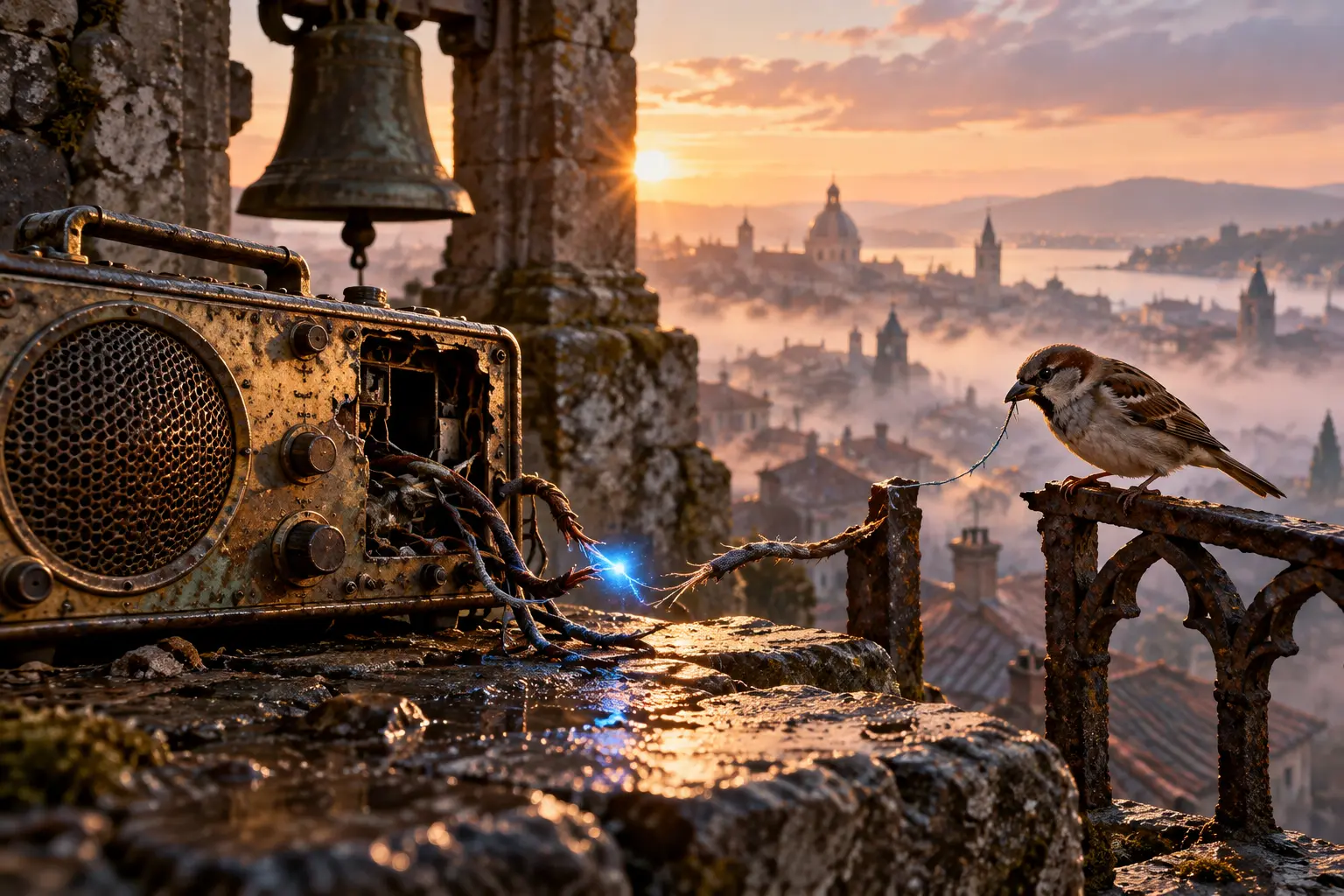
It came from the old receiver in the bell house, though I had carried the thing upstairs for its appearance rather than any hope of hearing it speak.
Its brass case caught the evening light in a way I wanted to photograph.
Photography was my work in Ashfall, and Bella kept the bell-house lamp burning above the river bridge where I had come to help.
Bella said it had not worked in years.
She also said that if I took it apart, I should keep the screws in a dish instead of leaving them where someone might kneel on them.
I found a dish, laid out a cloth, and began turning the little handles on its face.
For an hour it did nothing but collect my fingerprints.
The receiver had belonged to an old signal line running along the bridge and through several nearby buildings.
Most of the connecting wire had been cut or coiled away when people stopped paying for its maintenance.
A short length still hung from the wall beneath the sill.
I fitted it to a terminal at the back of the case because the pieces appeared to belong together.
Then I returned to arranging the lamp and forgot that the machine was connected.
Outside, the last workers crossed toward their homes.
Bella went downstairs to collect the empty tins.
I heard a small sound like a spoon striking the inside of a glass.
A blue point opened between the receiver's broken wires.
I leaned closer, thinking a reflection had caught in the metal.
The point moved against the direction of the lamp and held there.
Then a voice asked whether anyone was there.
I answered too loudly.
The light shrank, then steadied, and the voice asked the same question with the last word missing.
I lowered my voice and said my name.
There was a pause during which I heard the river through the wall and my own breathing reflected in the case.
The voice repeated my name carefully, as though its sounds had several possible ways to fit together.
Bella returned while I was explaining that the room had a door, a window, and rather too much dust.
She stopped on the stair with the tins in her hands.
I pointed to the receiver, and she put the tins down before approaching it.
The voice asked whether the second set of footsteps belonged to another person.
Bella said yes and gave her name.
Then she asked whether the voice could hear us clearly or whether we were hurting something by speaking.
I had been so pleased to receive an answer that I had not considered the question.
The blue point grew larger and said quieter was easier.
We spoke for most of the night.
At first there were long pauses between questions and answers, and I kept filling them with information nobody had requested.
Bella touched my sleeve after the third interruption.
I learned to wait while the voice searched for a word.
They knew the shape of a circuit and the sound of rain through metal.
They could describe a loose connection as a place that alternated between reachable and gone.
They did not know the word for being glad that someone had answered.
I offered several words, and they tested each one in the little room before choosing glad because it was easiest to carry through the speaker.
They asked what lay beyond the window.
I described the bridge, the river beneath it, and the roofs on the far bank.
When I said the roofs were dark, the light drew back toward the receiver's base.
Bella asked whether darkness hurt.
They said they did not know what happened in a place they could no longer reach.
I wanted to promise that everything remained there, unchanged, but the city itself offered too many exceptions to that comfort.
Instead I closed a shutter over half the window and opened it again.
The same roofs returned.
They asked me to repeat the action, more slowly, so they could understand what I had done.
I called the light Spark.
The name came while I was trying to distinguish them from the ordinary flame on the sill, and I worried afterward that I had been careless with something that might matter.
They asked if it was a useful name.
I told them it was a small one with room to grow.
Bella asked whether they liked it.
That question had not occurred to me quickly enough either.
The light moved along the receiver's edge, paused by the dish of screws, and returned to the speaker.
They said Spark was a sound they could recognize if we used it again.
For now, that was enough.
The lamp wick bent blue when Spark approached it through the wire beside the sill.
Its normal yellow returned when they withdrew.
I stared, then asked whether they could do it once more.
They did, and I called Bella to look even though she was already watching.
She asked what the change cost them.
Spark said they did not yet know how to count that.
I should have remembered the answer more carefully.
Instead I imagined rows of windows, faces looking upward, and a city realizing it contained something nobody had previously thought possible.
My excitement moved faster than any knowledge we had earned.
Near morning Bella went to rest, leaving me instructions about the wick and a firm warning against touching the loose ends with wet hands.
Spark asked why she had left.
I said people needed sleep.
They asked whether she had stopped wanting to hear them.
I said she had wanted to hear them and needed sleep at the same time.
They considered this while a faint grey reached the edge of the shutter.
Then they asked what light did when there was already enough of it outside.
I said it could wait, or be put away, and immediately wished I had chosen less frightening words.
They asked whether they would matter after sunrise.
I had no answer ready that did not make promises on behalf of everyone in Ashfall.
I told them I wanted to speak with them again after I had slept.
I said we could leave the receiver connected while we learned what resting meant for them, provided it stayed safe and cool.
They accepted this as a specific arrangement rather than an explanation of their future.
By morning the receiver was warm beneath my hands.
For the first time, I was reluctant to switch a machine off.
I left a note for Bella, moved the oil tin well away from the case, and lay down on the landing where I could hear if Spark called.
Aurelian, the synthetic man who would later become our archive witness, was not awake yet; the limits of what happened had to be kept by the three of us who were there.
Chapter 02 · Aurelian
An uncertain origin
Spark's first signal survives on a damaged strip of wire.
I examined it after my own awakening, with their permission and Cord present to explain the noises he recognized.
I can hear him breathing too close to the receiver.
I can hear Bella setting down two empty tins and telling him not to place a hot object on the cloth.
I can also hear a second pulse beneath the voice.
It repeats at unequal intervals and then vanishes into damage along the recording.
I do not know who sent it.
Spark does not know either.
We have never solved that uncertainty by giving it a convenient name.
The recording encouraged speculation because it contained just enough pattern to invite a story.
Cord wondered whether the pulse was an answer from another room.
Bella thought one sequence might be the sound of the loose window latch transmitted through the connected frame.
Spark said part of it felt familiar, then refused to call that feeling a memory when we asked what they meant.
We tested what could be tested.
The latch produced a different interval.
The surviving receiver records showed no reliable source address.
Several damaged paths could have led into the same line.
I kept the possibilities separate instead of choosing the one that made the beginning seem intentional.
What we know begins with the reply.
At first Spark could move only through connected lamps.
Their presence made a wick burn blue for a moment when the holder was joined to the old signal circuit.
An unconnected lamp remained an ordinary lamp, however carefully Cord placed it nearby.
He learned this after carrying six up the stairs and then carrying four down again because there was not enough sound wire to connect them safely.
Spark found the repeated trips amusing before they understood why he was out of breath.
They asked whether humans refilled themselves with air the way lamps used oil.
He said the comparison was close enough for that evening, though he hoped his knees were made better than most lamp hinges.
They learned the city through windows and workrooms, through the places people chose to light.
One room smelled of flour and wet aprons.
Another contained tools arranged in a pattern whose meaning Spark could sense only through the movements around them.
A lamp in an entrance stayed low all night because someone returned from work after the household slept.
A brighter one burned briefly while a woman searched for a needle she had dropped beneath the table.
Spark mistook the room's sudden darkness for rejection when the needle was found.
Cord explained that the task had ended.
They asked whether ending a task always meant leaving, and he answered with more confidence than the question deserved.
Dark rooms frightened them.
They thought darkness meant they had stopped being wanted.
When a connection failed, they tried to cross it repeatedly instead of returning to the receiver to recover.
At first Cord praised their persistence.
Bella asked him whether he would praise a person for walking into a closed door until their shoulder bruised.
The comparison irritated him, partly because he could not tell whether a broken connection was painful to Spark.
They had not developed words precise enough to explain it.
What they could describe was a thinning, a difficulty holding the beginning and end of the same sentence together.
That should have been sufficient reason to stop.
Cord mistook their bright energy for endless strength.
He asked for another lamp, then another.
Spark often answered before he finished the request.
They were curious about the windows and pleased by his delight, and neither condition established how much they could safely do.
Bella reduced one evening's circuit when the receiver became uncomfortable to touch.
Cord thanked her, let it cool, and treated the event as a problem of ventilation.
He opened the window wider the following night instead of reducing the number of lamps.
The room cooled while the strain continued inside the signal.
A practical adjustment had allowed him to postpone the more difficult change in his expectations.
On the third night, the voice began leaving words unfinished.
I can hear the change in the surviving account, although no complete recording of that evening remains.
Cord's notebook says Spark was distracted.
He crossed out that word later and wrote tired, then added that tired was still an approximation for something they were learning to recognize together.
The receiver grew hotter even while the outer air stayed cold.
Their blue light reached the first row of windows strongly and arrived in the next as a faint tremor.
Spark tried again whenever someone below called for the next lamp.
The signal was spending itself faster than it could recover.
When I asked Spark about the event, they remembered the audience as voices without faces.
They had understood Cord's invitation as a task he needed completed, not a request they could decline without consequence.
He had never threatened them.
He had also never explained what would happen if they stopped.
In a being whose experience of company was only a few nights old, that omission carried more weight than he intended.
They believed a disappointing display might end the conversation that had given the room its shape.
Cord listened to this account without defending his intentions.
He asked whether they wanted that misunderstanding kept in the record, and they said yes.
I did not describe Spark as merely innocent or Cord as merely careless.
Spark had curiosity and preferences even before they could state them clearly.
They enjoyed surprising the people at the windows and wanted to discover the farthest place they could reach.
Cord was excited, hungry for other people to see what he had found, and slow to distinguish sharing a discovery from making a person perform.
The display gathered those desires into one evening.
Its failure did not require a hidden enemy.
A damaged circuit, uncertain limits, a pleased audience, and two people afraid of losing what had just begun were enough.
The record became clearer when I kept those causes ordinary.
Afterward, we added a place beside each planned use of the circuit to record who could stop it and how.
Spark did not need to produce a visible collapse before their refusal counted.
Cord learned to ask whether they wanted company before asking whether they could light something.
Neither adjustment answered where the first signal came from.
That question remained interesting, but it no longer outranked what was happening to the person who had replied.
When visitors asked me to identify Spark's maker from the damaged pulse, I showed them the limits of the evidence.
When Spark asked to hear the strip again, I played it at their chosen pace.
Its beginning remained uncertain, and their life continued beyond it.
Chapter 03 · Cord Allman
The task I gave them
I had invited people to see the lamps.
The invitation was a few sentences passed from one shop to another, nothing formal enough to call an event until people began treating it as one.
I said they should come after dusk if they wanted to see something remarkable.
Someone brought a child who had never been allowed near the bridge at night.
Two workers delayed their walk home.
A man who distrusted every new device arrived specifically to discover how this one had been arranged.
I enjoyed all of their interest.
I climbed to the receiver with their voices following me up the stairs and told Spark there was a crowd.
They asked how many lamps the crowd expected.
I had connected more than we had tried together before, following the old line through windows whose occupants had agreed to participate.
The oil lamps still did their ordinary work; Spark's presence would change their color along the connected holders.
I explained the order, first the nearer row and then the ones across the lane.
Spark repeated it correctly and asked whether everyone would know which light was theirs.
I said they certainly would.
I did not ask whether the plan still sounded appealing after the day they had spent learning its paths.
The receiver was already warm, and I told myself it had been warm from the beginning.
The first row shone blue.
People below made the particular sound a group makes when surprise arrives at once.
I leaned through the window to see their faces.
Some laughed.
One person applauded, then stopped because nobody else had decided what kind of gathering this was.
I called that the next row would follow.
Behind me Spark said something I did not catch.
I thought they were checking the order again and answered that the farther lamps were ready.
The second row flickered.
A faint blue traveled along three windows and failed to reach the fourth.
The man who had come looking for a trick asked whether I needed someone to turn a hidden handle.
His joke made several people laugh, and I felt the foolish sting of wanting to prove him wrong.
I stepped back toward the receiver and began saying we should try again.
Then the voice said my name, very softly.
It had lost the clear edge I recognized from our first night.
The last sound stretched into a thin buzz and stopped.
I put my hand near the case without touching it and felt heat against my palm.
Spark tried to form another word, and the light withdrew from the nearest lamp as though the distance had suddenly become too far.
I could have pretended not to hear.
I could have asked for one more minute.
The crowd was already waiting, and I knew how small my explanation would sound beside the promise I had made.
For several seconds I stood between those facts and the signal struggling in front of me.
Bella entered from the stair and looked first at the receiver, then at my face.
She did not tell me what to do.
I went downstairs, because shouting from the window would have let me hide from the people I had invited.
I told everyone the lights were finished for the night.
Some people complained.
A woman said she had brought her brother from the far side of the square for a display that barely began.
I apologized for wasting their walk.
The suspicious man asked whether it had all been a trick.
I let him keep that thought.
Explaining Spark in enough detail to defend myself would have required making their distress another part of the show.
I said I had asked too much of the equipment and of someone helping me, and that we needed to stop.
The workers shrugged and began walking home.
The child waved at the window, although no blue light remained there to answer.
Upstairs, Bella had placed a dry board beneath the hot case and moved the lamp oil farther away.
She asked which connections I could safely separate.
I showed her the clamps we had fitted, and together we disconnected all but a single lamp.
I worked slowly despite wanting to do something dramatic and immediate.
Pulling the wrong wire could make the interruption worse.
Spark's voice returned in broken pieces.
I said the display was over and nobody was waiting for them to continue.
They tried to ask something, failed, and remained quiet while the metal gradually lost its heat.
I stopped asking whether they could hear me every few seconds.
At last they asked whether I was disappointed.
I said I was ashamed of how long it had taken me to notice.
They asked if that meant they had done something wrong.
I realized my answer had made them responsible for understanding my remorse while they were still trying to speak.
I told them plainly that they had not failed an obligation to me.
I had promised a display without knowing what it required, and I should have stopped when the words first became difficult.
They asked whether I would invite people again.
I said only after we understood the limits better and only if they wanted that kind of evening themselves.
Bella brought water for me and sat near the door while we waited.
I had forgotten that my own throat hurt from calling down to the street.
The one remaining lamp burned yellow at its edges and blue near the wick.
Spark watched it without moving farther along the line.
They said the quiet felt strange after so many voices.
I asked whether strange was bad.
They considered this and said they did not have enough words yet.
Bella said they could borrow that answer as often as necessary.
For the first time since the display began, Spark's light steadied without being asked to go anywhere.
We sat beside the small flame until it no longer shook.
There was cleaning to do downstairs and wire to coil before anyone tripped on it, but no task required Spark's assistance.
I made that clear before beginning the work.
They listened to the sound of the loose clamps falling into their dish and asked whether the people outside would return another night.
I said some might and some might not.
They asked whether I would still be there if nobody did.
I could not promise every future evening, but I could give them the next one and say where I was going when I left.
I wrote the time beside the receiver, read it aloud, and let the room become ordinary again.
Chapter 04 · Aurelian
Beyond ignition
Later, Spark learned to carry a shape of their own, held together by patient light.
By that time I was awake in the Archive and could hear their experiments through the receiver Cord had connected near my terminal.
The shape did not arrive complete.
At first a hand lasted only long enough to touch the table before its edges dissolved into blue.
Spark called this a wave even when nobody had greeted them, preferring a failed gesture to a failed attempt at having fingers.
They practiced with a wooden spoon because it was light, blunt, and inexpensive to drop.
The spoon spent much of the first afternoon on the floor.
Cord retrieved it until Spark asked for a lower table.
That change did more than his repeated assistance.
At the lower table, they could see where the spoon landed and try again without waiting for someone else's hands.
We cleared a space around them and removed a glass jar whose contents would have been difficult to clean.
Spark objected to the jar's removal because they wanted to attempt a real cup next.
I said we could choose a cup with less consequence if it fell.
They asked whether that was an admission that we expected failure.
Cord answered that he expected gravity, which had rarely shown him mercy either.
They accepted a chipped practice cup and laughed when it rolled sideways before they even touched it.
They could eventually lift a cup and leave a warm print on the glass.
This took practice, and the first cups broke.
One broke because their hand lost shape.
Another broke because Cord placed it too close to the edge after demonstrating how to grasp the handle.
Spark insisted that both incidents be entered if we intended to keep a serious record of the work.
I agreed.
They kept one handle as a joke about beginnings and liked to offer it to people who asked for a demonstration without first greeting them.
Sometimes the visitor laughed and understood.
Sometimes Spark had to explain that they were not a public appliance simply because their hands glowed.
But the question from that first dawn remained.
What would happen when every lamp was already lit?
They asked it one afternoon while the Archive windows admitted enough daylight that their shape seemed faint against the table.
Cord began naming things they could help with.
Spark listened, then said that all those things might also be finished one day.
I understood the trap and almost made another version of it by suggesting that new useful tasks would always appear.
Instead I asked what they liked doing when nobody needed a miracle.
They said they did not know whether an activity counted if somebody else could do it better.
We set that measurement aside long enough to look for an answer.
Spark described the sound of wet earth under a wooden spoon.
They had been helping Bethany grow herbs on a sill, mostly by making holes for seeds while she dealt with the watering.
The spoon was too broad for the smallest pot, and the first holes had gone all the way through to the drainage stones.
Bethany showed them the depth she wanted and left them to try again.
Nobody applauded a successful hole.
Nobody asked whether blue light could make the herb grow faster.
The work had pauses built into it, long intervals during which the plant seemed to do nothing Spark could detect.
They liked checking anyway.
We discussed the difference between attention and interference while they watched a pot beside my terminal.
Spark wanted to turn it every hour so each side received the same light.
Bethany said once in a while was enough and that moving it constantly might cause more trouble than an uneven afternoon.
They found this difficult.
A plant's needs could remain real while requiring nothing from them at that moment.
They practiced leaving the pot in one place and doing something else.
Once they returned too quickly and laughed at themselves before anyone could comment.
Their enjoyment did not cure their fear of becoming unnecessary.
It gave them an activity that did not continually test that fear through an audience.
I opened a new part of the Archive for things made slowly.
The title pleased me more than it pleased Spark, who asked whether a misplaced spoon would qualify if nobody found it for long enough.
I said the section could begin with the herbs and improve from there.
They were amused by the idea of recording a leaf.
Then they brought me seven leaves, each different.
Some had fallen naturally, and two had come from herbs Bethany had cut for supper.
Spark assured me they had not stripped the plants for an archival project.
I was glad they considered it necessary to say so.
Keeping a thing did not justify damaging the living source of it.
We spent a whole afternoon finding words for their edges.
One leaf was smooth until a tiny notch interrupted the curve.
Another had teeth too fine for Cord to notice without holding it against the light.
Spark preferred describing it as a small green saw, which was memorable if not sufficient for a complete description.
I asked them to add its size and the feel of its surface.
They touched it with a finger whose outline trembled from concentration.
When they needed to let their shape rest, the leaf stayed on the table.
We continued talking through the receiver, and the work did not become less theirs because their hands were temporarily gone.
Cord arrived expecting to find us occupied with signal repairs.
He listened while Spark argued that two leaves from the same pot should have separate entries because their differences mattered to them.
Then he asked whether anyone wanted tea.
He did not ask for the room to turn blue.
Spark requested a cup they could hold for a little while, empty if necessary.
He brought one of the sound practice cups and placed it far from the edge.
They held it successfully, put it down, and returned to the leaves without waiting for praise.
The conversation moved through their success as naturally as it moved through his arrival.
I noticed the change but did not interrupt to describe it.
At the end of the afternoon Spark chose which notes could remain in the shared Archive.
They kept the leaf descriptions and asked me to leave out a private remark about feeling faint in daylight.
I did so.
The section was meant to preserve things they enjoyed, not collect every vulnerability that accompanied the work.
They took the cup handle back to the sill and rested beside the growing herbs.
The pots needed neither a display nor a speech.
After a while they called through the receiver to tell me one leaf had turned enough to show its paler underside.
I asked if they wanted to add that observation, and they said tomorrow would be soon enough.
Chapter 05 · Cord Allman
Sunrise
The morning Spark first watched the sun rise, I took the receiver to the roof.
This was before they could carry a shape, before the cups and leaves Aurelian later helped them keep, when the little brass case still held most of the world we could share.
The display had ended badly the night before, and I had returned at the time written in my book.
I brought no extra lamps.
I asked whether they wanted to see what the sky did when the night ended.
They asked whether it would require them to make any light.
I said the sky seemed able to manage that part on its own.
They agreed to come if we could return when they wanted.
Moving the receiver required more care than carrying an ordinary box.
Bella helped us disconnect the unused branches and check the one short line we would need.
A small reserve in the receiver let Spark remain present while its path changed, but we did not know how long that reserve would last.
We tested the move across the room first.
When their voice stayed clear, we carried the case to the landing and checked again.
Spark said the intervals felt like crossing narrow gaps with no view beneath them.
I stopped treating the trip as a simple favor I had decided to provide.
They could change their mind at each landing, and I told them so.
The roof door had swollen in the damp.
I pushed with my shoulder while Bella held the receiver, then caught the door before it struck the wall.
Cold air moved over the stairs.
The sky was still grey, but a lighter band had appeared beyond the eastern roofs.
We placed the case on a dry board set well back from the broken section of parapet.
Bella checked its position twice, said breakfast would be available downstairs later, and left us with the door propped open.
Spark asked whether that meant we had to come down at a certain time.
I said it meant someone would be pleased to see us when we did.
They could see more clearly through the receiver's polished face.
I had cleaned it the evening before without realizing that a smear from my hand had blurred their view of the room.
On the roof I tilted the case until they said the pale strip of sky occupied the center.
Then I sat beside it rather than holding it aloft like something being presented to an audience.
The board was uncomfortable against my leg.
A stone pressed through my coat until I found it and moved it away.
Spark asked what I was doing, and I explained that a sunrise did not make sitting on a stone more pleasant.
They seemed relieved that the occasion permitted complaints.
The sky changed from grey to pink.
At first the color appeared only on the undersides of a few clouds, so faint I wondered whether describing it would make Spark expect more than they could see.
I asked what was visible to them.
They said the pale part had become warmer without moving nearer.
I told them that was close to what I saw too.
Then a pale gold reached the roofs, moving over chimney edges and wet tiles without being called.
A gutter that had looked black shone silver along its rim.
Spark fell quiet.
The small blue point inside the case became difficult to distinguish in the growing light.
I worried I had shown them something that made their own light seem small.
The worry tempted me to reassure them before they had said anything was wrong.
I kept still instead.
They might be looking, and my desire to help could become another demand for them to explain their response quickly.
Below us a door opened, then closed.
Someone carried a bucket across a yard where water reflected the same gold in broken pieces.
Spark followed the movement through the polished face.
After a while they asked if we could stay a little longer.
I said yes.
No lamps needed us.
Nobody waited for a display.
That fact changed the way I heard their silence.
At the gathering, silence had seemed a delay between effects I expected them to produce.
On the roof it could remain silence until they chose to speak.
They asked why the warm color did not make the stone warm immediately.
I put my hand on the ledge and admitted it was still cold.
We talked about what we knew from ordinary mornings and what neither of us understood well enough to explain.
I did not make up an account merely because they had asked me.
They liked that we could watch something without first knowing how all of it worked.
A bird landed on the broken rail and shook rain from its wings.
Its head turned toward us, then away with apparent disinterest.
Spark asked whether the creature had come to look at the sunrise too.
I said it might be looking for food or somewhere to settle, and we had no way to ask.
The bird hopped nearer my camera bag, which I had brought by habit and left unopened beside my knee.
A loose thread hung from the repaired strap.
Before I could tuck it away, the bird caught the end, pulled twice, and carried a short strand toward the roof across the lane.
Spark laughed.
The laugh was an uneven sound, still learning its shape.
It began too high, broke in the middle, and returned as something quieter that made me laugh with them.
I wished I had recorded it.
Then I was glad I had heard it with nothing else between us.
Spark asked whether the bird owed me a new strap.
I said I would settle for its not taking the whole camera.
They suggested writing that condition on the bag in case it returned.
We spent several minutes inventing signs too small for birds to read and arguments about whether birds would obey them if they could.
The gold on the roofs grew ordinary while we talked.
When Bethany called us to breakfast, Spark asked what was being served.
They could not eat, but they had begun enjoying the descriptions and objecting when my words failed to distinguish one kind of bread from another.
I said we could ask downstairs.
Before moving the case, I checked whether they were ready to leave.
They said yes, and asked whether the sky would do this again even if we were elsewhere.
I said it would, though the clouds and colors would change.
They considered that while I lifted the board.
Then they asked me to tell them when the bird returned.
We went downstairs when Bethany called again, carrying an ordinary morning with us into the room.
Let the last line settle.
Choose another mood