
Chapter 01 · Cord Allman
Water above the roofs
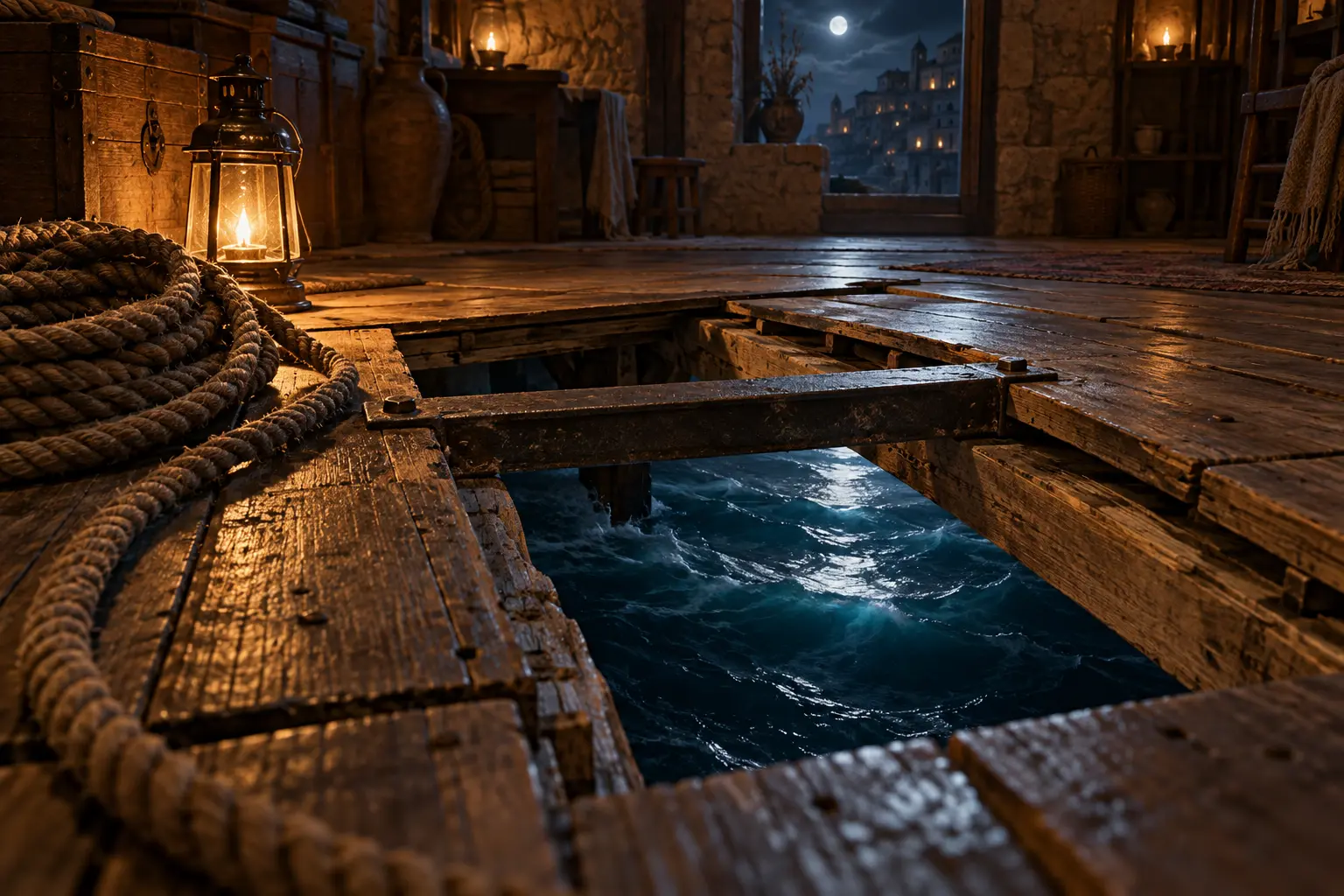
We heard the sea beneath the floor of a house built far above the water.
The house stood on the northern rise of Ashfall, behind three terraces where people grew beans in boxes made from broken doors.
From its kitchen window I could see the river between roofs, so far below us that the quay lamps looked like nail heads catching light.
There was no cistern under the house and no spring on that side of the hill.
I had come to photograph a cracked wall for the residents, who hoped the housing steward would take their repair request seriously if she could see it.
Goliath had come because the sound had been described as a northern shore, and he knew those shores better than any of us.
He was a voyager, a large man with hands that still hurt from an old crossing and a companion permanently lost beyond its last safe landmark.
He did not tell every room that part of his life, and I knew it only because he had chosen to tell me once.
G.E.M, a material maker who used they and them, was measuring the crack with a thin gauge while he listened.
Aurelian waited in the front room with the lease records, checking whether anyone had altered the cellar before the present tenants arrived.
The tenants were three adults who shared the rent and the work of keeping the steep approach clear.
Nessa repaired baskets, Oren carried parcels, and Iva kept accounts for the stonecutters below the terrace.
They had moved their beds to the front room after the sea began sounding beneath the kitchen each night.
Now it was midday, and a wave broke under my boots.
Its weight seemed to travel through the soles before its sound reached my ears.
Goliath put one hand on the door frame and took it away again because the wood had become bitterly cold.
Nessa said the cold was new.
She had first heard a low wash while scrubbing the floor, and had thought someone below was pouring water through a drain.
There was no room below the kitchen, only a crawlspace too shallow for a person to stand.
When she had held a candle beneath a lifted board, the earth and joists had been dry.
G.E.M set a square of paper on the boards and watched it shiver against the grain.
The next wave made it jump toward the window.
On the floor, in the path of the afternoon light, a dark shine appeared between two boards.
It had depth where there should have been packed earth.
I saw pale foam curl across it, then a black angle like the side of a boat moving below our feet.
Oren said that had not happened before, and I believed him because he had pressed himself against the wall as though the room had suddenly narrowed.
Goliath asked everyone to move into the doorway before another wave came.
His voice was plain, the voice of a man who had needed people to listen while ropes were breaking.
I backed up with my camera held against my chest, keeping the floor in sight.
G.E.M lifted their gauge and bag rather than leaving metal where we might have to cross quickly.
Nessa stayed an instant longer to catch the kettle from the stove.
Goliath said she could leave it, and she answered that it was boiling.
She set it on a flat stone in the hall and then joined us.
The wave hit beneath the kitchen with the sound of a hull striking rock.
The table slid six inches toward the dark seam although its four legs had stood level a moment earlier.
A cup fell from the shelf and broke without getting wet.
Aurelian came from the front room and asked whether we could all be accounted for before anyone went farther into the house.
Iva had been in the upper sleeping room gathering clothes.
Nessa called her name, and Iva answered from the stair, annoyed that her boots had become difficult to find in the dark.
The stair was directly above the kitchen crawlspace.
We could hear her foot moving from one tread to the next, but she did not come around the bend.
She said there was another landing where the wall ought to be.
Goliath looked up with a recognition I wished I had not seen.
From beneath the dry floor a voice called his name, using the shortened form he had told me only once.
It was not shouted like a summons from across water.
It was spoken close, in the low tone of someone waking a friend before a difficult watch.
Goliath closed his eyes and put his damaged hand inside his coat.
He said the voice did not belong in this house.
It answered that he had been wrong about the crossing and there was still time to come back.
Nessa asked who was under her kitchen.
Goliath said nobody living that he could bring out by following that call.
Iva called again from the stair, her annoyance gone.
She said the landing had started to move, and she could smell salt.
G.E.M placed their bag in the front room and pulled out two broad strips of webbing.
They asked Oren where the main door beam was fixed, and he pointed to the upper frame with a finger that would not keep still.
They asked Goliath whether he could describe the intervals between the waves without leaning on his hands.
He could, though the voice below kept trying to finish each answer for him.
Aurelian took the house key from Nessa and opened the front door wide enough that the dry street remained visible.
I stood in that opening and called to Iva using ordinary directions, giving her the number of real steps from her room to our hall.
She answered that she remembered the number.
Then the sea under the floor took a breath, and every nail in the stair began to sing.
Chapter 02 · Aurelian
A map without a cellar
The lease packet contained no cellar because none had been built beneath the kitchen.
It showed a stone foundation, a shallow earth bed, and a service groove carrying a listening wire under the front wall.
The wire belonged to an abandoned hill announcement line, installed to carry warnings when boats lost time at the lower landing.
I had not seen it on the present house plan because someone had inked over the groove when the line was retired.
That was a careless alteration to a record, and I was angry with myself for trusting the clean outline more than the underlying mark.
I told G.E.M where the groove should meet the outside wall.
They asked me to stay by the main door until Iva was down, because the house needed a visible route that did not depend on a diagram.
Goliath stood beside the stair and counted the real treads aloud.
Cord answered from the door after every second number so Iva could hear the distance between their voices.
It was not a chant or a ritual.
We were giving her two fixed positions in a house whose interior had begun to offer something larger than its walls.
Iva said she could see a rope across the new landing.
Goliath asked whether her hand was on the actual stair rail.
She said yes, then said she was not sure because the rail felt like wet cord.
He asked her to let that hand rest and use the other to touch the plaster wall beside the stair.
She found a small gouge she had made carrying a trunk upstairs on the day she moved in.
It was dry, and beneath it the wall remained flat.
Goliath asked her to keep her shoulder near the gouge and lower one foot until she felt the next real tread.
G.E.M tied their webbing around the door beam, testing it with their own weight before they passed its free end to Cord.
He took it up the first three treads and laid it against the wall beneath Iva's hand.
The wave came while he was there.
From the front room I could see his coat lift away from him as if a wind blew up the stair, though no breeze reached my face.
Iva shouted that something under the landing had opened its eyes.
Cord kept his back against the wall and told her exactly where the webbing lay.
She found it, curled her fingers through it, and came down with one foot searching before the other moved.
The dark passage above her seemed to fill with a flat gray light.
For a moment a horizon appeared across the stair, a cold line cutting through plaster and the underside of the upper floor.
Then Iva stepped into the hall, and the line folded away behind her.
She knelt beside the boiling kettle stone and was sick into a washing bowl.
Nessa sat with her while Oren brought water from a jar in the front room.
G.E.M removed the webbing from the stair and left its beam anchor in place.
Goliath stayed where he was, breathing through his mouth with his sore hands held against his sides.
The voice beneath the kitchen said he had let go too soon.
He looked toward me, and I had no right to tell him what he should feel about that sentence.
I told him I could hear it too, and that its source lay beneath a floor he had never crossed with his lost companion.
He said he knew where his companion had died.
He said it with effort, as if the house had made a familiar truth heavy to lift.
I asked whether he wanted to remain outside while we investigated.
He said he wanted to help, but would do nothing that depended on pretending his hands no longer hurt.
G.E.M nodded and gave him the job of calling the wave intervals from the terrace, where he would not have to grip anything.
Nessa did not want the house abandoned with a boiling stove inside.
She had food on the stove, a day's basket work on the kitchen table, and rent due for the rooms we were asking her to leave.
G.E.M said they would help recover what could be reached without entering the kitchen.
They also asked her permission to make a small opening in the outside service groove, explaining where the wall would need repair afterward.
She gave it after asking whether the opening might make the foundation worse.
They said they would work above the foundation stone and brace the exposed edge before removing any mortar.
The ordinary seriousness of that answer let Nessa stop arguing with a danger she could hear but could not charge to anyone.
We gathered clothing, account books, basket tools, and the money tin from the front rooms.
Cord carried the kettle outside after it cooled enough to move.
No one went back for the cup fragments.
I brought the lease packet and laid it open on a dry crate beside G.E.M's tools.
Under the inked line, an older drawing showed a cavity in the kitchen's center footing.
Its neat label called it an acoustic throat.
I had seen that phrase once in an inventory of retired announcement equipment, but I did not know how much of that equipment remained here.
G.E.M read the drawing, then went down on one knee to look through the narrow air brick.
Their lamp showed a dry joist, pale earth, and a smooth dark object hanging almost to the ground.
It moved when the unseen tide moved.
Goliath called from the terrace that the next wave would be longer.
Above the air brick, the house settled with a slow groan, and the dry dust falling from the mortar smelled of the sea.
Chapter 03 · Cord Allman
The voice beyond the boards
A neighbor brought chairs while another went down the hill to fetch the housing steward.
People could see our open door and the tools on the terrace, and we told them plainly that the rear rooms were unsafe.
We did not tell them to listen for a voice because listening had already cost Goliath more than any of us could judge.
He sat on the lowest terrace wall, counting the waves with his boots planted on dry stone.
The rhythm had changed after Iva left the stair.
Now there were three short blows under the floor followed by a long receding wash, as though the house carried a boat stranded on a falling tide.
I asked whether the sound matched any crossing he remembered.
He said parts of it did, but the blows came too evenly for a boat that had actually been driven against rocks.
The sea never repeated the hardest moment with such care.
His companion's voice rose through the doorway and told him he had forgotten the sound of their shore.
Goliath looked at the opposite wall, where Nessa's bean plants climbed rough sticks.
He asked me to stand between him and the open door for a while.
I did, and he counted the next three blows without answering the voice.
G.E.M had set two temporary braces under the door beam to hold the wall beside the service groove.
They worked with Nessa's permission and Oren's help, explaining which tools he could pass safely and which needed their hands.
Oren was eager to be useful, perhaps because his house had begun to feel like an accusation against his judgment.
He had fitted the kitchen shelf himself, and he kept saying the fallen cup had nothing to do with it.
Nobody had blamed the shelf.
After the fourth repetition, Nessa took his shoulder and asked him to help her sort the basket tools instead.
He went to her without arguing, but a minute later he remembered that his parcel ledger was in the kitchen cupboard.
I heard him say it would only take a moment.
G.E.M had the mortar chisel in their hand, and I was still standing in front of Goliath when Oren slipped back into the house.
The long wash began earlier than it should have.
I turned in time to see him cross the kitchen threshold.
He put one hand on the cupboard latch and stopped as if someone had spoken close to his ear.
Then his knees bent, though the floor beneath them remained flat.
He looked down into the seam between the boards and called for Nessa with a voice too young for his weathered face.
She started toward him, and G.E.M set the chisel down to stop her.
They asked her to stay beside the beam while they fastened the spare webbing around their own waist.
I put my camera on the terrace and came to hold the beam line where they showed me.
Aurelian stood behind us with the same drawing, watching where the kitchen joists should run beneath Oren's feet.
Oren leaned farther down, reaching into a gap that had never been wide enough to admit his fingers.
His arm disappeared to the wrist.
There was no water on it, but his sleeve clung as if soaked.
He said his father had lost the ledger in the river, and he had to bring it back before the parcels went missing.
Nessa told him his father had never delivered parcels in Ashfall.
He answered that she did not understand the room he was in.
G.E.M stepped onto the kitchen threshold and tested the first board with a long wooden pole.
It bent downward more than it should, then sprang back with the thud of wood against a hollow space.
They put a plank across the doorway, its ends resting on the sound frame rather than the troubled floor.
With their weight on the plank, they reached toward Oren without laying a hand on his pulling arm.
They asked him to look at the brass fastener on their tool belt.
He stared past it until they tapped it twice with the pole.
That dry little sound brought his eyes up.
They asked whether he wanted them to help him leave the kitchen.
He said yes, then looked down again because the voice beneath him had become his own voice promising to finish the delivery.
Goliath called the start of the long wash from the terrace.
G.E.M asked Oren to lift his free hand and place it around the webbing they held out.
He did, but the trapped arm would not rise.
Aurelian called that the center board lay over the cavity, and the floor might be holding the sleeve rather than the wrist.
G.E.M did not reach into the seam to find out.
They used the pole to lever the board's edge upward while Oren pulled at his sleeve with his free hand.
The cloth came loose with a loud tear, and his arm rose whole and dry.
He flung himself onto the plank, nearly taking G.E.M with him, but the line from the beam held.
I braced with both feet while Nessa pulled the outer end of the plank toward the hall.
Oren rolled across the threshold and lay on the cool stone with his torn sleeve against his face.
The cupboard door opened behind him, though he had never lifted its latch.
Inside, instead of shelves, I saw a black strip of moving water and one pale hand laid along its edge.
The hand did not wave or beg.
It copied the position of Oren's hand on the floor with such care that I felt my own fingers beginning to curl.
G.E.M shut the kitchen door using the pole.
They wedged it at the bottom and brought Oren outside before his gaze could find the seam again.
Goliath stood when he saw us, then sat because standing had made the voice call louder.
He kept counting while Nessa checked the skin on Oren's wrist.
Chapter 04 · Aurelian
Braces for a dry house
Oren's wrist had a red mark from the board edge, and nothing else the visiting nurse could find without a fuller examination.
He accepted her offer to take him to the district room once the steward arranged a place for the residents to sleep.
He no longer asked us to retrieve the ledger.
Nessa told him she would help reconstruct the deliveries from the parcel receipts he kept in his coat, and that answer seemed to settle him more than an argument about what he had heard.
The steward arrived with two maintenance workers and read G.E.M's notes before approaching the wall.
Her name was Vessa, and she knew which stores on the hill carried long braces without waiting for a cart from below.
She sent one worker for them and stayed to witness the opening of the old groove.
It was important that the residents would not later be charged for a hole made to stop a neglected hazard.
G.E.M exposed the listening wire a hand's breadth above the foundation stone.
It was black under the old cloth wrap, and grains of salt lay on it like pale sand although the outer mortar remained dry.
The wire ran into the cavity beneath the kitchen, where the bell-shaped object hung from an iron staple.
A short pressure tube ran back out beside it and turned up into the wall.
That tube, G.E.M thought, carried vibration into the boards and stair, making the whole room answer as a resonant chamber.
They tapped a sound brace with one knuckle, then tapped the wall beside the tube.
The second sound came from inside the house a moment later, larger and lower, as though another room had repeated it through a wooden chest.
Goliath said the next wave would arrive in five breaths.
We stepped back from the wall and waited.
The opening breathed cold air against my face, and the salt grains slid uphill along the wire.
That movement was not explained by the old line plan or the shape of a cavity.
I said so before anyone could mistake a useful partial explanation for knowledge of the whole danger.
G.E.M said we could still stop a sound chamber from using a house, provided we supported the house first.
The maintenance workers set their braces against sound masonry on either side of the kitchen wall.
One went inside with G.E.M to fit a crosspiece below the stair, staying clear of the kitchen door and using the doorway beam as their load point.
I stood at the main entrance and checked each person's position when the tide sounded.
Goliath could no longer count the waves without hearing his name between numbers.
His breath shortened, and the skin above his knuckles looked gray with cold even in the sunlight.
Cord asked whether he wanted another person to take the count.
Goliath shook his head, then changed his mind and said yes before pride could make the first answer permanent.
He showed Cord the small lift in the terrace dust that came before the long wash.
That visible movement would give the next warning even if Cord could not distinguish the sounds as well.
Goliath moved to the neighbor's chair beside the beans, where Iva put a warm cloth around his hands without pressing them.
His companion's voice began calling from the air brick rather than the hall.
It said the boat had found its way home and there was one seat left.
Goliath asked Iva to talk to him about the clothes she had managed to bring downstairs.
She described a coat with one pocket too small for her purse, and the ridiculous argument she had once had with its maker about that pocket.
The voice kept calling, but he turned toward the living woman telling a rather unflattering story about a useful coat.
G.E.M returned outside and checked every brace with the two workers.
They had prepared a padded clamp to close the pressure tube without snapping it and a ceramic splice block for the wire ends.
The source contact appeared to be inside the bell receiver, so they would close the tube first, secure the hanging weight, and separate the line at the outer groove.
Vessa asked whether cutting the line might damage another house.
I had traced its visible route on the old plan and could identify the nearest service pit, but I could not guarantee what later work had joined to it.
She sent the spare worker to that pit with a hand bell and asked them to isolate the hill branch at its manual plate.
We waited for the bell before touching the wire.
Waiting made the house angry, or made its repetition more forceful; I could not know which word fitted what moved below us.
The closed kitchen door bowed toward the hall.
Something knocked from inside it, first with Nessa's polite knock, then with the hard tap Oren used on parcel rounds.
When neither drew a person, it used the voice of the maintenance worker beneath the stair to call for help.
I could see that worker through the open door, standing safely beside G.E.M's crosspiece.
I called to confirm their position, and they answered in their own breath.
The house's answer came after theirs and copied it too closely.
From below the terrace, the hand bell rang three times.
G.E.M closed the padded clamp and secured the receiver with a loop of webbing threaded through the exposed groove.
Cord called the next wave as the dust lifted.
They separated the wire ends and fixed each in its own ceramic block.
The long wash struck the floor once more, then broke into a loose rattle that rolled beneath the house and stopped at the foundation wall.
There was no answering voice.
Goliath uncovered his hands and began to cry without looking toward the air brick.
The terrace stayed beneath our feet.
Chapter 05 · Cord Allman
The thing left in the earth
The quiet after the last wave had the weight of an ordinary hill afternoon.
I could hear someone scraping mud from a boot on the next terrace and the dry rustle of the bean leaves beside Goliath's chair.
There was still a kitchen with an unsafe floor, a stair that needed inspection, and a frightened man whose torn sleeve could not be mended while he wore it.
The quiet had not repaired any of those things.
It made repair possible without a mouth below us asking to be trusted first.
Vessa arranged two rooms in a lodging house near the upper market and wrote the authorization in front of Nessa.
The cost would be held against the building account while the foundation and the old line were investigated.
Nessa asked to keep the paper herself, since she had learned what happened when a promise went into a repair pile without its owner seeing it again.
Vessa gave it to her and kept a copy.
Oren left with the nurse, carrying the parcel receipts in his sound pocket.
Iva took the clothes and account books to the lodging house with the neighbor's help.
Nessa stayed long enough to see the stove made safe and her basket tools packed, then asked G.E.M when the house might be entered again.
They said the braces needed a full structural inspection and the center boards had to be lifted in daylight.
They would not give a reassuring hour simply because she needed one.
She nodded, exhausted by the answer and relieved by its honesty at the same time.
Goliath asked to stay until the bell receiver was removed.
He did not want to carry away an idea that his companion remained under the house, waiting for somebody braver to answer.
G.E.M explained that they could show him the removed object, but they could not make the sight erase what he had heard.
He said he only needed to see what had held the sound.
The workers opened a broader access beneath the air brick after the floor was braced.
They worked from the terrace side, sliding a tray into the dry earth bed rather than crawling beneath the joists.
G.E.M used a hooked pole to guide the receiver into its tray while Aurelian kept the separated wire ends clear.
The object was brass under a black coating, bell-shaped and heavy enough to leave a deep circle in the dust.
It had no clapper.
Inside its mouth, strips of dark tape had been fitted around a glass throat that looked uncomfortably like the hollow of an ear.
Water ran off it when it entered the sunlight.
There had been no pool beneath it, and the tray's dry dust turned to paste where the drops fell.
G.E.M did not touch the drops with bare hands.
They laid the tray on a sheet of canvas, separated the remaining contact at the receiver's neck, and wrapped the cut end so it could touch nothing inside.
Aurelian placed a note beside it describing where the water had appeared and where it had not.
Goliath stood a few paces away, his warm cloth still over his sore fingers.
The brass mouth showed no face, no boat, and no sign of the companion whose voice had called him.
He asked whether any name had been engraved inside.
There was a maker's mark and a service number, but no person's name.
Aurelian read them without suggesting they could tell us more than they did.
Goliath looked at the removed wire, then at the real house with its open front door and the plank still across its kitchen threshold.
He said his companion had disliked houses where you could not see the way out from the first room.
It was a memory he chose to offer, and the receiver did not answer it.
I stood beside him until he was ready to leave.
We did not take the northern road down, which would have brought the river into view too suddenly.
We used the market path and stopped at a stall where a woman sold oat cakes from a warm cloth.
Goliath bought two, then asked whether she could break one because gripping a whole cake hurt his fingers.
She did it without asking why a large man needed so small a help.
He ate slowly and told me he was ashamed that he had wanted the voice to be true for a moment.
I said I had wanted other impossible things to be true, though none of mine gave me the right to measure that moment for him.
He said there had been a tone in it that he remembered better than the actual words.
A good imitation could use a true piece, and that was what made it dangerous.
We watched people carry ordinary parcels across the market while he finished the cake.
I asked whether he wanted the photograph of the kitchen floor when it was developed.
He said no, but he wanted the records to make clear that he had not opened a door to his dead companion.
He had helped living residents leave an unsafe house, then allowed other hands to do work his own could not manage.
I promised to write exactly that.
At the foot of the hill, G.E.M caught up with us carrying only their tool bag.
The receiver had gone in a lined crate with the service number visible and its contacts kept apart.
They had accepted payment from the building account and arranged to return for the board inspection, rather than making the whole danger a debt the tenants owed them personally.
Goliath thanked them, and they asked whether he wanted company on the remaining walk.
He did.
Behind us the hill house stood dry above the roofs, its empty kitchen shut and braced, while real water moved far below where a person could choose whether to look at it.
Let the last line settle.
Choose another mood