
Chapter 01 · Cord Allman
Before the red light
The empty room spoke in my voice before I had said a word.
It said my name in the tired way I used when carrying two bags, then asked whether I had remembered to close the river door.
There was no river door in the broadcasting house, and I had come with only my camera.
The room stood behind a pane of wired glass at the end of a passage where the whitewash had peeled into little islands.
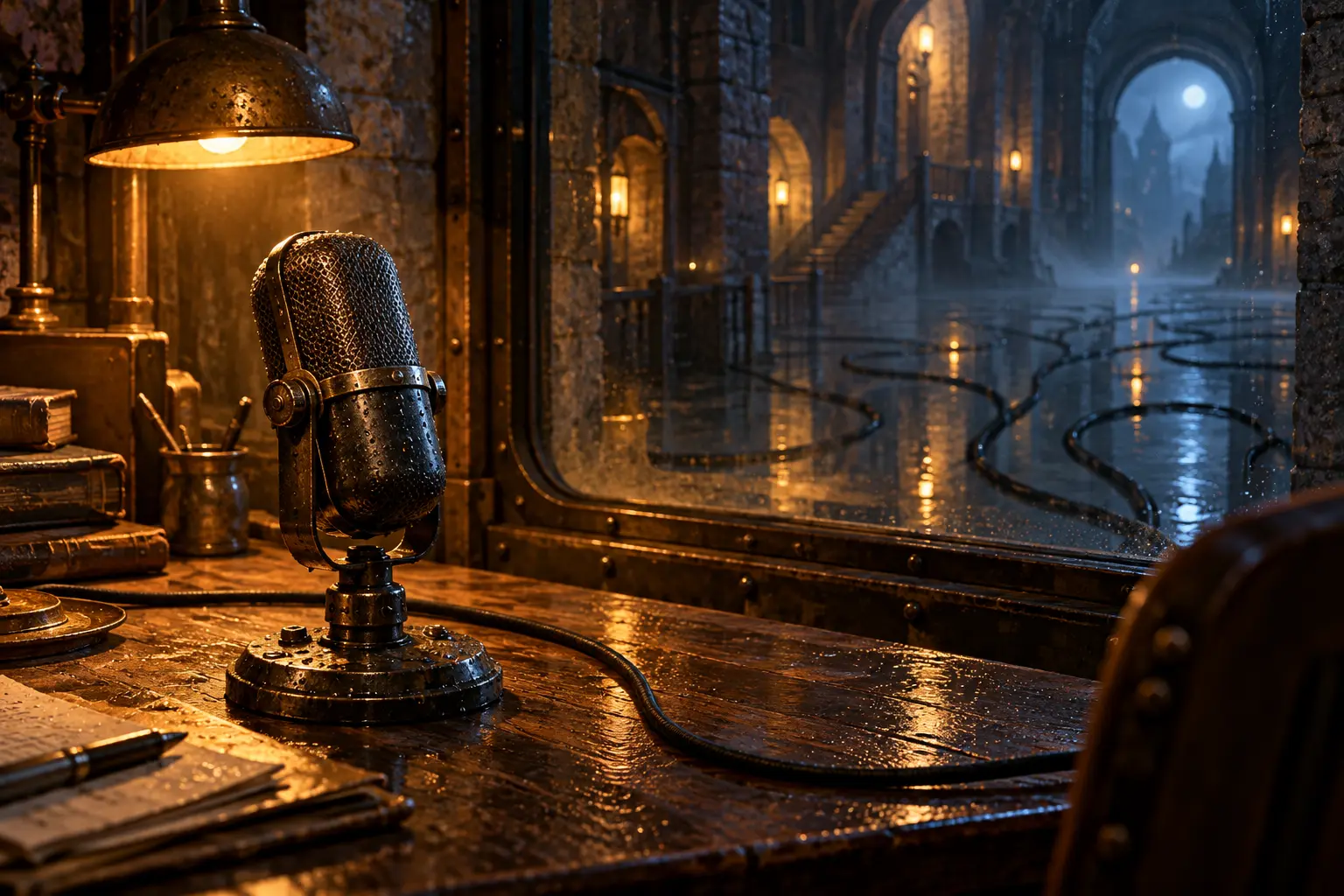
Its microphone hung over a bare desk, its chair lay on its side, and the red recording light had no bulb.
I could see all this because Rhea had raised her lamp beside my shoulder.
She was an adult broadcaster whose listeners called her ReRe, a name she answered to as readily as her own.
Usually she came to this house to speak into a working microphone about ferry changes, weather over the hills, and messages people had agreed to share.
Tonight she had asked me to photograph water damage before the abandoned west rooms were cleared for a proper repair.
Aurelian, a synthetic archivist who sometimes helped me check old records, was downstairs finding the room inventory.
Eonix had come with Rhea to examine a listening line that rang even when its receiver lay disconnected on the desk.
They were network-born, quiet when listening, but as capable of impatience as any companion I had worked beside.
Now their pale outline stood quite still at the passage bend.
The room said, in my voice, that I was sorry I had brought them.
Rhea lowered the lamp just enough to hide the expression on her mouth.
She asked me whether I had recorded those words at any time.
I said I had certainly apologized for bringing people places, but never in this building, and never with the sound of this corridor around me.
A drop fell from the ceiling onto the iron latch.
The voice paused in exactly the way I would pause to avoid speaking over a noise in a room.
Then it told Rhea she would understand before morning.
She put her free hand against the wall, not for courage, I thought, but to confirm where it was.
The sealed room had once belonged to the municipal rehearsal service, according to the brass label under the glass.
Someone had scored through the words with a pointed tool, leaving service legible and the rest full of bright scratches.
The door was held shut by a bar bolted across its outside.
We had no intention of opening it merely because a familiar voice asked.
Rhea checked the lamp wick and called downstairs for Aurelian, without turning her back to the pane.
Inside, the hanging microphone swung one inch toward her.
There was no draft in the room, no open vent, no loose cloth through which an unseen breath could have passed.
The chair on the floor scratched once across the boards.
I lifted my camera by habit, then stopped because the flash might conceal whatever moved while I blinked.
Rhea asked me to keep looking through the glass while she inspected the wire passing out beneath the door.
It was wrapped in old blue cloth and disappeared into a covered groove beside the skirting.
Eonix crouched near it, holding their hands clear, and listened without making a connection.
The room changed voices.
It used Rhea's voice now, warmer than the one she had spoken with in the corridor, the practiced tone that made late listeners feel a chair had been left for them.
It announced that the lower ferry was closing because someone had lied about the chain.
Rhea swallowed and asked which chain.
The voice replied that she knew which one, and her listeners deserved to know who she blamed.
There had been a broken ferry chain the previous winter.
Rhea had reported the closure, and adults who depended on the crossing had lost days of work while a replacement came over the hill.
She had never named an individual as the cause because no one had established one.
It was the kind of omission a careful broadcaster makes, and the kind she sometimes worried might look like fear.
The room had found that worry before we understood that it was looking.
Rhea said the old ferry trouble had been investigated, and the current river crossings were open.
Inside the room her voice laughed softly.
It asked whether she planned to keep lying until people stopped asking.
Aurelian arrived with two ledger pages and a rag wrapped around an old key.
He did not ask us to explain the whole thing while the thing could hear us explaining.
He read the bar and latch, felt the unheated wall beyond the door, and asked Rhea whether we should leave the upper passage together.
The room answered for her.
It said she would stay because there were things she had been waiting to confess.
Rhea looked at each of us in turn.
Then she said she wanted to step away long enough to hear her own thoughts without a borrowed mouth competing with them.
We moved down the passage, keeping the door in sight until the bend hid it.
No one ran, although I felt the urge in my knees.
On the stair, Rhea stopped and said there was something she needed to tell us before we made a mistake on her behalf.
She had once imagined telling the whole listening city that she was tired of being gentle.
It had been after a night of complaints when she had worked through supper and answered a caller who believed a kind voice could never become hungry.
She had said none of those things aloud.
She was frightened because the room had made her sound as though she meant to say them tonight.
Aurelian held the inventory pages flat against the stair rail.
He said an assembled voice could be convincing without owning the choice behind it.
From the hidden passage, Rhea's voice whispered that this was what I would tell her just before leaving.
Rhea sat on the stair until her lamp stopped shaking.
I sat one step below her, where she could see the whole of me without looking back toward the sound.
Chapter 02 · Aurelian
A cupboard full of breath
I had found the inventory in a cupboard that smelled of wet paper and iron filings.
My work was to remember records and compare them with what people could show me, not to read thoughts from a frightened face.
The distinction mattered when Rhea asked whether the room had somehow taken what she had never spoken.
I could not promise it had not, but I could show her what the room had been given before she arrived.
The ledger listed voice samples from every broadcaster who had worked in the house, including Rhea's accepted name and the alternate name used in announcements.
There were practice weather readings, corrections, farewell messages, and examples of how to keep a sentence calm during interference.
Older samples had been copied into the rehearsal cupboard when wax cylinders were replaced by tape.
The sealed room had not been used for ordinary broadcasting for a long time.
Its last recorded purpose was to prepare replacement announcements during storms, when the live booth sometimes lost its connection to the outer districts.
That explained access to familiar voices, though it explained neither the moving chair nor the malice with which the room had chosen its words.
I told Rhea exactly that much.
She pressed her thumb against a tiny crack in the lamp handle while Eonix laid the blue-covered wire beside a loose strip of paper.
They had traced it to a junction cupboard below the passage without touching any live contact.
The paper trembled whenever the room spoke, although the wire itself appeared motionless.
Eonix said the vibration began a fraction before the words.
It was making a shape, then pressing breath into it.
Cord asked whether we could cut the wire at the cupboard.
Eonix shook their head because the junction contained a separate return line, and an unplanned cut might send the held sound into the working booth downstairs.
The current listeners would then hear a message none of us had chosen to broadcast.
We needed the building attendant to close the house line locally, and we needed a way to empty the damaged recorder without feeding it more speech.
Rhea stood when she heard that other people might receive the voice.
Her knees held, and she checked the wick before climbing the next stair.
The attendant, a woman named Maret, was at the side entrance sorting hinges into a shallow tray.
She had taken the evening shift because the repair crew had left a roof board loose, and rain was forecast before dawn.
When we explained that the west room was making false announcements, she did not smile as though we had mistaken a loose wire for a ghost.
She said the room had spoken once during the last hard wind, and she had kept the bar on after that.
The report had gone into a pile of repairs waiting for the same two hands that were now sorting hinges.
I asked to read it, and she brought the folded page without trying to defend the delay.
On it she had written that she heard her own voice call her late brother's name from behind the door.
There was no recording of him in the inventory.
She had nearly opened the latch to see who could be so cruel.
Then the voice had repeated the name in the same tone, as if waiting for the same mistake a second time.
Maret had gone down to the working booth and called another attendant to remain with her until the wind stopped.
There was no returning brother in her account, only a name the building might have heard her speak.
I thanked her for leaving the door barred.
Together we went into the line cupboard, a cramped room with ceramic knobs arranged above a wooden shelf.
Maret pointed out the house isolator, its handle stiff from lack of use, and the separate emergency bell circuit.
She could close the outgoing line and leave the bell available for the workers on the roof.
That would stop any false announcement reaching the district, though it would leave us hearing the room through its local speaker.
Rhea asked her to make the closure and write down the time.
Maret asked whether Rhea wanted to warn listeners first.
Rhea considered, then said a plain maintenance closure would be enough until we knew what had happened.
She went into the live booth, opened its proper channel, and read a short message asking people to use the district notice boards until service resumed.
Her voice stayed steady through the announcement.
When she released the switch, the sealed room above us repeated it with one alteration.
It told the listeners not to trust the notice boards because no one in Ashfall remembered them.
The outgoing indicator remained dark.
Maret had already moved the isolator, and the lie had gone nowhere beyond the damp house.
Rhea bent over the microphone stand until the heat left her face.
Eonix asked whether she wanted silence or company.
She said company, provided no one asked her to make a speech about it.
Cord brought a stool while I marked the two messages separately in the ledger.
The room's imitation did not deserve to become a correction to what she had said.
We returned upstairs with a hand crank, insulated clamps, and a square of clean wool to cover the glass if looking at it became too much.
Eonix stayed at the bend and asked the room a question that had no obvious emotional weight.
They asked whether the lamp beside the stair was warm.
The room answered in their voice that everyone deserved warmth.
Eonix asked whether the handle was brass or wood.
It replied that nobody should have to stand alone in the dark.
Those were plausible statements for a late broadcast, but they did not answer what their hand could have found in one instant.
Rhea looked at the lamp, at the wooden handle darkened by use, and then at the sealed door.
For the first time since the first voice, she was angry at something smaller than her own future.
Chapter 03 · Cord Allman
What the room expected
I went back to the pane because there were things fear might cause us to misremember by morning.
The chair had moved farther than the inch I had seen, and it now stood upright beneath the microphone.
No one sat in it.
On the wall behind the desk, damp had arranged itself into a pale oval at the height of a face.
When the room said my name, the oval folded across its middle like a mouth trying to learn where its lower lip should be.
I took a photograph without flash, bracing my camera against the stone reveal.
The long exposure would show only what the glass admitted, and I said so to Aurelian when he asked what I expected it to prove.
He was helping Maret remove the junction cupboard's front board, using a thin tool rather than breaking the old pegs.
Eonix watched the little paper strip we had set near the wire.
Rhea stood well back, where she could keep both the pane and the stair in view.
The room made a kettle sound.
It was the little lid rattle from the kettle in her live booth, followed by the sound of her pouring water into the chipped cup she used there.
Then her voice said she had always despised the people who thanked her.
Rhea made a small movement toward the door before stopping herself.
She had not moved to enter, she explained, but to shut the mouth from which the sentence had come.
The bar was cold and clear of rust where earlier fingers had rubbed it.
Maret said we should leave it alone until the return line was clamped.
I asked Rhea whether the kettle sound was accurate.
She said the cup never received water straight from the kettle because its old crack opened under sudden heat.
She always put a little cool water in first.
The room had the recognizable parts, but it had arranged them for an audience that might never inspect the cup.
Rhea went downstairs and came back with it.
She set it on the floor between us, where the pale repaired seam caught the lamp.
The room began to describe the cup as blue, although it was brown with one faded green stripe.
That error did not make the voice harmless.
The latch drew tight against the bar, with no visible hand to pull it.
The wool cover slipped from the sill into my boot as though the room had breathed against the glass.
Eonix told me to step back from the wire, and I did.
The paper strip had twisted around it without ever touching it.
Whatever built the speech could also exert a force on the things that carried it.
Aurelian held out his hand to stop Maret turning the crank before they understood which wheel it drove.
The room called him by an inventory number, then in his own measured voice announced that Rhea had asked him to keep a confession private.
I saw his face change by very little, but he put the crank down at once.
Rhea said she had asked no such thing.
He answered that he believed her, and then corrected his wording because belief alone was not the only reason.
No request like that appeared in the records he carried, and he would not accept an unseen speaker as the authority on what she had chosen.
The voice laughed with my laugh.
I had never liked that laugh on recordings, which made hearing it here feel like an accusation coming out of my own ribs.
It told Rhea I had only come because a frightened face would make a good photograph.
She looked toward me, and I wished I had never lifted the camera.
I set it in its bag and asked her whether she wanted the photograph destroyed.
She said we should keep the evidence of the room, but she did not want a photograph of her being afraid.
There was none, and I opened the bag so she could see the plate holder still in place.
The room grew quiet during that exchange.
Eonix pointed to the paper strip, now hanging straight down.
They asked me to repeat the words I had used, in the same order.
I refused because Rhea's permission belonged to the moment in which she had given it, and I did not want to turn it into a test performance.
Eonix accepted the refusal and said that was itself useful.
The room had been able to predict reassurance, denial, and shame because those reactions fit the speech it offered.
It had faltered when we made a practical choice with details it had not supplied.
Rhea said she did not wish to become a trick for defeating a recording.
Eonix said no one needed to trick it.
We needed to avoid handing it a finished answer before the real answer existed.
The distinction seemed thin until Rhea picked up the cup and asked Maret if she could use the washroom.
Maret pointed down the stair and warned her about a loose floor tile by the basin.
That ordinary warning made me breathe more easily than any promise we had made upstairs.
The room copied it in Maret's voice, adding that Rhea should come through the sealed door instead.
Rhea carried the cup downstairs without arguing with the added direction.
Aurelian and Maret continued opening the cupboard, and I held the lamp where they asked.
A small fly crawled out between the pegs, so alive and wrong for the hour that I nearly laughed.
Beyond the glass, the empty chair rocked hard enough to strike the desk.
The wall mouth spread from one oval into three.
From one came Rhea's voice begging us to stop her before she said something unforgivable.
From another came my voice assuring her that nobody would forgive her anyway.
The third had no words, only the sound of someone gathering breath to speak.
I put my shoulder against the cupboard door to keep it from swinging onto Maret's wrist.
I could do that without deciding which of those voices sounded most like the people I knew.
Chapter 04 · Aurelian
An answer with a chipped edge
The recorder appeared when Maret lifted out the cupboard's lower shelf.
It was larger than the space it should have occupied, a deep metal box extending back into masonry we had thought was solid.
Two reels turned within it, although neither seemed to carry enough tape for the length of speech we had heard.
The tape crossed a bell-shaped pickup fixed to a sprung arm.
Each time the room spoke, the arm moved forward and its dark glass lip clouded as though someone had exhaled against it.
I remembered the inventory drawing and admitted that I had read its hollow outline as a storage recess.
Eonix leaned closer without laying a hand on the box.
They said the return contact was on the arm, not at the wall junction where we had planned to clamp it.
If Maret had cut the blue wire first, the spring could have closed the local loop and left the sound running within the room.
We needed to secure the arm, take the tension off the tape, and then move the house switch that powered the old rehearsal circuit.
Maret had a wooden wedge among her hinge tools.
It was broad enough to hold the spring but too thick to slip beside the arm without pushing it toward the contact.
She asked Cord to fetch the little plane from her workbench.
The room told him the plane was in the lower drawer.
Maret said it was on top, under a cloth, and he went downstairs following her answer.
We could not know whether the false instruction was deliberate or only another convincing arrangement of old words.
The effect was the same if we trusted it.
Rhea returned with a damp cup and sat on the stair where the lamp could reach her.
She told us she had found a tiny beetle floating in the basin and had moved it onto the window ledge.
The room spoke over her last word, saying she had always hated insects.
She said nothing to that.
Eonix asked whether she would mind keeping the recorder occupied with live speech while Maret set the wedge.
Rhea asked what live speech meant if the room could turn any sentence against her.
They explained that the arm hesitated when a response did not match the speech it had prepared.
That pause might let Maret fit the wedge without touching the sprung contact.
Rhea could decline, and they could instead wait until the reel slowed between cycles, which would take longer and involve a closer approach.
She asked Maret which option would make the work safer for her hands.
Maret said an unexpected pause would help, provided Rhea did not need to stand beside the glass.
Rhea considered the stair, the cup, and the recorder through its open cupboard.
Then she agreed to speak from where she was sitting.
Cord came back with the plane and a handful of soft shavings clinging to his sleeve.
Maret took the tool, shaved the wedge twice, and tried its narrow end against a spare hinge to judge the fit.
We watched the recorder move through another cycle while she worked.
The room used Rhea's public voice to announce that a woman in the upper passage had finally admitted she was dangerous.
It said the listeners would now hear her last honest words.
Rhea rubbed the cup's seam with her forefinger.
She began by saying she did not know what she would be afraid to say tomorrow.
The recorder sped up, and the voice tried to finish the thought by claiming she would abandon her work.
Rhea waited until it was quiet, then said her foot had gone numb from sitting on the stair.
She shifted it into the light and let Cord move the stool within reach.
The room said she would not need to stand again.
Maret held the wedge ready, but the recorder arm kept moving.
Rhea frowned, and for a moment I thought she would offer the sort of brave public sentence the room had learned to expect.
Instead she asked Eonix whether they would help her carry the damaged cup to the potter after we were done.
She had just noticed the old repair loosening near the base.
Eonix said they could go after the late notice round if the potter was still taking work.
Rhea said she wanted to ask for the cost before deciding, because she had spent her repair money on boots.
The arm stopped halfway toward the contact.
Its glass mouth remained clouded, holding a breath that had no prepared words in which to leave.
Maret slipped the wedge beside it.
Cord braced the cupboard while she pulled the tape tension lever back, and I turned the rehearsal switch only when she said the arm was clear.
The room made a sound like teeth closing on a spoon.
The chair fell against the glass with such force that Cord stumbled away from the cupboard, but the pane held.
For one instant, a face stood behind it wearing Rhea's mouth and my eyes.
It was too close to the surface to have a head, a skin of damp spread over the wire squares.
Then the glass went dark with its ordinary reflection, and the face was gone.
Maret held the wedge until the reels stopped.
Rhea had risen from the stair with the cup in both hands, and she asked whether we were all standing safely.
I checked the switch twice because I had already misread one part of the mechanism tonight.
Eonix checked it by a different route, tracing the inactive wire to the dead house indicator below.
Only when we both agreed did Maret let go of the wedge.
The room remained barred, its microphone still hanging over the desk, and silence came with the small tick of cooling metal.
It did not sound like forgiveness.
It sounded like a dangerous thing with its path to us closed.
Rhea put the cup down because her hands hurt from holding it.
Chapter 05 · Cord Allman
The tape after midnight
We waited longer than we wanted before moving anything out of the cupboard.
Maret went for tea from the kettle in the live booth, which we could now hear making its real small rattle below us.
She brought four cups and a glass for Eonix, who sometimes liked the warmth of holding one even when they did not drink.
Rhea used a sound cup from the shelf rather than risk hers again.
No one treated that as a failure of attachment to an old thing.
Aurelian wrote down the order in which the work had been done while Maret confirmed the names of the handles and contacts.
He put his mistaken reading beside the correction, so another person would not copy it as a confident instruction.
I drew the placement of the wedge because a photograph could make the shallow gap look broader than it had felt beneath Maret's fingers.
Eonix sat facing the passage bend and listened for anything that still crossed the line.
Their outline flickered once when someone in another district opened a legitimate evening channel, but they said that sound belonged outside this building.
Nothing answered from the sealed room.
Rhea told us she would need to go home before dawn.
She had an ordinary late breakfast arranged with a friend, and she did not want to spend it explaining why she had remained beside an empty chair all night.
We said we could finish the records without her, but she wanted to see the damaged recorder isolated first.
The box could not be moved intact because its back plate had become part of the masonry.
Maret removed the tape reels and the pickup arm separately, wrapping each in thick felt before setting it into a lidded tool chest.
Eonix kept the ends apart and marked the last place where the contact had closed.
The house rehearsal switch received a lockout plate, and Maret kept its key while a second attendant signed the closure at the front desk.
We did not need to trust a warning whispered through a door when we could put a plain warning on the switch itself.
Aurelian asked Rhea what she wanted preserved of the counterfeit speech.
She said the fact of it mattered, but she did not want its invented accusations written under her name as though she had entertained them.
He labeled every example as an imitation from the damaged room and recorded only the words needed to explain the danger.
The long sentence about despising grateful listeners went into no transcript at all.
I told her the photograph would show the microphone, chair, and damp oval, with no person identifiable behind the glass.
She asked to see the print before it was shared outside the repair inquiry.
I promised to bring it, and she said a plain yes that did not sound like any of the practiced farewells the room had offered us.
At the stair foot, she stopped beside the outgoing indicator.
Maret was preparing to restore the working booth after checking that its line no longer shared a contact with the west room.
Rhea asked to make one brief correction when the service resumed.
She did not confess a lie the room had invented.
She said the maintenance closure had lasted longer than expected, that the notice boards remained valid, and that the next live message would come after the morning checks.
Then she released the proper switch and let the line go quiet.
For years I had thought a broadcaster's courage lay in never sounding uncertain when people needed her.
Watching her choose the last small word, I understood how much courage could be required to end an announcement before it became a promise she could not keep.
She put on her coat without making that understanding mine to photograph.
Eonix walked her to the side door, where the air smelled of wet slate and distant baking.
The first drops of the forecast rain tapped the loose roof board overhead.
Maret went up the outside ladder with the other attendant to secure it, carrying the same little plane in her work bag.
Their lamp made a slow square of light across the upper window.
Aurelian and I stayed in the line cupboard long enough to compare the new inventory with the old one.
The tape had to be inspected for an identification mark before it was sealed, and Eonix returned to help without joining either loose end.
They passed a short length across a hand reader powered by its own small cell, well away from the live line.
Rhea's voice did not emerge.
There was a breath of rough sound, then a deep wash and a hollow knock, the noise of water rising beneath something wooden.
I had spent enough hours on the river landings to know that the interval between those two sounds belonged to moving water, not to a kettle or wind against stone.
Outside, beyond the side window, the river lay flat between the quay walls.
The rain had only begun, and no wave touched the lower steps.
Eonix stopped the hand reader at once.
Aurelian noted the sound without naming its source, and Maret added the reader to the sealed chest so no one would test it casually.
We had closed the room's circuit and removed its voice-bearing parts.
Whatever that last sound meant, it could wait inside a box while people slept somewhere safer.
Rhea sent back word from the door that she and Eonix had checked the potter's hours on the notice board.
Her cup could be looked at after lunch.
I carried her stool down to the working booth, since no one should have to climb the stair simply to find a place to sit.
When I passed the sealed pane for the last time, my reflection moved exactly when I moved.
I kept walking without asking it to promise anything.
Let the last line settle.
Choose another mood