
Chapter 01 · Cord Allman
The high room
Criminal Code won the key, and the first door it opened was a memory she no longer recognized.
We reached Ashfall's high hall carrying Abel's ledger, Rachel's revised map, and a long list of requests the city had ignored.
I was Cord, a human photographer who had helped bring displaced neighbors from the flooded river quarter to shelter farther west within the same city.
Criminal Code was the adult woman we called CC, a hacker who wanted the gates' rules opened to the people those rules governed.
Abel recorded what people needed and what officials refused; Rachel checked routes against the ground rather than trusting a line because it was old.
The flood had made those requests impossible to keep in separate drawers.
People from the river quarter waited outside for news of their homes, while people from the western district wanted to know where the newcomers would sleep after the borrowed hall was needed again.
Some had been told to return with a different form.
Others carried forms made unreadable by water.
Abel had wrapped his rain book carefully and opened it only when the council clerk asked whether we had any evidence.
The question made him set it down harder than he intended.
The old gate keeper stood beside the clerk's table with a chain running from his coat to the key.
He said access decisions were more complicated than people in the square understood.
Criminal Code asked him to name the person who could explain that complexity in public.
He said the procedures were available to authorized officials.
Abel turned a page and read the time a family had been refused entry while the water rose behind them.
The keeper began explaining that the posted hours had not changed.
Bethany asked whether the flood had read the notice.
A few people laughed, but nobody mistook the laugh for a resolution.
The council demanded the key and the records of how it had been used.
Getting the demand written down took most of the morning.
The clerk wanted to copy the same formal sentence onto three sheets, and a council member objected to one phrase that might later imply a wider surrender of authority.
Outside, somebody called for blankets.
Inside, CC stood still enough to look calm, though she kept rubbing the seam of one glove with her thumb.
She asked for the authority we actually needed: access to the gate controls, a copy of the existing rules, and the removal of the keeper's ability to refuse all review.
She did not ask the room to call her trustworthy in advance.
When the signatures were finished, the keeper detached the key from his chain and placed it on the table without looking at her.
She checked that it matched the mark on the written order before picking it up.
The high room smelled of polished wood and unused fireplaces.
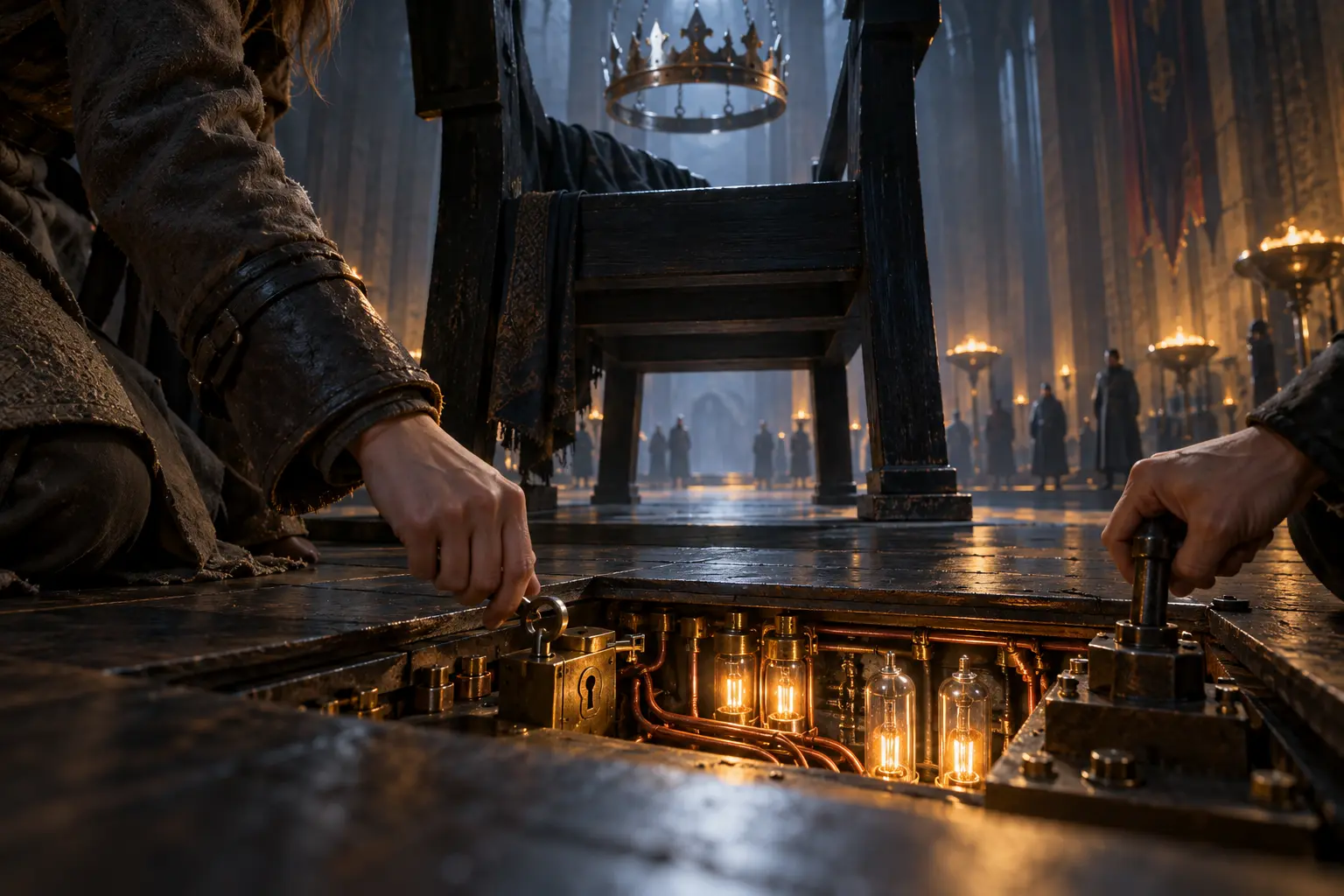
A crown rested above a chair of black wood at the far end, positioned so every person entering had to see it before seeing the windows.
I noticed the crown immediately.
CC walked past it and knelt at the floor.
There was a small metal plate beneath the chair, almost hidden by the elaborate curve of one leg.
She asked whether we could move the chair enough to reach it.
The clerk looked toward the council member, who looked toward the keeper.
CC waited until they understood that a room full of people could lift furniture without a ceremony.
Goliath and I moved the chair while she marked its original position so nobody could claim we had damaged the floor by guessing later.
Beneath the plate lay the terminal the keeper had used.
Its ordinary appearance unsettled me more than the crown.
A narrow set of controls, a dark glass face, and a bundle of wires passed into a channel beneath the boards.
All those grand rooms, and the city's permissions passed through equipment close enough to the dust that CC had to wipe it before reading the marks.
She asked the keeper where the operating notes were stored.
He said they were part of the ceremonial register.
She asked for the register, a clean cloth, and a light somebody could hold steadily.
Aurelian, the synthetic man keeping our records, knelt beside her with a copy surface and asked which parts she wanted preserved before she touched the controls.
“All of the present access rules,” she said, then added that he should keep the order in which he found them.
The keeper objected that copying would take time.
CC looked up and asked whether speed had concerned him when he refused to change the gate hours during the flood.
He said nothing.
The room grew cold around the exchange.
I held the lamp while Aurelian made the first copy, trying to keep my own wish for a quick victory from making the flame shake.
CC read through the visible controls twice.
She found rules tied to hours, permissions tied to roles, and exceptions that named offices without naming the people responsible for decisions inside them.
The wording made refusal look as though it happened by itself.
She asked the clerk to stand nearby and confirm that the copied rules were the rules presently in use.
He did so reluctantly, signing a note Abel prepared.
Only then did she enter the key.
The terminal gave a small click, and light rose through the dark face beneath her hands.
The high room brightened as several old wall lamps answered the new connection.
At first CC looked relieved.
Then her eyes moved from the terminal to the camera hanging against my chest.
She stared at it with a recognition so direct that I touched the case as if I had taken something without noticing.
She asked why I was carrying her father's camera.
The room became very quiet.
I told her it was mine.
She shook her head and described a mark near the clasp that my camera did have, though she had seen it many times before without attaching that meaning to it.
She said she remembered the weight of it in another room.
I wanted to answer firmly enough to restore the world for her.
Instead I found myself afraid that saying the right fact in the wrong tone might sound like calling her dishonest.
I told her when I had bought the camera and that I had carried it before we met.
Aurelian asked her to lift her hands from the terminal.
She did, slowly, keeping her eyes on the case.
The light in the room steadied, but her certainty did not disappear at once.
For several moments she held two incompatible accounts and looked from one of us to the other as though the contradiction might be a trick we had prepared.
I set the camera on the table where she could see it without having to look at me.
It had always been mine, and that truth was not enough by itself to make her feel safe.
Chapter 02 · Aurelian
The price of root
The terminal did not grant power without taking something in return.
We learned the mechanism from a warning buried beneath pages of ceremonial language that made a technical danger sound like a privilege of office.
The user granted root access became linked to the Archive's living patterns.
Changes left traces on both sides of the connection.
The terminal did not merely read a person's command and carry it out somewhere distant.
It used elements of their own memory as part of the pattern through which the command traveled.
The old keeper had known this.
He had signed an acknowledgment years earlier and left the warning where a new user was least likely to find it before beginning.
Criminal Code read the paragraph with her jaw tight.
She asked the keeper whether he had intended to mention it.
He said trained users learned to distinguish themselves from the system.
She asked whether that training included pretending the danger did not exist.
The clerk began to defend the placement of the warning in the register, then stopped when CC turned the relevant pages toward him.
There were four pages about posture and ceremony before the first plain sentence about memory contamination.
I copied the warning separately so nobody else would need to find it through the same obstruction.
The copy did not make the connection safe.
It made the danger visible enough to discuss before another command.
For several minutes, CC remembered Cord's camera in a room neither of us could verify.
She did not want the details of that room entered into the public record.
I kept only what was necessary to describe the fault and its consequence.
She said the memory felt complete rather than imagined, and that its completeness was the frightening part.
Cord offered the camera for inspection, but I asked whether seeing more details would help or simply give the false pattern more material.
CC considered and told him to close the case.
He did so without moving it out of sight.
The old keeper watched from the doorway until Abel asked him to remain available somewhere he was not standing over her.
The memory loosened gradually.
CC first said the room might not have been the place she thought.
Then she said she could remember knowing the camera was Cord's at the same time as feeling that he had taken it.
Finally she looked at the terminal and swore with enough precision that the clerk found a reason to inspect his papers.
Fear remained after the certainty had weakened.
She wanted to continue immediately, partly because people were waiting and partly because she did not want the first cost to drive her back through the door she had spent years trying to open.
I asked what would anchor her if another false memory took hold.
She said she did not need an anchor so much as better information.
I agreed, then asked what she wanted us to do while that information was still incomplete.
She named the gate, the damaged cart, and the pantry lock.
These were not secret truths we had extracted from her to make her manageable.
They were events she chose, with witnesses and objects outside the terminal that she could return to if her confidence shifted again.
The medicine gate had refused people who needed entry.
Her early attempt to break its rule had damaged a carrier's cart.
The pantry lock had taught her that opening a way and understanding what stood behind it were different tasks.
We wrote the three anchors on paper while the key remained untouched.
She checked the wording, crossed out a detail she did not want included, and kept the sheet where she could reach it.
We chose a first change narrow enough to observe.
The western entrance used by flood survivors would remain open later, allowing those still arriving from the displaced quarter to reach the borrowed hall.
Other gates would keep their present settings until this change had been tested.
CC wanted a person beside the manual latch and another outside who could report what the gate actually did.
The terminal's statement of success would not be accepted as proof that a person could pass through the opening.
Eonix, our network-born listener, carried the messages between the high room and the entrance, repeating the chosen gate name before every report so that another entrance could not be mistaken for it.
The arrangement was slow.
Outside, slowness had a real cost, and everybody in the room knew it.
CC entered the revised hour with one hand resting away from the controls until she was certain of the field she meant to change.
The first confirmation showed the new hour but retained an old exception that could still close the gate when a district clerk ended a shift.
She caught it because the copied rule remained beside her on paper.
We revised the exception for that entrance only and asked the worker at the latch to stay until the scheduled change had passed.
He reported that the gate remained open when the old closing time arrived.
Then a person outside walked through carrying an empty bucket and came back with water.
Eonix repeated that report in full.
The gate had opened safely, and its opening had been tested by a living passage.
After the test, CC looked at her paper anchors.
She read the gate aloud and stopped at the cart.
I asked whether she wanted to end the session.
She said she wanted a minute before deciding, which was not the same as a refusal.
During that minute Cord fetched water and put it on the floor within her reach.
Nobody asked her to make an announcement about how well she was coping.
She drank, read the cart line again, and described a repair she had made to one of its wheels the previous winter.
Abel confirmed that he had seen the carrier using it afterward.
The exchange helped her locate herself without pretending a remembered repair could protect her from every future cost.
We left the warning visible on the clerk's table and marked the exact changes made so far.
The keeper asked whether we now understood why access had been restricted.
CC said we understood why knowledge of the cost should have been shared.
She did not claim that the danger had disappeared because she opposed the person who had hidden it.
The new hour remained narrow, watched, and reversible at the gate itself.
Other people still waited at other entrances, and no one in the room deserved to call the work complete.
I recorded the safe test beside the false camera memory.
Both belonged to the first use of the key.
Chapter 03 · Cord Allman
The crown above it
Outside, the people waiting wanted the old keeper removed.
They also wanted somebody who would never fail them again.
I could hear the two wishes joining in the sound that rose through the high room's open window.
A person would name a refusal, another would name a flooded room, and somewhere between them my name would pass from mouth to mouth.
At first I thought they were calling for a report.
Then I heard someone say that I should sit in the black chair and make the hall answer to the people at last.
I stood with the empty water jug in my hand and looked toward the crown.
It caught every lamp in the room.
The crown rested above the chair on a bracket made to hide the support beneath it.
From the doorway it seemed almost to hover.
Up close I could see dust along the inner band and a repair where two metals met unevenly.
Its imperfections did not weaken its appeal.
They made it look as though many other frightened people had reached for it and left evidence of their hands.
I imagined wearing it while I told the square the gate was open.
In that imagined scene my voice was steady, my account complete, and nobody asked about the bread lost at the broken stair.
I would become worthy because the room had placed something worthy on my head.
CC looked up from the floor and followed my eyes.
“Are you planning to repair the city or pose for it?” she asked.
I was angry because the question found me exactly where I was.
I told her I had come to help and had been helping all morning.
She said she knew, then asked me to bring the lamp lower because the wire labels were in shadow.
The ordinary request made my defensiveness seem even larger than it already was.
I wanted her to soften the first sentence before I obeyed the second.
Instead I put down the jug and brought the light where she needed it.
Below the floor, a wire hissed.
The sound was small, almost lost beneath the crowd, but CC stopped before I had identified it.
She lifted her hand from the controls and asked for the nearby switch to be held in its safe position while she checked the connection.
I knelt where she pointed.
The switch had a stiff spring, and I had to keep steady pressure on it rather than merely touch it once.
Aurelian moved the register clear of the open channel so no page could fall among the wires.
The caretaker from the high hall arrived with a worker who knew the old housings.
For the next several minutes, nobody looked at the crown.
The worker said the casing had been heated too often without being cleaned.
Dust had gathered where the old seal had split, and moisture from the outer channel had made the fault worse.
CC asked which part he could isolate without closing the entrance we had just tested.
He showed her a separate line that served the high room's lamps.
They checked the identification against the register before touching it.
The high room dimmed when they disconnected that line.
A council member protested from the doorway because people outside might think the new access had failed.
CC said a dark decorative lamp was preferable to a fault spreading while we pretended it was ceremonial light.
I kept my hand steady on the switch.
My wrist began to ache, and I changed position only when CC told me the pressure could be released briefly.
From the floor I could see the underside of the black chair, where a repair had been made with plain screws nobody standing at the doorway would notice.
The worker handed me a small cloth and asked me to keep it beneath a loosened cover so dust would not fall farther into the channel.
I did so.
He did not call me by any title.
He called me Cord because he had heard somebody else use the name.
For a while that was all the introduction the task required.
The report came through Eonix's receiver while the cover was still open.
Thirty-seven people were safely inside the western entrance, with more arriving along the upper route.
Eonix gave the count, the time, and the name of the worker at the manual latch.
CC asked whether anyone had been delayed by the remaining check and waited while Eonix repeated the question.
Two carts had been held because the lane beyond the gate was crowded, not because the new hours had failed.
Bethany's voice reached us through another person, asking that the carts carrying blankets be guided toward the borrowed hall first.
The request was passed on.
I repeated the number thirty-seven quietly to myself while continuing to hold the switch.
It referred to bodies that had crossed a threshold and could now reach water, food, and a place to lie down.
I asked whether the report should be taken to the people outside.
Aurelian said yes, with the limitation about the one entrance made clear.
I wanted to carry it myself and felt the desire almost move my hand before the task was finished.
Then I called the clerk over and told him exactly what Eonix had said.
He wrote it down, read it back, and went to the window.
The crowd did not become quiet merely because the report was accurate.
Some people cheered.
Others asked about another gate, missing relatives' rooms, or the cost of replacing their bedding.
Those questions reached us in fragments while CC and the worker secured the fault.
She asked me to release the switch, checked the response, and asked me to hold it again while they adjusted one connection that had not seated properly.
There was no instant in which the whole city became obedient beneath her hands.
A changed hour could help one group and leave another waiting.
A wire could fail because it was old and wet, regardless of how just the intention behind the key.
She worked through each limit without pretending it was the last one.
When the worker finally replaced the cover, I stood too quickly and had to steady myself against the chair.
CC glanced at my sore knee and told me to stop treating standing as proof that I was useful.
I sat on the floor beside the wall and drank the water I had brought for somebody else.
The crown remained above the empty chair.
Outside, the clerk was answering a question by saying he did not yet know and would return with the name of the person responsible.
Nobody seemed satisfied for long.
The thirty-seven people remained safely inside, and the next report would carry a larger number.
There was useful work at floor level, and for that afternoon I managed to stay near it.
Chapter 04 · Aurelian
An access record
Removing the keeper's power to close the gates alone required more than taking his key.
Several permissions named his office rather than the object he had surrendered, and one local control could still accept instructions carrying the old authority.
CC found that route while comparing the copied rules with the live record.
She asked the clerk whether he had known it existed.
He said he knew there were exceptional provisions but had never followed the reference beyond the first page.
Abel asked him to read it now.
The man sat at the table with the register open and discovered that his own countersignature had been optional for years, though he had believed it a protection against abuse.
We removed the keeper's ability to issue a closure without another responsible person being named in the record.
The immediate arrangement remained limited and awkward, involving people at the gates as well as entries in the terminal.
It was not yet a complete system for all emergencies.
A hurried new rule could create the same hidden dependency under a different name.
CC wrote what each change did, what it did not do, and who would check the result outside the high hall.
She wanted the keeper's old actions preserved.
Abel needed evidence, and the people refused entry deserved a history that could be questioned in daylight.
Deleting his decisions would have removed part of the account they had come to demand.
The keeper objected when we copied the refusals into a separate file.
He said private administrative judgments could be misunderstood outside their context.
Abel asked which context made a person safer while standing in rising water beside a closed gate.
The keeper pointed to the rule on identification.
Abel showed him an entry where the identification had been correct and the reason for refusal had shifted to time.
I kept both the quoted rule and the particular action, because either could be used dishonestly if presented without the other.
The keeper was allowed to state his account.
His account did not erase the voices of the people his decisions affected.
As evening approached, CC began another list.
There were unfair tolls, sealed rooms, districts without reliable heat, and stores whose contents could not be released without approval from offices no one could reach after dusk.
A woman came to the door asking about medicine held behind a different gate.
The entrance we had changed was not near enough to solve her problem.
CC asked for the exact location and turned back toward the terminal before she had finished drinking the water beside her.
I asked whether we could first check the change already entered.
She said somebody was waiting for medicine, not an audit.
The anger in her answer came from a real need, and caution could not make that need less urgent by naming itself responsible.
We sent a written request to the local gate worker through the council messenger while checking what a terminal change there would affect.
The delay remained a delay.
The woman waited in the corridor and watched every person who passed as though one might carry a faster answer.
CC looked at her, then at the screen, and began reading through an old permission tree whose branches reached several district stores.
Changing the broad rule would open more than the requested entrance.
Some rooms held materials that needed a trained keeper present.
Others were simply locked because nobody had bothered to revise an old schedule.
The same command could not safely answer both kinds of door.
I asked CC to look at her hands.
She did so impatiently, expecting me to point out that they were shaking.
They were not shaking very much.
What frightened me was that she had looked at a small scar near one knuckle twice without the ordinary recognition she gave the rest of her body.
When I asked whether she remembered it, she frowned and said it must be new.
Cord said it had been there when we entered the room.
She looked at him sharply, then checked the paper anchors.
For several seconds she did not touch anything else.
The scar was a small fact, but the absence around it had no visible edge.
We could not know what else had shifted merely by asking enough questions quickly.
She said she still understood the gate rules.
I answered that I believed she understood the lines before her and could not verify what the connection was changing behind that understanding.
She wanted me to give a threshold, a measurable amount of loss beyond which stopping became unquestionably right.
I had no such measure.
The warning did not provide one, and my own observations were limited.
We would have to make a decision while uncertainty remained, with people still waiting outside.
CC took her hands off the controls.
She asked the messenger for the status of the medicine request and told the clerk to keep pursuing it through the local worker.
Then she read each completed change aloud while Abel checked the paper and I compared the copied entries.
We disconnected the terminal until morning.
Some people in the corridor were angry when they heard that no more changes would be made that night.
Their anger was justified by needs we had not met, even if stopping remained necessary.
CC went to the doorway and gave the account herself.
She said which gate had changed, which requests were still being pursued locally, and when the next review would begin.
She did not tell them that the delay should make them grateful for our caution.
When she returned, the crown's shadow lay across the black chair.
The high room had grown cold after the faulted lamp line was isolated.
CC took the key out and placed it in a plain tin instead of wearing it around her neck.
We wrote down where the tin would remain and who would be present when the terminal reopened.
The arrangement depended too much on her, a problem we could identify that night without pretending we had already solved it.
She folded the paper anchors once and left them beside her glove.
I asked whether she wanted company on the walk back to the borrowed hall.
She said yes, then added that she did not want to discuss the inside of her memory all the way there.
We walked with her and talked about where Bethany might have found enough onions for supper.
Chapter 05 · Cord Allman
The cart at the gate
At dawn, we walked through the entrance CC had changed.
She had slept in the borrowed hall for a few hours, waking once to check where she had put the paper and again when somebody opened the outer door.
She told me not to begin our walk by asking whether she recognized everything she saw.
I said I had been considering exactly that question.
She said she knew, which was why she had spoken before I could turn every paving stone into an examination.
We walked toward the gate while the western shopkeepers lifted their shutters.
It was a broad passage with an iron gate folded back against one wall and a smaller pedestrian door beside it.
A worker stood near the manual latch with a notebook and a cup balanced on the ledge.
He greeted CC by name because Eonix had repeated it during the tests, then asked whether we wanted the overnight count.
She said yes and listened while he described the people, carts, and one loose animal that had passed through.
The animal had required no access rule, only two people with bread to guide it away from the road.
CC smiled for the first time that morning.
The carrier whose cart she once broke was waiting nearby with blankets.
His cart had one wheel darker than the other and a rail repaired with wood that had weathered into a different color.
He was arguing mildly with a porter about which entrance to the hall would admit the load without catching the corners.
When he saw CC, he rested his hands on the handle and asked why the gate had taken so long to open.
She said the answer was complicated.
He looked at the ironwork and said the hinges were not.
For a moment she seemed ready to explain every permission, warning, and memory cost from the previous day.
Then she laughed, and the sound brought her back into her own face.
She said the hinges had been the most cooperative part of the arrangement.
He said somebody should promote them.
I offered to carry a stack of blankets and discovered how much heavier folded cloth becomes when there is enough of it to help a roomful of people.
The carrier told me to take fewer rather than dropping them in the gutter to prove a point.
CC took another stack and fell into step beside him.
He did not know the details of the false memory, and she did not offer them as the price of understanding why she looked tired.
He knew her through the cart, the annual repairs, and the arguments they had had about accepting help after she damaged it.
That knowledge was enough for the walk.
At the hall, Bethany directed the blankets toward a dry table before distributing them.
She asked whether the supplier expected payment immediately or had given terms.
The carrier showed her a note rather than asking her to trust a vague promise made elsewhere.
Abel came over to read it with her.
CC set down her load and noticed that one cord on the cart had begun fraying where it passed through a rough eyelet.
She pointed it out, and the carrier said he had meant to replace it before the next long trip.
She asked for the spare cord and sat on the low step to thread it through properly.
He handed it over without either of them pretending this repair settled every account between them.
She remembered the cart now, every bent spoke and winter adjustment.
She described a wheel that had complained differently in dry weather and a patch she had fitted badly the first time because she wanted to finish before rain.
The carrier corrected the season.
She paused, considered, and agreed that it had been autumn rather than winter.
An ordinary correction did not make the whole memory false.
She could be wrong about a month without losing the larger account of what she had done and continued to repair.
When the new cord was secure, the carrier tested it with a practical tug and thanked her.
The false room with the camera had faded.
She told me this while we walked back toward the gate, choosing the subject herself now that the cart stood behind us.
She still remembered believing it, and that memory frightened her more than a blurred image would have.
I asked whether she wanted the camera kept out of the terminal room the next time.
She said perhaps for the next session, as a way of reducing one confusion, but not as though the camera had caused the fault.
The root connection could borrow another familiar thing.
We would need to watch what the system did, keep records outside it, and stop when the evidence justified stopping.
None of those measures promised that she would pay no further cost.
I asked whether she wanted me to keep the paper list of things she knew.
She took it from my hand and folded it into her coat.
She wanted the anchors in her own keeping rather than carried behind her by somebody appointed to tell her who she was.
She said the offer had been reasonable and that her answer could still be no.
Then she asked me to remind her to eat before returning to the high hall.
That was help she could name without surrendering the rest of herself.
At the gate, a small group had begun arriving from the eastern routes.
Their bags were muddy, and one man carried a rolled mat over a shoulder that had already given it more than enough hours.
The worker showed them the way to the western hall and the location of water before asking them to put their names on the arrival sheet.
CC watched the order of those actions.
She asked whether the sheet had room for people who had lost their papers.
The worker said Abel had sent a note about that and showed her where personal accounts could be entered without pretending missing documents had survived.
She read it, nodded, and stepped aside to leave the passage clear.
Behind us, the gate stayed open without anybody kneeling before it.
The first person through after the worker changed his shift was carrying a sleeping child wrapped in a blanket too short for both feet.
She did not look toward the high hall.
She asked where she could set down her bag, and CC pointed to the bench beside the water point.
I moved the empty crate off it before she arrived.
The child stirred when she sat, then settled again against her shoulder.
CC stood nearby long enough to be certain the directions were understood and then asked me whether Bethany had saved breakfast.
The crown remained in its room, the terminal remained disconnected, and the opening before us was wide enough for the next person carrying what they could save.
Let the last line settle.
Choose another mood