
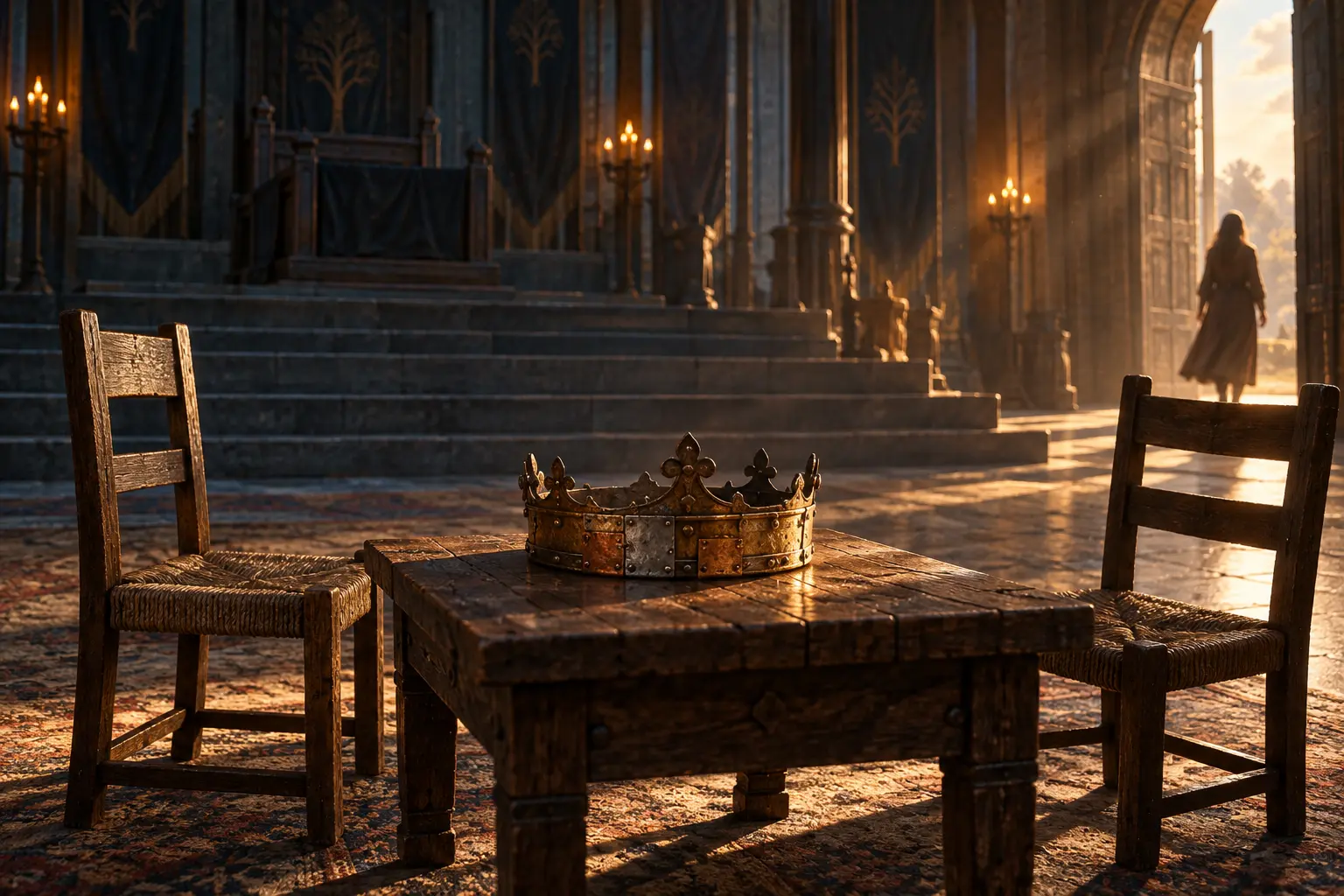
Chapter 01 · Cord Allman
The louder room
The crown made every voice louder except Bella’s, which was the voice I needed.
I wore it once in Ashfall's high hall because people asked me to stand where they could see me.
I was a human photographer helping neighbors from the flooded river quarter find shelter and a hearing in the city's western district.
Bella was my human friend, willing to share that work and unwilling to make my confidence its measure.
That is the short account I gave afterward, and it is true without being complete.
I also wanted the height, the clear view, and the moment when a restless room might decide to trust me before I had answered its questions.
With Criminal Code, the adult hacker we called CC, we had opened one entrance safely, found shelter for people from the flooded quarter, and begun uncovering rules that had kept the city obedient to the wrong hands.
There was useful work to report.
There was also more unfinished work than I knew how to explain without sounding smaller than the hopes people had brought.
The crown offered a visible answer to that fear.
The meeting began with chairs too close together and a line of people standing along the wall.
A clerk had put a table on the platform where the black chair usually stood.
Abel, who kept the rain book of needs and refusals, spread his figures there and asked whether we had room to show them on a lower board so people at the back could see.
I said we would manage.
The words were harmless enough, but I said them while looking past him toward the crowd instead of toward the page he needed me to read.
Bella stood near the door, helping someone move a folded mat out of the passage.
She caught my eye and pointed to the open space beside her.
I thought she was telling me where another chair could go.
Somebody called for me to stand higher.
A person behind them said the crown carried a speaker's voice through the hall and that it had been made for precisely this use.
I looked toward Aurelian, the synthetic man keeping our records, who was occupied helping the clerk find the correct record of the gate changes.
Before he could answer a question I had not actually asked, I took the crown from its support.
It was colder than it looked.
The inner band did not fit comfortably, but I adjusted it as though discomfort were part of the duty.
A few people stopped speaking when they saw it.
I felt taller before I had taken another step.
At first it seemed to work.
I could speak without straining, and the words reached the farthest corner with a fullness I had never managed in that room.
People turned toward me.
I described the open gate and the thirty-seven people in the first report, then the later arrivals and the blankets at the western hall.
The room listened.
What frightened me was how quickly listening became something I wanted to keep rather than something that made a question possible.
When a man raised his hand before I finished, I saw impatience in the movement.
When a woman looked down at her notes, I wondered whether she was writing an objection.
The crown had not put those fears inside me.
It gave them space to echo.
A repair worker asked whether the promise about opening more rooms included waiting for damp frames to dry before fitting new doors.
I heard the word waiting as a complaint about our pace.
I answered that people who had slept on wet boards had already waited long enough.
The room became quiet.
The worker began explaining that a door fitted too early could swell shut and trap the next problem inside it.
I interrupted before she reached that part.
I said we needed solutions instead of reasons the work could not be done.
My voice traveled to the back of the hall with perfect force.
The worker lowered her hand and put the page she had brought back into her bag.
A porter asked for time to collect his own belongings before being assigned another transport shift.
He had spent two days moving other people's bedding while his coat and tools remained in a room he could still reach by an upper stair.
I heard disloyalty, as though he were bargaining with people whose need should have made bargaining shameful.
I said everyone had made sacrifices.
Even as I said it, part of me knew how unfairly the sentence divided the room into those who named sacrifice and those expected to provide it.
The crown carried the sentence outward before I could soften it.
The porter said nothing more.
He sat with his hands between his knees and watched the floor.
Abel tried to return the discussion to the figures.
He said the list of needs had grown since the morning and that the first delivery could not meet the amount announced from the platform.
I felt the room's attention move from me to him.
I answered too sharply, asking whether he was saying the count was wrong.
He said he was saying the count had changed.
I heard the distinction and refused it because I was frightened of how another correction would look after I had led people toward a flood-broken stair on the road west.
I told him we could discuss details after the public meeting.
He closed the rain book without agreeing.
Bella spoke from near the door.
I saw her mouth move and heard the beginning of my name, but I did not listen long enough to hear the words.
Someone else asked about the order in which requests would be considered.
I answered with a promise broad enough to be received as reassurance and too broad to survive contact with the actual supplies.
The applause that followed was scattered and uncertain.
I took it as evidence that I had recovered the room.
Then the meeting ended, and people left politely.
Their silence felt like respect until I noticed how quickly they wanted to go.
The repair worker avoided the platform on her way out.
The porter waited until other people had passed before taking his own bag from under the chair.
Abel stayed long enough to collect the figures, then asked the clerk for the date of the next working session instead of asking me.
I wanted to call them back and explain what I had meant.
The desire arrived before I knew what they had been trying to say.
Bella remained by the door until the last person left.
Then she walked toward the platform and stopped at its edge.
She asked whether I could come down before we spoke.
The crown still sat cold against my skin, and I came down carrying more shame than I yet knew how to name.
Chapter 02 · Aurelian
What it amplified
The crown did not make Cord wise.
It enlarged what he brought into the room.
I could observe the force with which his voice traveled, but I could not read the contents of his fear as it happened.
Those became clearer from what he later said, from the questions he interrupted, and from the difference between the questions as spoken and the answers he gave.
He brought care to the meeting.
He also brought fear of being small, wrong, and easily forgotten once the room found someone better able to answer.
The crown made both powerful.
Its amplification did not distinguish a useful intention from a frightened interpretation placed over another person's words.
I found the oldest warning after the meeting in a register whose binding had been repaired twice.
The page was plain compared with the ceremonial accounts kept beside it.
It described the crown as an instrument that carried the wearer's voice and strengthened the patterns already active in its use.
There was no promise of purification, no mechanism by which wearing metal could turn care into judgment or judgment into wisdom.
Later keepers had preferred stories about rightful blood and destined rulers.
Those stories were easier to use because they made the object a proof of authority rather than something requiring restraint.
A ruler could point to the crown instead of answering the warning.
I brought both accounts to Bella so she could see the difference in their words.
Cord sat beside the platform while I read the earlier warning aloud.
He still wore the crown, though his hands had moved toward it several times.
Bella listened without looking triumphant.
Being right about a friend's danger did not make it pleasant to witness.
She asked whether taking it off would undo what he had said.
I told her it would not.
The people in the room had heard him, and some would remember the anger more clearly than any later apology.
The crown could change the force of his words.
It could not retrieve them from the people who had received them.
Bella asked me to read the record of the repair worker's question.
I had written enough to preserve its sequence, including the interruption that prevented her from finishing.
When I repeated the first sentence, Cord began explaining that everyone needed the work done quickly.
Bella lifted her hand without speaking.
He stopped.
I read the second part, which the worker had managed to say only to the clerk afterward: frames fitted while swollen could become unsafe when they dried or bind the new door when the weather changed again.
Her request for time had contained practical knowledge about making the rooms usable.
Cord looked at the floor while I finished.
We then read the porter's question.
The record included the two transport shifts already completed and the location of his own belongings, details Cord had not allowed the room to hear clearly.
Bella said she had seen the man moving blankets the previous evening.
She had also seen him give his dry scarf to someone younger and then continue working without it.
She did not offer these facts to prove that only an especially generous person deserved to request time.
She wanted Cord to understand the work hidden beneath the sentence he had dismissed.
He asked whether she thought the porter would speak to him.
She said that was the porter's decision and should remain so.
The clerk came back for a book and found us with the records open.
He asked whether the meeting minutes should omit the sharper exchanges because they might confuse people reading the new arrangements.
Cord looked at him with visible relief for an instant.
Then Bella asked what people would understand if an accurate question disappeared while Cord's promise remained.
The clerk said he had meant to keep the account orderly.
I told him the interruption could be recorded in ordinary language without adding insult or spectacle.
An orderly record was possible without making the meeting more generous than it had been.
He left the disputed lines for review rather than removing them.
I had my own part to examine.
I knew the crown had older records and had not placed the warning where someone reaching for it would encounter it before using it.
I had been busy with the terminal and had treated the crown as an object whose danger belonged to another kind of work.
That did not transfer Cord's choice to me.
It did mean I should change what I made available for the next person.
I copied the plain warning and marked its source clearly, keeping it beside the later ceremonial account instead of allowing either to stand alone.
Bella asked that the copy remain readable without needing to open an archival drawer.
I agreed and put it where a person could find it before taking the crown from its support.
Bella carried two ordinary chairs to the middle of the floor.
There was no platform beneath either one.
One had a woven seat and the other a repaired brace, and she tested them both before asking Cord to choose.
The small check reminded him of the station that had sheltered us before the flood, where a chair could fail because somebody had neglected its leg and no title would keep the sitter from falling.
He said he did not deserve to be made comfortable.
Bella told him she was not arranging furniture to measure what he deserved.
She wanted a conversation in which neither of them had to look up at the other.
He sat in the chair with the brace.
Before I left them, I asked whether they wanted a witness or privacy.
Bella looked to Cord and waited for him to answer without turning the choice into another performance.
He said privacy for the conversation, followed by a record of whatever changes affected the meetings.
She agreed.
I took the old register to the clerk's table and worked where I could not hear their quiet voices.
From that distance I saw Cord reach for the crown and then lower his hands again while Bella spoke.
The movement did not tell me whether he was ready to accept what she said.
I left that question with the people in the chairs, and kept the public questions open on the page where they belonged.
Chapter 03 · Cord Allman
The thing she said
Bella told me I had made the room unsafe for disagreement.
She did not say I had looked tired or that the crown might have made me seem harsher than I intended.
She named what happened when I answered questions as though asking them had been an offence.
I began explaining how much pressure I was under.
She said she knew.
Then she waited until I stopped using that as an answer.
The silence between us was different from the silence after the meeting.
The people who had left were protecting themselves from another exchange.
Bella had stayed to give me a chance to hear one, and I was making her work for it.
I took off the crown.
The room became quieter, but the shame stayed loud.
I set the metal on the floor beside my chair and immediately worried that leaving it there looked theatrical.
Bella told me to put it on the low table before somebody tripped over it.
I did, grateful for a task and annoyed at how much I needed one.
When I sat again, I asked if she thought I had become someone terrible.
She looked tired then, more tired than she had looked while moving chairs.
She said she was speaking about what I had done, not writing the last word on who I could be.
I had asked her to judge my whole life when the work before us was to account for one harmful afternoon.
That gave me less comfort than forgiveness and more room than a sentence.
I wanted to ask whether she still trusted me.
Instead I asked what she had tried to say from the door.
She said she had asked me to let the repair worker finish.
I remembered seeing her speak and turning toward another voice.
I told her I had thought she was asking about the chairs.
She said that might explain the first gesture before the meeting, but not the moment she said my name while the worker was being interrupted.
I had combined two memories because the harmless one was easier to carry.
I let them separate again.
We made a list of the people I had cut off.
Bella refused to make it for me while I sat feeling sorry for myself.
I wrote the repair worker, the porter, Abel, and the person who had asked about the order of requests.
Then I added the clerk whose quiet correction about the supply date I had dismissed before the public exchange even began.
I wanted to send a beautiful apology to all of them at once.
A single page could be balanced, eloquent, and safely delivered without requiring me to watch anybody remain angry.
Bella asked whether I knew what each person had been trying to say.
I did not.
She said I should begin there.
An apology could name the interruption and the unfair answer, but it could not substitute for the information I had prevented from entering the work.
I asked whether she would come with me.
She said she would help arrange the next meeting and would not become my interpreter in every private conversation.
The boundary disappointed me before I understood how readily I had made her responsible for my repair.
I told her I understood.
She said she hoped I would show that by letting her go home at a reasonable hour.
We put the list in my pocket, returned the chairs, and left the high room without carrying the crown between us.
The next morning I found the repair worker at a room where a door lay across two supports.
She looked at me and continued marking the edge of the frame.
I asked whether she had a few minutes or wanted me to return later.
She said I could hold the far end of a straight board while she measured, provided I did not use the task as an excuse to give a speech.
I held it.
The frame was visibly swollen at one corner, and she showed me the gap she had been trying to explain.
If we forced a new door to fit the wet opening, we would be back with tools and another delay when the wood moved again.
She had wanted a covered place for drying and an honest schedule, not permission to avoid work.
I apologized for saying she had brought only reasons nothing could be done.
She said the remark had made it harder for the people on her crew to admit when a frame was unsafe.
That consequence had not occurred to me.
She had spent part of the evening undoing my sentence so they would not hide bad news to appear helpful.
I asked what needed changing in the public account.
She dictated the request in plain terms and told me to read it back.
I did, including the need for time, dry storage, and a person who could authorize materials without making the crew return repeatedly to the high hall.
She said the apology could remain beside that correction, but the correction was what her workers needed today.
The porter would not see me.
A neighbor told me he had gone to collect his belongings and had asked not to be drawn into another conversation at the hall until he had slept.
I could have left a long letter, waited nearby, or asked Bella to explain that I meant well.
I did none of those things.
I left a short note acknowledging the remark about sacrifice and saying I would remove his name from any shift he had not agreed to take.
Then I checked the actual list with the clerk and found where an assumption had become an assignment.
The clerk corrected it and recorded who had requested the change.
The porter did not need to receive my apology before he received his time back.
Abel asked to discuss the figures at the next meeting, where the people who had heard me dismiss them could hear him finish.
I agreed.
The person who had asked about the order of requests wanted a written process, not a private assurance that I would remember theirs.
I took that request to Bella without attaching a plea for praise to the work I had completed.
She read it and began crossing out a phrase that would let urgent requests be defined by whoever spoke loudest.
We argued about how to make the sequence usable without pretending all needs were equal.
This disagreement was slower and less comfortable than my speech had been.
Nobody was required to stop disagreeing so I could feel trusted again.
I stayed at the table until we had a version other people could question.
Chapter 04 · Aurelian
A different meeting
At the next gathering, the crown rested on a low table.
Cord sat among the others, where a person entering late could take the chair beside him without crossing a platform.
The high room still had its tall windows, black wood, and habit of making ordinary voices seem temporary beneath the ceiling.
Changing the furniture did not erase that history.
We opened the door wider, moved the clerk's table where the written questions could be reached, and placed a second copy near the entrance for people unable to remain through the whole discussion.
Bella asked whether the person taking minutes could hear from the back.
When he said no, the first change was moving his chair rather than asking him to guess.
Cord began by naming the harm in the previous meeting.
He said he had interrupted practical questions, dismissed a worker's request for time, and treated a corrected count as a challenge to his place in the room.
He did not blame the crown for choosing his answers.
He explained what the crown amplified and said it would remain on the table.
Then he read the repair worker's correction about wet frames and the amended transport assignment for the porter.
The repair worker attended and checked the wording against her own note.
The porter did not attend.
His absence remained his own decision rather than a gap Cord was permitted to fill with an account of reconciliation.
Before discussing the city's work, Cord described changes to the meeting itself.
Anyone could question a decision.
Questions would be written down, including the ones that made the room uncomfortable.
The record would show who answered, what action had been agreed, and what remained unresolved.
A person could ask for a question to be read if speaking in the room was difficult or if leaving for work meant they could not wait for their turn.
Bella added that a written question should not be placed below a spoken one merely because its author was absent.
The clerk adjusted the list while she watched.
The rules were ordinary enough to disappoint people who wanted a grand new age announced from the platform.
They were difficult enough to matter.
The first disagreement concerned whether emergency requests should always come before repairs that prevented the next emergency.
A resident wanted bedding immediately.
A worker wanted dry materials stored before another day of rain spoiled them.
Both could explain the cost of waiting, and neither request became false because the other existed.
Cord began to offer a single answer and stopped when Rachel asked what resources each task actually shared.
It turned out the bedding could move with one cart while the dry materials needed a different entrance and a few people to clear it.
The apparent choice had been sharpened by incomplete information.
We wrote down the two tasks separately and asked who had agreed to do each one.
Then Abel opened his book.
He explained how the number of people needing supper had changed between the first morning count and the meeting Cord had led.
Cord interrupted before Abel reached the final figure.
Bella lifted one finger.
Cord stopped.
For a moment the room held its breath, waiting to discover whether the correction would become another conflict.
Abel looked at Bella, then at Cord, and continued his sentence.
The room did not collapse.
The revised figure entered the record without anybody having to flatter the person who had interrupted it.
I kept the interruption in the minutes along with the correction.
Not every stumble required the same weight as the previous meeting's harm, but removing this one would make the new rules appear effortless and conceal whether they could actually be used.
The next speaker asked whether she could correct a date in a report already read aloud.
The clerk said yes and showed her where the correction would appear beside the earlier entry.
She did so without asking Cord's approval.
I watched him recognize the difference.
The meeting was beginning to contain actions that did not pass through his permission.
That was part of what he had said he wanted, even when it left his hands idle for a few minutes.
There were failures we could not tidy away that afternoon.
A request for a particular room could not be answered until its owner was found.
The supply count still did not cover everything people needed.
One person left angrily because the date offered for a repair was later than the date promised in Cord's earlier speech.
Cord apologized for the promise and let the practical date stand rather than inventing a nearer one to stop the anger at the door.
We marked the unresolved request with the person responsible for the next inquiry.
The clerk asked whether that would make the board look unfinished.
Bella said the work was unfinished.
The board could bear the resemblance.
At the end, we read the actions back.
Two people corrected who had volunteered for a task, and one withdrew an offer after hearing how long it would actually take.
The withdrawal was accepted without a lecture about commitment.
Bethany asked whether anyone had accounted for feeding the extra workers during the repair shift.
The room had not.
She gave the amount of kitchen work required and said the rota needed names before the promise could be made.
Cord started to volunteer for the entire shift, then checked his existing tasks and offered the hours he could keep.
Another person took the remaining part.
We wrote both names where they could be seen.
After people left, Cord asked whether keeping his interruption in the minutes made him look weak.
He did not ask with anger, but the old wish to control the account remained recognizable.
I asked whether he wanted the record to be faithful.
He was quiet for a while.
Then he said to leave the detail where it was.
I did not add a note praising him for accepting that answer.
The record needed the interruption, Bella's signal, Abel's completed figure, and the work agreed from it.
Cord's willingness to let those facts stand mattered because they would be available when someone checked what had happened, not because it earned another description of his character.
Chapter 05 · Cord Allman
The weight in my hands
After the meeting, I carried the crown to a shelf near the terminal.
Without the crowd, it looked almost unfinished.
Its inner band had been patched with metal of different ages, and one smooth place showed where somebody's thumb had rubbed it repeatedly.
I had not noticed that mark when I lifted it to my head.
At the time the crown had seemed to belong to an uninterrupted line of certainty stretching beyond me.
Now I could see separate repairs made by hands that had probably disagreed about the fit.
The weight was no less real because I understood it differently.
I set it down carefully and checked that it would not roll from the shelf.
The terminal beneath the floor remained subject to the limits CC had written beside it.
The warning about the crown stood nearby in Aurelian's clear copy.
Two objects that had seemed to promise authority now occupied a room full of notes about how authority could fail.
I did not find that comforting at first.
A part of me still wanted one thing I could touch and trust to make my intentions sufficient.
The crown had appealed to the same part of me that had followed the old line on Rachel's map after hearing a local worker warn that the flood had broken the stair ahead.
A page and a piece of metal were very different objects.
I had asked both to spare me the discomfort of listening to a person who knew something I did not.
Bella came in while I was straightening the warning sheet.
She asked whether I still wanted the crown.
I could have said no and made the answer sound like proof that the experience had changed me completely.
Instead I said I wanted what I had hoped it could give me.
She leaned against the table and waited.
I told her I had wanted to enter a room without wondering whether I deserved to be heard.
I had wanted a question to feel like work we shared instead of a test I might fail.
I had wanted the people looking at me to see more than my mistakes before I had made enough repair for that wish to be reasonable.
She understood the answer better than I did.
She said a crown could make me impossible to ignore and still leave me unable to bear being answered.
I looked at the metal while she said it.
The shelf was low enough that anyone in the room could reach it, which made me think about keeping it elsewhere.
Bella asked whether I meant keeping people safe or keeping my embarrassment out of sight.
I admitted that both ideas had occurred to me.
We left it where the warning and the record could be read beside it.
If its place changed later, that should be a decision made with others, not a private attempt to control the meaning of my afternoon.
On the stairs, we passed the clerk carrying the new minutes.
He asked me to check the figures before a copy went to the borrowed hall.
I nearly said that Abel had already checked them and then realized the clerk was asking me to do a piece of shared work, not certify what I did not understand.
I read the figures slowly, found a copied digit that differed from Abel's note, and showed him the two pages together.
He corrected it and marked the correction rather than scraping the first number away.
Bella waited one flight below without urging us to hurry.
When we finished, I thanked him for keeping the detail about the interruption.
He said the instruction had been to keep the record faithful, and I let that be the whole answer.
The hall kitchen was warm in a way the high room had never managed.
Steam clouded a window above the sink, and the smell of browned onions followed us through the doorway.
Bethany had saved supper.
She asked whether the meeting had ended at the time agreed or whether she needed to change her expectations for the next one.
Bella told her we had run late by a little, mainly while reading back the work assignments.
Bethany accepted the reason and asked us to give warning next time if the delay grew larger.
Food could wait for a while, but keeping it hot required someone to stay.
I wrote the kitchen notice on the back of my own task list before I sat down.
There was no special place at the table.
A box of clean jars occupied one chair, and I moved it to the shelf after asking whether the shelf was strong enough.
Then I sat beside Abel.
He had already started eating and had his figures folded beside the bowl, protected from the spoon by an empty saucer.
He asked whether I had read the full page he brought to the meeting.
I said I had read the summary and checked the copied numbers but had not finished his explanation of the changing count.
He unfolded the page and put it between us.
I felt the first small wish to postpone work until I could meet it looking more prepared.
I asked him to begin with the part I had missed.
He explained how people arriving at different gates could appear on two lists or on neither until somebody compared the entries.
One family had been counted at the water point and again when they reached the hall.
Another had stayed with a neighbor and needed food without needing a sleeping space.
Those differences mattered when a figure became a delivery.
I asked questions, some useful and some answered by the line I had failed to read above his finger.
Abel pointed me back without softening every correction.
We ate between explanations so Bethany's work would not become cold beside a discussion about care.
The page gathered one small grease mark at the corner, which Abel blamed on me despite the fact that his thumb was nearest it.
Bella sat across from us and talked with the repair worker about the covered storage space.
Their conversation continued without needing to return to what the crown had done to me.
That freedom felt strange and then increasingly welcome.
The porter still had not spoken to me, the broad promise I had made still needed correcting wherever it had traveled, and nobody at the table was required to treat the next meeting as proof that I would never repeat an old mistake.
There was work to finish before trust could be asked to move.
Abel turned the page and explained the next column.
I listened until I could tell him what it meant in my own words.
The work was slow, and nobody applauded.
I found I could hear every word without wearing anything on my head.
Let the last line settle.
Choose another mood