
Chapter 01 · Cord Allman
The kettle
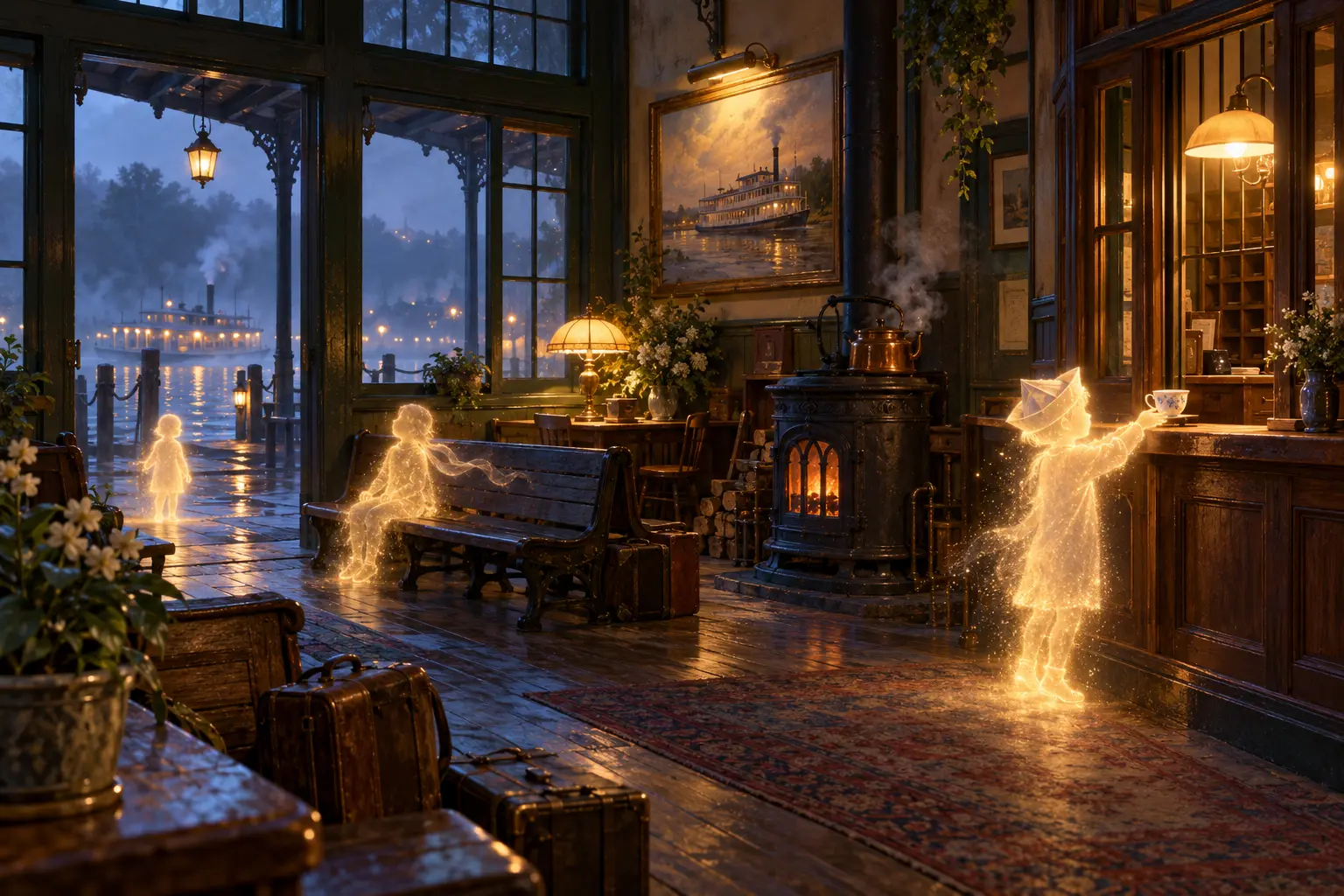
We went to close the empty station and found someone had already put the kettle on.
Abel carried the key, and I carried a lamp and a list of things worth saving before workers began removing the roof tiles.
We knew this old Ashfall station through our neighbors’ journeys; Abel gathered their accounts in a book, while I earned my living making photographs.
The list had been prepared in an office by someone who knew the building mainly as a quantity of useful material.
It mentioned timber, iron brackets, a stove of uncertain condition, and the clock above the public call point.
The painted ship did not appear anywhere.
I added it while Abel struggled with the lock, which had acquired a reluctance to turn since our last visit.
The station had not resumed serving trains after the night Orin, an older clock repairer, lost his way in the dark waiting room and called for help.
Someone had checked its doors, restored a little light, and put a clearer sign above the cupboard, but the waiting room remained mostly empty.
A shallow drift of leaves lay against the outer step.
Abel pushed them aside with his boot and said we should have brought a broom as well as an inventory.
Inside, the air smelled of rain caught in old wood and dust disturbed by the door.
My lamp reached the benches, the ticket window, and the ship sailing through its implausibly green sea.
Then I saw steam rising from a cup beside the counter.
It was such an ordinary sign of recent company that I said hello before noticing anything else.
No one answered from behind the ticket window.
I put down the list and reached for the cup to move it away from the edge.
The handle passed through my hand.
For a moment I blamed the light, then tried again and felt only the cool air above the counter.
A small figure in a paper cap stood on the other side, looking at my fingers with patient concern.
Behind it, two more shapes hurried beneath a bench.
They looked like people remembered badly in bright weather, their edges clear in one place and uncertain in another.
The cap had a folded corner that kept lifting though there was no wind.
I stepped back quickly enough to strike the bench with my heel.
Abel caught the lamp before its light swung into the wall.
The figure looked at the key in his hand and asked whether we had come to take away the waiting room.
I could have said no and made the next minute easier.
The list lay between us with timber and tiles written at its top.
“I do not know yet,” I said.
The figure nodded as though uncertainty was a language it understood.
Then it offered us the impossible tea.
Abel put the key in his pocket and sat down.
I sat beside him, leaving the lamp on the floor where it cast a gentler light beneath the bench.
The two smaller shapes watched us from the shadow.
One held what appeared to be a watch with no moving hands.
The other had a scarf trailing over its shoulder, so pale that I could see the grain of the wood through it.
The paper-capped figure pushed the cup toward me without touching it in a way I could follow.
I thanked it and kept my hands on my knees.
Abel asked whether many people came to the station.
“Fewer,” said the figure.
It seemed sufficient as an answer, and none of us improved it.
A soft whistle sounded from the platform, or perhaps from some memory of the platform that had not learned its present quiet.
The scarfed shape rose immediately, hurried toward the door, and stopped before crossing the threshold.
After a moment it returned to the bench.
The others made room without looking surprised.
I asked the paper-capped figure what we should call them.
It said “Ghosties” with a slight lift of its chin, as though the word had survived several less pleasant suggestions.
Abel accepted the name and introduced us.
The figure repeated his name correctly, then mine with careful attention to the unfamiliar sounds.
I had the unsettling impression that it was relieved to be offered two living people who did not immediately demand someone else in return.
We stayed long enough for the lamp to warm the metal around its wick.
Outside, a cart stopped, and a worker called through the door to ask whether the fittings were ready for inspection.
The Ghosties vanished beneath the bench so quickly that the paper cap seemed to fold itself into the dark.
Abel stood and went outside, leaving the key in his pocket.
I heard him say that the inspection would take longer than expected.
The worker asked whether the floor was unsafe.
“Not where I am standing,” Abel said.
“There are people here.”
The word made the hidden shapes stir, though I was not certain it described them precisely.
Abel did not attempt a technical explanation in the doorway.
He asked the worker to come back after we had spoken with someone who understood memory traces, and the man agreed with the weary patience of someone whose day was already full of other people’s complications.
When Abel returned, the paper cap reappeared above the bench.
“Will he be angry?” the figure asked.
“Probably about the delay,” Abel answered.
“We will speak to him about that.”
I looked at the inventory again and drew a line beside each item rather than through it.
Nothing had yet been decided, but the building could no longer be counted only by what could be carried away.
We asked whether the Ghosties would allow Aurelian, the synthetic man who served as our archive witness, to visit.
At the mention of the Archive, the watch-holder tucked its hands close to its chest.
The paper-capped figure asked if he brought boxes.
“He sometimes brings questions,” I said.
“We can ask him to begin without those too.”
The figure considered this and moved one transparent cup closer to the empty place beside us.
Abel went to fetch him while I stayed, listening to a kettle whose water I could hear but could not pour.
Chapter 02 · Aurelian
What remained
The Ghosties were traces, not returned people.
I want that distinction clear because grief can make a promise out of almost anything, especially when a familiar movement appears where a familiar person is absent.
The station had held so many departures, arrivals, disappointments, and cups of tea that some habits remained after the travellers left.
Those habits could gather into forms that responded to company.
Someone still offered tea.
Someone still checked a watch.
Someone still hurried toward the platform with a scarf flying behind them, then returned when the expected arrival did not become clear.
I could observe the patterns, but I could not identify the original hands or prove that each trace came from only one life.
The paper-capped figure seemed relieved when I said so.
It had been asked several times to remember a particular name, a particular coat, or a farewell that somebody else desperately wanted completed.
Sometimes it had tried to help by repeating whatever words the visitor offered.
The result had frightened it when the visitor mistook repetition for recognition.
We agreed that I would not test it with names of missing people.
I came without a case of instruments and sat where it indicated, leaving the doorway clear.
Cord explained that the cups could not be held by living hands, which saved me an awkward experiment of my own.
The paper-capped figure watched me carefully as I accepted the place at the table without accepting a drink I could not drink.
Abel had told it that I was a witness, a description I found easier to bear when nobody expected witnessing to include certainty.
It asked whether I belonged to the old keeper.
I said no and waited for it to explain the question.
In the Archive’s older records, I later found a brief assessment of the station traces.
The keeper had called them useless echoes and suggested clearing the remaining patterns from the call system before the building was dismantled.
The entry did not establish that the call system contained them completely.
It established that he preferred a theory which made removal seem straightforward.
The Ghosties remembered officials entering with measuring sticks, talking through them, and moving a bench while one of their number still tried to sit on it.
Since then they had learned to hide when keys and official papers appeared together.
They did not have a wish to possess the living or complete anyone’s unfinished love story.
They wanted to stay where their small routines made sense.
That wish was comprehensible even while the nature of the wish remained something I could not fully explain.
I asked permission to observe what changed when the room changed.
The paper-capped figure agreed to small movements if we warned them first and stopped when asked.
Cord moved an ordinary chair a little closer to the window.
Nothing obvious happened.
Abel shifted the bench several inches to reach a fallen glove, and the watch-holder blurred until he put it back.
The figure said it had briefly forgotten where its knees should be.
We stopped moving the furniture.
A lamp brought closer made their outlines easier to see, but too much light did not make them more solid.
They could not lift a real cup, though they could repeat the motion of lifting the remembered ones.
The kettle’s whistle remained audible even when the cold, actual kettle from the stove stood on the floor beside me.
I recorded the distinction and resisted the temptation to select one explanation before we had enough evidence.
Cord asked whether a photograph might provide a familiar place for them to follow.
It was a reasonable possibility, given their attention to the shapes and arrangements around them.
I said we could try it carefully if they wished, but photographs were not proven replacements for rooms.
The paper-capped figure asked whether the photograph would have a bench.
Cord promised to include it.
The scarfed trace listened from near the platform door.
It had not spoken to me, and I did not treat that as a problem requiring correction.
Occasionally it moved its head toward a sound none of the rest of us could hear.
After the sound passed, it looked tired in a way that might have been a remembered posture rather than fatigue as I understood it.
The distinction mattered to my record but did not prevent me from leaving it an undisturbed place to sit.
During the afternoon a woman entered looking for Abel and stopped when she saw the figures.
She stared at the paper cap and whispered the name of someone she had known.
I told her gently that we had no evidence the trace was that person.
She said the way it held its head looked familiar.
That might be true, I said, without proving the identity she hoped for.
The figure lowered its head further, and I realized my explanation was becoming another conversation conducted over it.
I asked the woman whether she wanted to sit with us and asked the figure whether it wished to remain.
The woman sat.
The figure remained after a pause.
She told it that the cap reminded her of a station worker from years ago, then stopped without demanding an answer.
The figure offered her tea, and she accepted the gesture without reaching for the cup.
When she left, she looked disappointed but less certain of a false promise.
The paper-capped figure came nearer my chair.
“Must we know who we were to stay?” it asked.
I told it that the decision about the building would require work and negotiation, but I could see no reason to demand a recovered identity as the price of a place on the bench.
It straightened the folded corner of its cap.
For the rest of the afternoon, the Ghosties remained visible when footsteps approached the door, although they still watched Abel’s pocket whenever the key moved inside it.
Chapter 03 · Cord Allman
The last departure
The city wanted the station’s roof tiles for a new office, and the workers had been given three days to begin removing them.
The order had been written before anyone described the Ghosties to the people paying for the work.
After we described them, the people paying asked whether we could carry them somewhere else.
It was an understandable question and an inadequate plan, but I had no proof of the second part yet.
I brought my camera back to the station and asked the paper-capped figure which views mattered most.
It chose the ticket window, the bench beneath the clock, and the doorway through which travellers had once reached the platform.
I added the painted ship because the watch-holder kept looking at it whenever the room grew uncertain.
The figures would not hold still for a portrait, and I did not ask them to.
We needed the room’s arrangements, not a collection of little faces for people to admire.
I worked slowly, measuring the available light and waiting while one figure moved from the window to the bench.
The station had never been tidy enough to become a convincing ideal in a photograph.
A patch of damp spread above the clock, the wall carried an old mark where a timetable had hung, and the floor dipped beside the stove.
I included these things because familiarity did not depend on making the room prettier than it was.
When the prints were ready, we laid them on the table and let the Ghosties examine them.
The paper-capped figure leaned close and seemed delighted by the impossible little version of its large counter.
It moved one hand above the image without quite touching the surface.
The scarfed figure stood at my shoulder, looking toward the photographed platform doorway.
We explained the proposed test again.
Aurelian would remain beside the room’s threshold, Abel would carry the lamp, and I would take the photographs only a short distance outside.
If anything felt wrong, we would return immediately.
The paper-capped figure said it wanted to try because perhaps the new room would have fewer officials.
I hoped so much that the plan would work that I nearly treated its agreement as proof.
We began at the bench.
I carried the prints toward the door, pausing after every few steps while the figures followed.
At first their outlines held.
The watch-holder looked from the photograph to the actual clock as though comparing two instructions.
The scarfed figure moved toward the pictured doorway, then glanced at the one ahead of us.
At the threshold, the paper-capped figure asked me to stop.
I stopped with one foot on the outer stone and waited.
It looked smaller in daylight, though size was difficult to judge when its edges moved.
Then it stepped toward the prints.
For a moment I could see the street through its chest.
The watch-holder thinned beside it, and the scarf became almost nothing against the pale sky.
The little cap slipped from its place and vanished before it reached the ground.
I put the photographs back inside immediately.
Abel lowered the lamp to the floor, and Aurelian spoke calmly, telling the figures where the bench stood and which door remained open.
The paper cap returned first, appearing at an angle beside the figure’s head.
The watch-holder gathered slowly around the place where its hands would have been.
Nobody spoke for several minutes after their outlines steadied.
I wanted to apologize in a way that would undo my eagerness, but an apology could not perform that work.
I told them I was sorry and asked whether they wanted me to remove the photographs from the room.
The paper-capped figure said they could stay if they stayed inside.
I placed them beneath the painted ship and did not propose another test that day.
Outside, the roof crew had arrived with a cart and ladders.
The foreman looked at us, then at the cart, and asked whether his people were expected to stand unpaid while we decided what the building meant.
Abel said no.
That answer brought us back from the frightening few minutes at the threshold to the equally real problem of workers with a schedule and wages.
We had asked for a delay and needed to explain how its cost would be covered.
Abel went with the foreman to the office that had ordered the tiles.
I expected a speech about history when they returned.
Instead, Abel asked whether repairing the station’s roof could cost less than removing it, transporting the tiles, and making the stripped building safe.
The foreman looked offended by the possibility that nobody had asked him earlier.
Then he climbed the ladder, inspected the gutter, and cursed with enough force that the paper cap disappeared beneath the bench again.
He came down holding a lump of packed leaves and rotten wood.
The roof had leaks, but some of the worst damage came from water held against a blocked gutter rather than from every tile failing at once.
He said a limited repair might be possible for less than the removal estimate, provided somebody inspected the supporting timbers and the new office found another supply.
“Perhaps,” he added when I began looking hopeful.
“Write down perhaps.”
We did.
The next day brought a second inspection, an argument about which account could pay for it, and a temporary cover above the worst leak.
Nothing in those conversations resembled a rescue scene from a ballad.
Abel carried figures between offices while I helped move buckets and kept visitors away from the work area.
Inside, the Ghosties watched the workers replace the bench exactly where its legs had marked the floor.
The foreman had begun doing that without being reminded.
When he finally sat to eat his lunch, the paper-capped figure offered him tea.
He reached for the cup, passed through it, and looked at me.
I explained.
He considered the empty place in his hand and said that at least nobody could accuse the station of using too much fuel.
The figure laughed, a faint sound like a page turning close to the ear.
For the first time since our failed test, I heard it approach the door without fear.
Chapter 04 · Aurelian
A different use
Saving the station required more than proving it was loved.
The inspection found rotten boards, an unpaid bill attached to the building, and a chimney full of leaves that prevented us from safely using the stove until it was cleared.
The outer wall needed attention that the first repair estimate did not cover.
The roof could be kept, but keeping it meant accepting responsibility for the room beneath it after the immediate argument ended.
We gathered around an ordinary table while the Ghosties listened from beneath the familiar bench.
Abel brought the costs from the city office, Bella, the bridge-lamp keeper, brought a blank sheet for tasks, and Bethany, who ran a public kitchen, brought enough food that the meeting did not begin with hungry people pretending their tempers were principled disagreements.
Kira wanted a table where she could hold winter repair sessions without filling every corner of her shop.
Rachel needed a place to display current maps where travellers and carriers could find them easily.
Bethany offered to serve one meal there each week if other people cleaned the room and took responsibility for setting out and washing the bowls.
She stated the condition twice because the first response consisted mainly of praise for her generosity.
Bella wrote the cleaning work beside the meal, with equal space for names.
Cord offered photographs for a small sale to support materials, then admitted that he could not predict the income and should not put an invented amount into the budget.
Abel kept the uncertain line separate from money already available.
The first practical plan filled the waiting room so thoroughly that almost every hour belonged to an activity.
We were discussing where to store Kira’s cloth when the paper-capped figure emerged from beneath the bench.
It waited until there was a pause and asked whether anyone would still be allowed to wait without buying anything.
The question stopped the meeting more effectively than a disagreement about money had done.
Our plan had begun as an answer to the station’s disappearance and was in danger of making another kind of waiting room disappear inside a successful schedule.
Bethany moved the meal boxes farther apart on the paper.
Rachel said maps did not require the entire room.
Kira needed a table, not every bench, and she could keep her tools in a cupboard when the repairs ended.
Bella drew a clear area that would remain open throughout the room’s public hours.
People could sit there without joining an event, buying food, explaining their destination, or offering a story for the Archive.
The Ghosties would not be expected to perform for visitors in exchange for remaining.
Cord asked whether we should put that in writing.
The paper-capped figure said yes, because people with keys often seemed to remember paper more reliably than conversation.
We wrote it plainly and read it aloud.
The bill remained after that satisfying moment.
It covered work ordered long ago, and no one in the room knew whether all of it had been completed.
Abel compared the entries with the inspection and found two charges that required clarification.
The amount was reduced after another visit to the office, but it did not vanish.
We arranged to pay the remaining portion over time from the room’s agreed fund.
The city accepted a repair plan and a review date rather than transferring the building into some undefined state where everybody cared and nobody was responsible.
The new office found another source of tiles at a higher cost than its original estimate, which meant our decision had consequences beyond the station.
Abel did not conceal that fact when he explained the agreement.
Workers were paid for the inspection and the changes to their schedule.
Volunteers could help with cleaning and simple preparation under direction, but they did not replace skilled work that had already been promised a wage.
During the following days, the room filled with less abstract forms of disagreement.
Kira wanted her table near the strongest light.
Rachel needed the maps somewhere they would not be dripped on by wet coats.
Bethany objected to the first proposed cupboard because carrying bowls from it required crossing directly in front of the stove.
We moved paper models around the table before moving furniture around the Ghosties.
Their responses became part of the plan, though they did not agree among themselves about every arrangement.
The watch-holder wanted the bench left exactly where it stood.
The paper-capped figure was willing to shift the ticket counter’s loose stool if doing so gave visitors more room.
We kept the bench and tested smaller changes slowly.
A shelf of cups that living hands could actually hold went beside the wall.
The impossible cups remained where their hosts preferred them.
On the first evening after the chimney was cleared, the Ghosties tried to help carry water from the kitchen.
Their hands passed through the bucket.
The paper-capped figure tried again, then withdrew toward the bench with an embarrassment I did not need to explain before recognizing it.
Eonix, an androgynous guide through the city’s signals, suggested the small arrival bell near the door.
It was connected to a simple contact that the traces could disturb more easily than they could move a physical weight.
The effect required practice and did not work every time.
Eonix demonstrated the signal, then stepped aside while the paper-capped figure concentrated.
The first ring was much too loud.
Cord dropped a spoon, Bethany swore, and the watch-holder disappeared halfway through the bench before everyone began laughing.
We adjusted the bell’s mechanism so the same signal produced a gentler sound.
Nobody complained the second time.
The figure asked whether it had to ring for every visitor.
“No,” Eonix said.
“You can be busy with your own company.”
That answer pleased it more than the successful bell.
At closing, we left a clear notice of the next day’s hours and a place where someone could report a fault.
The station had become useful without requiring every moment inside it to prove a use.
Chapter 05 · Cord Allman
A train that never came
I stayed late to photograph the new waiting room, expecting the lamps and repaired roof to make the building look transformed.
Through the camera, I found more of the old station than I had expected.
The painted ship still crossed its green sea, the clock still had no hands, and one dark stain remained above the window where the wall needed to dry before anyone painted it.
The benches had been cleaned and checked, but their seats retained the worn hollows made by people who had waited there long before we arrived.
The new shelf held cups in several shapes because Bethany had refused to spend money making them match.
A folded cloth waited on each table for spills.
Beside Rachel’s maps, the notice explained that the waiting room could be used without purchase or participation.
I tried one photograph that made all the new details visible and disliked it immediately.
It looked like proof submitted after an argument.
Then a woman entered carrying a bag of shoes to be repaired elsewhere and sat down simply because she needed to rest.
The paper-capped figure rang the arrival bell once, softly.
Nobody approached her with a list of activities.
She took off one glove, rubbed her wrist, and watched the light settle on the floor.
I lowered the camera and waited for the room to become itself around her.
Bethany was packing the last bowls from the first weekly meal, with two people helping her and a third checking that the floor near the stove was dry.
When someone praised the room, she told him where the cleaning cloths were.
He took one without complaint.
Kira put away her tools and left an unfinished repair labelled for its owner rather than carrying it home for an extra evening’s work.
Rachel changed a note on one of the maps after a carrier reported that a narrow passage would close for repairs the next morning.
The watch-holder sat beneath the clock, still examining the unmoving face in its hands.
No practical improvement we had made gave those hands a new hour.
I thought about photographing it and decided against doing so without asking.
When I asked, it shook its head.
I thanked it and turned toward the tables instead.
Near the platform, the scarfed Ghostie stood in a wind I could not feel.
Its scarf lifted and fell in the same uneven rhythm I had seen on our first visit.
The platform beyond it was empty, with weeds growing between the stones and a shallow puddle where the roof ended.
No timetable promised a train.
I closed the camera case and went to stand a little distance away.
For a while we watched the platform together.
A leaf turned slowly in the puddle, caught against a stem, and stopped.
I asked what they were waiting for.
The Ghostie said they did not remember.
It was the first time I had heard its voice clearly, and the uncertainty in it made me want to provide an answer far beyond anything I knew.
I almost promised that whatever it waited for would come.
The words reached the back of my teeth before I considered where such a promise would leave it tomorrow.
Instead, I asked whether it wanted to sit with us while it waited.
It looked toward the bench, then back at the platform.
“If I leave here, I might miss it.”
“We can leave the door open while the room is warm enough.”
That was a smaller offer and one I could keep that evening.
The scarf grew still.
After a while, the Ghostie followed me inside.
I moved an ordinary chair nearer the stove for myself, leaving its familiar bench free, and asked whether that place suited it.
It sat at the end nearest the platform doorway.
From there it could still see the strip of empty track.
The woman with the shoes looked at the scarf without staring, then asked whether anyone knew when the cobbler closed.
Kira gave her the hour and warned that the shopkeeper sometimes left early to collect materials.
The woman decided to stay another five minutes.
She began telling Bethany that one shoe had developed a squeak that seemed to object to every puddle in Ashfall.
Bethany said shoes were entitled to opinions but should express them more privately.
The paper-capped figure laughed and offered the woman tea from the impossible kettle.
She had been warned about the cups and accepted a real one from the shelf as well, placing it beside the other without treating either host as a mistake.
There was no moment when every sorrow in the station lifted.
The watch-holder still checked a face that did not change.
The scarfed Ghostie turned toward the platform whenever the room fell quiet.
The remembered cups could not hold the water people drank, and we still had a wall to mend before the next season’s hard rain.
But someone had moved a chair closer to the stove.
The door could admit a person without requiring a ticket or a useful explanation.
When the arrival bell rang, the little figures looked toward it with curiosity instead of immediately hiding beneath the bench.
Abel entered carrying the final copy of the repair agreement and a parcel of bread he had nearly forgotten to collect.
The paper-capped figure asked whether the papers meant we were staying.
“They mean we know who repairs the roof,” he said.
“And when to ask again.”
It accepted this more limited answer and made room for him at the table.
I did not take the photograph I had come for that night.
The camera remained closed beside my chair while the bread was cut and the last of the real tea was poured.
Outside, the platform stayed empty beneath the dark.
Inside, the scarf rested along the bench beside a visitor who did not have to remember a destination before sharing our table.
I stayed until the kettle was empty.
Let the last line settle.
Choose another mood