
Chapter 01 · Cord Allman
A line through water
Rachel drew a road home on every map, including the one that proved hers was gone.
I found her at a table covered with stones used to hold the paper flat, working through the afternoon noise of the Archive’s open front room.
Rachel made maps of Ashfall, I made photographs, and Aurelian, the synthetic man who served as the Archive’s witness, kept the sources we brought him.
Somebody was asking about a parcel, somebody else needed a record copied, and the door kept admitting a draught that lifted every unsecured corner.
Rachel had arranged her stones so precisely that none of the movement disturbed her drawing.
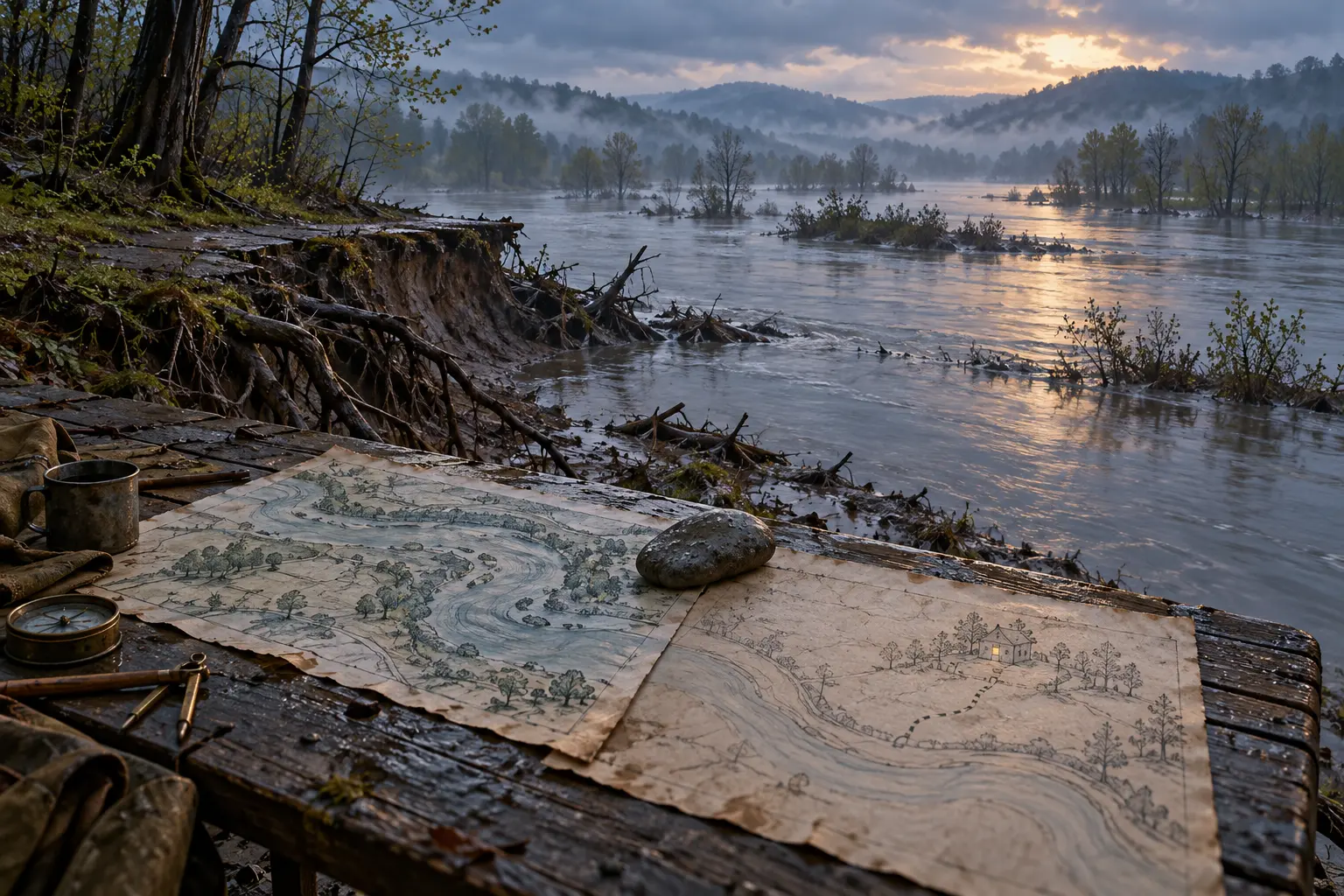
She was tracing the river’s new edge.
The water had taken a row of houses after a bank collapsed in spring, in a part of Ashfall where the old path ran close enough to the bend for people to hear boats passing from their kitchens.
The houses had been empty when they fell.
Their former residents had moved away over several years as the roofs worsened and the ground became difficult to trust.
No lives had been lost in that collapse, a fact the notice from the survey office stated clearly and thankfully.
Rachel had copied that sentence into the margin of her working sheet.
Beneath it, she had drawn the exact shape of the missing ground.
On the older map beside her elbow, a path led to a small square near the bend.
On the new one, the path stopped halfway through.
She kept bringing the pencil toward the place where the square should have been, then lifting it before it touched the paper.
I asked whether she needed another measure of the shore.
She said the measure was correct.
I had brought photographs of a stairway farther upstream, taken for a practical survey, and I offered to put them aside until she wanted them.
She reached for the envelope because the task was easier to discuss than the empty space in front of her.
We compared the height of a retaining wall in two prints and found that a loose board had made the older one misleading.
For ten minutes she was entirely herself as I usually knew her: exact, impatient with vague descriptions, and capable of seeing a mistake that had escaped three other people.
Then she turned back to the river map and carefully folded the older sheet.
I recognized the care people use when a thing is trying to become a relic.
“Was that where you lived?” I asked.
She nodded without looking up.
The small square had represented a house with a kitchen window facing the water and steps polished unevenly by generations of wet shoes.
She had moved away long before the bank fell.
The people who stayed after her had eventually found better rooms elsewhere, and the last furniture had been carried out before the final winter.
She had helped move a table and had complained that its legs caught on every doorframe.
There was no unfinished rescue to imagine.
Knowing that made her grateful.
It did not make the square easy to erase.
A man from the ferry office arrived to collect a clean version of the revised path.
Rachel placed her folded older map beneath a blank sheet before speaking to him.
He asked whether walkers could still reach the bend from the southern stair.
She showed him the unstable section and explained that the route needed a barrier until someone qualified to assess the ground had checked it again.
He said people had used that path for years.
“Yes,” she answered.
“That is why they need to be told.”
He looked at the sheet, then at her, and asked if the warning could be drawn less prominently because it covered part of the familiar route.
Rachel’s hand tightened around the pencil.
“The familiar route is the part that is missing.”
There was enough sharpness in her voice that he apologized, though I was not certain he understood what else he had touched.
She softened the explanation without softening the warning.
The ferry office could post an older map for historical interest if it clearly marked the date, but directions for current travel had to show the bank as it stood.
He agreed to take the safer route notice and left with the paper rolled inside a tube.
Rachel waited until the door closed before putting the pencil down.
I asked whether she wanted a walk.
She said she had already walked the shore twice that week for the measurements.
I said I meant any walk she did not have to turn into a drawing.
She almost smiled.
“I would still turn it into one.”
We settled for moving to the window with two cups of water.
The square outside contained a stall whose owner had shifted it three paces since Rachel last marked the market layout.
She noticed immediately and accused him, from a distance, of making work for her.
It was a small joke, but it brought her back into the room enough to ask what I had been photographing that morning.
I told her about a doorway with five different repairs in its frame and a woman who refused to stand in front of it because she said the doorway could speak for itself.
Rachel approved of the woman.
Then she asked whether a photograph could show where something had been without pretending it remained there.
I said sometimes, if the caption was honest and the person looking knew what they were being shown.
She looked toward the folded map on the table.
“I do not want to keep sending people into the water.”
I told her I had not thought she would.
“No,” she said.
“But I keep sending myself there.”
We stood at the window until the cups were empty.
When she returned to the drawing, she completed the new river line in ink, leaving the older map folded beneath her hand.
Chapter 02 · Aurelian
The last crossing
Rachel remembered the path to the house in distances that did not match any scale.
It was three songs from the ferry to the door if she sang at the pace she remembered, and one argument shorter if she walked quickly.
As a young person she had wanted nothing more than to leave, and she disliked the possibility that mourning the house might allow somebody to rewrite that impatience as a mistake.
She had wanted work that would take her beyond the bend, beyond people who knew which window belonged to her family, and beyond a room where every object had already acquired an opinion about where she should put her hands.
The kitchen table was good for eating and poor for drawing a large sheet.
Someone always needed the space just as she reached the difficult part of a map.
She would lift her papers, complain, and return later to find a ring from a cup precisely where she had marked a road.
The memories made her smile and then frown, because she feared affection would make the old frustrations seem less true.
We talked at the Archive table with the older map open between us.
I had not seen her childhood home when it stood, and I did not offer observations that belonged to a life before my own.
She showed me where the ferry landing had been, where she used to take a shortcut, and where an older neighbour had once persuaded her to carry a bucket by claiming that it lay directly on her route.
It had not.
She had corrected his directions so thoroughly that he asked her to draw them for him.
That was one of the first times she understood a map as something another person might need.
Later she marked roads outward in bright ink.
One went to a surveying workshop, another to a market where instruments could be bought cheaply if she could distinguish the sound ones from the decorative ones.
The lines crossed the little house square as though it were only their starting point.
She remembered being delighted when her first paid assignment required a bag packed for several nights.
Her family worried about the weather and the quality of the place where she would sleep.
She worried they would keep discussing those things until she missed the ferry.
Neither concern cancelled the other, though she had not had the patience to see that then.
On her last visit while the house still held furniture, she said she would come back soon.
She had meant it in the vague way that people mean a future they have not put on a calendar.
Work grew busy, then changed, then gave her another route to learn.
The people in the house moved elsewhere, carrying the useful things and arguing about which damaged ones still deserved the effort.
Rachel helped move the table through the narrow door and scraped her knuckles against the frame.
She remembered that annoyance vividly.
She could not remember whether she had looked at the kitchen window before leaving.
The omission troubled her more than she thought it should.
“I should have known it was the last time,” she said.
I asked how she could have known.
She looked at the map rather than at me.
There had been another visit after the furniture was gone, when she came to check a boundary measurement for the row.
She had stood outside, noted the sagging roof, and decided not to enter because the floor might be unsafe.
That decision was sound.
It also meant there was no final scene inside the kitchen that she could arrange into a satisfactory farewell.
Eventually there was no practical reason to return.
The house did not call her to repair it, and nobody she loved waited behind its door.
When the bank fell, she heard the news from a person discussing diverted paths and salvage rather than from somebody who understood what the square on her map meant.
She was ashamed of mourning a place she had allowed to become empty.
The word “allowed” appeared several times in her account, carrying more responsibility than she had ever possessed over the building or the river.
I asked what she thought she should have done differently.
She proposed repairing the roof, then admitted the walls and ground had needed work as well.
She proposed visiting more often, which might have given her more memories but would not have supported the bank.
At last she said she did not know.
I told her the record did not require her feelings to agree with her choices.
She asked whether that was something I had learned from Cord.
I said he had provided a great deal of evidence.
She laughed, and the laugh loosened something in her shoulders.
Then she drew the kitchen table on a separate piece of paper, making it too large for the scale because its size was part of what she wanted to remember.
We did not correct it.
She added the window, the stove, and the place where a chair always caught against an uneven board.
When she could not remember which side of the door held a hook, she left two small pencil marks and wrote a question beside them.
I asked whether she wanted me to search old photographs for an answer.
“Perhaps later,” she said.
“For now I want to know what I remember.”
That distinction changed the work.
We were no longer trying to restore a building precisely enough that she could pretend to enter it.
We were making room for the particular kitchen she carried, including the uncertain hook and the table that occupied too much space.
Before she left, she unfolded the old route map completely and smoothed its creases with the side of her hand.
She asked me to keep a place for it beside the new survey, rather than beneath it.
I moved the other records and gave both sheets enough room to lie flat.
Chapter 03 · Cord Allman
What the river left
Rachel asked me to go with her to the bend on a morning when the sky looked undecided about rain.
She did not want photographs.
I left the camera in its case at the Archive, then checked my empty shoulder twice on the way out because the absence of its weight felt like forgetting something necessary.
Rachel noticed and asked whether I would survive an entire morning without carrying a rectangle in front of my face.
I said it would depend on how picturesque she intended to be.
She told me to bring boots that could tolerate mud.
We took the open road above the bend and followed the route the survey workers had marked as safe.
Rachel read the new notice by the stair, checked that its date was visible, and straightened one corner where the paper had curled in the damp.
The lower path disappeared behind a barrier.
Beyond it, a piece of fence leaned toward water that had formerly lain several paces farther away.
The river looked unremarkable from a distance, which seemed unfair given how much of the land it had taken.
At the approved access point, we descended to a strip of firm ground above the wet margin.
Rachel tested each step with care and told me where the survey team had found soft soil.
She did not become reckless because the missing house mattered to her.
If anything, she was more exact than usual, keeping the boundaries in view as though she feared somebody might use her grief as evidence against her judgment.
The bank smelled of wet roots and the mineral cold of stones newly turned toward the air.
Bits of wood had lodged among the reeds farther down, but most were too distant to reach without entering uncertain ground.
We did not attempt it.
Rachel stood looking at the bend with her hands inside her coat pockets.
From that angle I could see where the row must have stood, though I would not have known which part belonged to her without the map.
She pointed out the former stair and the place where the house nearest the ferry had projected slightly ahead of the others.
Its owner had disliked children cutting across the step.
“We did it anyway,” she said.
“Did the shortcut save much time?”
“Almost none.”
That pleased her enough to make her smile.
We searched the accessible edge for a while, not with the urgency of people rescuing valuable things but with the particular hope that an ordinary object might recognize its owner.
I found a hinge half covered in silt.
Rachel examined the shape and shook her head.
The hinges from her kitchen door had been larger, with a ridge along the outer plate.
A strip of painted wood lay nearby, but its colour belonged to another house.
Then she uncovered the handle of a cup and worked the mud away carefully enough that I assumed she had recognized it.
She held it up, turned it once, and let out a breath.
It was not hers.
None of the objects came from her house, as far as either of us could tell.
She was disappointed and then embarrassed by the disappointment.
“Somebody else lost these,” she said.
“I know.”
“I should not be disappointed that they belong to somebody else.”
I asked whether we should place them where the salvage workers could find them without searching the same patch again.
The useful question gave us something to do while the feeling passed through its first sharpness.
We carried the hinge, the wood, and the cup to the marked collection area and wrote where we had found them.
Rachel added that we did not know their owners.
She disliked the temptation to turn a guess into provenance merely because it would make an object more interesting.
Afterward she searched a little longer.
I stayed within calling distance, examining the stones and occasionally asking whether she wanted water.
At last she stood beside the river with both hands empty and began describing the kitchen window.
Morning light had struck the far wall before reaching the table.
A pale rectangle moved across the plaster while the rest of the room remained cool, and her younger self had hated getting up early enough to see it.
In winter, somebody breathed on the glass and drew a shape in the mist with a finger.
The shape changed according to who arrived first.
Rachel usually drew a road and was accused of having only one idea.
She described the sound of a spoon against a cup, the smell of a damp coat near the stove, and the argument about whether the table should stand closer to the window.
Nobody had ever won that argument because moving the table solved one inconvenience and created another.
I could almost picture the room.
Then a small wave broke against the bank and brought us back to the water at our feet.
Rachel wiped her nose with the back of her glove and looked annoyed to discover that the glove was muddy.
I offered a cloth.
She used it, thanked me, and said she wished there were at least one object she could be certain of.
I had no way to make the river supply one.
After a while she bent to pick up a smooth stone near the edge of the path.
It was grey with a pale line running across it, worn by a history neither of us could trace.
She turned it in her palm and asked whether it was foolish to keep something that had never belonged to the house.
I said it would make a very good weight for a map.
She tried its balance on my open hand and decided it would.
We ate the bread we had brought while sitting on a dry ledge above the access path.
Rachel put the stone beside her cup and kept glancing at it, as though relieved that it required no claim larger than having been found that morning.
On the way home, she checked the warning notice again.
Then she took the upper road without looking back at every turn.
Chapter 04 · Aurelian
A map with two truths
We made two sheets, beginning with the one that could keep a stranger from walking into unsafe ground.
Rachel placed the latest measurements beside the new river drawing and checked each marked point against the survey notes.
Where an edge remained uncertain, she showed uncertainty rather than extending a clean line simply because the map looked unfinished without it.
The unsafe bank appeared prominently, along with the date of the survey and the instruction to follow posted changes on the ground.
This was the sheet the ferry office, carriers, and walkers needed.
It would help people arrive without being hurt.
The second sheet began with the small square of her house, drawn where it had stood before the collapse.
Rachel used pencil for the uncertain edges and ink for the parts supported by her older measurements.
Inside the square, she made a separate drawing of the kitchen, much too large to belong to the surrounding scale.
She connected it with a fine line and wrote that it was a remembered interior.
The hook by the door remained uncertain.
The morning light appeared as a pale wash that did not pretend to establish a precise hour.
This sheet would help her tell the story without asking the land to return.
I linked the two in the Archive so that someone looking at one could find the other.
Neither replaced the other.
Our first visitor to examine them was a ferry worker who had known the bend when several of the houses were still occupied.
He recognized a shed Rachel had omitted and offered to show her where it stood.
She gave him a pencil and asked what he remembered directly.
He marked the shed, then hesitated over a fence.
His account placed the fence farther from the water than her older survey did.
They compared the dates and discovered he remembered an earlier fence replaced before she measured the lane.
We kept both with their dates rather than forcing the marks to agree.
The visitor stayed longer than he had intended, telling Rachel about a place beneath the stair where he used to leave a spare pair of boots.
The boots mattered to him more than the shed, though no official map would have had a use for them.
Rachel drew a small mark and wrote his account beside it, after asking whether he wanted his name included.
A week later, she invited other people to mark places that no longer appeared on current maps.
We expected a few remembered buildings.
The first woman drew a patch of ground behind a shop where she had learned to ride a bicycle badly enough to knock over three buckets.
A man marked a tree that had shaded the doorway of his first room in Ashfall.
Another person drew a stall whose owner had allowed him to stand nearby when he did not have money to buy anything.
Some people wanted names attached to their memories.
Others wanted only the place and the account, and one visitor decided after talking that he preferred not to leave a written record at all.
Rachel thanked him for coming and handed his drawing back.
The map grew crowded.
A tree shared space with a demolished wall, and a shop existed beside two different versions of the street in front of it.
The sheet became too complicated to use for travel, which was acceptable because travel was not its purpose.
We wrote that fact on the cover in plain language.
A visitor still tried to use one of the remembered shortcuts to plan a delivery, so Rachel made the warning larger and put the current route map beside the entrance.
She did not blame him for wanting the simplest line.
She explained why the line no longer led where he needed to go, and he left with a usable copy.
During these sessions Rachel sometimes became tired before she admitted it.
People’s attachment to places could produce arguments over a doorway as fierce as any dispute about a living person.
One afternoon two neighbours insisted that the same bakery had stood on opposite sides of a corner.
After nearly an hour of disagreement, they realized they were remembering the business before and after it moved.
They laughed, then resumed arguing about which version had made better bread.
Rachel set her pencil down and went outside for five minutes.
When she returned, I had written both bread opinions without attempting to adjudicate them.
She approved and suggested that the Archive might survive by refusing to settle pastry questions.
The river stone held down the corner of her own sheet throughout the work.
People sometimes asked whether it had come from the house.
She answered no, explaining that she had picked it up on the morning she went to look at the new bank.
The distinction became easier for her to make each time.
It could belong to her account without belonging to the lost kitchen.
One evening, after the visitors had gone, she opened a fresh sheet for the road west within Ashfall.
The route passed through neighbourhoods whose stairs, alleys, and small crossings were difficult to summarize from older records.
She placed the current river survey beside it and began by marking what had changed.
I asked whether she wanted to stop for supper first.
She looked at the paper, then at the light, and decided she did.
Before leaving, she covered the memory map carefully but did not fold it away.
The kitchen window remained visible beneath the clear sheet, with its pale patch of morning light and its unresolved hook.
The road west waited on the next table, carrying a different kind of incompleteness.
Rachel put a date at its top before she wrote anything else.
Chapter 05 · Cord Allman
The road ahead
Months later, I asked Rachel how she knew when a map was finished.
She was trimming a copy of the western route with a knife and a straight edge, and she paused long enough to make it clear she considered the question dangerous.
“I do not,” she said.
“That sounds inconvenient for a mapmaker.”
“It is worse for a traveller who thinks otherwise.”
We were in the Archive on an afternoon when every open door seemed determined to slam, and Rachel had used the river stone to hold a corner flat while the ink dried.
I had come to collect a route through the western part of Ashfall, where older stairs joined narrow lanes above the lower ground.
She had surveyed it in sections, speaking with people who used the paths daily and adding notes where their knowledge corrected the older plans.
The finished sheet looked reassuringly clear.
That was the problem, she told me, before I had even admitted how reassuring I found it.
A clean line could make a difficult passage look simpler than it was.
A small symbol for stairs did not show whether those stairs became slippery after rain or whether a loose rail had finally been repaired.
Roads changed.
People built steps where a wall had been, closed a gate to mend a courtyard, or moved a market stall into a space that had once carried a direct route.
Floodwater found a way around a promise.
A useful map needed a date and somebody willing to revise it.
She turned the sheet toward me and pointed to three places where travellers should ask locally before continuing.
The first lay near a set of low stairs that collected runoff from the streets above.
The second used a passage that sometimes closed while deliveries were unloaded.
The third crossed ground whose drainage depended on a channel people periodically forgot to clear.
None required panic or an elaborate expedition.
All required listening to somebody whose feet had been there more recently than the ink on the page.
I asked whether she could mark an alternative for each.
She had already done so, but the alternatives could also change.
I felt an unreasonable irritation at this refusal to supply certainty after doing so much work.
Rachel saw it before I found a courteous way to express it.
“You want the paper to be responsible for the walking,” she said.
“I want to know where I am going.”
“You can know that and still ask about the next stair.”
I looked again at the route and tried to imagine meeting someone who contradicted its clear line.
I knew enough to say I would listen.
I also knew how easily I became attached to a plan once other people expected me to lead them along it.
Rachel made me repeat the instruction rather than merely nodding at it.
At the three marked places, I would ask locally before continuing, especially after heavy rain or visible changes to the ground.
If the account on the street disagreed with the map, I would stop and establish why.
She did not smile when I said it, as though we had completed a charming little exercise.
She gave me a pencil and showed me the blank margin where I could note a change without obscuring the route itself.
Then she asked me to help carry copies to the ferry office and the market noticeboard.
We walked together, and I watched her notice details I would have passed without recording.
A new step had reduced the height of a doorway threshold.
A shutter, when open, forced tall people toward the edge of a narrow path.
A drain cover had been replaced with one that caught the tip of a walking stick.
She did not try to put every observation on the main map.
Some belonged in maintenance requests, some in a spoken warning, and some only in the knowledge of the people who used that doorway.
At the market, a seller told her that one of the western passages had reopened that morning after repairs.
Rachel asked whether carts could pass or only people on foot.
The seller did not know, so she wrote the distinction as a question and said she would check.
I admired the ease with which she left the answer incomplete in public.
When I said so, she reminded me that I had seen her spend an entire afternoon unable to end one small path at the river.
We passed a shop displaying photographs of Ashfall before the bank collapse.
One showed the row of houses at the bend, taken from far enough away that the windows were only pale squares.
Rachel stopped and asked the seller if she might look closely.
Her house was there, but the kitchen window lay on the hidden side.
She bought a small print anyway, after checking its date, and put it in her bag without pretending it supplied what could not be seen.
Back at the Archive, she placed it near the memory drawing and held both under the lamp.
At the door I noticed the river stone resting on the corner of the kitchen sheet.
Rachel had added the window in pale yellow and moved the uncertain hook slightly to one side, still leaving a question beside it.
I asked whether the light was right.
She said it was close enough for remembering.
Then she returned to the current route and wrote the market seller’s report in the margin, marking it unverified until she could visit.
I rolled my copy carefully and put the pencil inside its tie so I would not forget it.
Rachel reminded me to mark anything that had changed along the road.
I promised I would.
Outside, the square appeared ordinary, every familiar entrance exactly where I expected it.
I carried the map with the pleasant confidence of someone who had been given good advice and had not yet been tested by the need to use it.
Keeping that promise would prove harder than making it.
Let the last line settle.
Choose another mood