
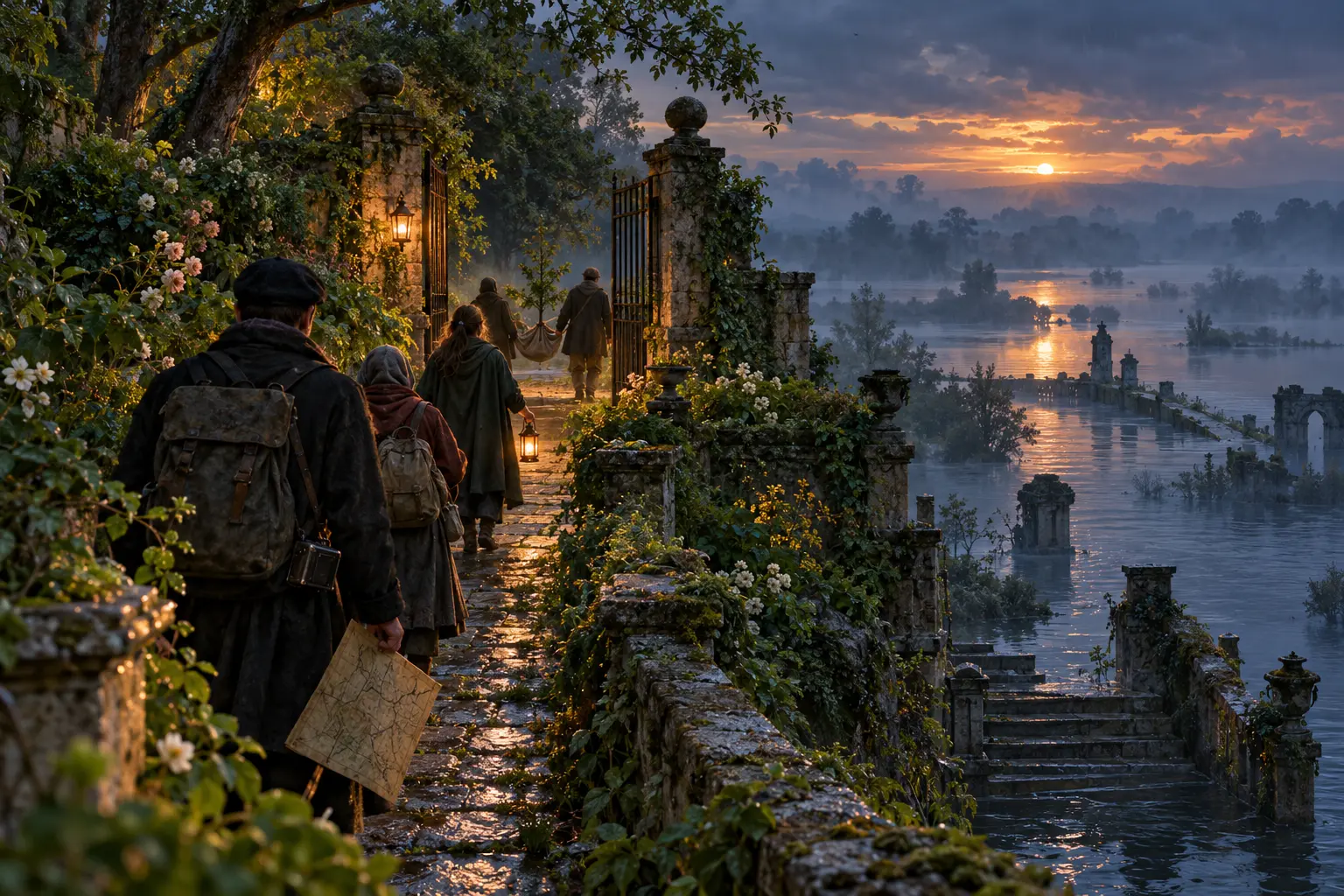
Chapter 01 · Cord Allman
The wrong confidence
I led them west with a map I trusted more than the people standing beside me.
After the flood, the high ground across Ashfall's western causeway seemed close enough to reach before dark.
We were moving west within the city, away from the drowned river quarter and the station that had sheltered us.
I was a human photographer, more practiced at keeping a view than choosing a road for people who needed shelter.
Aurelian, the synthetic man keeping our records, walked with us; neither his careful copies nor my photographs could tell us what the water had changed overnight.
From the shelter where we had spent the night, I could see a pale edge of roof beyond the low cloud and imagined the rooms beneath it waiting for us.
It was an easy picture to carry because it required nothing of the people already living there.
Rachel spread her map on a crate and pointed to three places where the route might have changed.
She had written the date in clear ink and left room for reports beside the older lines.
I looked carefully enough to remember the marks.
I did not look carefully enough to accept what they meant.
We left after breakfast with food in several bags and the young tree salvaged from the station suspended between borrowed poles.
Its roots were wrapped in damp cloth, and one green leaf moved against the grey of the morning.
Goliath, whose strength still required rest and another pair of hands, carried one end with another traveler while Spark, our blue-light companion, walked close enough to watch the folds for drying.
Their blue light could help us see a root without making it whole.
Kira kept the Ghosties' familiar objects together, moving the bench board, arrival bell, and painted ship in stages when the traces became too faint.
The Ghosties were memory traces bound to those objects, not the dead returned to travel beside us.
Bethany, who organized the meals we all depended on, checked the food before letting me take two bags.
She told me which held the driest bread and asked me to keep them clear of the wet ground.
I said I would.
At that point I still mistook an earnest promise for evidence that I would notice everything necessary to keep it.
My knee hurt from the bridge crossing.
I did not mention it because several people were carrying more, and I wanted to seem equal to the pace I had proposed.
Rachel walked beside me for the first stretch and asked whether I remembered the route through the old gardens.
I said I had photographed the terraces there years before.
She asked whether I remembered the drainage wall below them.
I remembered a view, a line of steps, and a certain late light on stone.
These were not the same as knowing which wall might have washed away in the night.
I answered that the map would help us find it.
She said the map would help us ask better questions.
At each stop, the people behind us needed longer than I expected.
Someone had to adjust a wet boot whose seam was rubbing.
A child needed a drink and then needed to be coaxed away from the cup because holding it felt better than walking again.
The cloth around the roots had to be checked, and the sling had to be shifted before one person's hands grew too numb to hold safely.
Abel, who recorded needs and refusals in his rain book, stayed near the back and called forward when the distance opened between us.
I would stop, turn, and tell myself I was being patient.
Then I would set off a little too quickly again.
I was afraid that an uncertain pace would make my uncertainty visible.
Near the first junction, a worker stood beside a cart with one wheel removed.
He was wearing a coat patched with a piece of sailcloth and had mud dried to the height of his thighs.
He watched the tree approach, then asked which way we meant to go.
I showed him the lower steps on the map.
He said they were gone.
I asked whether he meant the narrow stair beside the retaining wall or the wider one farther west.
He said the narrow stair and pointed directly at the place beneath my finger.
Rachel came closer so she could hear without making him repeat himself.
The worker said he had come along the upper route at dawn and seen the lower landing from above.
The stone had shifted, and water was cutting underneath it.
We should take the gardens, he said, even though they would add distance.
I looked at the old line on the map.
I could remember the steps clearly, broad enough in my photographs to look dependable, and I found myself treating that memory as another witness in the conversation.
I asked how recently he had seen them.
He stared at me for a moment before repeating that it had been this morning.
Behind us, someone coughed and shifted a load from one shoulder to the other.
Rachel told me we should use the upper route.
I said the lower path would save time if even part of the stair remained.
She said the worker had just explained that the approach was undermined.
I thanked him as though courtesy could finish an argument that I had not honestly considered.
Then I chose the shorter path.
I did not order everyone to follow in a grand voice.
I folded the map, took several steps, and let the fact of moving become the decision.
People who were tired, wet, and already depending on one another began moving after me.
That was enough power to do damage.
The lower path narrowed between a wall and the swollen water.
For a while it seemed to justify me.
The ground held, the western roofs appeared closer, and the turn toward the stair came where I remembered it.
I called back that we were nearly through the narrow part.
Then I reached the corner and saw empty air where the landing should have been.
The steps ended in broken stone above a muddy channel.
A whole section of wall had slid outward, leaving roots hanging from the exposed bank like cut ropes.
The route on the map continued across the space because the page had not been there to lose it.
I put down the food bags too quickly while trying to warn the people behind me to stop.
One caught against a jagged edge of stone and tore.
I grabbed for the cloth as bread rolled into the shallow water along the wall.
Bethany reached me in time to save part of the bag and nothing more.
Behind her the tree carriers halted, uncertain where they could safely rest their load.
Rachel told them to turn toward a sheltered recess before the wind took the cloth off the roots.
I stood with a torn bag in my hands and the worker's warning repeating in my head with exact, useless clarity.
By the time we saw the broken stair, turning back would cost us hours.
Everyone stopped behind me.
The silence was harder to face than an accusation.
Chapter 02 · Aurelian
What the map said
Rachel's map carried its limits in writing.
The date stood beside the scale, and a note advised travelers to follow current local reports where the flood had changed the ground.
Cord had read the note that morning.
He later asked me to record this plainly because he did not want his decision softened into a misunderstanding of the page.
At the broken stair, however, there was no time for a complete account of his motives.
The wind reached the roots of the tree, people needed somewhere to stand, and a torn food bag was releasing wet crumbs into the channel beside the path.
Rachel began with those facts.
She asked Cord to help move the tree out of the wind.
He offered to take the longest watch when we reached shelter that night.
She repeated her request.
The offer of a difficult future duty could not protect the roots in the present, and she refused to let him make his shame the next task everyone else had to carry.
He put the torn bag into Bethany's hands, moved to the sling, and followed Goliath's instruction about where to grip.
They shifted the tree into the recess without lifting it higher than necessary.
Spark tucked a loose cloth back around the outer roots.
One thin branch had rubbed against the stone wall during the halt.
Blueberry, a grown woman whose singing had often steadied us, placed a folded coat between the bark and the wall before it could rub again.
Abel counted the food with Bethany.
They separated what had stayed inside its wrapping from what had fallen into the dirty water.
Cord suggested cutting away the wet edges.
Bethany said the bread that had entered the channel could not be made clean by appearing less wet.
He accepted the answer, though I could see how much he wanted the loss to become smaller through effort.
They saved the wrapped portions and laid the rest aside where nobody would mistakenly pack them again.
The amount was small enough for us to survive and large enough to matter.
There would be less to share before we reached the western hall, if we found a hall willing to receive us.
A woman carrying a child's spare clothes asked why we had come this way after the warning.
Nobody answered for Cord.
He said he had trusted his memory and the old route more than the person who had seen the damage.
The woman looked toward the broken steps and then at the child beside her.
She said she had heard the worker clearly.
Cord said he had too.
That answer made the silence sharper for a moment, but it left her with the truth she needed to judge what had happened.
She moved to stand beside Rachel while the new route was discussed.
I recognized the comfort Cord had sought in the page.
Records can feel solid when the world will not stay still.
I have treated a complete entry as though it must be more trustworthy than a living account that pauses, corrects itself, or arrives with mud on its shoes.
At the Archive, that habit produces errors that can sit quietly for years.
On this path it had produced a tired group beside a missing stair.
Rachel laid the map across a flat section of wall and kept one hand over it against the wind.
She drew a heavy line through the broken route.
The correction was not a wound to the map.
It was the work the map now required.
We could not simply climb the exposed bank.
Goliath tested the first firm-looking patch with a pole and watched a portion of it slide into the water.
The tree could not be carried through the upper opening without catching its branches and shifting weight onto uncertain ground.
Several travelers might have scrambled through alone, but moving the group meant considering the people who could not.
Rachel asked two locals among us what they remembered of the garden wall.
One had delivered vegetables there the previous summer.
The other knew a service path but had never used it during flooding.
She kept those distinctions beside their reports instead of joining them into a certainty neither person had offered.
Abel walked back along the approach with another traveler to check whether the junction remained clear.
They returned before we began moving, reporting that the narrowest section was still usable if we went slowly and did not pass one another carrying loads.
The delay was useful because it replaced an assumption with a current observation.
Rachel proposed returning to the upper path, entering the old gardens, and asking at the service gate before choosing the final descent.
Cord traced the route with his finger but did not begin walking while she spoke.
He asked where she wanted him in the line.
She said behind Goliath, watching the ground beneath the sling.
He nodded and went there.
Before leaving, we divided the remaining dry bread into smaller portions.
Bethany said the next meal would have to be found at the western district and that we should be honest about the amount now.
Nobody was asked to make a display of refusing their share.
The child with the spare clothes asked whether the bread had become smaller because the road had become longer.
Her mother said that was approximately what had happened.
Cord flinched at the ordinary explanation, then handed his own portion to the child to hold while he tied the bag more securely.
He took it back when the knot was finished.
A public sacrifice would not have fed everybody or corrected the route.
We left the recess with the tree sheltered as well as the repaired sling allowed.
Kira brought the painted ship level with the bench board until the Ghosties gathered close enough to continue.
Their outlines were weak in daylight and weaker when the wind opened the cloth.
I checked the objects and the living people separately, resisting the urge to compress all our responsibilities into a single reassuring count.
Cord waited while the last carrier found the pace.
When Rachel signaled the turn back, he followed.
The map went into her coat with the new dark line still wet at its edge.
The road ahead was longer than the one we had hoped for, and it was the road the available evidence could support.
Chapter 03 · Cord Allman
The longer road
I apologized before we started up the garden path.
I did not blame the map, the worker's manner, the noise, my sore knee, or the fact that I had meant to get everyone somewhere dry.
All those details were available if I wanted them, and I could feel myself reaching for them like handles on a difficult object.
Instead I said that Rachel had warned me, the worker had warned me, and I had chosen to go against both.
I said the lost food and time were consequences of my choice.
Then I stopped speaking before the apology became a request for people to comfort me.
The woman with the child's clothes said she would follow Rachel from now on.
I told her that made sense.
It cost me more pride than I expected.
Part of me had imagined that admitting fault would quickly restore everyone's trust, as if honesty were a coin I could exchange for the position I had just misused.
She was not being cruel.
She was choosing where to stand in a group that needed to reach shelter.
Rachel asked her to keep the child toward the inside edge of the path, away from a drop hidden by ivy.
The woman thanked her and moved.
I took my place behind Goliath and watched the next three feet of ground.
The upper route climbed through gardens that had once belonged to large houses farther west.
Their lower walls were green with damp, and some of the ironwork leaned where roots had lifted the stone beneath it.
The river sounded farther away there, though we could still see its pale brown breadth between terraces.
In one bed, winter greens had been pressed flat by the rain.
A row of pear trees held a few leaves that rattled when the wind came over the wall.
I recognized the place from photographs I had made in another season.
This time I paid attention to drains, loose stones, and the width available for the sling.
The things outside my old frame mattered most.
Goliath carried the heavier end.
He told me when the load needed to stop before his hands reached their limit, and we stopped without waiting for him to fail.
I cleared stones where I could safely reach them and called out steps that were too shallow to see beneath leaves.
Once I moved a stone that was helping hold a worn edge in place.
Rachel noticed the soil loosening and told me to put it back until everybody had passed.
I did, embarrassed by another small correction on a day already full of them.
She did not attach it to a judgment of my whole character.
She simply needed the stone where it was.
At a narrow turn, the branches would not clear the wall while the tree remained upright.
Spark wanted us to squeeze through rather than tilt it.
Goliath said the sling could shift if we tried to drag the trunk sideways under the weight of the roots.
We set it down and discussed the angle while everyone else waited in a wider space behind us.
Blueberry found a strip of cloth to gather the lowest branches loosely without bending them sharply.
Kira adjusted the outer fold beneath the root ball.
With the weight shared between four people, we tilted the tree only as much as the turn required.
Spark watched every branch pass and told us when we could lift it straight again.
I could feel the work giving my shame somewhere useful to go.
It did not make the shame noble or pleasant.
My knee hurt, I was hungry, and I disliked being watched by people who had good reason to doubt my next suggestion.
But the work had edges.
A loose stone could be seen and avoided.
A strap could be retied.
A load could be set down before somebody's hand opened against their will.
These were smaller matters than the apology I wanted to make, and they were the only apology that could help anyone during the next hour.
Near dusk we reached a locked service gate.
It stood between two high walls, with a bell pull on the far side and a latch we could see through the bars.
Beyond it lay a paved yard, a water barrel, and a shed with smoke coming from a short pipe.
I felt the familiar wish for a difficult door to become the scene of somebody's decisive power.
Criminal Code, the woman we called CC and the most practiced hacker among us, walked forward, examined the lock, and looked through the gate.
A gardener stood by the shed, carrying an armful of empty pots.
CC called to him and asked whether he could open the gate for people coming from the flooded quarter.
He set down the pots and came over.
He did not know who she was.
He asked where we needed to go and whether the tree was diseased.
Spark answered the second question with more detail than he required, explaining the flood and the injured roots.
The gardener listened, then said the roots needed shelter from the wind while we discussed directions.
He opened the gate.
CC looked at my surprised face and asked whether I thought every door needed a rebellion.
I said I had expected something more complicated.
She said the day had already supplied enough complication without our manufacturing another portion.
Even the woman who had chosen to follow Rachel smiled at that.
The gardener gave us water and pointed toward a covered place beside the shed.
He had received no formal warning that a group was coming through, though he had heard the river bridges were damaged.
Rachel showed him her map and asked which descent remained safe for people carrying a heavy sling.
He rejected the most direct route because rain had lifted paving stones along it.
Then he described a path past the old potting wall and a broad lane leading to the western square.
I wrote the directions on Rachel's map, carefully enough that another tired person could follow them.
When I finished, I read them back and asked the gardener to correct the turn I had understood least well.
He did.
We thanked him before lifting the tree again.
He offered a handful of straw to pad one pole where it pressed against a carrier's shoulder and refused payment for water from his own barrel.
Bethany asked where we might request shelter in the square.
He named the district desk and warned that the official there preferred a completed form before making an exception.
She said she would begin with the people and see whether the form could catch up.
The gardener laughed and held the gate while the last of us passed.
I waited on the far side until everyone was through.
Then I walked behind Rachel toward lights that had looked close all morning and were only now becoming near.
Chapter 04 · Aurelian
A new bank
The western district was still part of Ashfall, though some of its residents spoke of the old river quarter as another world.
We arrived through a broad lane where the paving remained clean enough to show the color of the stone.
Water ran in the gutters, contained by edges that had failed farther east.
Their lamps burned steadily because the high hall stood nearby, and the evening windows held a warmth that made our own wet sleeves more noticeable.
A woman closing a shop looked at the tree, the slings, and the painted ship before she looked at our faces.
Then she came back outside and asked whether anybody needed a place to set down a bag.
Bethany thanked her and asked for directions to the district desk.
The first official met us beneath a lamp beside the western square.
He had a clipboard protected by an oiled cover and a pen that he kept trying to keep dry despite the roof above him.
His eyes moved straight to the roots.
He asked whether we had permission to bring a tree into the square.
The question was not entirely unreasonable in a district where a cart had once blocked an emergency passage for half a day.
It was unreasonable as the first question asked of the people standing before him.
Bethany asked where we should put those who needed to sleep.
That forced him to look beyond the tree.
He asked how many people there were.
Abel gave him the count and offered the list without opening it to everyone in the square.
The official began asking which households had an established address in the west.
Rachel said that our addresses in the east were presently under water and asked whether the unused hall behind the square had a sound roof.
He said it did, but that it had not been prepared as lodging.
Bethany asked whether its floor could be swept.
He looked toward a child asleep against her mother's shoulder and then back at the clipboard.
“Yes,” he said, putting the pen away for the first time.
Finding the key took longer than admitting the room existed.
The official sent a messenger to a caretaker, who arrived carrying three rings and the resentment of somebody called away from a meal.
He expected us to demand beds, heat, and arrangements the hall did not possess.
Bethany asked where the broom was.
The question changed his expression.
He showed us a cupboard with cleaning tools and said the kitchen flue needed checking before anyone lit its stove.
Goliath offered to inspect what could be seen without climbing onto a wet roof.
The caretaker accepted, then went to fetch another lamp and some folded mats from a storeroom.
We entered slowly because the doorway was narrow and because relief can make people careless at the exact moment a last task still needs attention.
Kira went first with the bench board.
The arrival bell followed, then the painted ship, each placed near the entrance before the next object moved.
The Ghosties had become faint around the painted colors during the long road.
Now their outlines gathered more clearly in the candlelight, though not with the easy familiarity they had held at the station.
One small trace lingered beside the door as if waiting for a wall that no longer stood behind it.
Kira shifted the board so its worn edge faced inward.
The trace moved a little nearer.
The hall smelled of dust and stored curtains.
Its floor was broad, its windows high, and its walls bare except for marks where notices had once hung.
It was not the station.
No one pretended that arranging the objects could make it the station.
The caretaker told us which door opened to the yard and which cupboard had a broken catch.
Rachel checked the exits before laying out sleeping spaces.
Solace found a quieter corner for people who wanted less movement around them, without offering to stay awake there all night.
Bella, a human friend who made care into work people could share, asked two other people to help with the first turn of watching the entrance.
Cord worked with the broom until dust rose into everybody's faces.
The caretaker showed him how to dampen the bristles lightly, and he began again.
Abel opened the food bags and explained what remained without hiding the loss on the lower path.
The shopkeeper from the lane arrived with bread she had not sold and a pot of cooked beans from her own supper.
Bethany asked what the hall could repay and made a note when the woman said they could discuss it tomorrow.
A gift did not require a bill, but neither would Bethany let gratitude obscure the work and food someone else had supplied.
We put the contributions where they could be shared evenly.
The tree needed a protected place with room for its roots and some air around its leaves.
The caretaker produced a shallow crate that had held bedding and let us line it with the remaining damp sacks.
It was a temporary support, not a repaired bed or a promise of recovery.
Spark and Blueberry settled the root ball while G.E.M checked that the poles no longer pressed against the bark.
One small light remained among the branches.
It did not restore the lamps we had lost or make the hall our permanent home.
It showed us the edge of a leaf while we worked.
That was enough to keep us from closing the cloth over it by mistake.
Cord brought Rachel's map to the district official and asked where the hall stood in relation to the lane we had used.
He made a mark, then asked Rachel to check it before handing the pencil back.
She moved it slightly and added the entrance that remained unlocked after dark.
The official gave us the location of a clean water point and said he would ask the high hall for a supply decision in the morning.
He would not promise what that decision would be.
Bethany thanked him for the room and asked what time someone with authority would arrive.
He gave a time, and Abel wrote it down where all of us could see it.
Once people had eaten, the hall grew quieter in separate patches.
A child woke long enough to ask whether the river could climb this high.
Her mother asked Rachel, who explained what she had checked and what she would check again in daylight.
The answer was more careful than a promise and calmer than silence.
I placed the living list beside the record of the objects we had carried.
The Ghosties settled around the bell and painted ship near the entrance.
Outside, the western lamps stayed bright while someone inside coughed into a borrowed blanket.
I left room in the record for the difference between reaching shelter and knowing what shelter would cost us next.
Chapter 05 · Cord Allman
The pencil
That night, I sat on the hall floor with the map across my knees.
The boards were cold through my clothes, but I did not want to take another chair from someone whose legs needed it more.
When Rachel passed, she told me there was an empty stool near the cupboard if I intended to keep working.
I took the stool.
My knee throbbed when I bent it, and I rested the heel of that foot on a folded sack.
The map slipped sideways, showing the old graceful line through the broken stair.
I took the pencil and drew a dark bar across it.
Beside the bar I wrote what the worker had told us and when he had seen the damage.
I added that we had later reached the place and confirmed the lower landing was gone.
It would have been easy to write only the second observation and let my own late arrival appear to have discovered the truth.
I wrote the worker's description as closely as I could remember it and marked the words I could not reproduce exactly.
Then I added the gardener's route.
There was no room left for elegance at that corner of the page.
The hall made unfamiliar sounds as people settled.
A door latch clicked twice before somebody learned how far it needed lifting.
The caretaker's mats rustled whenever a sleeper turned.
Near the entrance, the arrival bell rested on its side, wrapped so that an accidental touch would not startle the room.
I could see a faint trace move along the bench board, pause near the painted ship, and settle again.
The familiar objects had reached us.
The station itself remained beyond the flood, and I did not know what shape its walls would hold when we could return.
I kept that uncertainty away from the map because a route did not need to carry every grief beside it.
Abel sat next to me holding two pieces of bread.
One was damp at the edge from its journey in a bag that had not torn.
He offered me the better one, considered my expression, and broke both pieces in half instead.
“Less opportunity for a speech,” he said.
I accepted my half of each.
We ate while I checked the turn beside the potting wall against the gardener's words.
Abel pointed to a water mark on the page and asked whether it represented another stream.
I said it represented my failure to close the cover before drinking.
He told me to label it if I wanted future travelers to survive the scholarship.
After a while I asked whether he thought I could still lead anything after that day.
He chewed before answering, which gave me time to regret making my uncertainty his supper conversation.
He said he hoped I would learn to follow before finding out.
I looked at the map because looking at him would have made the answer harder to hear.
Then I asked how long that learning might take.
He said he was not in charge of granting me a certificate.
Tomorrow there would be information I did not have and people who did.
I could begin by noticing when that happened instead of searching for the quickest way back to the front.
I told him I had thought getting everyone to shelter before dark mattered more than appearing uncertain.
He asked whether I had thought that or had thought appearing certain would get everyone to shelter before dark.
The difference sat between us with the crumbs.
I had treated confidence as a kind of service because people were frightened and I wanted to offer something that sounded whole.
But the worker had offered a more useful service with mud on his coat and a cart he could not yet move.
I had thanked him without letting his words change my feet.
Abel waited while I wrote another correction beside the junction.
He did not need to tell me what it should say.
Bethany came over to collect empty cups and found us still eating.
I apologized again for the bread we had lost.
She said she had heard the apology and wanted me to remember the loss when we discussed tomorrow's supplies.
I asked whether I could help request replacements in the morning.
She said yes, provided I brought the actual count and did not turn the request into a story about my shame.
People needed food whether or not I found the right way to feel about having wasted some.
She took the cups and left us a little water in the jug.
The plainness of her instruction felt like something I could carry without dropping it.
Before sleeping, Rachel checked the map beside me.
She corrected the width I had given one garden turn and added a note that a person carrying a large load should ask locally before attempting the descent.
I asked whether she wanted my account of ignoring her warning written in the margin.
She said that belonged in the record of the day, not in directions a tired traveler needed to read quickly.
The map should make the safer choice easier to find.
I crossed out a sentence that had begun explaining my motives and replaced it with the location of the clean water point.
Rachel nodded when she read it.
The approval concerned the mark, and I let it concern the mark.
The page looked less elegant than it had at breakfast.
It would be more useful.
We put it where the morning's first walkers could see it and left space for new reports rather than crowding every blank with our conclusions.
Abel lay down near the entrance after agreeing with Bella on the hour he would take watch.
I stayed awake long enough to hear the district clock strike and to notice how loud it seemed without the station walls around us.
Across the room, the young tree held one small light above its damaged roots.
Spark slept on a mat nearby with one hand open beside the crate.
Blueberry had covered them with a blanket and then chosen a place far enough away to sleep without being asked to inspect another leaf.
I found the small knife used for sharpening pencils in the map cover.
Its blade was blunt enough that I had to work carefully to avoid breaking the point.
Wood curled onto my knee in thin pale strips.
I gathered the shavings instead of leaving them for whoever swept the hall, then tested the pencil on a scrap.
It made a clear line without needing much pressure.
There would be another road to consider in the morning, another request to put before people who knew different parts of the city.
For that night, I could make one useful tool ready.
I sharpened the pencil and put it where Rachel would find it in the morning.
Let the last line settle.
Choose another mood