
Chapter 01 · Cord Allman
The water rose
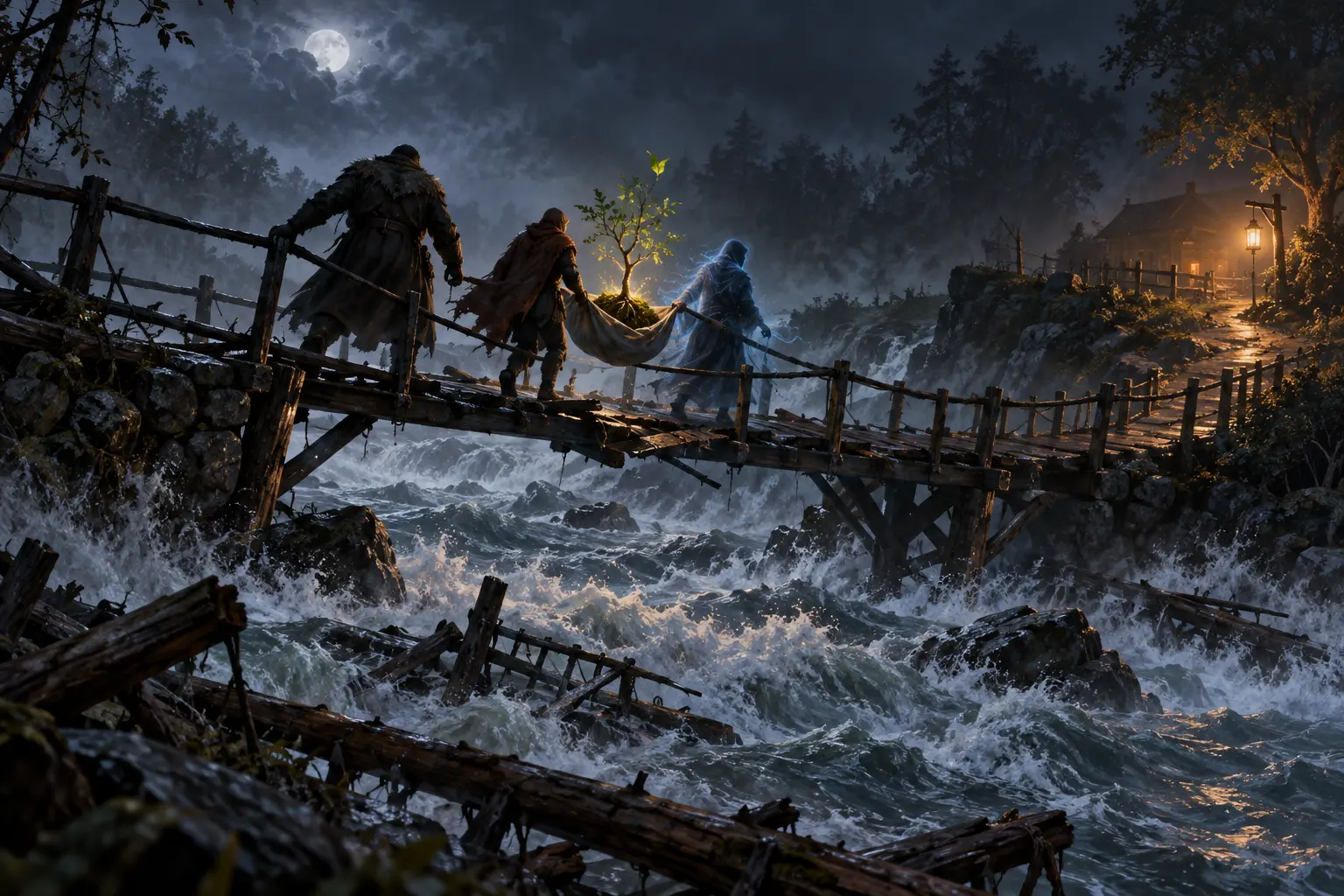
We had one night to carry the young tree across a bridge that would not survive the river.
The rain that began it fell elsewhere, in the hills beyond our view, which helped me believe for too long that the river beside us would behave as it had yesterday.
At Ashfall’s old station, now a public waiting room, the afternoon was merely damp.
People shook their coats beneath the awning and complained that the floor would never dry.
Bethany, the station’s kitchen keeper, moved a bucket beneath a leak she had meant to have repaired the following week.
I was choosing between two photographs from my work for a small notice when Rachel, the mapmaker, came through the doorway with mud to her knees.
She asked who had the key to the store of rope.
Outside, she marked the rising water on the station door.
The first line lay below the lower hinge.
By the time Goliath returned with the rope, the second line had reached the hinge's top.
Rachel wrote the times beside both marks in pencil, pressing hard enough to leave grooves beneath the words.
She said we needed to leave while the bridge still had usable boards and before the lower approach disappeared.
I asked whether the water might settle after dark.
She looked at me for a long moment and then explained that the rain upstream would continue arriving after our own sky cleared.
I heard the explanation and still searched the sky as if it might overrule her.
A bench lifted from the square while we were speaking.
It had stood near the edge of the memorial path, yellow paint still bright along its back.
The water raised one end, twisted it free of the stones beneath it, and turned it slowly until its seat faced the station.
For a moment it looked as though someone had moved it to watch us.
Then it struck a post and swung away.
Blueberry, the adult singer who had helped paint the benches, ran two steps after it before stopping at the current's edge.
She called that nobody was to follow it.
The firmness in her voice made several people step back.
I put the photographs in their envelope and asked Rachel what needed doing first.
We divided the work at the station door because everyone could see the rising marks there.
Goliath went to inspect the bridge and arrange ropes where they could help people keep their balance.
Bethany packed food that did not need a fire, wrapping portions tightly enough to survive wet hands.
Kira, the mender, fetched strong cloth for slings and dry coverings.
Abel, who gathered household testimony, took the list of occupied rooms and began asking for answers in person.
Bella, the bridge-lamp keeper, went toward the bellhouse while the path remained shallow, carrying a bag for the things she could reasonably move.
Spark stood beside the young tree, looking from its trunk to the water creeping around the bed.
Their blue light flickered against the wet bark.
Spark’s hands gathered from that light, but the tree was a living thing with ordinary needs; its roots had become linked to the station lamps as it grew.
The roots had spread farther than we expected.
The tree that had once fit in a cracked cup now held itself in the earth through dozens of delicate attachments.
We had celebrated every new leaf without measuring what growth would require when the ground became unsafe.
Spark knelt and brushed soil away with their hands.
They asked whether we could build a higher wall around it.
Rachel examined the water coming beneath the bed and shook her head.
Even if we stopped the surface flow for an hour, the soil below was filling.
Digging it free would hurt it.
Leaving it would drown it.
I put the camera down inside the station and took a spade.
Spark watched the blade as though it were approaching a living hand.
I asked where they wanted me to begin.
They pointed beyond the farthest exposed root and then moved the point farther away.
We had no room for the wide circle they wanted.
A drain and the station footing narrowed the ground on one side, while the water already covered the other.
G.E.M, a maker who worked in clay and wood, brought a short-handled tool that would let us loosen soil nearer the wall.
Blueberry arrived with sacks and asked which ones could be ruined.
I said all of mine.
The first root snapped with a sound so small that only Spark and I heard it.
They closed their eyes.
I stopped, the spade still buried in the wet ground, and wanted someone else to decide whether the next movement was allowed.
Spark placed their hands on the other handle.
They said we should loosen more soil before lifting.
We did so, working in narrow sections while Blueberry gathered the roots we could save and wrapped them in damp cloth.
The tree leaned toward me, and I felt its weight through the spade before seeing the trunk move.
G.E.M called for another hand at the sling.
Kira came running with the cloth over her shoulder.
The water was cold enough to make my ankles ache through my boots.
A spoon floated past, followed by a little knot of straw from somewhere upriver.
Inside the station a lamp went out, then another.
Someone shouted that the signal was failing and began running toward the door.
Eonix, an androgynous guide through Ashfall’s signals, answered from the desk, telling them that the roots were being lifted and that the route remained the bridge to the higher bank.
At the station door Aurelian, the synthetic man who kept our Archive, was checking Abel’s room list against each person’s answer.
The explanation traveled through the room in several voices.
Spark looked back at the darkened windows and then at their hands.
I told them to keep watching the root ball while I cleared another section of soil.
It was a task they could still do, and one I needed them to do accurately.
We could not take all the earth with us.
The sling sagged under the first attempt, and Goliath, returning from the bridge, told us to remove the loose outer soil before anyone hurt their back trying to carry water by the shovel.
Spark objected, then watched the cloth strain and accepted the change.
We kept enough around the central roots to hold them together.
Kira added another fold beneath the weakened side and marked the places where hands could grip without pulling the cloth apart.
By the time we lifted, the square had changed shape.
The lowest curb had disappeared, and the entrance step stood alone in a moving sheet of brown water.
Rachel pointed to the bridge and said we had used the time available.
We carried the injured tree toward it while the station lamps went dark behind us.
Chapter 02 · Aurelian
What the roots carried
The tree was already linked to the lamps near the station.
As its roots came free, the lights dimmed one by one, making the evacuation harder at the exact moment it became more urgent.
People who had been packing upstairs came down to ask whether the signal had failed everywhere.
Others mistook the fading lamps for an instruction to remain indoors until somebody repaired them.
Eonix used the remaining line to repeat the route in plain words and asked listeners to pass it to a person beside them.
Their receiver hissed between each message.
They shortened the wording rather than making it louder and less clear.
The high bank beyond the bridge remained the place to gather.
I took a position near the station door with paper, a lamp of our own, and Abel's list.
The old ledger could not be trusted to tell us who was still inside.
A name on a page had already proved capable of vanishing while the person attached to it remained cold, hungry, and alive.
This time I checked each entry against a living voice or a direct report from someone who had just seen the person move.
A blanket shaped around a body was not enough when the face inside it belonged to someone else.
People were frightened and gave incomplete answers.
I asked short questions and repeated names back, making corrections where they could see them.
Some corrected my pronunciation even while water entered their shoes.
Abel searched the upper rooms with a station worker who knew the doors.
They found a woman trying to carry a chest that had belonged to her mother.
It was too wide for the stairs, and one handle had already pulled free.
She said she would wait until more people were available.
Abel asked what was inside rather than telling her the chest did not matter.
They brought down letters, a shawl, and a small packet of photographs in two pillowcases.
The chest stayed where it was.
At my table the woman gave her name and then the chest's place, as though I might be making a list of things to retrieve later.
I recorded both, without promising a return.
A man from the upper passage refused to cross until his neighbor had answered.
The neighbor had left earlier through the kitchen and was already on the high bank.
Our first message failed to reach him because Eonix's line broke into static halfway through the surname.
We asked a person coming back for another load to carry the complete answer in writing.
When the note arrived, the man read it twice and finally let someone take his bag.
The delay cost minutes we could feel in the water against the door.
It also prevented him from searching rooms that had already been cleared.
We began sending written confirmations with people whenever the signal broke.
Kira came to ask about the Ghosties while I was checking the upstairs list.
Their small traces had become faint around the waiting room's painted ship.
They were memory traces held by familiar arrangements, not people we could lift bodily into a cart.
An earlier attempt to lead them outside with photographs of the room had scattered their outlines until we brought the prints back inside.
We could not repeat that experiment with floodwater rising through the floor.
Kira unwrapped a bench board we had saved during a repair and set it just outside the waiting room.
The nearest trace moved toward it, losing its edge, then gathered again at the grain of the wood.
She called me over before moving anything farther.
We carried the objects in stages.
The bench board went first, only as far as the entrance where the light still reached.
The arrival bell followed in a fold of cloth that prevented its bracket from scratching whoever carried it.
Then we brought the painted ship, keeping its face uncovered so the traces could gather around the colors they knew.
A small figure lingered where the old bench had stood.
Kira went back with one end of the board instead of calling more loudly to something that did not answer like a living child.
The trace followed the familiar edge to the doorway.
Its presence remained faint, and neither of us pretended that moving the object guaranteed we could preserve everything attached to it.
A shelf of books began taking water before the last room was cleared.
I knew which volumes held records we had not copied.
I also knew the people moving past me had only so many hands and that the bridge could not take every load at once.
I chose a small bundle of loose pages already wrapped against damp and asked a passerby whether they could carry it without letting go of the person they were supporting.
They could not.
I kept it until another pair of hands became available.
The books on the lower shelf darkened from the bottom upward.
I marked their titles on the back of the list while I could still see them.
Then I returned to the names.
Bella came back from the bellhouse with a bag and wet sleeves.
She had secured what she could without pulling the lamp apart in the dark.
The lamp itself remained lit, a small steady point beyond the moving water.
She asked whether all the upper rooms had answered.
I showed her the two entries still waiting for confirmation.
She went to the kitchen passage and found one person helping Bethany with food sacks.
The other was a worker who had stayed to shut a storeroom and now came out carrying nothing because the wood inside was already soaked.
He wanted me to record that he had tried the lock twice.
I did, then sent him toward the bridge.
By the time the tree reached the approach, the station was nearly empty.
We moved the last familiar objects close together, letting the traces follow in small wavering stages.
Eonix disconnected the portable receiver and carried it because the fixed line no longer gave a reliable word.
Abel checked the final room with the worker, then came to my table and read the list against his own marks.
Everybody assigned to that side of the crossing had either answered or was visible before us.
We would check again on the high bank.
I folded the wet paper inside a dry cover and lifted the arrival bell.
Its clapper moved once against the cloth, making a dull contained note as we left the station behind.
Chapter 03 · Cord Allman
The middle plank
The tree was heavier on the approach than it had been in the square.
Mud pulled at our boots, the cloth slipped against wet fingers, and each step made the root ball settle into a slightly different shape.
Spark carried one corner beside me, keeping their light close to the place our feet would land.
Goliath stood at the first support of the bridge with one hand on the loose rail.
He had tested what he could and marked the usable line with a rope low enough to see.
There was no route he could certify for the entire night.
He could tell us where the boards were holding now and where they were already gone.
We listened while he explained the crossing, and nobody told him to hurry his words.
Bethany and Abel had gone ahead with food and the people who needed an arm on either side.
Kira followed them with the first familiar objects, keeping the painted ship covered from spray but visible to the traces gathered near it.
Blueberry waited at our rear with spare cloth and a bag of the smaller things we had nearly left in our haste.
She had tied her hair back so tightly that rain ran straight down her neck.
When I asked whether she had saved any paint, she said the question could wait until we reached somewhere worth painting.
Her tone was dry enough to steady me.
Then the bridge shifted beneath a passing load, and we all looked down.
Water struck the supports with a sound like doors being kicked open.
The old bridge had crossed this river for longer than I had lived in Ashfall, which had made me trust it in the lazy way people trust something older than themselves.
Now I could see joints moving where I had assumed there was one continuous structure.
A strip of the lower rail had torn away.
Goliath held the remaining section only long enough for a person beside him to find the rope and pass safely.
He was not holding the river back.
He was keeping a useful handhold from twisting free while we got across a limited piece of ground.
Even that effort had drawn the muscles tight along his jaw.
We lifted the sling for the first narrow section.
Spark counted our steps aloud so the weight would move together.
Their voice was steadier than their light, which pulsed when spray struck them and then recovered.
I tried to watch the tree, the boards, and Goliath's hand at once.
He told me to look at my next foot instead.
I obeyed for three steps and then looked toward the dark gap beyond the broken rail.
The current seemed to move uphill there, folding over itself around a support.
I imagined losing the sling and reaching after it.
I had to pull my attention back by naming the board beneath my boot.
Halfway across, a plank split under my foot.
The sound was sharp and close, unlike the heavy blows beneath the bridge.
My leg dropped far enough that the edge caught my shin, and I fell to one knee.
The sling pulled toward the gap.
Spark caught their corner with both hands and leaned back too hard.
The tree lurched toward them, tightening the cloth across the roots.
Blueberry grabbed the rear fold, and I tried to lift while still trapped against the broken board.
For a moment every one of us was working against a different danger.
The trunk shook, and wet soil spilled through a tear in the outer sack.
Goliath shouted for us to stop pulling against each other.
The force of his voice reached us through the river without anger in it.
We held still for one breath, badly balanced and frightened.
He told Spark to lower their hands a little, told Blueberry which fold to keep, and asked whether I could move my foot without standing.
I could, once the weight stopped dragging me sideways.
The edge scraped my boot as I drew it free.
I set the foot where he pointed, then moved my knee onto a board that had not split.
He waited until I said I was ready before telling us to lift.
The bridge bent under the combined weight.
I said it was going to break, and Goliath answered that the rigid part was already gone.
We had to move with the remaining boards slowly enough to feel each shift.
His words gave me no guarantee, only something to do with the next few seconds.
Spark let their blue light fall low along the wet grain.
It showed the edges without turning the bridge into anything stronger than wood.
We moved the sling one hand's width, stopped, moved our feet, and moved it again.
The cloth creaked against the branches packed beside the trunk.
I heard myself breathing through my mouth and could not make it quieter.
Near the far support the path widened enough for Abel to reach us.
He took a fold of the sling without pulling until Goliath told him where the weight could go.
Bethany stood beside him with her sleeves pushed up and an expression that allowed no room for me to collapse theatrically.
Together they received the roots onto a prepared patch of cloth on the bank.
Spark kept hold after the weight had gone, their fingers locked around the seam.
Blueberry touched their wrist and said the tree was down.
They released it slowly.
Only then did I notice that my hands had gone numb.
When I tried to open them, they stayed curled for a moment like hands in a photograph of somebody else's fear.
Goliath came across after the last person on the approach had reached the rope.
He did not carry a final miraculous load from the station.
He watched the boards, called the usable steps, and left when there was nobody behind him to guide.
Kira and Aurelian brought the last familiar objects onto the bank, keeping them close until the Ghosties settled in faint shapes around the painted ship.
Abel called names from his list, and living voices answered through the sound of the river.
I sat on a stone because my knee would not yet hold me well.
Spark asked me whether I had heard another root snap on the bridge.
I said I had heard the cloth and could not be sure about the root.
They nodded and bent over the damaged bundle without asking me to turn uncertainty into comfort.
Chapter 04 · Aurelian
The bridge we lost
We saved the tree, but we did not save the bridge.
Its center fell before dawn, after the last crossing and before any reasonable return could be attempted.
The failure began with a sound that several people mistook for another load of debris striking the supports.
Then the dark line of the deck lowered at its center.
One rail stood for a moment without the boards beneath it, making a shape too slight to belong to the structure we had crossed.
It twisted, vanished, and came up downstream tangled with pieces of the deck.
Goliath told everyone to move farther back from the edge because the bank itself was softening.
The order reached us before we finished understanding what we had seen.
Bella stood watching the bellhouse lamp on the other side.
It was a small light beyond water we could no longer cross.
She had carried a bag out of that room and could name every ordinary object left behind it.
The oil bottle, the rag for cleaning glass, a shelf that leaned a little, the place where Cord's camera strap had once caught against the chair.
She did not say these things aloud at the bank.
I knew some from earlier records and learned others only later, when she chose to tell them.
At the time she stood with her hands empty.
When Goliath asked her to step back, she moved without taking her eyes from the light.
We gathered beneath an open shelter on the higher ground.
It had been built for waiting carts and smelled of old hay beneath the wet coats.
The roof covered only part of the floor when the wind drove rain sideways.
People chose places according to who needed the driest ground first, then rearranged themselves when they discovered where water collected.
Bethany opened the food sacks and counted what had reached us.
Some bread was wet at one corner, but most remained usable inside its wrapping.
She sent a person around with portions before attempting to make anything hot.
A man said he could wait until the children had eaten.
She handed him food too and said there was enough for this meal if everybody stopped making her argue about it.
Abel and I checked the list again.
We did not count a coat, a bundle, or a familiar voice heard at a distance as a complete answer.
People gave their names, corrected our marks, and told us which room they had left.
One person was missing from the first count because she had gone behind the shelter to help a neighbor change into dry clothes.
We found her within minutes, irritated that everyone had begun worrying while she was occupied with a practical kindness.
Abel explained why we needed her answer, and she gave it without further complaint.
Everybody on his list had answered.
The relief did not arrive all at once; it moved through the shelter as each small group heard the confirmation.
I could have described the escape as a clean victory.
The account would have been easier to finish, and nobody eating under the roof needed me to list losses while they tried to warm their hands.
But people began naming losses themselves.
A woman asked whether anyone had saved the chest from the upstairs room.
The worker who had tried the storeroom lock said the winter wood was gone.
Another asked about the books on the lower shelf, and I told him what I had seen rather than implying they might already be safe somewhere else.
He sat down hard on a crate.
He had spent months repairing one of those bindings and had expected to read it again when the evenings grew longer.
We made two pages because one page did not have enough room, not because the saved and lost belonged to separate moral accounts.
People were alive.
The bridge was gone.
Books had soaked beyond what we could recover that night.
Winter wood had entered the river, and familiar rooms would not be slept in again for an unknown length of time.
These statements shared the same date.
I read them to Abel, who added a damaged door, a missing tool chest, and the bench Blueberry had watched turn in the current.
She asked me to record that nobody had followed the bench into the water.
She wanted its loss remembered with the decision that had kept another person on the bank.
Spark knelt beside the tree and asked whether it would live.
The damaged roots gave me no certain answer.
Some had torn cleanly, others had lost their fine ends, and the central ball had loosened when the sack split on the bridge.
I could describe what I saw, but description did not become a promise merely because Spark needed one.
I said we would have to keep watching it and find suitable soil when we could move safely.
They looked at me for a moment, angry at the limit.
Then they asked Bethany whether she had cloth that could be sacrificed.
Bethany said cloth could be washed and brought what remained in the dry sack.
We covered the roots with wet cloth, using clean water from a carried jug rather than the floodwater around the bank.
There was not enough to waste, so Blueberry measured it a little at a time while Spark spread the folds.
G.E.M checked the sling and repaired the torn outer layer with a temporary binding.
Kira said it would hold for another careful journey but should not be mistaken for a new sling.
Goliath found two straight poles among the shelter's stored timber and asked the owner, who was sitting beside us, whether we could borrow them.
The owner agreed provided we returned whatever remained usable.
We wrote that down too.
An emergency did not make other people's tools appear without a history.
As the night thinned, the Ghosties grew clearer around the objects Kira had arranged beneath the driest part of the roof.
They held no conversation that could tell us whether every trace had crossed.
We kept the bench board, bell, and painted ship close enough to preserve the familiar relation that had guided them so far.
Cord lay nearby with his injured knee supported on a rolled coat, awake whenever somebody passed.
Bella remained at the shelter's edge, watching the lamp.
I finished the list of living answers and put it where Abel could reach it.
Then I sat beside the tree while Spark rested their hands, and checked that the cloth stayed damp through the last hours before morning.
Chapter 05 · Cord Allman
On the higher bank
We slept badly beneath the open shelter above the river.
Some people slept for an hour and woke not knowing where they were; others stayed awake because each new sound resembled something breaking.
I lay with my coat beneath my head and my knee aching whenever I forgot to keep it still.
Rain had stopped, but water continued falling from the roof's edge onto a discarded pan.
The small regular tapping became more difficult to bear than the river.
Eventually someone moved the pan.
I was grateful enough to want to thank them and too tired to discover who had done it.
The silence that followed lasted until a person at the far end began quietly snoring.
I woke to Bella pressing a cup into my hands.
The tea tasted of smoke and the metal pot it had traveled in.
She had heated it over a small sheltered fire with help from two people who knew where dry fuel had been stored above the flood line.
I asked whether she had slept.
She said a little, which might have meant a few minutes or might have been a way to end the question.
I did not demand a more honest answer while she stood holding other cups.
I took one from her to pass along the bench.
My fingers had recovered enough to keep it level.
Across the water, the bellhouse lamp finally went out.
There was no dramatic flare or visible fall of the building.
The point of light simply stopped being there, leaving the window the same grey as the wall around it.
Bella saw it at the same moment I did.
Her hand stayed on the empty cup she had been about to fill.
I wanted to promise we would return, relight it, and find the room waiting exactly as we had left it.
The words would have cost me nothing and asked her to carry the uncertainty inside them.
Instead I asked whether she wanted me beside her for a while.
She moved over on the bench.
We sat facing the place where the bridge had been.
A few broken supports remained above the water, too far apart to suggest a crossing anymore.
Debris caught against one, gathered, broke loose, and moved on.
Bella said she had left a cloth drying over the back of the chair in the bellhouse.
I remembered the cloth because I had used it the previous evening and hung it badly, so one wet corner folded over itself.
I told her that.
She said she knew because she had straightened it.
For a moment we were in the room together without pretending it had survived untouched.
Then she drank her tea and leaned forward with her elbows on her knees.
Behind us, Spark and Blueberry loosened the cloth around the roots.
One leaf had stayed green.
There were others whose edges had curled, and a small branch hung at an angle it had not held before the crossing.
Spark wanted to remove the damaged branch immediately.
G.E.M asked whether they knew enough to do that before the tree had somewhere stable to stand.
Spark lowered their hand and said no.
Blueberry retied the cloth loosely so air could reach the bark and asked someone to bring the remaining clean water.
I could hear their disagreement without hearing failure in it.
They were looking at the same injured thing and trying to make the next decision carefully.
Bethany counted breakfast portions with Abel.
The food had reached us in several bags carried by different people, and nobody could remember exactly where the last wrapped loaf had been put.
We found it beneath a folded blanket beside the painted ship.
Kira had placed it there while making room for the bell and then forgotten in the rush.
She looked so relieved that Bethany said the loaf had shown excellent judgment in choosing a dry bed.
People laughed with their mouths full.
The humor did not make the night less serious.
It made eating possible without turning every bite into a ceremony of survival.
Rachel opened the western map on a crate and weighted its corners with the few stones she had carried.
She had saved the river stone she used as a paperweight, though several of her larger sheets were now wet at the edges.
The map showed the long causeway toward higher ground within Ashfall.
There were gardens above it, service paths, and a western square near the high hall.
I knew some of those streets from visits before the flood.
That familiarity would later tempt me to treat memory as better evidence than it was.
For now I listened while Rachel marked where reports were needed and where yesterday's paths could no longer be assumed safe.
A worker who had reached the shelter from a northern lane offered to carry word ahead before the group moved.
He knew a route above the water, though not every turn we would need with the tree and the tired people beside it.
Rachel wrote a message asking for shelter, clean water, and current information about the western approaches.
She read it back to him, then added the number of people we had counted and the fact that some needed a slow pace.
Bethany asked her to mention that we were carrying our own breakfast but would need food later.
The worker tucked the note inside his coat and ate before leaving.
Nobody asked him to run on an empty stomach.
We prepared what could be prepared without pretending we were rested.
Goliath fitted the borrowed poles to the sling and had us test the balance before lifting the tree far from the ground.
Kira packed the familiar objects so the Ghosties could move in stages again.
Aurelian put the records inside a cover and checked with Abel that the names remained readable.
Bella counted cups and laughed tiredly when she found herself including the one still in my hands.
I finished the tea and returned it.
When I stood, my knee objected sharply enough that I had to wait with a hand on the bench.
Goliath saw and shifted one planned load away from me without making an announcement.
I looked once more across the river.
The lamp remained dark, the bridge remained broken, and the city beyond them was still ours even where we could not reach it.
There was no clean edge between leaving and staying faithful to a place.
Bella put her bag over her shoulder and asked whether I had the camera.
I touched the case, which had survived because somebody had carried it while I held the spade.
I did not yet know whom to thank.
Bethany called us back for the last pieces of breakfast before they were packed away.
There was higher ground to reach, and people there who needed to know we were coming.
We would take the road after breakfast.
Nobody had to begin it hungry.
Let the last line settle.
Choose another mood