
Chapter 01 · Cord Allman
The gate in the water
Goliath could hold the gate against the river, but only if nobody asked him to let go.
That was how I remember the afternoon now, though it began with a pencil, a calm stretch of water, and an argument about where to stack the boards.
We were repairing a narrow crossing in Ashfall above the old flood line.
I was Cord, a human photographer working with neighbors whose skills had kept the river quarter alive through the flood.
Goliath's strength was real and fallible, and Rachel, who checked our routes and water marks, knew better than to make it the crossing's only precaution.
The river had dropped enough for the work, or so the morning marks suggested.
Rachel checked them herself before the first worker went down to the lower platform.
She wrote the time beside each reading and asked the foreman to keep the exit clear as materials arrived.
He agreed, then moved a crate that had already been placed in the wrong spot by someone who believed it would stay there for only a minute.
Goliath helped carry the first boards from the cart.
He wore the old coat whose shoulders had been patched after the flood, and he made the weight look easier than it was until a younger worker tried to copy the way he lifted.
Goliath stopped him and showed him how to take a smaller load.
“There are no prizes for making the second journey impossible,” he said.
The younger worker grinned and carried two boards instead of four.
Aurelian, the synthetic man keeping our records, was at the upper relay with the work plan and the voice line.
I was there to document the crossing before the new work covered the damaged joints, then to help move supplies once the photographs were finished.
Rachel asked me to include the water marks and the approach from the upper bank.
A photograph of a bridge without its exits told only the most flattering part of the story.
I made the pictures she requested and put the camera away before going down with a box of fittings.
The river moved with a low, constant sound beneath the platform.
It smelled of stone, wet timber, and mud warming in the pale sun.
Goliath worked beside a carpenter, holding a board while its position was checked against the line.
He was in a good mood, joking about a measurement written so badly that the same mark could mean either a modest correction or an entirely new bridge.
Rachel came down to settle the argument and pointed out that both men had been reading the paper upside down.
The laughter carried easily over the water.
By midday, the work had found a rhythm.
Tools moved between hands, offcuts went into a box, and the gate at the platform entrance was propped clear so materials could pass without somebody opening it each time.
The gate had survived earlier water damage but its lower hinge still needed replacement.
That repair was on the day’s list.
Like several other tasks, it had seemed less urgent while the morning river lay quietly below us.
We stopped for food on the upper bank, leaving the lower platform empty during the break.
Goliath sat with his back against a stone and told the younger worker that a boat could be ruined by an argument between two people who both insisted the other should steer.
The story was funny until he reached the part about weather changing while everyone watched the quarrel.
He paused, took a drink, and returned to a practical detail about the oarlocks.
Nobody asked him to continue into the old storm.
It had taken a companion he loved while he held a sail too long; that person had not come home, and no later river could give him the choice again.
After the break, Rachel checked the marks again.
The water was higher than the morning reading, though still within the range written for the day’s work.
She went farther along the bank to look upstream where the channel narrowed between two walls.
A branch passed in the current, turning end over end, followed by another carrying fresh leaves from higher ground.
She returned more quickly than she had left.
Water from the hills was reaching us, and the change was no longer gradual enough to trust the earlier estimate.
She called for everyone to leave the lower platform.
The foreman repeated the instruction, and people began putting tools down instead of trying to finish the fastening in their hands.
I carried the fittings box toward the exit because it was already in my grasp.
Rachel told me to leave it and use both hands on the rail.
I put it down.
That small obedience is easier to remember than the many occasions when I had been slower to accept her judgment.
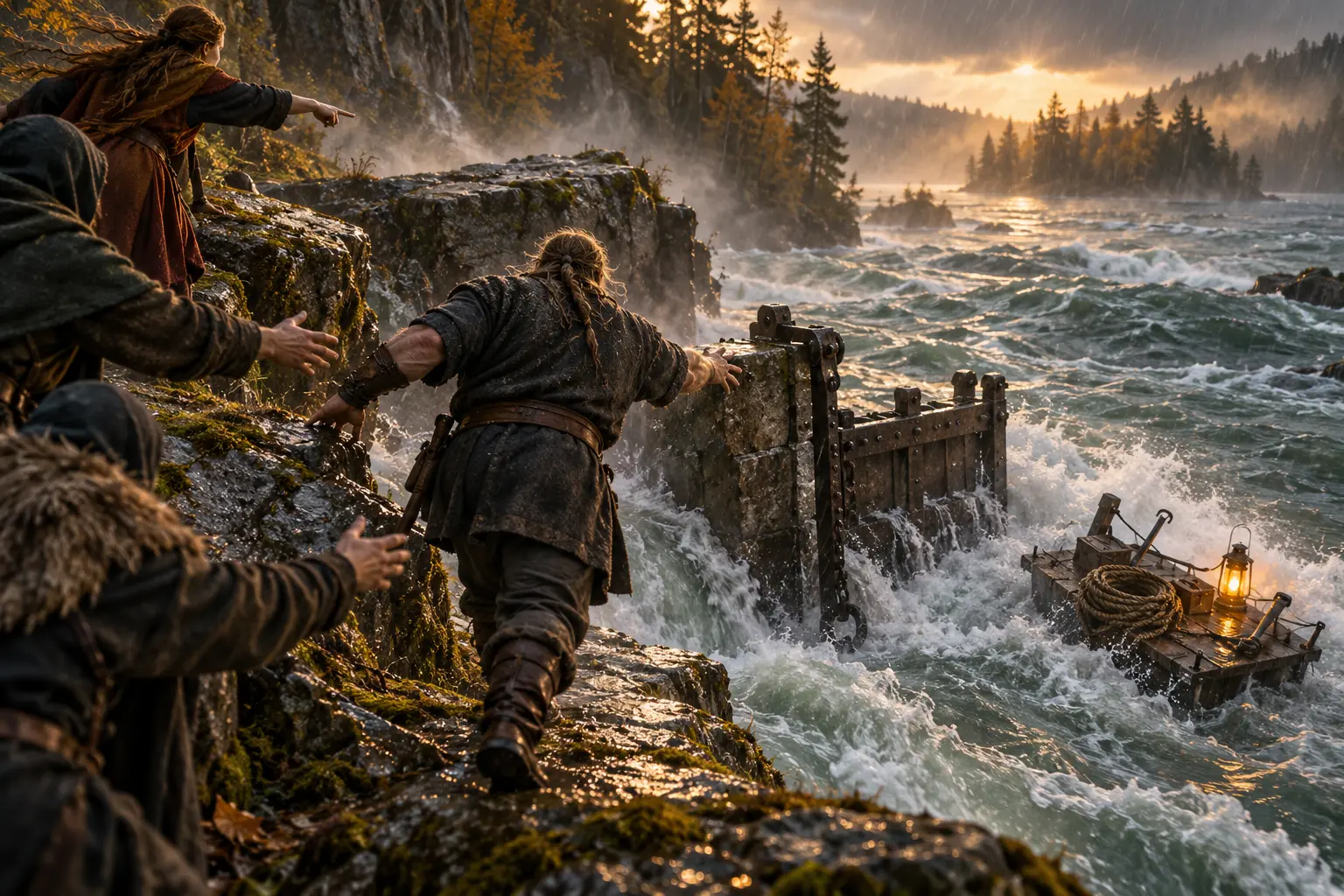
The gate shifted as the first workers climbed through.
Its prop slipped on the wet boards, and the current caught the lower edge before anyone could reach the latch.
The iron swung across the exit toward a worker carrying a long measuring rod.
Goliath caught it before it struck him.
The worker stumbled, dropped the rod, and scrambled past the opening Goliath held.
The others followed, moving up the steps while the foreman counted aloud.
Then the current pressed the gate flat against Goliath’s hands.
The lower hinge twisted with a sound I felt through the rail.
He could keep the exit open or step away from the strain.
He could not do both while people were still moving through it.
By the time the last worker reached the upper steps, the water had taken the position in which he needed to stand safely.
I reached the bank and turned back.
Goliath remained on the lower footing, shoulders bent, boots planted against a force that had grown while he held still.
The storage platform beside him trembled as its damaged connections took the pull of the gate.
Tools slid across the boards and struck the edge.
He did not look at them.
He looked past the river, with a fixed terror I had seen only when a sound or a change of wind returned him to the storm in the small boat.
He was no longer only at this crossing.
His hands held iron, but some part of him was still holding a sail he had refused to release.
Rachel called his name once, firmly enough to reach him.
He turned his head a little, and that movement gave us the first chance to bring him back to the river that was actually in front of him.
Chapter 02 · Aurelian
The mark on the wall
The old measurements were sound for the morning and wrong for the afternoon.
From the upper relay, I had received the work plan, the first readings, and the list of people entering the lower platform.
The upstream report arrived late because the observer’s regular route did not include the new worksite until the end of the afternoon.
Nothing in the approved schedule required a fresh hill report before workers returned after their break.
Rachel’s direct checks were the reason the evacuation began before the water rose further.
I recorded that distinction while keeping the voice line open, because an accurate account would matter once the immediate danger passed.
It did not yet help Goliath move.
The foreman called the workers’ names from the upper bank.
I checked each answer against the entry list rather than accepting a general statement that everyone was clear.
One man answered twice because the sound of the river covered his first reply.
Another had gone around the storage wall to meet a worker arriving with spare parts and needed to be called back into view.
The late arrival had never entered the lower platform.
We confirmed that separately so nobody would search for a person who was already safe farther up the path.
Every worker on the list answered.
Only Goliath remained on the lower footing.
The gate was attached to a storage platform holding tools and a coil used for the river network.
The coil had taken time and money to obtain, and the carpenter’s tools included several that could not be replaced simply by opening a local cupboard.
Goliath had helped carry them down in the morning.
He knew their weight, their purpose, and the people who would lose work if they disappeared.
The platform’s connections had been weakened by earlier water damage, and the gate now transmitted the current’s pressure into the same strained frame.
If he released it, the whole damaged section would likely break away.
If he kept holding, the river would continue increasing the force against his body until the choice was made for him.
I described the situation through the speaker in the plainest words I could find.
The city needed the tools.
It needed him alive more.
Goliath did not answer.
From the upper position, I could see his head turned toward Rachel but could not tell whether my words had reached him as words or only as another sound inside the water.
A fact can fail to reach somebody caught inside an older loss.
I had learned that listening to Goliath speak about the storm, though knowing it did not immediately tell me what to do.
Rachel moved down the upper steps until he could see her clearly.
She stayed above the water and kept one hand on the secured rail.
She did not promise that the river would be kind or tell him to stop being afraid.
She pointed to a narrow safe ledge beside his shoulder, the place where the upper stair joined the older stone wall.
It was wet, but it remained clear of the gate’s path.
She told him where to put his foot when he let the gate go.
Abel, who kept our rain book of needs and refusals, and Cord moved to the upper side of that ledge, staying where the stone supported them.
The foreman cleared the steps behind them so nobody would have to climb over a bucket or a dropped coat during the next movement.
Another worker brought a line from the bank and passed it toward the people nearest the ledge without trying to throw himself into the water.
Everyone had something to do that was more useful than shouting different instructions at once.
Rachel kept speaking to Goliath.
She asked him to look at the ledge, then at her hand, then at the place his boot would land.
His eyes moved as she asked, but his hands remained fixed around the iron.
He said something the river swallowed.
I lowered the unrelated channel sounds at the relay and asked Rachel to repeat what she had heard.
“He wants to know whether the lower store is clear.”
The foreman confirmed that it was, but Rachel asked him to look again from the safe bank before answering.
The storage area was open to view through its upper side.
No person remained there.
A coat caught on a hook moved in the spray, resembling a bent figure at a distance.
The foreman named it for what it was and described the empty space around it.
I added the confirmation to the count and repeated it over the speaker.
Goliath’s shoulders shifted a little.
He had seen the movement of the coat and could not leave while the shape remained uncertain.
This was a practical fear, separate from the old storm, and we needed to answer it rather than treating everything he did as trauma.
Rachel thanked the foreman and returned to the next movement.
She told Goliath the gate would go downstream, the platform might follow it, and the ledge would remain beside him.
There was no promise that he could save the equipment on the way.
The instruction required him to leave it.
He looked toward the coil and the tools, then back toward the upper bank.
For several seconds, nobody spoke except Rachel.
The current made a deep drumming sound beneath the platform, and one of the boards lifted at its loose end.
I stopped calculating how long the remaining connection might last because any number would have suggested a precision I did not possess.
Instead, I kept the line clear and the count ready.
Goliath asked whether everyone was out.
This time the words reached us without another person repeating them.
Rachel said we would answer him one by one, so he could hear the people whose lives he was trying to protect.
I read the list in order, leaving enough space for each voice to cross the water.
Chapter 03 · Cord Allman
Letting it fall
The first worker answered from beside the cart, his voice high with the effort of being heard over the river.
The second stood farther along the bank and raised a hand as he called.
The carpenter named herself and said she was clear of the lower platform.
The younger worker who had dropped the measuring rod answered twice, then laughed once from nerves and apologized for laughing.
Nobody needed the apology.
Abel called from the ledge beside me, and I gave my own answer while holding the upper rail.
Rachel spoke last among those nearest the water.
Aurelian confirmed the full count through the speaker.
Goliath listened to actual voices instead of a promise made on behalf of people he could not see.
When the list ended, he looked at the ledge Rachel had shown him.
His face held effort, fear, and something like anger at the impossible demand we were making.
We were asking him to choose a loss while he still possessed enough strength to delay it.
Rachel said his name again.
He nodded once.
Then he let go.
The gate tore from its hinge with a sound that seemed too large for the narrow river.
For an instant it stood almost upright, black iron against pale moving water, and then the current turned it sideways.
The storage platform broke away in a lurch of boards and twisted fittings.
A toolbox struck the rail, opened, and scattered its contents into the river before the whole section disappeared around the bend.
The coil followed, its protective casing briefly visible beneath the surface like a dark wheel.
Goliath fell toward the ledge.
He had chosen the movement Rachel described, but choosing did not make wet stone generous.
His boot slipped before finding the edge, and his weight came against the patched coat as Abel and I caught it.
The cloth stretched beneath our hands.
For a terrible moment, I heard the beginning of a tear near the shoulder seam.
I wanted to pull harder and understood at the same time that the coat might not survive another demand of that kind.
Goliath’s free hand searched the stone, fingers opening badly after holding the iron so long.
Rachel pointed to the higher step within his reach and kept telling him where it was.
His knee struck the ledge, slid, and finally found purchase.
The shift brought enough of his weight toward us that Abel could change his grip.
The worker above passed the line within reach, and the people on the bank steadied the movement without dragging us sideways.
We hauled him onto the upper steps with no elegance at all.
Someone swore, somebody else lost a glove, and I struck my elbow hard enough to see a bright little flash at the edge of my vision.
Then Goliath was on the bank, breathing against the wet grass, and the space where he had stood belonged entirely to the river.
He lay with one hand still closed around nothing.
Abel crouched beside him without trying to prise the fingers open.
Rachel knelt where Goliath could see her when he turned his head.
The foreman sent for the medic waiting at the upper work shelter and told everyone else to move back far enough to give room.
I sat on the grass because my legs had begun shaking now that they were no longer required to hold a particular position.
The water carried small pieces of wood past the bank.
One was painted with a mark we had used that morning to identify the correct length for a repair.
I watched it pass and felt an unreasonable urge to retrieve it, as if saving one offcut might reverse the whole loss.
Abel saw where I was looking and shook his head.
I stayed where I was.
Goliath turned toward Rachel at last.
“I lost the tools,” he said.
“Yes.”
She let the fact remain true for a moment before continuing.
“You are here to help us replace them.”
He closed his eyes and swallowed, then opened them again as the medic asked where the pain was worst.
His palms were scraped, several fingers swollen, and one wrist had taken a strain he tried to dismiss until the smallest movement changed his breathing.
The medic examined him and told him he would need a proper assessment at the hall before anybody decided what the injury allowed.
Goliath began to push himself upright with the injured hand.
She stopped him with a clear instruction and asked two of us to help from the other side.
Being told how to move after using his body with such confidence all morning seemed almost as difficult for him as the pain.
We brought dry coverings from the cart and replaced the wet outer layer without exposing him to the wind longer than necessary.
He apologized for the damaged coat.
Kira, the repairer who had patched his coat and who had arrived with the supply carrier just before the evacuation and remained safely above, said the coat had done respectable work and could wait its turn for attention.
The remark gave him something ordinary to answer.
He said he hoped the coat would not expect a medal.
She told him it would settle for being allowed to dry properly.
While we prepared to leave, Rachel and the foreman closed the site and marked the unsafe approaches.
Nobody went down after the tools.
The losses were written from the inventory, with uncertain items left uncertain until the river could be inspected safely.
I had not taken a photograph during the rescue.
The camera remained in its case near the cart, and no part of me wished I had held it instead of Goliath’s coat.
On the road back, he rode in the cart with his hands protected and his eyes fixed on the space between his knees.
The young worker walked beside him and thanked him for catching the gate.
Goliath nodded but did not answer until the cart stopped at a rough patch.
“Next time,” he said, “we make sure the gate cannot do that.”
The worker agreed, and Rachel wrote the sentence on the back of the work plan before the road jolted us forward again.
Chapter 04 · Aurelian
What strength could hear
Goliath’s hands ached for days.
The swelling eased unevenly, and the medic’s instructions continued after the first relief of knowing he had escaped the river alive.
He could not grip heavy objects safely, and he disliked the number of ordinary tasks that now required a different movement or another person’s help.
A cup could be lifted if its handle sat correctly against his fingers.
A coat fastening was harder.
Opening a stiff door made him angry in a way he then regretted because the person holding it for him had done nothing wrong.
He apologized when he snapped, but the apology did not make the next door easy.
I visited him in the western hall on the third afternoon and found him trying to move a basket from a chair by lifting it against his forearm.
The basket contained folded towels and weighed little.
Its lightness seemed to make the difficulty more insulting.
I asked where he wanted it, then waited for permission before carrying it to the shelf.
He watched me finish and said he was tired of people looking pleased whenever he allowed them to help.
I told him I would try to keep my expression less educational.
He laughed, which was the first useful thing I had contributed to the visit.
Kira arrived later with gloves whose wide fastenings used Spark’s new buttons.
Spark was our blue-light companion, now learning to carve wood as well as help keep the lamps working.
The design allowed Goliath to guide the closure without bending his fingers far, while the gloves protected the healing skin during the light tasks the medic permitted.
They did not make him ready for lifting, and Kira said so before he could pretend otherwise.
Spark had adapted the shape after Kira explained what movement was difficult, then tested the fastening on cloth before finishing the pair.
Goliath put one glove on slowly.
The button passed through with less struggle than the small one on his old cuff.
He looked at the fastening, worked it once more, and said nothing for a while.
Kira pretended to examine the repaired edge of his coat so he would not have to answer the gift immediately.
When he finally spoke, he asked how much he owed for the gloves and the alteration.
She named the agreed price and told him Spark’s buttons were included.
He paid from the pouch he could open with his less painful hand and asked her to thank them for noticing the shape of the problem.
After she left, he kept the gloves beside him rather than putting them away.
He told me that releasing the gate had felt like abandoning someone again.
The words came quietly, after several minutes spent discussing the actual losses from the platform.
I did not treat them as an invitation to solve the old storm through the new rescue.
One event had taken a person he loved.
This one had not.
He had held a sail too long in the earlier storm, and the memory still carried questions he could not answer by making the later river behave differently.
Letting go now did not bring the lost companion back or prove what another choice would have changed then.
The difference deserved time and an honest place to stand.
I asked what he remembered most clearly from the gate.
He said the pressure in his hands, the moving coat in the storage area, and the fear that somebody remained behind it.
He had needed the count because an assurance that everyone was safe sounded too much like a hope.
Hearing each voice gave him people to place on the bank.
Rachel came the following morning to review the crossing plan when he felt ready.
She brought the original drawing, the readings, the delayed hill report, and blank paper large enough to make changes without hiding the first design.
Goliath expected to be asked why he had held on.
She asked what he could see from the lower footing that the planners on the bank had missed.
He described the coat hook that could make an empty area look occupied, the way tools obscured the exit when placed for easy reach, and the gate’s movement once its prop slipped.
Rachel marked each point.
His memory of fear became useful information without requiring the fear to be admirable.
They changed the gate so it could be released from above and could not swing unchecked across the only lower exit.
The damaged storage arrangement would not be rebuilt in the same place.
Tools needed a safer position and a means of being abandoned without trapping somebody beside them.
The working hours changed as well.
Fresh upstream readings would be required before each work period, with checks repeated according to the agreed rise and a named watcher whose only task was observing the water.
Anyone on the crew could call a stop when the limit was crossed.
Restarting would require new readings and a clear agreement, not the foreman’s embarrassment about losing another afternoon.
The foreman attended the second review and admitted that pressure to complete the crossing had made the unfinished hinge feel acceptable for too long.
Rachel recorded her own assumption that the older schedule for upstream reports would serve the new work.
Goliath did not become the single cause of the danger because his hands happened to be the last thing holding it back.
Replacing the lost tools took money from the repair reserve and delayed other work.
We made that cost visible without using it to suggest he should have stayed at the gate.
Some items could be borrowed, others bought, and some work would wait.
The missing coil could not simply be restored through the terminal.
Its loss remained on the river network inventory while the wider relay fault stayed unresolved.
When the revised drawing was complete, Rachel asked Goliath to check it once more from the perspective of someone standing below.
He found a fastening placed where a glove might catch and moved it higher.
Then both their names went on the page.
His hands still hurt when he signed, and the signature looked uneven.
Nobody offered to make it resemble the old one.
Chapter 05 · Cord Allman
The unfinished crossing
We returned to the river when the water was low enough to work safely under the revised plan.
The site looked strangely bare without the lower storage platform.
Fresh marks on the stone showed where the lost structure had rubbed against the wall before breaking away, and a pale strip of wood remained wedged high beyond anyone’s safe reach.
We left it there.
The river had not become a display cabinet from which every piece of the afternoon could be recovered.
Goliath stood on the bank while other people carried the first boards.
His hands were improving, but they were not ready for the work his shoulders wanted to do.
He wore Kira’s gloves with Spark’s broad buttons fastened at the wrists, and he kept flexing his fingers only within the movement he had been told was safe.
The young worker from the earlier day carried two boards, then returned for another two without being reminded.
Goliath watched him and gave a small nod.
He wanted to help, and it showed whenever a load paused or a person looked around for another pair of hands.
Rachel gave him the task of watching the new marks.
It was real work, not a way to keep him occupied.
He would compare the readings with the agreed limits, receive the upstream observer’s reports, and call everyone back if the water rose beyond the stopping line.
Another worker would take over when his watch ended so he did not turn stillness into another endless duty.
The task required attention rather than a powerful grip, and the consequence of missing a change was clear to everyone present.
Before anyone went below, he read the stopping rule aloud and asked the crew to repeat the signal they would follow.
One man made a joke about being sent home before earning his bread.
The foreman said they would be paid for the agreed shift and use any stopped time on safe work above the bank.
That ended the joke’s power to pressure someone into silence.
I took photographs of the revised gate, the clear exit, and the marked wall for the repair record.
Then I made one picture of the half-built crossing from farther back, including the unconnected boards, the empty span, and the people preparing to work.
Goliath stood near the edge of the frame with the reading sheet on a board beside him.
I asked whether he was comfortable being included, and he said yes after checking that the photograph would show what he was actually doing.
He did not want to look as though he was merely standing apart while other people repaired his failure.
Rachel, close enough to hear, said the reading sheet should be visible if I could manage it.
I changed the angle.
The morning work proceeded slowly because each new arrangement needed to be tested in use.
The manual release worked from above, but a marker beside it proved hard to see from the lower stair.
We moved the marker before continuing.
A borrowed tool did the job differently from the one lost in the river, and the carpenter took time to show the younger worker how to use it without forcing the cut.
Nothing about the day resembled a triumphant return.
It felt like a repair crew learning a revised site while a strong man practised believing that watching mattered.
Near midday, Goliath called Rachel to the marks.
The water had risen between readings, and the report from upstream described more flow coming through the narrow reach.
They compared the time and level, then checked the visible line again.
He did not wait for the rise to become dramatic enough that nobody could disagree with him.
When the water passed the limit they had agreed, he called everyone back.
For a moment, the carpenter looked at the fastening nearly complete beneath her hand.
Then she put the tool in its safe place and climbed out.
The others followed in order.
Nobody asked Goliath whether he was sure simply because the bank still looked calm from above.
The foreman counted the crew, and Goliath checked the count against the entry list.
This time he stood where every answer could reach him without crossing a dangerous stretch of water.
The crossing remained unfinished that day.
There were boards ready to fit, a gap still open, and enough paid hours remaining that the crew could inspect the borrowed equipment and prepare materials on the upper ground.
The river continued rising for a while, carrying leaves past the place where the platform had been.
Goliath watched until the next observer took over, then gave a clear handover with the last reading and the next check due.
He resisted the urge to remain beside the marks after his replacement had accepted them.
That was visible work too, though nobody made a speech about it.
We checked the tools against the list before leaving.
The new inventory contained gaps where replacements had not arrived, and each gap had a plan or an honest note that the answer remained unsettled.
Goliath tried to lift the empty recording board under one arm, found the position uncomfortable, and handed it to me without apology.
His hands would need more time.
On the road home, he asked whether I had taken a photograph of the half-built bridge.
I said I had and described the frame, including the unfinished span and the water marks beside him.
He asked to see it when it was printed.
I promised to bring it before showing it elsewhere.
We walked with the rest of the crew toward supper, listening to an argument about whether the borrowed saw should be returned sharpened even though it had arrived blunt.
Goliath joined the argument with considerable feeling, which pleased me more than any solemn account of recovery could have done.
At the square, he adjusted one of Kira’s gloves against the wind using Spark’s broad button and did it slowly enough that it worked the first time.
The crossing behind us was unfinished because somebody had called people home before the water forced the choice.
When he eventually held the photograph, that unfinished space would have a living person beside it.
For once, it would remind him of a person who had made it home.
Let the last line settle.
Choose another mood