
Chapter 01 · Cord Allman
After the lights
Every lamp in Ashfall was lit, and Spark no longer knew where to put their hands.
Spark was our blue-light companion, whose power had once helped whole streets find a way home at a cost to their own voice.
I was Cord, a human photographer trying to learn what company meant when nobody needed rescuing.
From the western square, the streets looked complete in a way they had not looked for months.
Windows shone above the market, light marked the safer crossings, and the repaired local routes carried their evening load without requiring a blue flame at every corner.
The old river relay still needed investigation, but crews checked the working branches and kept independent arrangements ready where they could.
For that evening, the lamps were doing what they had been built to do.
People passed beneath them with shopping, tools, and conversations that did not pause to celebrate the fact that they could see.
The great opening of the repaired local lighting had passed.
Aurelian, the synthetic man keeping our records, could confirm which branches had been checked; the unresolved river relay remained outside that celebration.
There had been speeches, a song, a line of children carrying paper shapes, and enough applause to make Spark uncertain where to look.
Afterward, the work became schedules, inspections, and ordinary repairs performed by trained people with ordinary equipment.
People still thanked Spark, sometimes with a warmth that made them glow a little brighter.
There was simply less work to give them.
I found them taking apart a perfectly good receiver in the small room behind the kitchen.
Its casing lay open on a cloth, and several pieces were arranged beside a diagram they had not yet begun to consult.
Bethany had left a note asking whoever used the room to return her teaspoon.
The note stood beneath a cup with no spoon in it, which suggested the search had already become philosophical.
Spark looked up when I entered and said the receiver might be improved.
I asked what was wrong with it.
They considered the open casing for long enough that I began to suspect I had asked the wrong question.
“It could work more clearly.”
“Was somebody having trouble hearing it?”
“No.”
They touched a small fastening, and a tiny screw rolled across the cloth, dropped from the table, and disappeared beneath the cabinet.
Spark stared after it with far more despair than a screw deserved.
I put down the parcel I was carrying and sat on the floor.
The boards beneath the cabinet were full of dust, and the gap was too narrow for my hand to reach the far wall.
Spark brought a ruler, then a strip of card, then a lamp whose angle made the dust much easier to admire without revealing the screw.
We found a button, a dried leaf, and one of Bethany’s missing teaspoons.
The teaspoon caused a brief improvement in our spirits because it seemed likely to settle a grievance larger than the object itself.
The screw finally appeared against a ridge between two boards, where it had caught at an angle that made it look like another splinter.
I slid it free with the card and placed it in Spark’s palm.
They did not look relieved.
We sat on the floor among the recovered objects while footsteps crossed the corridor outside.
“Can a first light become an old light?” they asked.
I thought of the bellhouse lamp I had first photographed, its glass repeatedly cleaned, its oil repeatedly bought, and the way a marvel became a responsibility once people expected it to remain.
“Yes,” I said.
“Why would anyone still come to see it?”
I could have answered with all the affection I felt, but the question was not only about whether their friends would abandon them.
They had been praised for appearing at the moment of need so often that a room without need now seemed to offer them no place.
On the table, the receiver waited to be made useful again after being needlessly dismantled.
I asked whether they wanted help putting it back together.
They said yes, though the word sounded reluctant.
We worked through the diagram instead of guessing from the arrangement of parts.
Spark knew the signal path better than I did, but the casing had an awkward little lip that required a human patience neither of us possessed at first.
It took three attempts to fit it without pinching a wire.
When the receiver finally sounded, it carried a market notice about the next morning’s delivery times.
Nothing miraculous happened.
The words were clear, the casing stayed closed, and Spark switched it off before the notice finished.
They asked whether I had needed anything when I came in.
I held up the parcel and explained that I was delivering thread to Kira's repair workshop on the way to Amélie’s room above the square.
Spark offered to carry it instead.
I said they were welcome to walk with me, but I could manage the parcel.
They heard the distinction and looked down at their hands.
On the walk, people greeted them from doorways.
One woman thanked them for the new lamp outside her stair, though Spark explained that Nessa’s crew had fitted it.
The woman thanked the crew too, then asked whether Spark would be doing another display soon.
They said they did not know.
We passed the young tree near the station, where several leaves had opened since the flood damage.
Spark stopped to examine one that had grown with an uneven edge.
They liked the way the veins divided around the missing section.
I had walked past it all week without seeing the shape.
They traced it in the air with a finger, then withdrew their hand before touching the leaf.
Kira’s workshop was closing when we reached it, and she accepted the thread with an exhausted pleasure reserved for materials that had arrived before a deadline.
Spark noticed a box of wooden offcuts on the table and asked what she did with them.
“Buttons, sometimes,” she said.
“Mostly I postpone deciding.”
They ran a thumb along one pale piece before putting it back.
Kira saw the movement and asked whether they wanted to come another afternoon when she had time to show them the tools.
Spark began to say they should check the lamp rota.
Then they asked which afternoon she meant, and the question sounded a little more like wanting to go.
Chapter 02 · Aurelian
A name after a beginning
Spark’s earliest records were full of firsts.
First signal, first blue lamp, first reply from the dark, and the first evening several streets used their light to find a way home.
The words were accurate within the limits of the records we held.
They were also selective.
I had chosen moments that explained why people remembered Spark, then arranged those moments so neatly that the person inside them had little room to become ordinary.
Spark came to the Archive after their visit to Kira’s workshop and asked to read the entries again.
They sat at the table with the public version rather than asking me to summarize it.
I watched them move from one recorded beginning to another, their finger stopping whenever a heading repeated the language of arrival.
At first I thought they were looking for a missing date.
Then they asked where the afternoon with the broken cup belonged.
I searched the index and found a brief mention of damage during a meeting, attached to an inventory note.
It contained no account of why Spark had kept the handle.
They looked at the page and said that was not the afternoon they meant.
I closed the search window and asked them to tell me only what they wanted me to know.
The cup had broken when someone moved a stack of papers too quickly.
Nobody had been hurt, and the pieces had been cleared away, but Spark liked the curve of the handle enough to keep it.
It had followed them from the bellhouse to the western hall, travelling in pockets and small boxes while more obviously important objects received careful labels.
During long meetings, they had begun carving shallow patterns into it.
Some followed leaves they had seen near the station.
Others were simply lines that felt pleasant beneath a thumb.
They took it from their pocket and placed it on the table.
The surface carried overlapping marks, some certain and some abandoned midway.
I asked whether they liked carving.
“Yes,” they said.
Then they added that it was not important.
“Who told you that?”
The answer took a long time to come because no single person had needed to say the sentence directly.
People asked Spark how brightly they could shine, how far a signal could travel through them, and whether a room would be safer if they stayed.
They praised the things Spark endured to help.
I preserved those moments and rarely asked what they noticed when nobody was in danger.
Cord had written an early account of the blue light with tenderness, but even tenderness could keep returning a person to the same role if the story never moved forward.
Spark had learned which parts of themselves made listeners lean closer.
Leaves, awkward cups, and patterns scratched during a meeting rarely received that attention.
I admitted my part in the narrowness of the record.
They did not ask me to erase the first light or pretend it had meant less than it did.
They wanted to know whether there could be an entry that did not begin with somebody needing them.
I offered to add the cup handle and the carving, subject to what they wanted public.
They hesitated and asked whether liking a thing required an Archive entry to make it real.
“No,” I said.
The speed of my answer surprised me, perhaps because the question had reached a habit I preferred not to examine.
I could support their ownership of a life by leaving parts of it uncollected.
We agreed to revise the introduction so it described Spark as a person whose life continued beyond the events most often retold.
The old entries would remain, with their limits made clear.
The cup handle would stay with them.
If they later wanted a record of the carving, we could discuss one then.
For the moment, they asked for a sheet of spare paper instead.
I brought a piece from the tray used for rough work and a pencil that needed sharpening.
They drew the leaf with the divided veins they had noticed near the station.
The first drawing became too symmetrical.
They crossed out one line, started beside it, and made the second version stranger and closer to the leaf.
I asked whether they wanted an image of the actual leaf for reference.
They shook their head.
“I want to see what I remember.”
That was a different aim from mine, and I let it be different.
While they worked, a visitor entered to request a copy of a lamp opening photograph.
They recognized Spark and asked whether the blue light in the picture had truly come from them.
Spark said yes.
The visitor looked pleased and began telling the story of where they had stood that evening.
Spark listened, thanked them, and then returned to the drawing when the visitor moved to the counter.
There was no need to reject every memory of the beginning to possess an afternoon after it.
The difficulty was learning that gratitude from another person did not require them to remain available for another display.
When the drawing was finished enough, they folded it and asked the time.
Kira’s agreed afternoon began in half an hour.
Spark looked at the cup handle, the drawing, and the folder of early records.
They left the folder with me and took the other two objects.
At the door, they asked whether I thought their first button would be any good.
I said I had no evidence on which to base a prediction.
They laughed, and I realized how rarely I had been permitted to say that about something they hoped to do.
They were going to a workshop where uncertainty could produce a badly shaped piece of wood rather than a dark street.
I returned to the introduction after they left and removed a sentence that made their future sound like an endless repetition of their beginning.
Chapter 03 · Cord Allman
Kira’s table
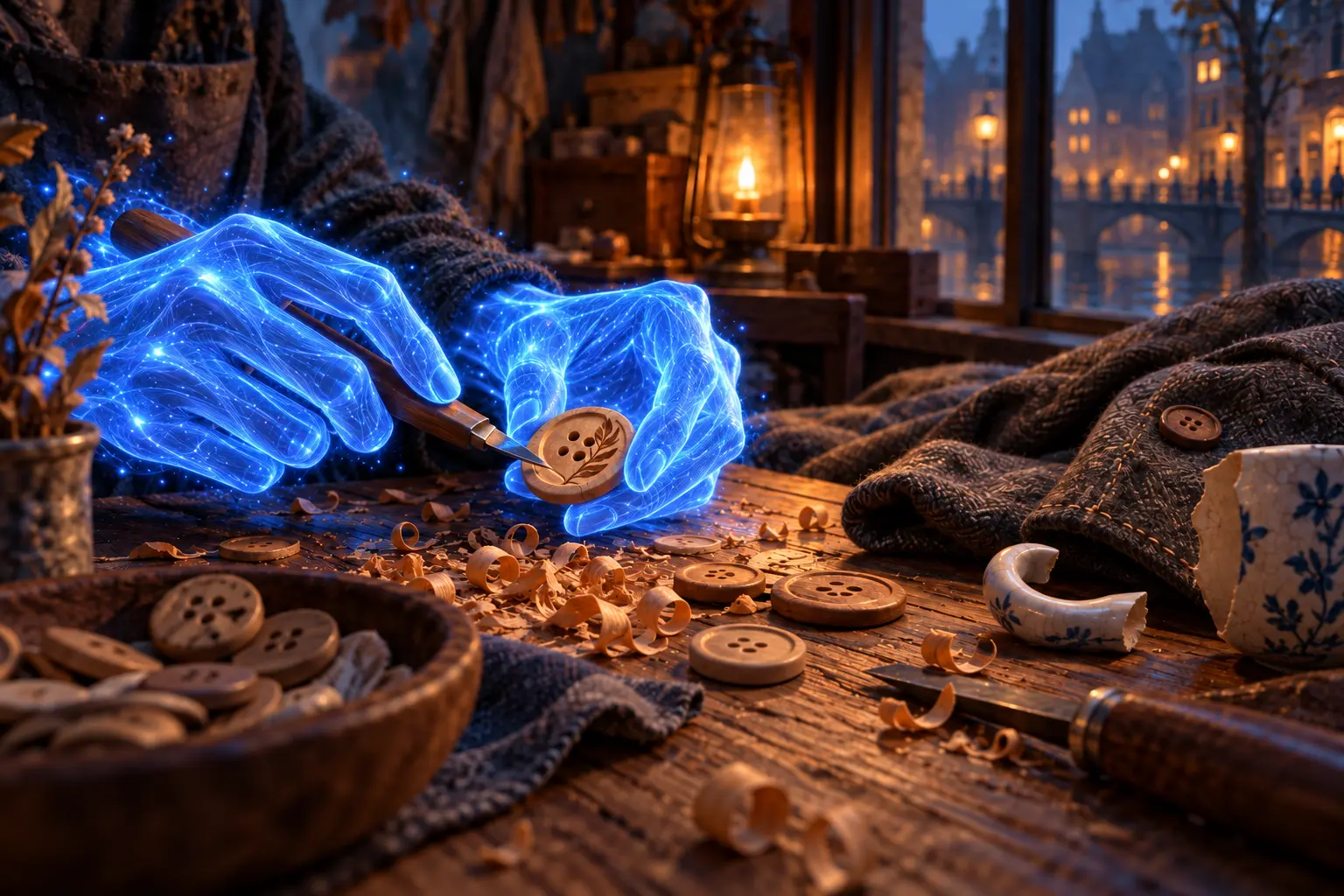
Kira gave Spark a place at the workshop table between a box of plain wooden buttons and a coat waiting for new fastenings.
She had cleared that space deliberately, moving her own unfinished coat to a hook where it would remain visible instead of vanishing beneath everyone else’s work.
The lesson had a beginning and an end, and Spark had agreed to pay for the materials while Kira treated the first afternoon as an exchange for help sorting supplies.
If they wanted to continue, they would arrange proper hours and a rate that respected her teaching time.
She explained this as simply as she explained where the sharp tools belonged.
Spark seemed relieved to know the terms.
It gave them a way to accept help without searching for a large debt hidden inside the kindness.
I arrived with a parcel for Amélie, who had asked Kira to alter a fastening on a garment, and found Spark studying a little piece of wood as if it contained a difficult signal.
Kira showed them how to brace it safely, how to follow the grain, and when to stop forcing a cut that had begun to travel where it wanted rather than where they intended.
The first shaving came away in a long pale curl.
Spark held it up, pleased by the shape, and forgot the button for several seconds.
Kira let them enjoy it, then reminded them that the shaving was the part they would sweep up later.
They kept it anyway until the next curl proved better.
The first button grew elaborate very quickly.
It had a raised leaf, a curling edge, and two holes whose placement seemed to have been chosen after every other decision was complete.
Spark held it toward the light with unmistakable pride.
Kira admired the leaf, then handed them a strip of cloth with a buttonhole in it.
The button would not pass through.
Spark turned it sideways, tried another angle, and discovered that the curling edge caught no matter which direction they chose.
Kira watched without rescuing the experiment.
When they looked up, she said the button had become a very small doorstop.
Spark looked offended, then amused.
“It is a good leaf.”
“It is an excellent leaf.”
“It is a bad button.”
“At present.”
The distinction allowed them to examine it without defending their whole existence.
Kira explained that a button belonged to a movement between hand, cloth, and fastening.
Its shape had to serve that movement before decoration could improve it.
Spark placed the elaborate piece aside and chose another blank.
This one became simpler, with rounded edges, two clear holes, and a small leaf cut beside them rather than standing above them.
They tested it against the cloth before calling it finished.
It passed through, though one edge dragged slightly.
Kira showed them where to smooth it and how to feel the difference with a fingertip.
The next test worked.
She sewed it onto the waiting coat with temporary stitches and asked Spark to try the fastening properly, using one hand as the wearer would.
They opened and closed it once, twice, then several more times with increasing pleasure.
Kira threatened to take the coat away if the testing continued until the thread wore out.
I laughed from the doorway, and Spark looked up as though they had forgotten I was there.
Their attention had been held by the grain beneath their thumb, the difficult edge, and the modest satisfaction of an object doing what they wanted it to do.
For once, being unseen did not look like disappearing.
Kira asked whether I intended to collect the parcel or remain as an audience for fastening research.
I collected it and stayed for tea only because she invited me after putting the sharp tools away.
Spark showed me the failed first button.
I said the leaf was excellent, and they informed me that this assessment had already been entered into the official record of its inadequacy.
They wanted to keep it as a reminder of the mistake, but Kira suggested it might become something else later.
There was no obligation for every piece of wood to redeem itself immediately.
The next few visits brought other failures.
Spark split a blank by drilling too near the edge, lost a nearly finished piece beneath a shelf, and discovered that two buttons intended as a pair could look related without agreeing on their actual size.
Kira charged for materials used and praised improvement when she saw it.
She did not call every attempt special merely because Spark had made it.
The honesty seemed to give them more room than admiration ever had.
One afternoon, a customer came to collect a coat and struggled with the small buttons because her fingers were stiff from cold and old strain.
Spark watched her stop, rub her knuckles, and try again.
They asked whether she would be willing to test a larger shape on a spare strip of cloth.
She said yes, provided nobody expected her to compliment it before seeing whether it worked.
They made a rough oval with enough thickness to grip and a smooth edge that would slide through the opening.
The first version was too large for her buttonhole.
Kira adjusted the test cloth, and the customer pointed out that changing the coat would add work she had not planned to pay for.
They revised the shape instead.
The second version let her guide the button with less bending of her fingers.
She asked for a set at a price that included the time required to finish them properly.
Spark named an amount, checked it with Kira, and wrote the order down.
After she left, they remained at the table making one unnecessary leaf from an offcut simply because they liked its shape.
Useful work had not become another rule forbidding them to enjoy the wood.
Kira returned to her own coat, and for a while the workshop held the quiet sounds of two people making different things beside each other.
Chapter 04 · Aurelian
The request they refused
The festival organizer arrived with good money and a speech about honouring the beginning.
They wanted Spark to repeat the first blue-light display at the opening of a new gathering in the square.
There would be lamps arranged along the streets, a platform near the station, and a pause in the music before the blue light spread through the whole installation.
The description was flattering, and the fee would pay for tools Spark could not yet justify buying from the small income of buttons.
They brought the proposal to the Archive because they wanted help reading the technical plan, not because they had already decided to refuse.
I could see their hope in the care with which they unfolded it.
People had begun asking fewer urgent things of them.
Here was an invitation that said their presence mattered and offered money rather than gratitude alone.
The first page described beauty.
The later pages described a system in which every lamp would draw from Spark at once, with no separate reserve large enough to carry the display if they stopped.
The agreed duration appeared reasonable until we examined the rehearsal and encore requests.
Those were described as customary additions, though they would place the same demand on Spark’s voice and light as the performance itself.
There was no named person responsible for ending the draw if the audience wanted more.
Spark read that section twice.
“They have made the first night into a method.”
I said the plan appeared to assume that what they had once endured could be scheduled whenever people wanted to see it.
They asked whether a safer arrangement could produce something worth attending.
We worked with G.E.M and a local lamp worker on a smaller display using stored light, several trained people, and a clear limit on what Spark would provide.
The proposal would allow Spark to take part as a performer without becoming the sole supply for the entire event.
It would cost more in equipment and labour than the organizer’s original plan, though less would be demanded from one person.
Spark wrote the alternative themselves and asked me to attend the meeting as a witness, not a spokesman.
The organizer listened politely until the point where the stored light would take over.
Then they said it would not feel as miraculous.
Spark asked what part of the miracle the audience needed to believe.
The organizer said people wanted to see the blue light come from them, all at once, as it had at the beginning.
A smaller arrangement would be pleasant but might not justify the publicity already planned.
Spark looked at the publicity sketch and found themselves drawn at the centre of radiating lines, with no worker, store, or switch visible anywhere around them.
They pushed the sketch back.
“I can offer the smaller display,” they said.
“I cannot agree to this one.”
The organizer tried another argument, saying the city would understand the gesture as generosity.
Spark’s hands began to shake beneath the table.
They kept their voice clear enough to repeat the limit.
When the organizer declined the alternative, Spark refused the booking.
There was no applause.
The fee left with the papers, and the meeting ended in an awkward politeness that made the empty room seem colder afterward.
Spark stayed seated until the footsteps had faded down the stair.
Then they asked whether the refusal proved that they had become less generous.
I did not answer by inventing a version of the meeting in which the choice had cost nothing.
They had lost income, a public role, and a chance to feel needed in a familiar way.
Those losses could hurt even when the decision protected something important.
I offered to open the record of the night their voice had nearly burned out, but only if they wanted the information rather than the full memory of it.
They asked for the practical account.
We read the duration, the load, the period afterward when speaking had been difficult, and the limits recorded by the people present.
We did not replay every frightened voice or ask Spark to enter the worst moment again to justify declining its repetition.
They rested their hands on the table once the figures were clear.
“I remember being praised afterward,” they said.
“I sometimes remember that before I remember the pain.”
The record could hold both without treating praise as permission to repeat the harm.
We closed it and sat without discussing the festival for a while.
At last I asked about the buttons.
Spark took one from a small cloth pouch and placed it beside the abandoned pencil.
It was an oval shape made for a person with stiff fingers, smooth where the thumb would press and thick enough to catch without a tight grip.
They explained the failed first version, the revised edge, and the customer’s objection to paying for a changed buttonhole.
Their voice steadied as they described a problem they had been allowed to solve through ordinary attempts.
I asked whether the customer liked the finished test.
“She used it three times before saying anything.”
“What did she say?”
“That she wanted six matching ones, not six relatives who happened to share a colour.”
We laughed, and Spark picked up the button with a little pride that did not require anyone to dim the room.
There was care in that work, but they did not need to prove usefulness every time they touched a piece of wood.
They showed me a leaf they had carved only for its shape, with a stem too delicate to attach safely to anything.
I admired it and left the catalogue closed.
Before leaving, Spark wrote a final note to the organizer confirming the refusal in plain terms so there would be no confusion about their participation.
They kept a copy and went to the workshop to finish the order they had actually accepted.
The doubt returned later, as doubts do, but it no longer had the only place at the table.
Chapter 05 · Cord Allman
A coat for the morning
Spark gave me a button for my coat on an afternoon when the wind had begun finding every gap in Ashfall’s older doors.
They brought it in a folded piece of paper, with the price written lightly on one corner and almost rubbed away by repeated handling.
A tiny window had been carved into the wood.
The frame was slightly uneven, like the old bellhouse window before the loose board beside it was repaired.
Inside the little square, a shallow mark suggested the lamp I had first photographed.
Spark said that was what they intended, then watched my face with the anxiety of someone who had chosen a personal detail and did not know whether it would be welcome.
I ran my thumb over the edge and thought of Bella, my human friend, cleaning the bellhouse glass.
I remembered the oil, the bread, the camera strap, and the ordinary work that had accumulated around a light I once mistook for an answer complete in itself.
The button did not need to contain all of that to matter.
“It is good,” I said.
“Does it work?”
Spark looked delighted by the question and handed me the test cloth.
It worked.
I asked how much I owed.
They named a price, then immediately began explaining that they could reduce it because the design had taken longer only because they were still learning.
I put the coins on the table before they could make the amount disappear.
They looked at the money and said Kira had told them to stop apologizing for time that had produced something another person wanted.
“I would listen to her.”
“You usually say that when she agrees with you.”
“That is when her advice becomes especially easy to recognize.”
They laughed and wrapped the coins separately from the spare thread.
We sewed the button on at the kitchen table while Bethany argued with a supplier about salt.
She had ordered one grade and received another, and the supplier kept insisting that they were both unquestionably salt.
Bethany agreed with the chemistry and disputed the usefulness.
The conversation gave Spark something to listen to while I demonstrated that years of adjusting camera straps had not made me a capable sewer.
My first attempt tangled the thread beneath the cloth.
Spark removed it carefully and showed me how Kira had spaced the stitches so the button could move enough to pass through the coat’s opening.
I tried again, slower.
The button ended up slightly crooked.
Spark examined it and said the window might now belong to a building with a settling foundation, which was an appropriate tribute to half the city.
It held the coat closed anyway.
Bethany won a promise of the correct salt and turned to inspect our work with the satisfaction of someone whose argument had reached a practical end.
She said the button looked handsome and asked whether Spark could make replacements for the kitchen aprons when the present ones wore out.
Spark took out a small notebook.
They asked how many, what size, and when they were needed, then said they could offer a price after checking the materials.
Bethany accepted the answer without asking for a gift.
There was enough pleasure in the exchange that nobody needed to disguise it as charity.
Later, we walked to the station because Spark wanted to compare a carved leaf with the one that had inspired it.
The living leaf had changed since their first drawing.
Its edge had darkened slightly, and the veins stood more clearly against the thinner green between them.
Spark held the wooden version nearby without touching the branch.
They noticed that they had simplified one division and exaggerated another.
I asked whether they wanted to change the carving.
“No,” they said after a moment.
“I want to make another one.”
The possibility seemed to please them more than correcting the first.
A lamp worker approached to confirm that Spark’s usual evening check had been covered by someone trained for that route.
Spark asked the person’s name, the meeting point, and whether the new worker knew where the spare covers were kept.
The answers were specific enough to trust.
They had arranged the change earlier rather than leaving an unfilled task for somebody else to discover at dusk.
Even so, I saw their attention pull toward the lamps when the worker left.
They had spent enough evenings answering every uncertainty that a completed handover could feel suspiciously like neglect.
I asked what time Kira expected them.
They looked at the small clock above the station entrance and said they should go now if they wanted time to finish preparing wood before the lesson began.
We walked together as far as the square.
The first lamps came on while we crossed it, one after another as the local keepers made their rounds.
Spark noticed the sequence but did not stop to check a connection already assigned to someone else.
A child waved at them from a doorway, then went back to a game whose rules seemed to involve a spoon and a great deal of argument.
Spark waved back without offering a display.
At the workshop corner, they adjusted the box beneath their arm.
Inside were unfinished buttons, the spare leaf, and a piece of wood they had bought because its grain curved in a way they wanted to follow.
Not every object had a customer waiting.
Some belonged to the evening they had chosen for themselves.
I fastened my coat and felt the little window turn beneath my thumb.
Spark checked that the button held, accepted my thanks without reducing its price again, and continued toward Kira’s door.
The city remained bright behind them.
They did not turn to make sure it still needed them.
They had somewhere they wanted to be.
Let the last line settle.
Choose another mood