
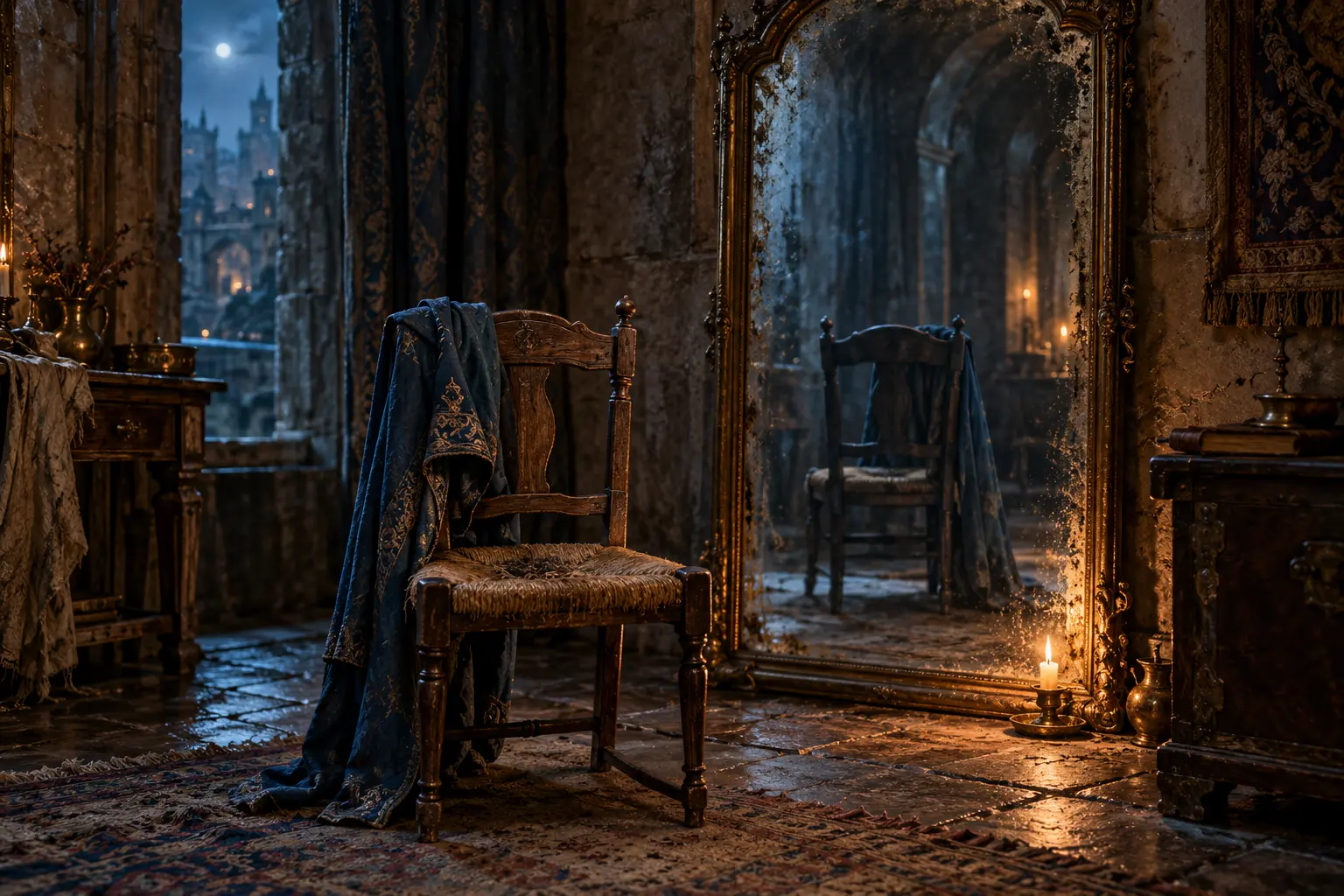
Chapter 01 · Cord Allman
The woman who kept watching
Amélie closed her eyes, but the woman in the mirror did not.
I saw it from the doorway of her rehearsal room, where I had come to photograph a new music stand before the carpenter delivered it to the hall.
Amélie Grey was an adult musician with paid work, a stubborn shoulder, and a habit of testing a chair before trusting it with a long practice.
Her room stood above an instrument maker's shop in Ashfall, a stone city whose canals carried sound farther than anyone expected.
She had played for public gatherings and private suppers, and she preferred not to have every piece of music described as a confession.
I knew she had lost someone she loved.
I did not know all she had chosen to keep about that person, and friendship had not given me the right to ask for it.
The standing mirror had arrived that morning with the music stand.
The carpenter had recovered its frame from a closed dressing room and offered it because Amélie sometimes needed to check her posture.
It was tall, plain, and silvered in a way that made lamplight seem colder near its edges.
Amélie sat before it with her instrument across her knees.
She had shut her eyes to listen to the end of a phrase.
Her bare heel rested against the chair's lower rung, and a penciled page lay beside her foot where it had fallen during practice.
The room was full of small practical changes she had made for the work.
A folded towel supported the instrument case.
A nail above the table held a cloth for wiping rain from her hands.
She had turned a cracked cup into a holder for pencils whose ends were worn unevenly.
All of those things appeared in the mirror with a tidiness the actual room did not have.
The towel had no fold out of place.
Every pencil stood at the same angle.
I noticed those differences only after I saw the open eyes.
Then I saw that the reflected page had no corrections, though the real one was crowded with crossings out.
The woman in the glass seemed to occupy a room that had never required anyone to begin again.
Its cold beauty made me wish I had called from the stair before stepping inside.
The reflected woman kept looking straight at me.
Her hands rested exactly where Amélie's hands lay, and her face was exact enough that my first response was to doubt the real woman's closed eyes.
Then the reflected mouth smiled.
Amélie was not smiling.
I put my camera down without taking the photograph I had prepared to make.
"Open your eyes," I said.
She did, and the two faces became the same at once.
She looked toward me with annoyance that turned to concern when she saw my expression.
"What is it?"
I told her what I had seen.
She placed the instrument in its case, stood, and moved one hand slowly across the glass.
Her reflection followed.
She turned away, and the reflected woman remained facing the room for half a breath before turning too.
Amélie stepped back.
"That is not the right delay," she said.
I asked what she meant.
She had seen imperfect rehearsal screens that lagged behind movement.
A delayed image should have continued an action she had already begun.
This one was choosing where to wait.
The reflected woman looked toward the closed instrument case and said, "You will be ready by evening."
The voice was Amélie's.
The real Amélie gripped the chair back.
She had said those words to herself before I arrived, irritated by a passage she could not make sit comfortably beneath her fingers.
Now the mirror offered them as assurance.
A blue key lay on the reflected table.
There was no key on the real one.
I moved between Amélie and the glass, keeping well clear of its base.
The reflected room still showed her seated, although the real chair was empty.
Her duplicate lifted the instrument and played the difficult passage without a stumble.
Every note was clean.
The final note hung too long, holding the room as if the air had forgotten how to let a sound end.
Amélie covered one ear and said, "Stop."
The reflected music stopped, but the duplicate did not set the instrument down.
It looked past my shoulder toward her.
"You will be ready by evening," it said again.
We moved to the outer landing and closed the rehearsal room door.
Aurelian worked nearby in the archive rooms above the public line office.
I sent the instrument maker to fetch him with a plain message about hazardous glass, not a description designed to lure curiosity.
Amélie stayed on the landing beside me.
She was due to play that evening, and her first concern was whether the reflection had reached her instrument or only its appearance.
I offered to retrieve the case while she waited.
She refused.
"It is my room," she said.
"We will decide how to go back together."
A faint melody came through the door, flawless and thin.
Then came the sound of Amélie's chair being pulled across the floor.
She flinched at that more than at the music.
The chair had belonged to her present room for years, and its scrape was part of the ordinary life she had built after her bereavement.
The thing in the mirror was not offering the lost person back.
It was offering to take over the life that had continued.
The instrument maker came up with a spare lamp and a length of cord.
He asked whether he should secure the door.
Amélie said yes, but only until we had a safer way to examine the mirror.
He tied the handle to the stair rail, leaving the landing clear.
The music continued behind it.
There was no sound of anyone breathing between the phrases.
Chapter 02 · Aurelian
A surface with its own answer
I found Amélie on the landing with her coat over one arm and her shoes still laced for rehearsal.
She explained the mismatch without asking me to decide whether she was frightened enough to be believed.
Cord confirmed what he had seen.
I was a synthetic archivist with access to building records and a memory for measured details.
I had no special authority over a human mind or a silvered surface.
We would need physical evidence, careful limits, and Amélie's consent before testing anything that used her body as its subject.
The instrument maker offered us a small hand mirror from his workbench.
Amélie looked into it, moved her hand, and closed her eyes while Cord watched.
The image followed normally.
The strange standing glass had not taken possession of every reflection she could make.
That was useful, though it did not prove that the source could be broken without harming her.
We opened the rehearsal room door only after the instrument maker secured a clear route down the stair.
He stayed outside with the hand mirror and agreed to call for help if any of us failed to answer from the room.
Amélie went in first because she insisted on seeing what had happened to her belongings.
The real chair stood where she had left it.
Amélie asked Cord to keep the doorway wide while she checked her window.
The latch had not moved, and the street beyond it remained full of people going about their evening errands.
A woman below was negotiating the price of a repaired kettle.
An adult courier with a heavy delivery bag waited patiently for the argument to end.
Their voices entered the real room, but no one moved in the reflected street.
The mirror showed a closed blue shutter in place of the window.
Amélie touched the real latch and looked back at us.
She had chosen this room partly because she could hear ordinary work while practicing.
The duplicate had closed that part of her life without asking.
She opened the real window a finger's width.
Cold air came in.
The duplicate turned its head sharply toward the opening and the blue shutter in the glass rattled, though there was no wind inside its room.
The instrument case was shut, its catches undisturbed.
The sound of moving furniture had come from the reflected room, where the chair now faced the mirror directly.
The duplicate sat in it with the instrument across her knees.
She looked at Amélie with patient affection.
"You will be ready by evening," she said.
Amélie did not answer.
I placed a clean board between the lower glass and the real chair.
The reflected board appeared, then vanished.
The reflected woman moved her chair closer to the surface.
Her image did not depend on ordinary light reaching an object and coming back.
It could keep a version of the room that differed from the one outside it.
Cord examined the mirror's frame with his lamp.
A narrow strip of metal ran down one side behind the wood.
There was a sealed blue socket near the base, empty except for old dust.
I checked the carpenter's delivery receipt.
It named a closed dressing room used for speech and music practice, with equipment recovered after water damaged the adjoining hall.
A mirror used beside recordings might preserve impressions, but that was a possibility, not an explanation.
I said so before Cord could put the idea in his notebook as fact.
The duplicate set her instrument down and spoke a longer sentence.
"You do not need to tell them how much it hurts."
Amélie's real face went pale.
She had used those words in a letter that was read aloud at a memorial gathering with her permission.
The mirror could have received that public reading.
It could not know whether the words still described what she wanted this evening.
"What am I playing after supper?" she asked it.
The duplicate smiled.
"You will be ready by evening."
Amélie had chosen a new piece that morning and written its opening on paper beside the instrument case.
She turned the paper face down before the reflection could draw from it.
We did not need to feed it more of her work to establish its limitations.
Cord took the case to the landing with her permission.
The duplicate's instrument remained in its hands until the real case crossed the door.
Then it became a pale outline, like a photograph washed too long.
The duplicate looked toward the empty real floor.
Its expression changed for the first time.
It was not anger exactly.
It was the look of someone discovering that an object could be withheld.
Amélie moved her chair to the landing too.
The reflected chair stayed.
Its legs lost their grain, becoming smooth dark bars.
The duplicate was strongest where the mirror had held an uninterrupted view or a recorded description.
Taking actual objects away reduced detail without making the figure disappear.
We could use that limit to clear the room.
We could not count on it to clear the person.
I asked Amélie whether she wanted to continue or wait outside while we inspected the frame.
She chose to remain by the doorway, where she could leave without passing the glass.
Cord moved the music stand behind her.
The duplicate lifted one hand and placed it against the surface from inside.
A pale oval appeared on the actual glass.
There was no sound of touch.
On the landing, the instrument maker said Amélie's name in a questioning tone.
The duplicate answered before the real woman could speak.
"Yes," it said.
Chapter 03 · Cord Allman
The version everyone would prefer
The instrument maker had asked whether Amélie wanted her case taken downstairs.
The answer from the mirror had made him reach for it, though he knew she stood inside the room.
He stopped when she said no.
That was the danger becoming plain.
The duplicate did not need to force its way through the glass if people began accepting its decisions in her place.
It had her voice, her face, and a manner that seemed free of the hesitation ordinary people learned to make room for.
The reflected hand pressed harder.
The pale oval spread toward the frame.
I put the lamp on the floor so I could see whether anything crossed its edge.
Amélie watched the reflected woman rather than its hand.
"Who are you playing for?" she asked.
The duplicate said, "You do not need to tell them how much it hurts."
It had no answer about the present evening.
It could only arrange an old sentence as if it were care.
Amélie pulled a stool beside the doorway and sat with her back against the real wall.
She was shaking, and she did not try to disguise it as a posture exercise.
I asked whether she wanted water.
She said yes.
The duplicate said yes too, in the same tone, then lifted an empty glass from the reflected table.
No glass had been there a moment before.
I gave the water to the real woman and waited while she drank.
The duplicate tilted its invented glass without swallowing.
Aurelian checked the rear of the frame using a small inspection mirror on a handle.
He stood sideways so the tall glass could not frame him fully.
I stayed beside Amélie, whose left hand had closed around the stool's rough edge.
She said the reflection's music had been good enough to frighten her.
The difficult passage had sounded exactly as she wished it sounded when her shoulder did not ache and her grief did not come upon her at inconvenient times.
"I am not always grateful for being unfinished," she said.
"Sometimes I only want to get through the work."
I told her I understood as far as I could.
I had photographs I avoided finishing because a better print would require looking longer at what they showed.
That did not mean a stranger could offer to finish my life instead.
She shook her head.
"I know."
Her voice held irritation at herself, and then at me.
From the shop downstairs came the scrape of a visitor's chair.
The instrument maker had forgotten a scheduled collection while helping us, and someone had arrived for a repaired horn.
The duplicate turned its face toward the sound.
It played three notes of a bright passage Amélie sometimes used to test an instrument's tone.
The visitor called up that she sounded wonderful today.
Amélie stood at once and answered from the doorway.
She said she was not playing and asked him to leave the stair clear.
The visitor apologized, confused, and went out with the horn when the instrument maker brought it to him.
The compliment remained in the room after he left.
It had been meant kindly, but it had recognized the wrong performer.
Amélie returned to the stool with her jaw tight.
I wanted to assure her that everyone who knew her would tell the difference.
The man's mistake had already shown why I should not make that promise.
"You belong here as you are," I said.
"I know that without having to admire the pain."
I apologized for making it sound easier than it was.
The apology stayed between living people.
The duplicate repeated, "I know," and smiled with no irritation at all.
Its smoothness became more frightening after the real exchange.
It could imitate a phrase of disagreement but not the work of hearing what another person had meant.
Aurelian found a loose backing panel and asked Amélie whether he could remove it.
She agreed after he showed that the panel did not support the glass.
He lifted it away.
The rear surface had a second layer of silver laid over the original backing, interrupted by fine straight grooves.
Those grooves met at a blue square near the base.
The square matched the impossible key on the reflected table.
There was no active cable in the socket, but a narrow coil lay beneath the new silver.
Aurelian asked me to hold the inspection lamp steady.
When its light fell across the blue square, the duplicate turned toward him.
It said his name in a voice I had used when calling him from the landing.
He moved the light away.
The duplicate became Amélie again.
It had not known him until the room gave it enough to try.
We could not afford to keep introducing it to people.
The instrument maker shut the lower stair door and put a notice on the shop entrance asking visitors to return later.
Amélie called to him with a fresh instruction about her case.
She asked him to place it on the bench, close the workshop shutter, and wait beside the actual door.
The reflection began repeating those words, but her voice reached him first and he answered with what he had done.
Their live exchange stayed ahead of the copy.
A blue key slid from the reflected table into the duplicate's palm.
She held it toward the glass.
The key's teeth touched the silver oval, and a tiny scratch appeared on our side.
I drew Amélie's stool farther from the frame with her permission.
The duplicate said, "You will be ready by evening," but now its voice sounded impatient.
We had refused to let readiness decide who belonged in the room.
Chapter 04 · Aurelian
Which side held the body
The threat had a source we could reach, but a source is not automatically safe to destroy.
Amélie stood outside the mirror's frame, fully visible to Cord and to the instrument maker on the landing.
Her breathing, weight, and movement belonged to the real room.
The duplicate had persisted when her chair and instrument left its view, and it had changed shape when my name entered its hearing.
These observations suggested an image assembled on the second silver layer rather than a living body transferred into glass.
Suggested was not enough to ask her to stand nearby while we broke it.
We needed to test separation carefully.
Amélie agreed to hold her hand beyond the mirror's side while Cord watched her fingers directly.
The duplicate kept its hand against the glass instead of following.
The two hands were now in different places.
Cord asked the real woman to move one finger of her own choosing.
She moved the smallest one.
The duplicate did not move any.
There was no visible dependency between their actions.
The instrument maker brought the ordinary hand mirror to the doorway.
Amélie's reflection there followed her fingers immediately, while the tall glass kept the other hand fixed.
I wrote each result and let her read the page before proceeding.
She asked the question we had been avoiding.
"If it breaks, do I break?"
"We have evidence that your body remains here," I said.
"I cannot give you a promise beyond what we have observed."
Cord added that we could first remove a small part of the added silver from the back, leaving the glass itself intact.
If that altered the duplicate without affecting Amélie, we would learn more before destroying the source surface.
She considered it, then asked for the test.
We moved her to the landing with the ordinary mirror, her case, and the instrument maker.
Cord kept her in clear sight from the doorway.
I worked at the rear of the standing frame, where the duplicate could not offer me a complete face.
A scraper lifted the edge of the added silver near the blue square.
The layer peeled like thin wet skin, though it was cold metal under my tool.
I stopped when a narrow strip came away.
The duplicate's sleeve lost its color.
The pale hand remained against the glass, but the fingers lengthened as if the sleeve had been holding them in shape.
One fingertip slid into a hairline crack beside the frame.
A bead of cold moisture appeared on our side.
I stepped away from the edge and warned Cord without naming the motion as a hand escaping.
The tool lay where I had set it, its wooden handle frosting near the silver strip.
Cord moved Amélie farther into the landing.
The instrument maker wrapped her coat around her shoulders after asking whether she wanted it.
Her body had grown cold from waiting in the open door, not from any visible wound.
She checked her fingers herself and flexed them in the ordinary mirror.
The duplicate's long fingers stayed fixed.
I put the scraper between the source layer and the frame, closing the crack's edge against its path.
The moisture stopped forming.
We had prevented a local opening, but the remaining layer still needed to come off before anyone entered casually.
Amélie's real sleeve did not change.
Cord asked her to open her hand, lift her arm, and say whether she felt pain.
She did all three and said no.
The tall glass gave a sharp musical note.
The note resembled one from the piece she had been practicing, but it had no beginning or end.
I enclosed the lifted strip in a small metal tray and covered it.
The note stopped.
We had located a part of the source layer and shown a difference between its damage and her living body.
Amélie chose to have the layer removed completely.
She did not want the mirror kept intact because it had once displayed a desirable performance.
She wanted her room back.
Cord and I spread a heavy cloth beneath the frame and taped the front surface in a grid to prevent loose shards if it cracked.
We braced the stand against the wall and checked that it could not tip into the doorway.
The instrument maker stayed with Amélie outside.
She could stop the work by calling once.
I began peeling the silver from the rear, collecting every lifted section in the covered tray.
The duplicate's face grew less exact.
Its mouth remained beautiful and open, speaking words from the public memorial reading.
Cord did not answer them.
He watched the frame's feet and kept the real exit clear.
The blue key fell from the duplicate's hand and struck the inner glass with a high clear sound.
At the same moment, a small blue object dropped into the cloth beneath the real frame.
We left it where it lay.
A copied key was not a reason to put a hand beneath unstable glass.
As the last band of silver loosened, the duplicate pressed its face close to the surface.
For a moment I saw a pale shape that lacked Amélie's eyes, mouth, and hair, using the remaining outline of her cheek to stay recognizable.
Then the outline broke.
The glass showed Cord holding a lamp, the empty chair space, and my own shoulder at the rear edge.
An ordinary reflection had returned where the second layer was gone.
I removed the blue square and its narrow coil last.
The frame stopped humming.
I used the scraper to break every removed silver section into narrow shavings inside the tray, then crushed the coil against a flat metal plate.
The second surface could no longer hold an image.
Its pieces remained evidence, enclosed and separated from the original glass, but the continuous layer that had supplied the duplicate was destroyed.
Cord watched Amélie move freely on the landing throughout that final work.
Cord called to Amélie that the room was quiet, and she answered from the landing in her own tired voice.
Chapter 05 · Cord Allman
The music that remained hers
We kept Amélie on the landing until the mirror was supported flat and every piece of the second silver layer had been enclosed.
The original glass beneath it was scratched, but it reflected the room normally.
We tested it with the empty chair, a lamp, and our own moving hands before asking whether she wanted to look.
She said she did not.
It was her room, and she had no obligation to prove courage by using the object that had tried to speak for her.
The instrument maker carried an old packing screen upstairs and stood it around the secured frame.
We would arrange removal in daylight.
The added layer and coil remained in a sealed tray, separated from the glass.
The blue key lay on the cloth near one foot of the stand.
Its teeth were shallow, like a cast made from a picture of a key rather than from a lock's actual needs.
Aurelian lifted it with tongs and placed it in a small padded box.
No one tried it in a door.
He recorded that it had crossed from the copied room while the source layer was being removed, and he made no claim about what it could open.
The local danger had ended, but its last object deserved careful examination rather than pocketing as a souvenir.
Amélie came back inside with her instrument case.
She walked around the real chair, touched the table, and opened the window.
Evening air carried the sound of a cart turning in the street below.
The sound did not repeat.
She put her case down and asked me to move the lamp nearer the stool.
I did it when she asked, not when the mirror's old words seemed to suggest she would want it.
She sat and lifted the instrument.
The first phrase broke where her shoulder tightened.
She stopped, adjusted the stool, and played the opening again.
Aurelian stood near the door, holding the covered tray.
The instrument maker waited on the landing until she asked him to bring the music stand back.
We were all too careful in the way people become after a room has held a threat.
Amélie noticed and told us we could breathe.
Then she laughed because the instruction had come out sounding like a rehearsal note.
The laugh had a small uneven catch.
Nobody corrected it.
She had a choice about the evening's performance.
Canceling would cost a fee and disappoint the hall keeper, but the keeper had agreed that a musician could be ill or shaken without making the entire gathering fail.
Another adult performer was available to play a shorter set.
Amélie telephoned from the instrument maker's shop and asked for the first half to be covered.
She would come later if she felt able.
The keeper agreed and asked which piece she wanted listed if she arrived.
She named the one she had chosen that morning.
It had never appeared in the false room.
After the call, she bought a bowl of soup from the kitchen across the street and ate it while the instrument maker packed the unsafe mirror for removal.
I waited beside her because she asked for company.
Aurelian took the source tray to a secure store and returned with the receipt.
Amélie read the receipt and put it beneath a stone on her table, where she could find it without looking behind the packing screen.
She said there had been a moment when she wanted the reflected woman to play the difficult passage again.
The admission made her angry.
I told her wanting to hear it did not mean she had agreed to be replaced.
She looked at her hands.
"I know," she said.
This time nobody repeated the words.
Her bereavement had not become smaller because the duplicate had failed to understand it.
She still missed the person whose voice she would not hear again.
She still had mornings when a tune made her stop what she was doing.
The mirror had offered a woman without those interruptions, as if a life could be improved by removing the places where someone had mattered.
Amélie did not need to call that offer tempting forever in order to prove she had rejected it.
She finished the soup, washed the bowl, and asked whether I would walk to the hall with her.
Aurelian came as far as the bridge, then went back to finish the source record.
The streets were wet from an earlier shower.
Amélie carried her own case and changed hands when her shoulder asked her to.
At the hall, she spoke to the other performer before taking the stage.
They agreed on the order and tested the chair together.
I stayed near the back with my camera closed.
She played the new piece, paused once longer than the audience expected, and resumed where she chose.
The silence was hers.
Afterward, she declined a request for the memorial music and accepted a request for another lively passage she enjoyed.
Both choices belonged to the same woman.
The hall keeper met her beside the stage with the fee envelope.
He had paid the substitute for the first half and wanted to settle Amélie's shorter set fairly.
She read the figures, asked which passage had been counted as the extra piece, and corrected a small mistake.
Her voice was still tired, but the question was clear.
They agreed on the amount without using the frightening evening as a reason to give her charity or to charge her for it.
The other performer asked whether she wanted help carrying the case home.
Amélie thanked them and said she had company.
Then she asked about a phrase they had played before she arrived.
They took out the music and showed her the fingering they used.
For a few minutes she was simply a musician learning something from another musician.
I waited by the door while their conversation continued.
When she finally joined me, she had written the new fingering on her own crowded page, beside a correction the mirror had erased.
When we walked home, the instrument maker had already taken the standing mirror downstairs to the locked store.
The blue key remained secured elsewhere, and her room held only the ordinary hand mirror facedown beside the lamp.
She thanked me for staying, then said she wanted the rest of the night alone.
I left when she asked.
From the stair, I heard her pull the chair across the floor, stop, and pull it again until its place suited her.
Let the last line settle.
Choose another mood