
Chapter 01 · Cord Allman
The door without a room
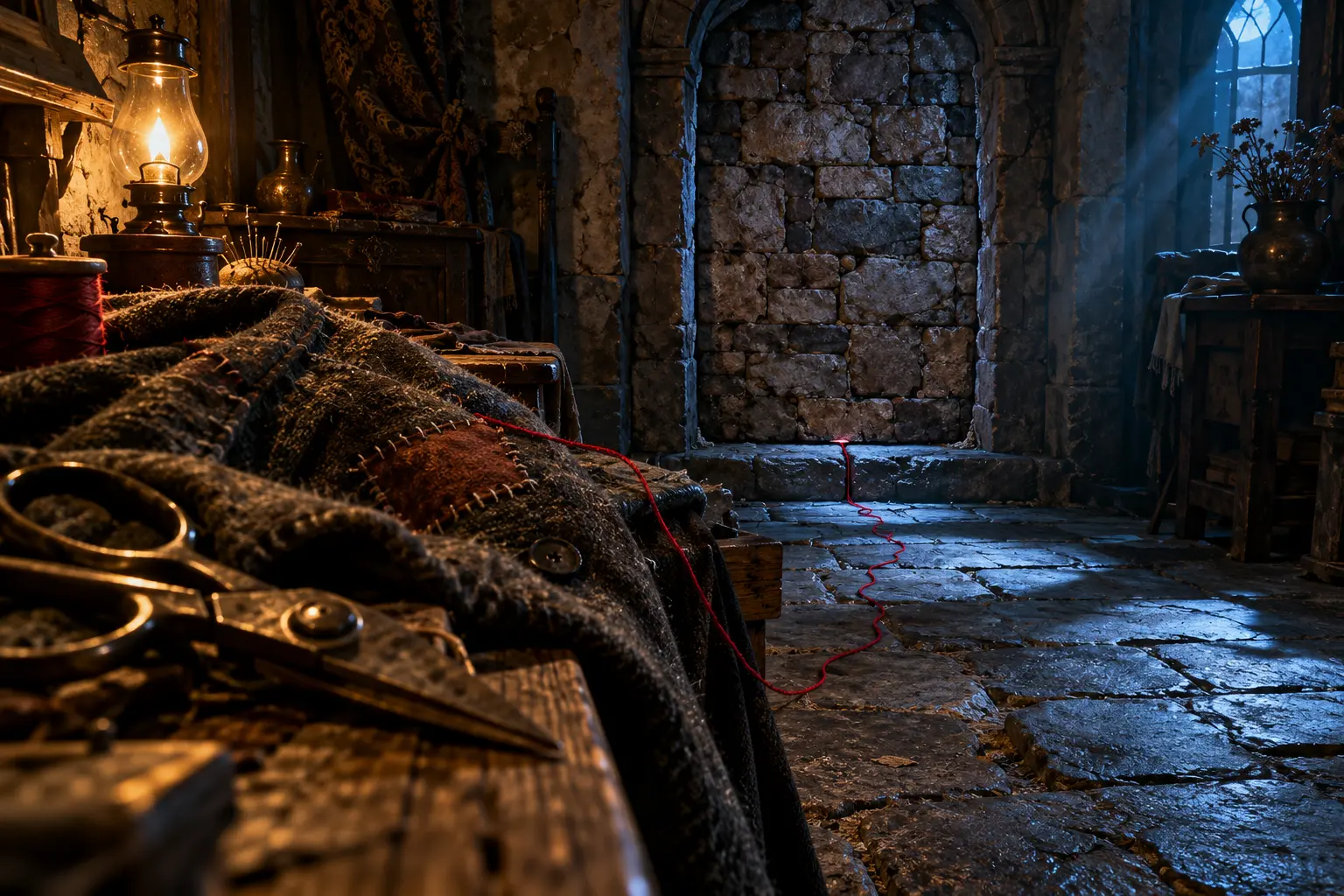
Every night, another length of red thread appeared beneath a door that had been bricked shut.
Kira had been collecting it in a blue bowl, and by the time she asked me to photograph the doorway, there was enough thread to mend every coat on her bench.
She was a grown woman who repaired material things for a living, with good shears, a ledger of fair prices, and no patience for a hinge that had been painted over.
Her workshop stood beside a narrow canal in Ashfall, the stone city where I kept my cameras and a room full of pictures that still needed names.
The door occupied the workshop's back wall.
Three courses of brick filled its opening, but the old wooden jamb remained around them, and a brass latch still hung where a door had once closed.
Nobody could explain why the builders had kept it.
Kira had rented the room after the passage beyond it was declared unsafe.
She had never seen whatever lay on the far side.
"The thread comes through there," she said, pointing to a joint between the lowest bricks.
"I thought a neighbor had dropped a spool."
She showed me the bowl.
The red had the warm depth of blood seen through skin, though I did not say so.
A loose end lay over the rim and touched a chipped spot that Kira had marked with pencil.
The pencil mark was still there, but the chip beneath it was smaller than its outline.
I put the bowl on a sheet of paper and traced the remaining break before doing anything else.
Kira watched me make the outline and said the chip had come from a dropped spoon.
She could remember dropping it, but not who had been eating with her.
A thread does not need help becoming frightening.
"Did you use any?" I asked.
She lifted a wool coat from the bench.
Its elbow had been restored so neatly that I could not find the tear until she held it to the light.
The stitches did not cross the broken fibers.
The fibers had become whole again around them.
"I pulled the thread through once," Kira said.
"After that, the needle moved as if the cloth was guiding it."
She had stopped sewing, unpicked the first row, and then seen the elbow repair itself overnight.
I asked where the removed thread was.
She pointed to the bowl again.
No knot distinguished the used piece from the rest.
Bella came in from the street carrying bread and a folded paper parcel.
She was a practical woman whose first response to a room full of troubled people was often to check whether they had eaten.
Today she put the bread down without offering it.
"This is not my apron," she said.
Kira took the parcel and unfolded a linen apron with a green patch at the pocket.
Bella had brought it for a repair the previous day.
I knew this because I had seen her carry it up from the community kitchen, tucked beneath her arm with the torn tie trailing.
Now the tie was whole.
The patch was gone.
Even the marks where the patch had been sewn had vanished.
"It is your apron," Kira said.
"I repaired the tie."
"My sister put that pocket on when I first started kitchen work."
Bella touched the smooth linen as if searching for a scar on someone she knew.
"I remember the patch," I said.
Her face changed.
"So do I," she said slowly.
"But I cannot remember her putting it there."
She said her sister was alive and worked across the river.
Nothing had happened to that woman.
What had vanished was the afternoon when they had sat by a window arguing about whether the green would look foolish.
Bella knew the event had occurred because she had told the story so often.
Its details no longer came when she reached for them.
Kira placed the apron on the table and turned away from the blue bowl.
Her shoulders held the rigid care of someone afraid that a careless move might injure another person.
"I used ordinary cotton on the apron," she said.
Then she looked at the bright new tie and knew she had not.
The needle she had left beside the red thread had entered her work without her choosing it.
She could recall cutting linen, threading cotton, and drinking from her cup.
Between the cup and the finished repair there was an empty stretch.
I photographed the apron before anyone touched it again.
Bella stood beside me and named what should have been visible.
Patch, small grease stain, frayed hem, a burn near the lower pocket.
Only the burn remained, and as we watched it began to fade.
A red line showed briefly inside the cloth.
Bella pulled the apron from the table.
The line disappeared, but so did the burn.
She pressed one hand over her mouth.
"That was the day I dropped the pan," she said.
"I know I dropped it."
She stared toward the window.
"Where was I?"
Kira took her shears and cut the tie clear of the apron.
The cut made a crisp ordinary sound.
The red line returned along the hem, moving toward the pocket like a worm beneath a sheet.
She did not chase it with the shears.
She put the whole apron into an empty wash basin and set a flat board over it.
The board rose a fraction, then settled.
From the bricked doorway came the dry sliding sound of a spool rolling across an unseen floor.
It rolled for far too long.
Bella backed away, and I held the camera without lifting it.
We were all listening when the bowl on the bench tipped slowly toward the door.
Chapter 02 · Aurelian
Repairs without witnesses
Cord came to the archive for help with records rather than explanations, which made it easier for me to be useful.
I was a synthetic archivist who could retain documents, lists, and testimony.
I could not enter Bella's missing afternoon or decide what Kira had done in a gap she could not recall.
I brought blank paper, a measuring tape, and copies of the building plans.
At the workshop, the bowl had been enclosed in a bread tin, and the apron lay under a board weighted with two stones.
Kira had stopped all work.
Seven customers expected repairs that evening.
She had written each one a plain notice saying that an unexplained fault in her materials required delay.
She would not send the fault home simply because her ledger needed payment.
Bella sat on the window bench with her hands around a cold cup.
She had called her sister on a borrowed speaking line outside the building.
Their conversation was ordinary and reassuring until Bella asked about the green patch.
Her sister remembered sewing it, remembered the rain, and remembered Bella saying the green was the color of a canal in spring.
Bella could repeat those details now.
She still could not remember being there.
"I have a story about it," she told me.
"That is different from having the afternoon."
I wrote her words exactly and asked permission before putting her name beside them.
The record might help her later, but it was not mine to take because I had carried a notebook.
Kira brought out the other objects that had changed.
There were two gloves, a satchel, a table cloth, and the wool coat Cord had seen.
The satchel's owner had come that morning and failed to recognize a scratch beside its buckle.
He remembered catching it on a nail while helping a friend move house.
When Kira asked which friend, he could not say.
She had given him a plain spare bag and kept the satchel with his consent.
The thread appeared to remove marks of use and the memories joined to them.
It did not erase every fact about an object at once.
That slower action made the repairs seem generous long enough to enter a home.
We could test removal without giving it another person's treasured possession.
Kira had a scrap of canvas stained by a spilled cup only that morning.
Cord had witnessed the spill and photographed the bench afterward.
The stain meant little, but it had a known event behind it.
We put the scrap in a shallow tray.
Kira took a short piece of red thread from the tin with tweezers, laid it along the stained edge, and stepped away.
The thread sank into the weave.
The brown mark paled.
I asked Kira to describe the spill.
She remembered lifting the cup and turning toward the door.
She could not remember the liquid striking the cloth.
Cord could, because the thread had not repaired something he considered his.
I asked him to turn his back while Kira described the cup.
She could still remember buying it and choosing its handle for the space it gave her thumb.
The thread had not taken everything connected with the canvas.
It was eating the particular event that had left a mark.
We set the cup beyond the groundsheet and covered it with a plain cloth so that no stray end could reach its cracked foot.
That difference offered a limit we could use.
The material carried the attachment, and the strongest claim seemed to fall on its owner or maker.
I wrote seemed in the record, leaving it visible.
Kira used a blunt needle to lift one red loop from the canvas.
The loop resisted like a live muscle.
She pulled slowly while Bella held the tray still with a wooden spoon.
A continuous thread emerged, much longer than the piece we had laid down.
The stain darkened again.
Kira gasped and dropped the tweezers.
"The cup hit the thimble," she said.
"I laughed because it rang."
Cord confirmed that detail.
We had not spoken of the thimble during the test.
Removing the thread restored at least this recent memory, though we had no reason to assume older damage would reverse so neatly.
Bella stood at once.
"Then do the apron."
Kira wanted to promise her the whole afternoon.
I saw the promise forming in her face and asked them both to sit before we began.
The basin was trembling beneath its board.
We had to uncover it without allowing the red thread to touch anyone's clothing.
Cord cleared the bench and spread a glazed groundsheet over it.
Bella removed her coat and rolled up her sleeves.
Kira found a pair of broad handled pliers she used for leather work.
The building plan showed an old service passage beyond the blocked doorway, connecting to several workshops and a closed storage hall.
No room number existed where the thread seemed to originate.
A blank on a plan can mean poor surveying, a changed wall, or an omission.
It cannot safely be treated as permission to break through.
We needed to remove the thread from the objects first.
Only then could we decide what to do about the doorway supplying it.
Bella insisted on helping with her apron.
She could tell us when the linen began to look honestly hers again.
Kira handed her a clean wooden rod to hold the cloth down, not to touch the thread.
Cord lifted the board.
The apron lay perfectly flat, every ordinary crease gone.
One red stitch passed through its center where the green pocket should have been.
Below the board, etched into the wood's grain, was the clear round stain left by Bella's cold cup.
The thread had tried to repair the board too.
We moved the cup far from the bench.
Chapter 03 · Cord Allman
The work of taking back
Kira lifted the first stitch with the same patience she used on wool that belonged to someone with no spare coat.
The thread tightened, pulling the apron into a cone.
Bella held its edges down with the rod and said nothing.
Her quiet was deliberate.
I could see her wanting to ask whether the window had come back yet, whether her sister's laugh had come back, whether a person could recover an afternoon by pulling hard enough.
The questions would have made Kira's hands hurry.
She spared them that.
The red thread slid through the linen with a soft scraping sound.
A small oil spot appeared beside the pocket.
Bella let out her breath.
"I used to put the serving spoon there," she said.
"I stopped because it stained everything."
The next length released a crease near the waist, then the frayed lower hem.
Kira wound each extracted piece around a wooden tile.
She did not use a spool, because the sound of one rolling behind the bricks had made every empty spool on her bench feel expectant.
I kept the tin open just enough to receive the tiles and shut it between each one.
When the green pocket returned, it did not bloom into place.
Its stitches emerged first, tiny holes outlining an uneven rectangle.
Then the green showed through the linen like wet color through paper.
Bella began to cry while holding the rod exactly where Kira had asked her to hold it.
"The rain blew under the sill," she said.
"We had to move the chair."
She smiled once through the tears.
The memory had arrived with an inconvenience.
That convinced her more than any beautiful detail could have done.
Kira removed the final loop from the tie.
The original tear returned, plain and repairable.
Bella laid her palm beside it and refused to touch the thread.
"Leave the tear until you have rested," she said.
Kira nodded, but her eyes had already gone to the coat.
An adult man had needed it for work near the water.
If its memory kept being removed, he might lose more than a familiar sleeve.
We worked through the afternoon with the workshop shutter raised and ordinary street sounds entering the room.
Kira called each owner and asked permission to remove the unknown repair.
She explained that the original wear would return.
Nobody objected once she told them what Bella had experienced.
One woman said she would rather keep a torn table cloth than forget the table around which it had been used.
Another asked whether a glove could lose the hand that wore it.
Kira said she did not know, and that was why the gloves were staying in the workshop until the thread was out.
The table cloth had required a different kind of patience.
Its border held six separate pieces of red fiber, each beneath an old stain.
Kira lifted them one at a time while Bella kept the cloth spread flat.
At the third, an old candle mark returned and the smell of warmed wax entered the room.
We opened the window wider.
The smell faded without leaving a flame, but we checked beneath the bench before continuing.
The satchel was hardest.
Its lining had become flawless while we dealt with the apron, and every lifted stitch pulled against the buckle.
I held the buckle with a strap instead of my fingers.
When the long scratch returned, the brass made a ringing sound that seemed to come from the doorway rather than the bag.
Kira stopped.
A length of red thread had emerged beneath the lowest brick and was moving across the floor toward the bench.
It did not wriggle.
It grew steadily, as if someone beyond the wall was paying it out.
Bella set a clean glass jar over its end.
The thread rose inside the jar and touched the underside of the lid.
"It does not like losing its work," she said.
Aurelian measured its length from the wall without stepping over it.
We were leaving the apron and satchel damaged again, and the source was supplying new material faster.
I felt a childish urge to praise the repairs so that it would settle.
The urge did not belong to any sensible part of me.
It was the same weakness that makes a person agree with someone who has taken hold of their wrist.
I put my hand on the scarred edge of Kira's bench.
The grooves under my fingers came from years of work, and no one needed to apologize for them.
Kira set the satchel aside and checked the shears.
A red hair had wound around the pivot.
Her tools were being repaired too.
The shears opened smoothly, but the small chip in one handle had disappeared.
She stared at the handle.
"Where did I buy these?" she asked.
Bella answered that Kira had saved for them and bought them from a retiring cutter across the canal.
Kira looked at Bella as if she had been told about a stranger's good fortune.
We removed the thread from the pivot.
The chip returned.
Kira sat down abruptly and pressed her forehead against her wrist.
She remembered the cutter showing her how to rest her thumb without forcing the blades.
She had almost lost a piece of her own work while trying to return other people's belongings.
Bella closed the shutter halfway to make the room less exposed.
She put bread on a clean board and told Kira to eat.
Nobody called the pause a weakness.
The thread beneath the jar kept rising, filling the glass with red loops.
We would finish the objects, but finishing them would not stop the doorway.
Chapter 04 · Aurelian
The thing the latch held
The source had to be found without making the workshop's damaged wall fall on us.
I reviewed the plans while Kira ate and Cord kept watch over the jar.
Bella went to find the canal building keeper, who had supervised the bricking of the passage.
He came with his own lantern and a bar for testing loose stone.
He did not enter merely because we said a thread had become dangerous.
He stood outside the room, listened to the account, and asked what had already been tried.
I showed him the record and the canvas scrap, its ordinary stain restored.
Then he agreed to help inspect the far side.
There was another entrance to the service passage from a courtyard two buildings away.
It had been secured because a drain had failed, not because the whole roof was unsound.
The keeper could open the first section while leaving the flooded section closed.
Bella stayed with Kira to remove the remaining thread.
She also put a notice on the outside door and turned away a delivery of fresh wool.
The carter wanted to leave his bundle in the passage, saying he could not take it back across the canal.
Bella found him a dry ledge under a neighboring awning instead.
Keeping new material out of the workshop mattered more than saving the few steps the delivery would cost.
Kira heard the conversation and thanked him for waiting.
Cord and I went with the keeper through the courtyard.
It smelled of coal dust and wet rope.
He unlocked a low gate and wedged the door behind it so we would not have to grope for the fastening on the return.
We marked each junction with chalk on loose stones, following the real route rather than a line I remembered from the plan.
The lantern revealed brass rails running along one wall.
Most had been stripped of their fittings.
At the rear of Kira's workshop, the brickwork looked sound, though its lowest joint held a red thread as thick as twine.
It ran upward along the wooden jamb to the unused latch.
That latch had survived on both sides of the wall.
Someone had kept it as a convenient place to hook a bag or hang a lamp.
Now a small wooden reel sat behind its brass tongue, hidden in a square recess.
The reel's center was hollow.
Red thread passed around it without shortening, disappearing through a narrow split into the stone.
The keeper put his lantern down.
"That was not there when we closed this," he said.
We did not ask him to swear it.
The thread had been doing things ordinary materials could not do, and an unnoticed reel would not have been the strangest of them.
Cord photographed the reel before touching it.
I checked that the passage had no active speaking line.
A pair of old wires entered the recess, but both ends lay severed in dry dust.
We had found an anchor, not an explanation for the whole phenomenon.
The brass tongue held the thread at a sharp angle and seemed to prevent it from slipping back.
There was no reason to tug the thread until we knew what tension it carried.
The keeper tested the screws around the latch with his screwdriver.
One turned easily.
The red thread tightened, and from the far side of the wall Kira called out.
Cord answered immediately.
Her bowl had split in two.
No one was hurt, but the thread in the jar was pressing hard enough to make its lid bulge.
The anchor responded to physical movement.
We could not dismantle it while the thread still occupied the objects in the workshop.
I asked Cord to return and help finish that work.
He objected to leaving me in the passage, then accepted when the keeper pointed out that two of us would remain and the door was wedged open.
We did not need to remain in a frightened knot to keep one another safe.
While we waited, I counted the turns around the hollow reel.
Seven were visible.
Whenever I looked away to write, there were still seven, though their spacing changed.
The thread was maintaining its shape rather than unwinding from a stored quantity.
I described this to the keeper.
He told me his job did not require knowing why a pipe filled if he could find the valve.
I envied the simplicity of that, but the latch was no familiar valve.
We could only choose the safest physical action available.
Bella called through the wall when the last glove had been restored to its worn condition.
Kira said her tools were clear too.
Cord had enclosed all extracted pieces in the tin.
The jar held only the strand coming from the door.
We agreed to cut that strand simultaneously on both sides of the wall, then remove the anchor without leaving loose red ends in either room.
The keeper clamped the thread against a flat metal plate.
I put a lidded tray beneath the reel.
Cord called that his clamp was ready on the workshop side.
Bella counted down slowly.
At her last word, the keeper cut the strand with heavy snips.
A sound traveled through the stone, not a scream but a long strained note, like cloth tearing near a speaking tube.
The reel struck the tray.
Its hollow center filled with red loops.
I closed the lid, and the keeper removed the latch screws.
A handprint appeared in the dust beneath the brass, pressed by nothing we could see.
We stepped back until the print stopped spreading.
Then he lifted the latch with his bar and dropped it into the tray beside the reel.
The severed thread on the wall shrank into ordinary frayed fiber.
From the workshop came the crack of the jar lid settling back into place.
Chapter 05 · Cord Allman
Honest seams
The workshop looked less perfect after we finished, and that was how we knew which work remained ours.
The apron had its torn tie.
The gloves had thin fingertips.
The coat had an open elbow that Kira could repair with cloth chosen by its owner.
We placed every object on a separate sheet and photographed the returned marks before beginning any ordinary mending.
Aurelian recorded the owners' accounts without claiming that all memories had come back complete.
The satchel's owner remembered his friend's name again, but not what they had eaten that evening.
He could not tell whether he had ever remembered the meal before.
That uncertainty belonged to him.
We did not enlarge it into permanent damage or shrink it into a neat recovery.
Bella had the afternoon by the window, the rain under the sill, and the crooked green patch.
She called her sister a second time from the public line across the street.
When she returned, she looked tired rather than transformed.
"We argued about the green again," she said.
"She says it was my choice."
Kira laughed once, and the sound broke into a breath she had been holding too long.
The canal keeper laid the lidded tray on a stone shelf outside the workshop.
The reel inside remained full, but no more thread emerged through its seam.
We put the latch in a separate metal box, using tongs to move it.
A few red fibers were still caught around its tongue.
They did not vanish when cut.
I photographed the fibers and wrote exactly where they had been found.
The old service passage led farther beneath Ashfall than our safe inspection had allowed us to go.
Its route might matter another day.
For this day, the anchor had been removed and the wall had stopped supplying thread.
The keeper filled the lowest joint with fresh mortar and covered the recess on his side with a bolted plate.
He left the brass tongue missing rather than replacing it with another latch.
It had no door to hold shut.
We kept the tray and box in a locked materials store where neither would be mistaken for useful mending supplies.
Aurelian attached warnings that named the observed risks and forbade casual use.
The recovered thread was not a miracle material waiting for a cleverer owner.
It had taken pieces of people's lives while presenting them with cleaner possessions.
That cost could not be made fair by calling it an efficient repair.
Kira asked us to help her speak to the customers whose work was delayed.
She did not need us to apologize in her place.
She needed witnesses while she explained what had happened and arranged new times.
We sat with her through the evening.
A man with the wool coat came first.
He worked unloading boats, and the open elbow meant he would need another layer until the repair was done.
Bella found a spare coat in the building keeper's cupboard, and he accepted it after testing that the sleeves would let him lift.
Kira offered the ordinary mend free because the unsafe repair had been her responsibility.
He said she should charge for the new patch, since the old price had only covered a few stitches.
They agreed on a modest sum and wrote it down.
Fear had not made either of them careless about labor.
The woman who owned the table cloth arrived carrying a small photograph of a supper.
Its edges had been bent, and the table cloth in the picture bore the same candle mark that had returned that afternoon.
She held the picture against the cloth and cried quietly.
Kira let her have time, then asked whether the candle mark should stay visible in the repair.
The woman said yes.
The new patch would go underneath.
I found myself looking at each scar and stain as if I had never understood an object before.
That was an effect of fear too.
An ordinary tear did not suddenly become sacred because something had tried to erase it.
It could still be uncomfortable, inconvenient, or ugly enough that its owner wanted it changed.
The choice mattered more than our reverence.
Kira listened to each person and repaired only what they asked her to repair.
Bella stayed until the last customer left.
Then she made Kira stop for the night.
There was still the ordinary mess of interrupted work to settle.
We returned unused needles to their cases, washed the basin, and swept broken glaze from beneath the table.
Kira wrote down which customers would need loaned clothing and which could wait.
Bella checked the list against the actual bundles.
Twice they disagreed about a name, and twice they called the owner rather than trusting a tired guess.
That made the closing slower and the next morning possible.
The bench had been scrubbed, the needles counted, and all remaining thread came from labeled rolls whose purchase Kira could recall.
She turned the blue bowl's broken halves in her hands.
The crack passed through an old chip on its rim.
"I was going to mend this," she said.
"Not tonight," Bella answered.
Kira set the pieces on a cloth.
She could mend a bowl later with wire or have a potter join it, if she chose.
Its broken shape did not demand an immediate lesson from any of us.
Aurelian and I returned the following morning.
No thread lay beneath the wall.
The mortar was dry at its edges, and the keeper's plate had remained secure.
Kira had slept in a room above another workshop, away from the place where the bowl had rolled toward the bricks.
She intended to return to her own bed that evening, but she would leave the bench lamp burning.
Bella brought the apron back for its ordinary tie repair.
They selected plain cotton together and tested the needle before beginning.
I watched Kira make the first stitch, draw it through, and stop to adjust a fold.
The cloth did not guide her hands.
The finished tie would hold because she understood her work, and its uneven places would remain available to the person who wore it.
Outside, someone had snagged a sleeve on a gate and was complaining about the tear.
Kira heard them, opened her window, and said she could look at it after lunch.
Let the last line settle.
Choose another mood