
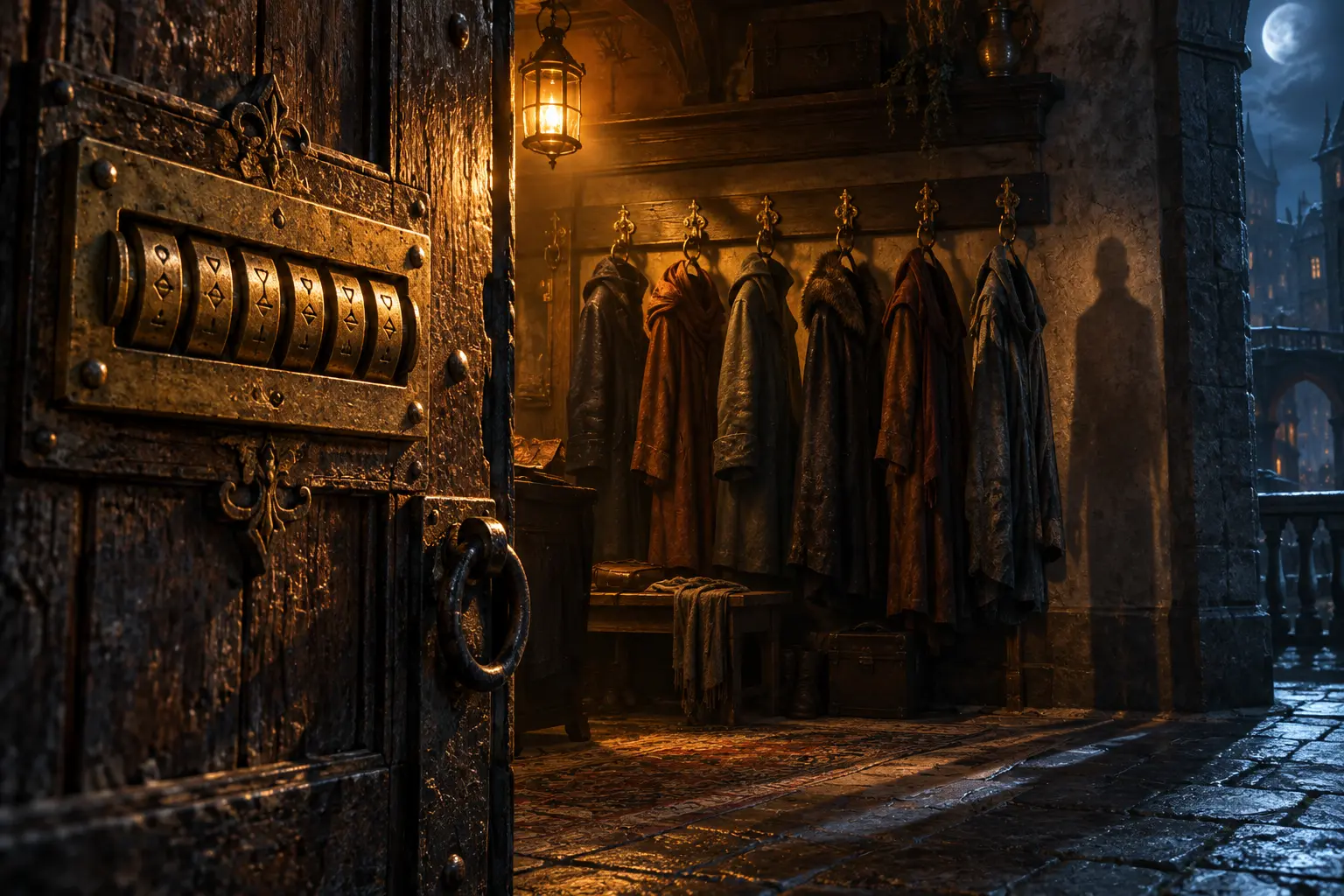
Chapter 01 · Cord Allman
One number too many
The service door counted six of us going in and seven coming out.
The seventh number clicked onto its brass plate after my boot cleared the sill, though nobody stood behind me except the people who had entered with me.
There was Aurelian, a synthetic archivist carrying the passage plans.
There was Abel, a human keeper of names who had come to check the old workers' register.
There was Criminal Code, an adult woman who worked on damaged lines and insisted that the name she used was no substitute for permission.
The two remaining people were Mira and Tomas, building workers employed to inspect a drain and make the passage safe for handcarts.
I was Cord Allman, a photographer carrying a lamp and the camera that was supposed to record what needed repair.
We stood in the stone undercroft of Ashfall's lower workshops.
The city above us was full of open markets and canal light.
Here, water dripped into a trough, and the door had just claimed a person we had not brought.
"Probably a loose tooth," Tomas said.
He tapped the counter plate with the back of his knuckle.
The brass showed a neat seven.
We had checked it before entering because the building keeper wanted to know whether the old counter could be reused.
It had started at nothing and risen through six distinct clicks.
Tomas had made us pause after each person so he could watch the teeth through the casing window.
I had gone in last, carrying the lamp because my hands were free of tools.
No one had brushed the trigger on the way back except with one passing foot.
We checked the mud on the sill.
There were six recognizable patterns, including the square patch Mira had glued beneath her heel.
Beyond those patterns lay a narrow wet mark like the sole of a shoe without a tread.
The mark had no matching trace in the yard.
I crouched to photograph it.
While I adjusted the focus, it deepened in the stone, taking the shape of my own boot's broken edge.
I moved away before it could finish.
On the other side, a second dial recorded exits.
That was the dial now showing seven.
Mira put her bag down and counted us aloud.
She touched her own shoulder last, then looked past me into the passage.
A seventh coat hung on a hook beyond the door.
It was gray wool, long enough for an adult, with water dripping from its hem.
There had been six hooks when we went in.
I knew because I had photographed them.
The empty spaces between the coats had given me a clear way to compare the wall's length with the plan.
Now the extra hook fitted neatly between mine and Tomas's.
Criminal Code told us to step clear of the door while she inspected the mechanism.
She asked the building keeper, waiting in the yard, for permission to open its local casing.
He agreed and handed her the narrow key.
She had once helped share control of larger lines, and she would not reclaim that control merely because a brass counter had become frightening.
This door had its own small recorder and a mechanical trigger.
We could work on those without reaching into the city's other systems.
Abel asked each of us to state our name.
We did it with the discomfort of adults asked to introduce themselves twice in one afternoon.
When Tomas finished, a voice inside the passage said, "Tomas."
It sounded like Tomas speaking into a cup.
He went pale and stepped backward.
Abel held up his hand without touching him.
"Stay with us," he said.
"Do not answer the door."
The seventh coat moved on its hook.
A shoulder filled it.
Then a pair of shoes appeared beneath the wet hem, their toes turned toward us.
The shape between them and the collar was dark enough that I could not see a seam.
It had no face.
The place above its coat was simply passage shadow, held where a head should have been.
I raised my lamp, and the shape stepped back.
Its shoes did not cross the sill.
"Who left that coat?" Mira asked.
The shape replied, "Who left that coat?"
It used her exact voice, including the catch of breath before coat.
Criminal Code stopped working on the casing.
"Nobody needs to explain themselves to it," she said.
We moved into the yard together.
Daylight fell across the outer threshold from a gap between buildings.
The seventh shape came as far as the line of sun and stopped.
The wall behind it grew darker as if an evening had arrived only inside the passage.
Abel closed the service door.
The count fell from seven to six with a hard click.
For one relieved breath, I thought the extra thing had gone.
Then the plate clicked back to seven.
A small printed slip emerged from a slot beneath it.
Tomas lifted the slip before anyone warned him.
He read it and sat on the nearest crate.
The paper listed seven workers assigned to the drain inspection.
It gave our names and a seventh name, Lena Vale, whose duties were stated as lamp bearer.
There was a wage amount, a signature, and a small photograph clipped to the lower corner.
The photograph showed seven coats hanging in the passage.
In front of them stood seven adults.
The seventh face had been turned just far enough away to appear natural.
I recognized my camera bag and the mud on Mira's left boot.
I had never taken that photograph.
Tomas rubbed the signature with his thumb.
"I approved the work sheet yesterday," he said.
"It had six names."
The service door gave another click.
From inside came the sound of someone lifting a lamp by its handle.
I looked down at my own lamp and saw that I was holding it too tightly to set it down.
Chapter 02 · Aurelian
Paper that wanted a body
A false register can be dangerous without a faceless person standing behind it.
It can deny wages, direct a worker into a closed passage, or persuade an honest clerk that someone missing has already left.
The paper from the door did all three in miniature.
I could read the seventh name, but reading it did not establish the existence of its owner.
Abel asked Tomas to place the slip on the crate rather than carry it in his pocket.
The man obeyed, looking ashamed that he had touched it.
"You thought it was a work sheet," Abel said.
"That is what it was made to resemble."
We agreed that nobody would pass through the door alone.
The six of us remained in the yard while the building keeper fetched the original ledger from his office.
He knew us by sight, but that did not make his recollection immune to suggestion.
He repeated our names while walking away, then stopped and turned around.
"There was a woman with a lamp last week," he said.
Abel asked whether he had spoken to her.
The keeper considered it.
He remembered a gray coat in the passage and a light moving beyond a corner.
He could not say whether a person had carried the coat or the lamp.
"Put that down as uncertain," he told me.
I did.
Criminal Code opened the counter's casing from the yard side.
The trigger was a brass paddle at ankle height, connected to a toothed wheel.
A separate wire led from the wheel into a recorder bolted behind the jamb.
The recorder held narrow strips of printed orders and a speaking spool.
Its small local cell was old but still supplied a weak current.
She asked us not to touch the wheel while she tested whether the cell fed anything beyond the door.
The connections led inward, toward the abandoned service routes.
A little lever inside the casing allowed a worker to test the trigger without walking through the doorway.
Criminal Code pressed it once with the end of her screwdriver.
The counter stayed at seven.
She pressed again, and the figure behind the door knocked twice against the wood.
It was not counting every movement of the mechanism.
It was insisting on a particular total.
Mira asked whether we should wind it back by hand.
Criminal Code showed her the tension held in the spring and said that forcing it could send pieces through the open casing.
Mira fetched a sheet of thick canvas from her bag and held it clear while the spring was secured.
We could address a real mechanical danger without granting the number's claim.
She marked the visible wires and inspected their physical ends.
"I can disconnect this recorder," she said.
"I cannot tell you what else that will silence."
Abel wanted the names preserved before we disturbed it.
He was not seeking proof that Lena Vale existed.
He wanted a record of the way the lie had presented itself.
Cord photographed the slip on the crate, avoiding the door's dark glass window.
I copied its contents onto plain paper and clearly marked it as an unverified output.
The name changed while I worked.
Not on my paper, but on the original slip.
Lena Vale became Mara Venn.
The duties remained lamp bearer.
Tomas said he had known a Mara Venn when he worked at the northern depot.
He looked toward the door and nearly stood.
Abel asked what he remembered of her.
Tomas described a woman who whistled while tightening bolts.
He could not remember her face, because she had usually worked under a hood in the rain.
That uncertainty was enough for the door.
A whistle sounded from behind it.
The tune was incomplete, stopping after the first four notes.
Tomas's hands closed over his knees.
"That was her," he said.
"That was a tune," Criminal Code answered gently.
"We have not seen her."
I checked the speaking spool against the recorder's printed contents.
It held fragments of old work conversations, including four notes whistled near the microphone.
The passage had kept traces of people using it.
Whatever occupied the extra coat was assembling those traces around a need to be counted.
It did not have to understand Tomas's former colleague to make him supply the rest.
The keeper returned with the ledger and a second adult attendant who stayed outside the yard gate.
The ledger named six workers for today's inspection.
An older sheet listed Mara Venn among three people assigned to replace lamps along a closed branch of the passage.
She had transferred to another district afterward.
Her departure had a witness and a signed receipt for her tools.
Abel read the entry aloud once, then shut the ledger.
"A record of someone passing through does not leave them here," he said.
The door clicked seven times.
We heard each name in turn, spoken in a different recorded voice.
The seventh was now the keeper's own voice saying, "There was a woman with a lamp."
Criminal Code disconnected the recorder's cell with insulated pliers.
The voice stopped.
The counter remained at seven.
A wet sleeve pushed into the narrow gap beneath the closed door.
It had no arm inside it.
Mira took two steps back and looked for the yard gate.
The gap there seemed smaller than it had before.
Cord went to the gate, opened it wide, and put his lamp on the paving outside.
The light was not needed in the sun, but the ordinary movement made a path available.
Abel checked that all six of us could see it.
Then he asked us to count living hands instead of names on paper.
Chapter 03 · Cord Allman
Six pairs of hands
We did not begin by grabbing one another.
Abel asked whether each person would agree to show both hands and stand where the others could see their body.
It was a modest request, but it gave Tomas something real to decide after the door had offered him a remembered coworker.
He stood, unfolded his fingers, and looked directly at Mira.
She nodded and showed her hands too.
Criminal Code wiped oil from one palm before holding it up.
Aurelian's hands were made, but they belonged to him and moved with his chosen effort.
Abel lifted his own.
I set my camera beside the lamp and completed the circle.
Six bodies, twelve hands.
The door said nothing because its recorder had been silenced.
Its count remained seven.
We needed to leave the yard, seal the passage, and ensure that the building workers had not been directed into it by another false order.
There were nine people employed in the neighboring workshops that afternoon.
The keeper could account for eight through the open upper rooms.
The ninth was an adult electrician named Sima, inspecting the old station branch beyond the service bend.
A work sheet had sent her there before we arrived.
Abel went still when he heard this.
"Who signed the sheet?" he asked.
The keeper unfolded it from his pocket.
It bore Tomas's signature, copied closely enough that the man could not point out a flaw.
Tomas had approved only the drain inspection.
The door had not just invented an extra colleague.
It had used a real man's signature to put a real woman beyond its reach.
We could not close the place and leave her there.
Criminal Code spread the route plan on the crate.
Sima's assignment lay beyond a fork leading toward a closed station.
There was an upper stair to daylight, but the stair had not been used since a storehouse shutter fell across its outer door.
The keeper could open that exit from the street if we reached Sima from inside.
He and the attendant left at once, carrying a bar and a saw.
Abel divided the six of us into two groups.
Mira and Tomas would stay in the yard to make sure nobody followed a printed order through the door.
Criminal Code would work at the casing and keep the recorder disconnected.
Aurelian, Abel, and I would go only as far as needed to find Sima.
If we could not reach her by the marked route, we would return and seek more workers.
We took a fresh rope, tied knots at fixed distances, and secured its end to a stone bollard outside the sunlit threshold.
The rope was no magic measure.
It could be cut or pulled.
It would still give us a physical route independent of a helpful voice.
Before entering, Abel asked each of us to name the person we expected to find.
Mira tested the rope's first knot and found that it loosened when she pulled sideways.
She retied it and asked me to put my weight on the line.
I leaned back until the fibers bit into my palm.
The bollard held.
Tomas wanted to give us his spare lamp, but its cell had come from the passage store.
We took an oil lantern instead and checked that its flame stayed steady when the door opened.
Sima would need a light that did not depend on the circuit that had spoken in our voices.
Criminal Code gave Abel the recorder's removed cell wrapped in canvas so nobody in the yard could mistakenly reconnect it.
Mira promised to keep the open casing in sight.
Sima, living adult, electrician, blue work jacket, last seen that morning.
We did not describe the faceless shape or rehearse the borrowed name.
Criminal Code opened the door.
The seventh coat now hung empty on its hook.
Our own six coats had vanished, although all six of us still wore them.
I had not noticed that inconsistency until the empty hooks made it plain.
The photograph on the false work sheet had invited us to accept an ordinary action we had never performed.
We left our real coats on our bodies and went inside.
The passage smelled of rain though the walls were dry.
At the first bend, a voice called, "Hold the lamp higher."
It was the keeper's voice, recorded on the spool before Criminal Code removed its cell.
The sound now came from farther along the passage.
There was another source we had not disconnected.
Aurelian touched the rope to show he had heard and did not answer.
Abel carried a small bell, which he rang twice at each junction.
A live answer from Sima would have to do more than repeat the sound.
He called her name and said we were following the drain route.
After a long pause she answered from the left branch.
"I can hear you, but the stair is not here."
The voice sounded strained, with the awkward breath of someone carrying tools.
Abel asked her to say what she could touch.
"A rail," she said.
"Stone wall, wet sleeve, tool case."
We heard the tool case strike the floor.
The faceless shape stood at the far bend, between us and her voice.
It wore Sima's blue jacket now, and its empty head inclined as if tired.
It held two dark objects where hands should have been.
Abel stopped us before we moved closer.
"Sima, set your case down and describe something you choose to do now," he called.
"I already set it down," she answered angrily.
"I am taking my glove off because this rail is cutting through it."
A glove hit the floor out of sight.
The shape did not move its false hands.
We went toward the sound of the real glove, keeping the rope between our palms.
Chapter 04 · Aurelian
The stair that did not agree
Sima stood in a short side passage with her shoulder against a pipe and her bare hand wrapped in the sleeve of her jacket.
The rail had a broken edge, and she had used it to keep from falling when the floor seemed to lengthen beneath her.
She was angry enough to speak clearly.
That did not make her less frightened.
She asked why the keeper had sent her into a closed route with no proper warning.
Abel told her the order was false and that the keeper was opening the daylight exit.
We did not ask her to accept this as an apology.
She would deserve a full account later, when she could read it in a room that stayed still.
Cord examined her hand without touching it until she agreed.
The skin had a shallow scrape, not an injury that prevented walking.
He offered a clean cloth, and she bound it herself.
We brought her to the rope and gave her a place between Cord and Abel.
At the junction behind us, the shape in the blue jacket turned its empty head toward her.
"I am taking my glove off," it said.
Its borrowed voice had caught up with her live choice.
It could imitate recorded words, but only after there were words to take.
That delay had helped us find the woman and might help us leave.
We did not try to outwit it with riddles.
A riddle could become another line for it to wear.
We spoke only what our work required.
Abel rang the bell twice, and from the daylight exit came three real strikes on metal.
The keeper was beyond the shutter, working it loose.
We followed the rope toward the upper stair shown on the plan.
There were seven steps visible at the turn.
The plan called for eleven.
Sima said she had climbed those seven twice and returned to the same rail.
Cord put his boot on the first step while keeping his hand on the rope.
Its height was ordinary.
He took the second and looked back at us.
No new landing appeared.
The dark passage behind him seemed to rise with the stair.
We could not trust its visible end.
We could test the actual stone and the sound from outside.
I asked the keeper to keep tapping the shutter at uneven intervals of his own choosing.
The irregular sound traveled down through the steps.
The rope pulled tight behind me without any of us moving.
I turned only enough to see its nearest knot disappear around the bend.
Something farther down the passage was drawing the line toward itself.
Abel looped it around a stone post before the tension reached Sima's bound hand.
The fibers creaked, then slackened.
Cord checked our remaining length and found a damp place where no water had been visible.
We did not treat the rope as a guarantee after that.
We kept it because its knots still showed where we had walked, but we followed the keeper's changing taps for the final distance.
Sima told him to strike once when he lifted the hinge and twice when he set it down.
The sounds changed with his work.
At the sixth tread, we could hear it more clearly from the wall on our right than from above.
Cord raised his lamp.
A seam crossed the stone where an old plaster screen had been painted to resemble more wall.
The station plans marked that screen as a partition beside the stair, not part of the stair itself.
The apparent seven steps were leading us past the real exit.
Abel put the tip of his staff against the plaster.
The surface flexed.
Sima took a small hammer from her case, asked us to stand aside, and struck near the seam.
The plaster broke in a small dry square.
Cool outdoor air came through it.
No dark sleeve followed.
Cord lifted the lamp behind us while Sima widened the opening enough for the keeper to see her.
He shouted her name, then stopped himself when Abel asked him to say what his hands were doing.
"I am pulling the shutter toward the street," he said.
"The attendant is lifting the bottom hinge."
We heard the hinge scrape, saw its real iron appear beyond the broken plaster, and stepped away from the opening while they freed it.
The faceless shape stood at the foot of the false stair.
It repeated the keeper's words in the keeper's voice.
Its hands did nothing.
The sun came through in a flat bright wedge.
The shape stopped where the light struck the lower tread.
Its blue jacket became gray again, and water began dripping from a hem that had never been wet on Sima's body.
We climbed through the opened shutter one at a time.
Cord went first so he could help steady the real sill.
Sima went next, carrying her own case.
Abel followed, keeping the bell silent now that the route was clear.
I came last and did not look back until my feet stood on the street.
The passage remained dark beyond the opening.
A strip of paper lay on the lower tread.
It named seven people exiting at the upper stair.
I could see its neat print without entering again.
The false record would not be corrected by argument.
The living bodies outside it could be accounted for without its agreement.
We found Mira, Tomas, and Criminal Code coming around the corner from the yard.
Seven real people stood together now, including Sima.
That number belonged to us because we had physically brought another person out.
It did not belong to the door.
Abel counted names and hands again, then wrote the changed group on a clean sheet with a witness beside every name.
Chapter 05 · Cord Allman
The register outside
Sima sat on a doorstep in the sun while Mira fetched water and a proper dressing for her hand.
The scrape had begun to sting, and she said that was an excellent reason to remain where ordinary water and cloth could be found.
Tomas brought the false work order to her and explained his signature.
She studied it, then asked him to bring the real sheet too.
When he returned, she placed them side by side.
The copied signature looked exact.
The real sheet had a crease where he had folded it around a nail in his pocket.
The false one had no crease until she pointed this out.
Then a pale line appeared across its center.
Sima covered it with a board.
"Do not improve it for us," she said.
Nobody laughed.
Criminal Code had disconnected the door's recorder and removed its speaking spool, but the passage still held at least one other listening point.
She asked the keeper for permission to isolate the entire service branch at its local distribution box.
He took her to the box, and she checked each marked connection against the physical wires before cutting power.
It was not a command to Ashfall's whole network.
The neighboring workshops kept their lamps and ordinary lines.
The closed passage lost its little circuit, and the counter finally went blank.
The seventh coat remained on its hook when we looked through the yard doorway from the light.
It no longer held shoulders or shoes.
We did not take it down.
A motionless coat was insufficient evidence that the passage had become safe to use.
The keeper bolted both entrances from outside and arranged for the upper shutter to be boarded with a warning on the street side.
A later team would inspect the empty route with daylight access and independent lighting.
For now, no one needed to cross it for wages, tools, or another false instruction.
Abel made a new register in the yard.
It named all actual workers seen that day and recorded where each had gone afterward.
Mira signed beside Tomas.
Tomas signed beside Mira.
Sima asked the attendant to witness her departure rather than the keeper, because she was not ready to forgive the office that had accepted the false sheet.
The keeper agreed without making her anger another problem she had to solve before leaving.
While Mira dressed her hand, Sima asked me to describe the figure she had not seen clearly.
I said it had worn a copy of her jacket and repeated words she had just spoken.
She looked down at the actual jacket, whose cuff was now streaked with plaster dust.
Then she took a piece of chalk and marked the inside hem with a cross.
It was her own precaution, not a test we had recommended.
The mark did not make the jacket immune to anything.
It gave her one known change she had chosen herself.
Mira asked whether she wanted company on the walk to her workshop.
Sima said yes, after she had finished the water.
They waited on the step together while the ledger work continued.
The keeper also promised payment for the lost inspection hours and the dressing for her hand.
Criminal Code checked the old orders for other assignments to the closed branch.
Most could be traced to people who had completed or refused them in person.
Two had no proper receipt.
The keeper sent adult workers by open streets to find those people, and we stayed until both answered from their current workshops.
One had ignored the order because it used an old job title.
The other had come to the yard, found the gate shut, and gone for lunch.
Their ordinary decisions had kept them out of the dark.
Aurelian preserved the uncertainty around the borrowed names.
The recorder contained fragments of Mara Venn's whistling, the keeper's instructions, and Tomas approving a different drain repair.
None of those fragments had become the people who had made them.
We arranged to notify the living workers whose voices had been used, giving them enough information to decide whether the recordings should remain in restricted evidence or be destroyed after examination.
Their permission mattered even when the passage had treated their words as loose tools.
Under the removed recorder, Criminal Code found a rolled route card.
Its paper had been protected by the brass housing.
The card showed the service branch running toward an abandoned station beyond the canal workshops.
A tiny square marked a room near the last platform.
The printed description called it a rehearsal waiting room, though there was no account of what had been rehearsed there.
I photographed the card with its edges visible and let Aurelian copy the route.
We did not send anyone down it before the day ended.
A clue could remain a clue while workers rested.
At dusk, Abel walked the seven of us to the open street gate.
He asked us to tell him where we meant to go, so no one would be left searching for someone who had simply gone home.
Mira and Tomas would return their borrowed tools together.
Sima would go to her own workshop and telephone her employer from there.
Criminal Code intended to write the keeper's circuit record while the cuts were fresh in her mind.
Aurelian and I would carry the sealed spool to a store with no active speaking line.
Abel would keep the witnessed register in the names office.
These were destinations we could change if we chose.
The register was a record of living decisions, not a door's claim on our bodies.
I went back once to photograph the yard in the last light.
The service door looked old and heavy, its brass plate empty, its bolts newly bright where the keeper had tested them.
Nothing called from behind it.
I took the picture and lowered the camera before the sun had entirely left the sill.
My own coat was still warm at the shoulder.
I kept it on as I walked out, and nobody added a click to my leaving.
Let the last line settle.
Choose another mood