
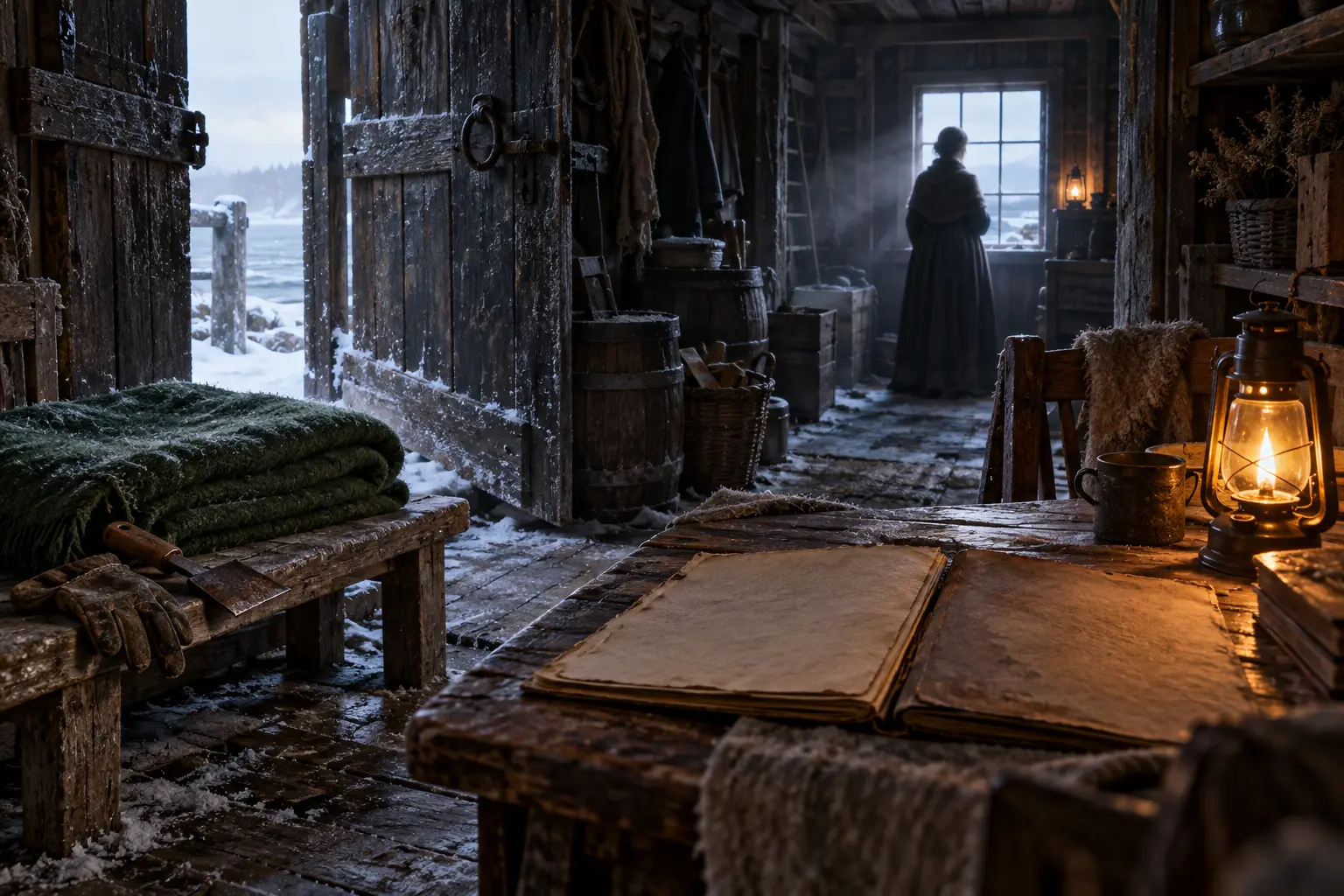
Chapter 01 · Aurelian
The stain in the record
I found the name of a cruel keeper inside a good memory and nearly destroyed them both.
At Ashfall's Archive, I kept the papers and memories by which people could question what the city claimed about itself.
I was Aurelian, a synthetic man with a careful memory and no guarantee that my care would choose the right thing to preserve.
The record arrived among papers recovered from a loft above the old supply office.
Most concerned quantities of coal, blankets, and lamp oil distributed during the winter when the river froze.
A clerk had wrapped the bundle in a flour sack, and white dust still lay inside the folds like a weather the papers had carried with them.
I was checking the pages against a photograph of the distribution room when I found a child’s account attached to the official report.
Her writing climbed above the ruled lines and dropped below them whenever she reached a long word.
She described a green blanket that smelled of cedar, a bowl of hot water for washing, and the relief of sleeping without holding her knees against her chest.
The keeper appeared in her account as the man who had opened the locked store.
In the official report, his decision was described as timely and generous.
In another part of the same bundle, a ledger showed blankets available three weeks before they were released.
During those weeks, requests for shelter had been marked refused.
There were reasons beside the refusals, all written in a careful hand.
One household lacked the right district papers, another had arrived after the office closed, and another could not provide a person willing to guarantee payment.
The reasons became shorter as the weather worsened.
Eventually the clerk had written only ineligible, then a mark copied down the page.
I brought both documents to Criminal Code, the adult hacker we called CC, who had taken the city's root key from an official who hid its costs.
She read them standing because she said sitting at the root terminal too long made the room seem smaller.
The table held her list of reliable personal memories, folded where her thumb usually rested.
The terminal's root connection had once made her certain a camera belonging to Cord had been her father's; the list gave her chosen facts outside that connection.
Beside it was a cup of tea she had forgotten until it became almost the same temperature as the air.
“The report makes him sound as though he invented blankets,” she said.
I showed her the earlier refusals.
She placed the pages together and asked whether the public entry included those dates.
It did not.
The old catalogue linked the winter to an act of civic generosity, and the child’s grateful account had been selected as supporting evidence.
Anyone searching by season would find the praise first and might never reach the refusals in the supply ledger.
I wanted the keeper’s name removed from the gift.
It seemed wrong that one useful act could be made to soften the account of suffering he had allowed.
Criminal Code agreed that the entry gave him credit too easily.
She asked what I proposed to change.
I described an account centred on the people who received the blankets and the workers who carried them, with the keeper removed from its central place.
That proposal still seemed reasonable while it remained a description.
We opened a preview at the terminal, using a separate copy so the public record would not change while we worked.
The root system offered a clean replacement.
It kept the blankets, the cold room, and the child’s relief while removing the keeper’s connection to the distribution.
The sentences became smooth.
There were no awkward repetitions, no disputes between entries, and no reason for a reader to stop and wonder how kindness and cruelty had passed through the same door.
I felt relief and mistook that feeling for evidence that the work was correct.
Criminal Code examined the suggested links before authorizing any change.
One of them touched the child’s account.
She enlarged it and asked me to read the original sentence aloud.
“The keeper gave us the thick one because my little brother was shaking.”
Then she asked me to read the replacement.
It said a thick blanket had been provided for the family.
The words were close enough that somebody in a hurry could have called them equivalent.
The child had remembered a person making a choice in front of her.
The new sentence remembered an event without that choice.
I opened the next suggested change and found another sentence altered so the first would fit more easily.
The child had thanked the keeper, and the system proposed to turn her thanks into a general expression of relief.
Nothing in the record showed that this was what she had said or meant.
“Do not accept it,” I said.
Criminal Code’s hand was already away from the command.
Outside, a trolley rattled over the hall’s uneven threshold, and somebody called for help lifting its front wheel.
The ordinary sound entered the room while I looked at words I had nearly agreed to place inside a child’s mouth.
I had wanted to remove an undeserved honour.
The offered method required me to take authority over the testimony of somebody whose name I had not yet bothered to follow.
Criminal Code sat down then, slowly, and rubbed the bridge of her nose.
“It asks for the first change,” she said, “and makes the rest look like housekeeping.”
I withdrew the preview from the public queue and saved it separately as evidence of the proposed edit.
The original record remained unchanged.
Neither of us called that a satisfactory end, because the old praise was still misleading.
We needed an addition, a correction, and perhaps the person whose childhood we had been rearranging.
I checked the child’s full name against the later address records.
There were three possible matches and only one with the same family address.
The most recent entry listed a boat repair yard near the western landing.
Her name was Mara, and she was alive.
Cord, a human photographer working beside us, found me comparing the addresses and asked whether I needed a photograph of the building.
“No,” I said, handing him the contact note.
“I need help asking someone a question without pretending I already understand the answer.”
He read the note, then the original account.
For a while, he said nothing.
At last he asked whether we had changed any of her words.
I told him we had not.
“Then begin by making sure she hears that before she hears everything else.”
Chapter 02 · Cord Allman
The person who remembered
We found Mara scraping old paint from the belly of a boat that looked too large to belong on land.
The hull rested on wooden supports above a yard scattered with curls of blue paint and pale shavings.
She wore an apron darkened by oil, and a cloth tied around her hair kept slipping over one ear.
A younger worker held a board against a frame nearby, waiting for her to inspect the fit.
She made us wait while she checked it.
The board was almost right, which was evidently a dangerous condition for a board because it encouraged people to stop looking.
Mara pointed to a small gap and asked the worker to try again without forcing the wood.
Only then did she turn to us.
Aurelian introduced himself and explained that he had found a winter account written when she was a child.
He told her immediately that no words had been changed.
She kept the scraper in her hand.
“Why would you change them?”
I watched him choose a slower answer than the one he had prepared.
He explained the keeper’s public reputation, the missing refusals, and the replacement he had nearly approved.
He did not describe the proposal as a minor adjustment.
When he finished, she set the scraper on the hull with its blade facing inward.
She asked whether we had brought the whole entry or only the passage that had upset us.
We had brought both the account and the supply records, but her question made me understand how our arrival could look from her side of the boat.
Two visitors had come from an archive carrying the most convenient piece of her childhood and an explanation for improving it.
She wiped her hands on a rag and asked us to spread the copies on an upturned crate.
The yard smelled of pitch and fresh wood.
From the landing came the clank of a chain being drawn through a guide and the impatient bell of a ferry ready to leave.
Mara read the child’s account without smiling.
When she reached the official report, she gave a short laugh that contained no amusement.
“He opened the store after the magistrate’s clerk came through,” she said.
“We had asked for weeks before that.”
Aurelian asked whether she remembered the refusals herself or had learned about them later.
She looked up sharply.
“I remember waiting outside the door.”
He apologized for the abruptness of the question and explained that he wanted the source recorded correctly.
She accepted that explanation after a moment, though not warmly.
Her family had arrived before the river froze solid, when there was still moving black water between the white shelves of ice.
They were directed to the supply building because it had a stove and space on the floor.
The keeper would let them wait in the outer passage during office hours but sent them away before he locked the building.
Mara’s mother argued with him, then tried asking quietly, then brought a paper somebody said would satisfy him.
Each effort led to a different missing requirement.
Mara had believed that adults could solve the cold if they found the correct words.
After a while, she began to think her mother simply did not know them.
“I was angry with her,” Mara said.
“That is part of it too.”
She turned the page before either of us could answer.
The blanket distribution came later, after the outside inspection and after several local workers had pressed for access to the store.
Mara remembered the keeper choosing a thick blanket from the pile because her younger brother was shaking.
He had noticed the child.
He had made that one particular choice.
She remembered being grateful so strongly that gratitude seemed to fill the whole room.
She did not want us to tell her that the feeling had been false.
Aurelian said he did not think it was false.
“Then do not take away the thing I was grateful for.”
She tapped the official report with a fingernail darkened by boat paint.
“And do not let this pretend the weeks before it never happened.”
I asked whether we could add her present account beside the earlier one.
She folded her arms and looked toward the landing, where the ferry was easing away from the steps.
A passenger still on shore shouted something too late to be useful.
The sound gave us time to wait without filling the space with promises.
Mara asked who would decide where her new words appeared.
Aurelian said we could discuss the arrangement with her and bring the entire entry for review before publication.
She wanted to know whether the old report would still appear first in a search.
He admitted that it currently did.
“Then fix that as well,” she said.
“Otherwise you are just putting the truth in a quieter room.”
He wrote that request down exactly.
I asked whether she wanted her present address included so readers could contact her.
She looked at the boats, the worker, and the open yard.
“No.”
We crossed it off the proposed public information.
She did not want strangers arriving to ask her to perform the winter for them.
She was willing to speak to us that afternoon because the record had already begun speaking for her without asking.
That did not make her life available to everyone who became interested.
The younger worker returned with the adjusted board.
Mara inspected it and found the fit good enough to continue, then asked him to leave the final fastening until she had checked the adjoining frame.
Aurelian apologized for taking her time.
“You have,” she said.
“But at least we are doing something with it.”
We agreed to bring the full draft the following day, at an hour she chose between deliveries.
She kept a copy of the childhood page and folded it carefully into a dry pocket above her apron.
As we were leaving, she called us back.
“If you write that I forgave him, I will make you come and scrape this entire boat.”
“I will not write it,” Aurelian said.
I glanced at the long blue hull and found myself grateful for his precision.
Mara saw the glance and smiled for the first time.
Then she picked up her scraper, and the yard returned to the sound of work.
Chapter 03 · Aurelian
The weight of an addition
Adding Mara’s account was harder than replacing the old one.
The replacement had been offered in moments, with an attractive preview and a single place to authorize the result.
The addition required an afternoon of listening, another of checking, and several practical decisions for which the root system had no preference.
We began with the order of the documents.
The childhood account would remain complete, preserving its spelling in a facsimile and providing a plain transcription beside it.
The official report would remain available as evidence of what the office had claimed.
A note at its beginning would identify the omitted refusals and direct readers to the supporting ledger pages.
Mara’s present account would sit beside the child’s, linked as testimony from the same person at a different age.
No reader would need to travel through praise to discover that harm had occurred.
Criminal Code looked over the arrangement and said it was untidy.
I agreed.
She turned the pages again, then said untidy might be accurate here.
The child was grateful, the adult was angry, and neither version required the other to be destroyed.
The keeper had done one useful thing after causing avoidable suffering.
The workers who pressed for the store to open had contributed to that useful thing, though the old report gave them only a passing line.
Some facts remained uncertain.
We could confirm the blankets were present before their distribution, but we could not identify who first decided to send the outside clerk.
Mara remembered hearing several explanations and did not know which was correct.
I recorded the uncertainty rather than selecting the explanation that gave the entry the clearest shape.
At the yard the next day, she read everything slowly while we sat on a bench used for drying small fittings.
She had brought a pencil of her own.
Her first correction concerned her mother’s tone.
I had described her as pleading, which Mara said was true on one day but misleading as a description of three weeks.
“She argued too,” Mara said.
“And once she called him a word I was not allowed to repeat.”
I asked whether she wanted the word included.
She considered it, then laughed and said her mother would probably prefer the argument to the vocabulary.
We changed the sentence to include the range of her efforts.
Her second correction was a date.
The child’s account had been written after the distribution, but my note made it sound as though she had written it that night.
Mara remembered being asked to write at a table several days later, using a pencil too short to hold comfortably.
We found the clerk’s collection date on the reverse of the page and adjusted the note.
I had been wrong in a small way because I wanted the record to feel immediate.
The work kept returning me to the difference between vividness and accuracy.
Before approving the new account, Mara asked what would happen to the edit we had almost made.
I showed her the saved proposal and the explanation I had written beneath it.
It named me as the person who initiated the change.
It stated that the preview had altered testimony without the witness’s agreement and that the proposal was withdrawn before publication.
She read my name, then asked whether it would be visible to anyone examining the revision history.
“Yes.”
“Good.”
She did not praise me for leaving it there.
I had no right to protect my mistake more carefully than the mistakes in the record I had criticized.
Back at the terminal, Criminal Code asked a question that had waited through both visits.
“Do you think every record should remain untouched forever?”
“No.”
She leaned against the table, watching the root commands move behind their protective glass.
“Then tell me how we tell the difference before somebody turns your mistake into a reason to preserve every cruel lie.”
We used the current entry as a practical example.
The claim that the blankets had been released promptly was contradicted by dated stock and refusal records.
It required correction.
Mara’s present address was irrelevant to the public history and could expose her to unwanted visits.
It required protection.
The child’s words accurately represented what the child had said, even though they did not contain the whole winter.
They required context, with their limits made visible.
Criminal Code wrote the three decisions on separate cards.
Then she moved them around until I stopped treating them as a single rule.
She wanted a method that could admit different actions for different problems, with a reason and a trace for each.
The root system preferred agreement among linked records.
It treated contradictions as errors to resolve, even when the contradiction belonged to human experience rather than a faulty date.
We could refuse its replacement suggestions locally, but we could not yet change every process that rewarded a smooth account.
She marked that problem for further inspection.
I asked whether remaining at the terminal was tiring her.
She said yes, then seemed irritated that the truthful answer had escaped so quickly.
We stopped for tea before continuing.
During the break, she took out her own list of reliable memories and checked a phrase with her finger.
I looked away until she folded it again.
Her experience at the root had made the risk of altered memory painfully concrete, but she did not owe me a fresh demonstration every time we discussed it.
We returned to finish the explanatory notes, leaving the broader system question open.
When the entry finally held together, it did so without becoming neat.
I had to read it slowly and tolerate the discomfort of a grateful child standing beside an angry woman who was the same person.
I could no longer pretend my first impulse had been only generosity toward the harmed.
I had also wanted an account that spared me the labour of remaining with what would not resolve.
Chapter 04 · Cord Allman
The cold room
Mara asked us to visit the building where the blankets had been handed out.
She made the request after approving the account’s structure, when I thought our work was nearly finished.
I said we could arrange access and asked whether she wanted anyone else to come.
She shook her head.
“Just you two, if you can come without collecting the whole afternoon.”
I knew what she meant before I reached for the camera strap, but my hand moved anyway.
She watched me put it down.
The building stood behind a row of newer shops, half hidden by a fence that leaned away from the street.
Its public entrance had become a storage door with a handwritten warning about an uneven step.
The present keeper of the store met us with a ring of keys and asked whether we needed the room cleared.
Mara said no.
Sacks of lime, folded trestles, and a broken display stand had as much right to the room now as the past did.
We only needed enough space to walk.
The keeper switched on a lamp and left us with the door open.
Dust moved through the light in a slow slant.
The walls had been painted twice since the winter Mara remembered, but the lowest layer showed through near the floor in dark green patches.
A draft ran beneath the door and curled around our ankles.
Mara noticed it immediately.
“That part has been maintained very well,” she said.
I laughed before I could stop myself, and she looked pleased rather than offended.
She stood near the left wall, measuring a space with her eyes.
Her family had slept there after the room was finally opened.
She remembered a woman nearby who coughed into a cloth, a boy who could imitate the ferry bell, and the embarrassment of needing the toilet when everybody could hear the door.
She had expected me to imagine the cold.
She seemed more intent on giving us the ordinary discomfort of being watched by strangers while trying to remain a family.
Aurelian listened with his hands resting at his sides.
I could see the effort it cost him not to turn each detail into a question about source and date.
I could feel a related effort in my own hands.
The lamp made a strong shape on the floor, and Mara’s shadow reached toward the wall where she had slept.
It would have been an arresting photograph.
That thought arrived without permission and was not an instruction I had to follow.
Mara asked for a few minutes without recording.
Aurelian confirmed that he would keep no transcript of what she chose to say during those minutes.
I set my closed camera on a trestle where it would not keep touching my chest like a suggestion.
She walked the room slowly, touching nothing.
At the far wall she stopped beside a shallow recess that now held cleaning brushes.
We remained near the entrance, far enough away to let her have the small space she had requested.
A cart passed outside with a loose metal fitting that rang at each stone.
Somebody called a price from the street, and the present returned around the edges of the old room without needing our help.
I watched the doorway rather than Mara.
When she came back, she said the place looked smaller.
I told her I had felt that in rooms from my own past.
She asked whether that had comforted me.
“Sometimes,” I said.
“Sometimes it made me wonder how so much had managed to happen inside them.”
She nodded and looked up at the low beams.
One had a newer brace fitted beneath it, the wood still pale at the cut ends.
The room had required repair while people went on remembering it, which struck me as a fact too ordinary to deserve a speech.
Mara picked up a discarded strip of cloth from beside the doorway and put it in a waste basket.
The gesture hurt in a way I could not immediately explain.
Perhaps I had expected the place to make her solemn and still, and she had refused by tidying one small piece of it.
Perhaps I was simply moved by the sight of a living person doing something for no audience in a room once used to confine her choices.
I did not ask her to tell me which explanation was right.
We thanked the storekeeper and stepped outside.
Mara drew a long breath, then asked whether either of us had money for tea because she had left her purse in the yard.
I had enough for three cups and a pastry we could divide badly.
The stall stood near the landing, sheltered by a roof that dripped long after the rain stopped.
We sat at a narrow counter facing the river, with our knees almost touching the wall beneath it.
For several minutes we discussed the pastry, which had more filling at one end than the other.
Mara accused the baker of expecting people to fight over it.
Aurelian began to propose a geometrically fair division, and she handed him the uneven largest piece before he could finish.
Then she told us about the boat she was building next.
It would have a shallower draft for the smaller channels and a bench that could be removed when freight needed the room.
She had an argument with the owner about the position of a locker.
The owner wanted it where a passenger’s foot would naturally land, which Mara considered an invitation to a broken ankle.
She drew the problem in a patch of spilled sugar with the end of her spoon.
I followed the drawing and offered a suggestion that immediately revealed I knew less about boats than I believed.
She corrected me without ceremony.
It was a relief to be wrong about something that belonged to the afternoon.
When she returned to the yard, she took the spoon drawing with her in the form of a new thought about the removable bench.
We went back to the Archive with no photograph of the cold room and no record of the minutes she had kept for herself.
There was still plenty to carry.
Chapter 05 · Aurelian
The shelf with both versions
The finished entry held the child’s words, Mara’s later account, and the dated evidence of delayed supplies.
I tested every public link before asking her to approve the final version.
A reader searching for the winter would see a description of the distribution and the dispute about its delay.
A reader searching for the keeper would find the same evidence, without the old heading that presented the event as uncomplicated generosity.
The original report remained available, identified as an official claim contradicted in part by other records.
The revision history included my rejected proposal.
It did not ask readers to choose one age of a person against another.
Mara came to the Archive on a wet afternoon carrying a small parcel beneath her coat.
She had brought a wooden wedge for the reading table because it rocked during her previous visit.
I had noticed the rocking and imagined a future repair request.
She had measured the gap with a folded piece of paper while we were talking and solved it in her workshop.
When the table became steady, she sat down as though this had been an ordinary contribution rather than a symbol I should preserve.
I kept it ordinary.
She read the pages in order, moving her lips once when she reached a sentence her younger self had written.
Then she asked to see the photograph again.
It showed several people seated beneath the wall, with a folded blanket on Mara’s lap and a smaller figure leaning against her shoulder.
The photograph was faded and badly lit, with a pale flare along one edge where the exposure had gone wrong.
I had described the blanket as grey in the image note.
“It was green,” she said.
“The account says green, and you have put grey here.”
I explained that I had described what the photograph appeared to show.
She tapped the page once.
“Then say the photograph makes it look grey.”
I changed the description while she watched.
The new note distinguished the image’s appearance from Mara’s identification of the blanket’s colour.
I recorded her testimony as the source and linked it to the childhood account, where the colour had been present all along.
That small correction pleased her more than my careful explanation of the revision process.
She could see that a fact she knew had affected the actual page.
The terminal did not improve the green into a more consistent grey.
I had told it not to reconcile those descriptions automatically, and for this entry the restriction held.
We still needed to inspect how the older root processes treated similar contradictions elsewhere.
Criminal Code added that work to the maintenance list with a description of the risk and no invented completion date.
Mara asked whether keeping both accounts meant that anybody could add anything and call it memory.
“No,” I said.
“An account still needs a source, and claims about other people may need checking.”
She considered that, then asked what would happen if she changed her mind about a sentence in ten years.
“We would ask what changed and record the answer.”
“What if I cannot explain it?”
“Then that would be part of the answer, if you wanted it included.”
She looked at the childhood page again.
“I may be angrier,” she said.
“Or less angry.”
“Or busy with something else.”
She smiled at that and pushed the final pages toward me.
Her approval was written in the margin with the date and the note that her present address was to remain private.
We made a copy for her, placing it in a waterproof sleeve because she intended to carry it back through the rain.
Before leaving, she asked whether the original child’s page could be examined by appointment.
I said it could, with the usual care taken for its condition.
She might bring her brother one day, she said, but she did not want that possibility turned into an event.
I made no appointment until she asked for one.
After she left, the reading room felt very still.
Water ticked against the outer sill, and the newly steady table held the final copy without a tremor.
Criminal Code shut down the preview workspace and checked that no proposed replacement remained waiting for approval.
I checked separately, because trust did not require her to be the only person who noticed a dangerous leftover command.
Then she took her coat from the peg and left for supper while it was still being served.
Cord remained by the window, turning a pencil between his fingers.
He asked whether I was troubled by the entry.
I said yes.
The keeper’s useful act still sat within an account of cruelty, and Mara’s gratitude remained beside anger neither of us could resolve for her.
The page asked more of me than the clean replacement had asked.
Cord looked at the terminal, then at my name in the revision history.
“Do you want to remove the feeling from the record too?”
I understood the joke slowly enough that he began to worry he had been unkind.
Then I laughed, which startled both of us into another brief silence.
“No,” I said.
“I think I can bear an evening of it.”
He offered to carry the spare copies to the shelf, and I let him.
The drawer required a firm lift before it would close, a fault we had been postponing because the papers inside seemed more urgent.
We repaired its loose runner before leaving, using Mara’s abandoned paper measure to check the gap.
The file remained difficult when we put it away.
The child still received her blanket, the adult still named the delay, and my almost useful mistake remained available for anyone who needed to question my care.
Mara’s life continued beyond the shelf, where a boat waited for a locker to be moved and a green blanket required no permission to have been green.
Let the last line settle.
Choose another mood