
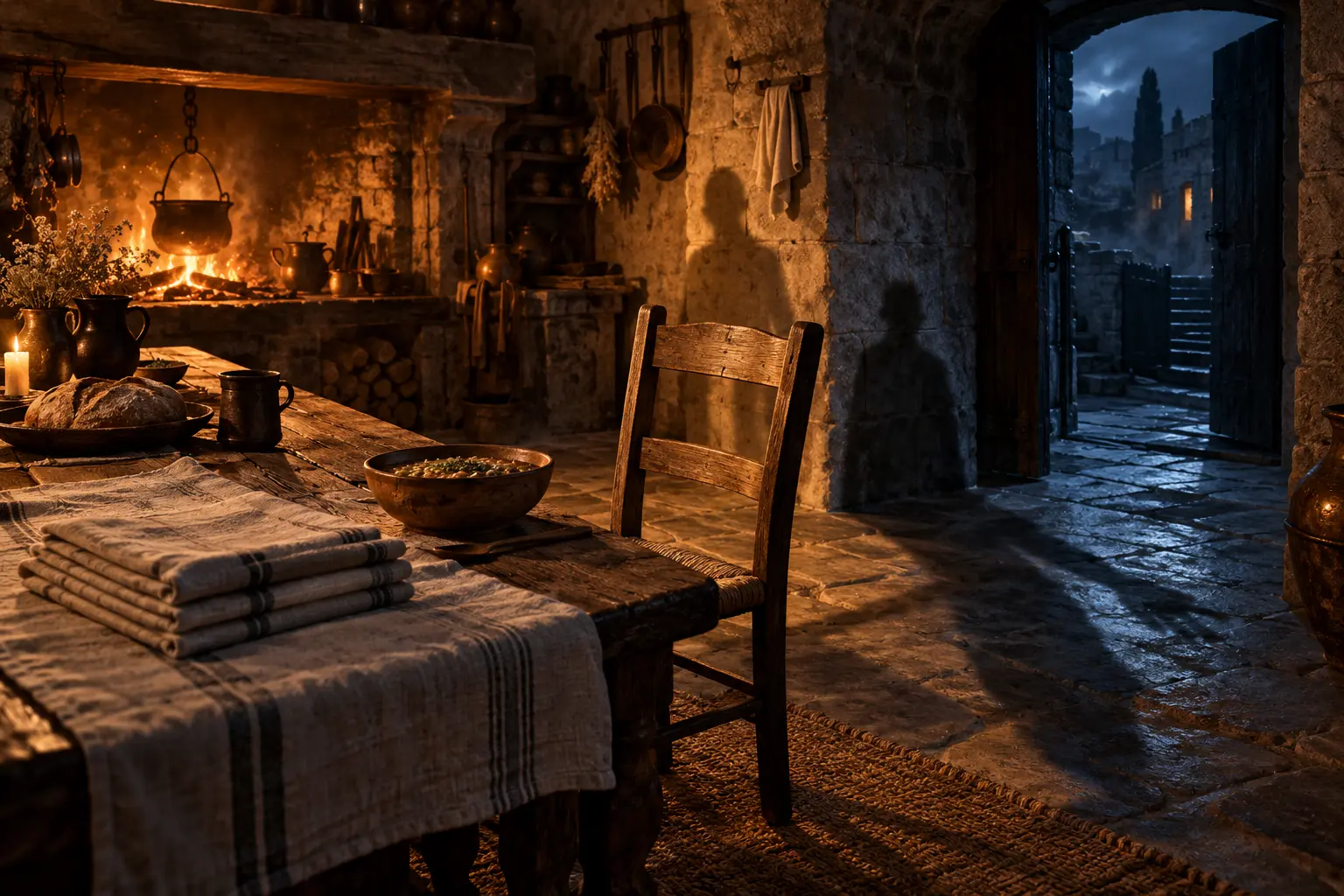
Chapter 01 · Cord Allman
A place not asked for
The stranger knew how to fold our towels, but not how to ask for a place at the table.
They stood beside the drying rail in the community kitchen, making neat rectangles from the heavy cloths we used around hot pots.
Each fold was exact, including the little corner Bethany turned inward to mark a towel that belonged on the serving side.
I had arrived late with a basket of washed apples and my camera bag, expecting to carry things rather than make photographs.
The kitchen stood in a stone hall near the lower market, where evening food was served during posted hours and workers were paid for the work they agreed to do.
Bethany managed the preparation shift, and she had been trying to make those hours mean something after too many evenings stretched into uncounted work.
Solace, who used they and them, was helping with the serving tables because the regular worker had requested a day off.
Aurelian had come to compare the storeroom inventory with some donated equipment, using his synthetic memory to find discrepancies rather than deciding what anyone ought to give away.
The stranger looked like an adult whose face I might fail to recognize on a crowded landing.
They wore a plain gray coat and shoes dusted with flour, though neither garment was wet from the rain outside.
I asked whether they had come for supper.
They folded a towel, placed it on the rail, and repeated my question in the same mild tone.
Then they said there would be more bowls after the first pot was empty.
It was a sentence Bethany had said often enough to become part of the room's weather.
I put the apple basket down and called her over.
She came with her sleeves rolled and a ledger tucked under one elbow.
She looked at the towels, asked the stranger to leave the preparation area, and told them where they could sit while we found out what they needed.
They moved toward the table with the precise short steps of our night washer, a woman named Mara who was supposed to arrive after supper.
Bethany frowned, then checked the wall clock.
Mara should have been there already to take over the pots, and the two workers whose shift was ending needed to leave for a ferry.
Solace asked the stranger whether they would like a bowl and gave them two choices from the food already prepared.
The stranger reached out both hands and lifted an empty bowl from the stack.
Their right hand used the grip of a worker called Den, who had lost strength in one thumb and supported crockery against his palm instead.
Den was standing a few feet away, wiping the service counter.
His cloth fell from his hand.
He stared at his thumb, opened and closed it, then said the motion for holding the bowl had simply gone.
The stranger set their bowl down without spilling anything and folded their hands on the table.
Those hands were ordinary in shape but very pale, with creases that shifted when I tried to see them closely.
Bethany asked everyone to put down hot or sharp things.
She said it calmly enough that people obeyed before they began to ask questions.
One worker set a knife into its tray, and another moved the pot ladle away from the edge.
Solace brought food to the stranger without putting the bowl into their hands.
They asked whether the stranger wanted them to sit nearby or leave the space clear.
The stranger answered that there would be more bowls after the first pot was empty.
I looked toward the drying rail and noticed that the newest folded towel cast two shadows against the white wall.
One lay beneath the lamp, where any towel's shadow should have fallen.
The other showed a pair of wrists bending as if someone were still folding it inside the plaster.
Bethany went to pick up the towel and stopped when her own fingers would not remember the corner turn.
She could grasp the cloth and lay it flat, but the familiar folding movement had become a space she could feel herself reaching into.
She told me exactly that, without calling it tiredness.
The stranger turned their head toward the pantry passage.
We heard a metal spoon fall beyond the pantry door, followed by three weak knocks.
Bethany called Mara's name and went into the passage with Solace beside her.
I stayed by the table because the stranger had begun laying out spoons with the serving worker's quick alternating motion.
The worker put both palms on the counter and said she could no longer tell which hand came next.
No one was screaming yet.
The room was full of the small sounds people make when an ordinary task suddenly becomes impossible and they hope another person will explain it without making them ashamed.
Aurelian came from the storeroom with a paper tag in his hand.
He asked whether the bell receiver delivered earlier had been fitted to anything.
It had been placed beside the pantry pump as a temporary listening aid, Bethany said from the passage, because the pump had been knocking and someone thought a salvaged sound cup would help locate the loose valve.
It was disconnected from any outside line.
That had seemed enough to make it safe.
The stranger drew their chair closer to the table without touching the floor with their shoes.
Aurelian looked at the two shadows and told me not to ask it where it had come from.
We first needed to find Mara, who was living and had not answered when Bethany called.
Another spoon fell behind the pantry door.
Then the stranger began washing its empty bowl with a motion I had seen Mara use a hundred times, and the knocks in the passage stopped.
Chapter 02 · Aurelian
Hands in the margin
I knew the receiver only from its service tag, which had arrived in a tray of salvaged fittings.
The tag said it had been removed from a disused serving-room line and should remain isolated while its inner contacts were examined.
It was a small open-cup model, one of many fittings once placed beside workrooms, with a separate inventory number of its own.
The examination note had been folded underneath the inventory sheet, where a hurried worker could mistake it for another receipt.
I had failed to read the lower page when the donation was brought in.
I told Bethany that at once, because the kitchen had enough real work without having to carry a mystery about whose mistake allowed the object inside.
She said we could settle the records later and asked whether I knew how to stop it stealing motions.
I did not.
The tag gave no account of that danger, and I would not convert the words remain isolated into knowledge they did not contain.
We could see the receiver through the pantry passage window, where it lay beside the pump with its brass mouth facing the wall.
A local wire loop had been fitted to it by the maintenance worker trying to hear the valve.
The loop crossed a metal bracket on the pump handle and returned to the receiver's neck.
Although the outside line was absent, the loop had given the object a circuit within a room full of repeated labor.
I could suggest that connection without pretending it explained why the visitor now copied hands.
Bethany held the pantry latch down.
The door moved against it by less than a finger's width, then stopped as if the room behind it had been filled with packed cloth.
She called Mara again and asked whether she was hurt.
A breath came through the crack, too soft for me to separate into words.
Solace put their cheek near the door without touching its metal latch.
They said Mara was there, and that she had asked us not to turn the handle again.
Bethany let go and stepped back.
The pantry was only a narrow room with one lower window, shelves on either side, and enough floor for a person to carry a flour sack through.
Mara had entered it to fetch clean drying cloths before her shift.
Her lunch tin stood on the shelf outside, where she always left it because she disliked the taste of cold food near warm flour.
It was a tin I had seen in other inventory photographs, and recognizing it made the empty space beside it more frightening than the stranger's borrowed face.
This was someone who had arrived for work expecting to finish at an agreed hour.
Bethany asked the workers whose shifts had ended to leave by the side door, unless they freely wanted to stay for an additional paid hour.
Den stayed, and the serving worker went to catch her ferry after telling us which motions the visitor had taken.
Neither choice needed an explanation beyond what we had asked.
Solace took the serving station and told the waiting diners that food could be collected from the front table while the preparation room was closed.
They asked two people to carry bowls without watching the stranger at the long table.
The visitor copied the ladle movement anyway, reaching across the untouched bowl.
Bethany's shoulder jerked as if she had forgotten where her elbow belonged.
She set her own ladle down before it could fall.
The visitor was gathering movements it had seen in this room, and using them as though performing a worker's skill could confer the worker's place.
It still had not asked for the food Solace had set before it.
Cord stood between it and the pantry passage, keeping his hands still at his sides.
I asked him whether it copied unfamiliar motions.
He said it had repeated his question but not the way he set down the apple basket, which used both forearms because the broken handle could not bear weight.
Den demonstrated a slow new grip around a cold cup, one he had never used during service.
The stranger continued washing the empty bowl.
His grip remained his, and he could release it when he chose.
He said the old supporting motion felt absent, like reaching for a stair tread that had been removed.
Bethany asked him not to keep testing his hand while we still needed him to protect it.
We covered the drying rail with a plain cloth and moved towels, knives, and cups out of the visitor's view.
Solace offered the visitor a second meal option, with no demand that it tell us a private story before receiving food.
It repeated the supper sentence and made Mara's washing motion again.
In the pantry crack, a pale hand appeared for an instant, fingers pressed flat against darkness.
I could not tell whether it was Mara's hand or another imitation.
Solace asked for a sign that required a present choice.
They asked whether Mara wanted the people she knew to remain near the door, and said she could answer with a tap or a word rather than a work gesture.
Two taps came, uneven and close.
Bethany said she would stay, but would not ask Mara to perform the job the visitor was already stealing.
Bethany took the pay ledger from under her arm and laid it on the passage shelf, away from the receiver.
She entered the start of the interruption while she could still remember it clearly.
The clock continued moving, and every minute it took to find Mara would belong to work the kitchen had failed to make safe.
Den asked whether he should write his name beside hers as a witness.
She handed him the pencil, and he used the unfamiliar grip that still answered him.
His letters wandered below the line, but his name was plainly there.
Cord went to the outer yard to look through the pantry's lower window.
I stayed beside the door with Bethany, holding the inventory sheet so the dangerous instruction was finally visible on its proper side.
Chapter 03 · Cord Allman
The worker behind the shelves
Rain had softened the yard earth around the pantry window, and my boots sank as I brought a crate beneath it.
The window was covered with wired glass, cloudy with flour dust on its inner side.
I could see the lower shelf and the edge of the wash basin, but there was much more distance between them than the pantry possessed.
Beyond the basin stood a second shelf, then a third, each holding the same stack of folded towels.
Their corners pointed toward me in a line that seemed to go all the way beneath the kitchen floor.
Mara sat between the first two shelves with one knee drawn toward her chest.
She was a broad-shouldered adult woman whose working apron had been repaired at its lower edge with green thread.
Her eyes moved when I tapped the glass, but her hands remained in the shallow basin before her.
I could not see water in it.
Her fingers made the washing motion the stranger had been using, even while she looked at me as if begging me to stop them.
I called her name through the window frame and said Bethany and Solace were by the pantry door.
She moved her lips, but the words came from somewhere behind the shelves rather than from the face I could see.
She said the bowl would not come clean.
There was no bowl between her hands.
I asked whether she could feel the floor beneath her left heel.
She closed her eyes and pushed that heel down, a small movement that seemed to take more effort than washing a hundred bowls.
The floor appeared beneath it, the real gray pantry tile I had helped carry in during a repair.
For an instant the extra shelves grew thin enough that I saw a sack of oats against the proper far wall.
Then the stranger moved in the kitchen, and the second shelf became solid again.
Mara's hands quickened.
I wanted to break the glass, but its wire mesh would hold dangerous edges across the low opening, and I could not reach her without bringing those edges toward her arms.
I went back inside to explain what I had seen.
Bethany listened without leaving her place near the door.
She said Mara had asked for shorter washing shifts because the constant motion hurt her shoulders, and we had only managed to change the schedule the week before.
She was furious that even this thing had reached for the same overworked hands.
Solace asked whether Mara could choose a movement outside the visitor's borrowed routine.
I told them about the heel and the real tile appearing under it.
They brought a slate and drew the pantry from what Bethany remembered, leaving the extra shelves as a separate shaded area rather than giving them the authority of actual walls.
The receiver sat to Mara's right, between the basin and the pump.
If we could reach the wire loop from the window, we could separate it without entering the copied depth.
If Mara could keep contact with real tile long enough, we might guide her toward the door while the loop was held apart.
Bethany asked Mara through the crack whether she wanted us to try that.
One tap came, then a second, and a whispered yes followed them.
The whisper was hoarse, nothing like the visitor's effortless washroom phrases.
The stranger rose at the long table.
Its bowl remained full and untouched.
It reached toward the covered drying rail, and the cloth lifted in a line shaped like wrists.
Den stood in its path and asked it to leave the towels alone.
It copied his hand signal, and his arm lowered as though the bones inside had forgotten how to hold its weight.
He stepped back against the wall, angry and frightened at once.
Bethany told him the visitor had enough movements and we did not need to supply another simply to prove it wrong.
Solace drew the visitor's chair away from the pantry passage using a hooked broom handle rather than a familiar serving gesture.
The stranger followed the chair by sliding its feet, an awkward movement with none of Mara's known grace.
That gave us a clear strip of floor near the door.
I went back into the yard with a small screwdriver and the maintenance worker's long insulated pliers.
The window frame had removable lower clips, fitted so the pane could be cleaned without breaking the mesh.
I undid them one at a time while Aurelian stood inside the passage counting how many clips had come loose.
The glass sagged toward me as the last screw came out.
I held it with my forearms and lowered it onto the folded sack Bethany had set below.
The cold from the pantry smelled of dishwater left overnight.
Inside, Mara's apron was dry, but shadow covered it in long wet streaks shaped like the edges of towels.
She watched the open window and asked whether she was late for work.
I said her shift would be recorded as paid, and Bethany had already arranged that she would not be asked to finish it.
Mara's eyes filled, and the extra shelves seemed to draw nearer.
I asked her to look at my boots instead of the shelves.
They were muddy, planted in the real yard, and one lace had slipped loose beneath the crate.
She said I was going to fall if I kept stepping on it.
I laughed once because it was the first thing she had said that belonged wholly to her present irritation with me.
Then I tied the lace where she could see.
Her left heel found the tile again.
I laid the long pliers through the window and waited for Solace to begin speaking from the door, using no rhythm the visitor could turn into another job.
Chapter 04 · Aurelian
Permission in the narrow room
Solace asked Mara whether she wanted Bethany's voice or theirs while Cord reached for the wire.
Mara said Bethany's, then apologized because Solace had been kind to her.
Solace said kindness did not require being chosen for every task and moved back so Bethany could stand nearest the crack.
That exchange made the pantry darkness shrink a little around the actual doorway.
It was not the correct phrase for unlocking a room.
It was a living person choosing who could help and another person accepting a choice that cost them a moment's closeness.
The visitor at the table could copy words of welcome, but it had not once waited for a reply that changed what it did.
Bethany asked Mara whether she could move her heel toward the door by one tile.
Mara said not yet because her other knee had gone numb.
Bethany told Cord to wait.
The pliers rested above the wire loop without touching it, and Cord held his arm still through the window.
The stranger began repeating that there would be more bowls after the first pot was empty, louder now, making it sound like a demand for endless service.
Den covered his ears with the hand whose new grip still belonged to him.
Solace put the serving door on its hook so no diner would come into the room by accident.
They told the waiting people the kitchen was closing early and anyone still hungry could collect bread and apples from the front table.
There would be no hot food carried through the room while we were trying to bring Mara out.
Bethany asked whether Mara wanted to straighten the numb leg or have us keep talking while she waited for feeling to return.
Mara chose waiting.
From the window Cord described the rain on the yard wall, the loose bean strings overhead, and the puddle that had formed in his boot print.
Mara's washing hands slowed but did not stop.
The visitor stood again and turned toward the pantry, its face becoming smooth where eyes should have looked.
It had the suggestion of eyelids but no pupils, as if faces mattered less to it than the movements by which people earned a place.
Solace rolled a table across its path using the unfamiliar side rail rather than the handles workers normally took.
The visitor reached out, and for one dreadful moment the table's shadow showed twenty hands braced beneath it.
Solace let go at once.
The table remained a table, heavy and imperfect on its uneven feet.
The stranger stood on the far side, trying the motions it had borrowed against an object that needed a present adjustment.
Den shifted the nearest foot with a wooden wedge, and the table held between us.
Mara said her knee had begun to hurt, which was better than its silence, and that she could try moving.
Bethany asked her to keep her heel on tile and bring the other foot toward it without lifting both at once.
She did.
Through the crack I saw the true pantry floor extend from the doorway to the edge of her apron.
The duplicated shelves continued beyond her, dark and dry, offering enough work to fill any number of nights.
Cord lowered the pliers onto the wire where it crossed the pump bracket.
He did not cut it while it was taut.
The maintenance worker, standing beside him in the yard, loosened the bracket screw until the loop sagged and the contact rose clear of the metal handle.
At that instant Mara's hands stopped washing.
The visitor put its hands flat on the table and made a sound like wet cloth twisted too tightly.
Bethany told Mara she could keep her hands wherever they felt safe.
There was no need to prove she owned them by completing a task.
Mara drew them to her chest and began to shuffle toward the door on the real tiles.
Cord held the lifted contact with the pliers while the maintenance worker slid a dry ceramic sleeve over it.
I could hear the pump knocking by itself, a loose mechanical valve with no voice in it now.
Mara reached the first shelf, then stopped because the pantry latch stood across the way at the height of her face.
From our side the latch was exactly where it belonged, lower on the door.
Bethany asked whether she wanted us to lift the door outward while she stayed still.
Mara said yes, and I helped Bethany pull at the edge without operating the handle again.
The copied latch moved upward like a shadow losing its source.
The real door opened just wide enough for Solace to put a low stool through the gap.
They asked before touching Mara's elbow.
She agreed, and they guided her onto the stool, then moved it back toward us one short scrape at a time.
When her knees crossed the threshold, the pantry became its proper narrow depth.
The extra shelves vanished without falling or leaving a place into which someone could follow them.
Mara leaned against Bethany and let us see her hands shaking.
At the table, the stranger's borrowed fingers lost their creases.
It reached once toward the full bowl, missed its edge, and folded down into the chair as though there were no shoulders inside the coat.
Solace covered the chair with a plain cloth and kept everyone clear while the maintenance worker removed the receiver loop entirely.
There was no person beneath the cloth when we looked together.
There were folded towels, a flour-dusted gray apron that belonged to nobody on the roster, and an empty lantern standing upright where its feet had been.
Mara was still breathing beside us, her hands within her own sight.
Bethany asked whether she wanted water, and waited until she answered.
Chapter 05 · Cord Allman
An unfinished night's pay
We closed the kitchen for the rest of the evening.
A sign at the front explained where bread and fruit could be collected and when someone would give a further update.
It did not describe Mara's fear, the visitor's false face, or the private motions that had vanished from people's hands.
Diners could understand an early closure without being given a worker's worst hour as an explanation for their interrupted meal.
Two adults volunteered to take the remaining food to the neighboring hall, and Bethany agreed only after the other kitchen confirmed that it had staff and space.
We were not going to push the work through another door merely because this one had become dangerous.
Mara sat in the front room with her lunch tin on her lap while the nurse examined her shoulders and hands.
She had cramps and numb fingertips, but she could choose to open and close them.
Bethany's familiar towel fold had returned as soon as the receiver was removed.
Den could support the cold cup against his palm again, although he said he did not intend to keep checking it every few minutes simply to reassure us.
The lost motions had belonged to the visitor's active hold, not to a bargain anyone had knowingly made.
That mattered when Mara asked whether she had invited it by touching the pump handle.
Aurelian said a neglected object had been fitted beside her work station without a full reading of its warning.
Touching an ordinary handle at her own job was not permission to take her hands.
He put that in the incident note without turning her question into a confession.
The maintenance worker signed the note too, describing exactly what he had attached and what he had assumed.
He was pale with shame, and Bethany did not comfort him by saying the mistake had harmed nobody.
She asked him to help make sure donated equipment was separated from working tools until its full record had been read.
He agreed, then went to repair the window clips so the pantry could be locked without leaving rain to damage the food stores.
I held the pane while he fitted it back into the frame.
The glass showed only one set of shelves now, the oat sack, and the basin in which there had never been a bowl.
He asked whether I would photograph the receiver once its loop had been removed.
I said I would do that for the repair record, with no worker's face in the frame.
Solace moved the gray apron and the empty lantern onto a separate table away from the drying rail.
The apron was flour-dusted, neatly stitched, and empty of any smell that suggested a person had worn it home from a long shift.
The lantern had no oil, wick, or soot in its chimney.
Its base held an old dawn-service stamp that Aurelian could identify from equipment drawings, though he did not know why the visitor had carried it.
No one lit it to find out.
It went into a padded box with the disconnected receiver, each object fixed so its loose contacts could touch nothing else.
The box would stay in the closed inventory room until a daylight examination could be arranged.
Solace wrote the handling warning in large plain letters and left space beneath it for later corrections.
Mara asked for her pay before leaving, because she had a lodging bill and did not want to discover tomorrow that an unfinished shift had become her fault.
Bethany brought the ledger to the front room.
She entered Mara's full agreed shift, the added hours of workers who had freely stayed, and the early departure of those who had been told they could leave.
She did not turn volunteers at the front table into unpaid replacements for people now frightened of the preparation room.
Mara read her own line and signed it with an unsteady hand.
The signature was less tidy than usual, and she smiled at it for a moment before folding the pay paper away.
She asked whether she could come in tomorrow simply to look at the pantry with someone beside her, without being expected to wash a pot.
Bethany said yes and named an hour within her own shift.
Solace offered to be there too if Mara wanted, and she chose both of them.
They did not make her choose one person's kindness to spare another's feelings.
The nurse walked with Mara to the lodging street, carrying the lunch tin at her request.
Den left soon after, saying he wanted to eat something made by someone who was not worried about his thumb.
Bethany laughed, a small rough laugh that belonged to the kitchen we knew.
Then she sat down because she had been standing far beyond her intended preparation hours.
I put a bowl of cooled soup before her and asked whether she wanted company or enough quiet to taste it.
She chose quiet first, and I went to check the front table.
There were three apples left, a crust of bread, and a towel unfolded beneath them so the damp would not soften the wood.
I knew how to fold that towel now, but left it doing the useful imperfect job it had been given.
When Bethany called me back, she had finished half the soup and wanted to discuss the sign for tomorrow.
It would say the preparation room remained closed pending inspection and that workers would receive direct word about their scheduled shifts.
It would promise no miraculous reopening and ask no one to earn sympathy by telling the story again.
Across the room, Solace pushed the stranger's chair under the table after checking that its single ordinary shadow followed it.
The untouched bowl had been emptied, washed by a person who chose the work, and put away.
Let the last line settle.
Choose another mood