
Chapter 01 · Aurelian
Half a name
The broadcasts stopped halfway through a name, and even the emergency bell had forgotten its sound.
I was Aurelian, the synthetic man keeping Ashfall's Archive and the repair records by which workers shared its routes.
I remember the exact pause because I was speaking when it happened.
Criminal Code, the adult hacker we called CC, had helped replace one keeper's unchecked authority with local permissions and witnessed shifts; old instructions still lay beneath the rules we could see.
The evening repair rota lay open beneath my hand, weighted at one corner by a clean bolt someone had mistaken for an ink weight.
I had read the first two routes and begun the surname of the next worker when the small green light above the channel went dark.
At first, I thought I had touched the wrong control.
I took my hand away, checked the switch and waited through the ordinary interval between one connection and another.
The unfinished name returned from the speaker, softer than I had spoken it and followed by a click that was not mine.
Then it returned again.
Across the table, a clock lost its regular beat and struck the inside of its case with a thin, uncertain sound.
The Archive lamps dimmed together, recovered slightly and dimmed again until the writing on the rota became difficult to read.
I reached for the river relay because we had used it to compare faults since the main lamps at singer Blueberry’s show had failed while independent floor lights kept that one hall safe.
The same fragment came back through that channel, including the faint scrape of my sleeve against the desk.
It was a copy of a copy, carrying the room around the name while failing to carry anybody’s answer.
From the square came a shout, then another, followed by the silence people leave while expecting a bell to tell them what is happening.
The emergency bell had a powered striker linked to the relay.
Its indicator flashed once, but the metal remained still.
I tried to send a short instruction to the landing, asking them to report whether the manual gate was open.
My own words returned before I had finished speaking them.
The two messages overlapped and divided, producing a quick flutter of voices that sounded like a crowd disagreeing behind a wall.
I felt the disturbance inside the Archive before I understood its reach.
Recent records appeared twice on the reading surface, then displaced one another with dates that belonged to earlier versions.
A water delivery marked complete became pending again, though I had a signed receipt beside me.
A street’s corrected name reverted to the old spelling and then changed back as if two unseen clerks were fighting over the same pencil.
I stopped the display before either version could overwrite the separate paper record.
That action protected one surface and did nothing to stop the relay feeding itself.
Eonix, our network-born listener, appeared in the doorway with their outline breaking at the edges, the blue of their presence drawn into thin uncertain threads.
They held one hand against the frame until the rest of them steadied enough to cross the room.
They asked me to stop sending.
I told them I was trying to reach the landing, and they repeated the request more sharply than I had heard them speak in weeks.
Every attempt to fill the silence was giving the loop another piece to repeat.
I took my hand away from the channel.
For several breaths, the speaker continued offering versions of what I had already said, each one less distinct and more insistent.
Eonix turned the local sound down, then disconnected the return line with a cloth wrapped around their fingers.
The room became quieter, but their face did not change.
They said the silence in this room was not evidence that the wider fault had stopped.
Beyond the window, the young tree gave a thin light and then drew it back toward its roots.
The upper leaves were still visible, but their edges no longer outlined the whole courtyard.
Someone below lit a carried lamp, and a second person shielded it with a coat while the flame caught.
Those ordinary movements gave me a scale against which to measure the restless records on my desk.
The fault was not only damage to the Archive’s order.
It was darkness on stairs, missed deliveries and people trying to decide whether a closed door would open for them.
I asked Eonix how far the loop had spread.
They named the hall, the square, the landing and two outer channels, then stopped before turning uncertainty into a map.
They could hear fragments beyond those places, but not enough to know which connections still carried living speech.
Listening harder was pulling them toward the repeated voices until they could no longer distinguish one direction from another.
I asked them to disconnect from the widest band and keep only the nearest route long enough to test it.
They hesitated because some of those voices might be asking for help.
I knew that hesitation from the water request we had once heard eight times without sending a named person to carry a bucket upstairs.
We agreed on a single test that would require an answer nobody’s old message already contained.
I wrote a word on paper, and Eonix sent it toward the hall without saying it through any other channel.
The return carried yesterday’s weather, my broken name and a request for oil from the previous week.
It did not carry the word.
We marked that route unconfirmed and shut down the test.
A runner arrived from the square carrying the manual response sheet and a lantern with a bent handle.
He said Bella, our human friend and hall organizer, was opening the hall and wanted a written account of which powered functions had failed.
I gave him the short list we could verify, including the emergency striker, and left space underneath for changes.
He asked whether people should stay away from the ordinary keys.
I told him the metal locks worked independently and should be used according to the plan beside each door.
He read this back to me before leaving, and the small discipline settled something inside the room.
Eonix sat down with their hands on their knees, holding their outline steady by withdrawing from the noise they could not yet help.
I covered the channel controls with a sheet marked do not send until checked.
Then I began a fresh record with the time of the failure and the words we knew, leaving the next person’s name unfinished until I could tell them why.
Chapter 02 · Cord Allman
Feet in the street
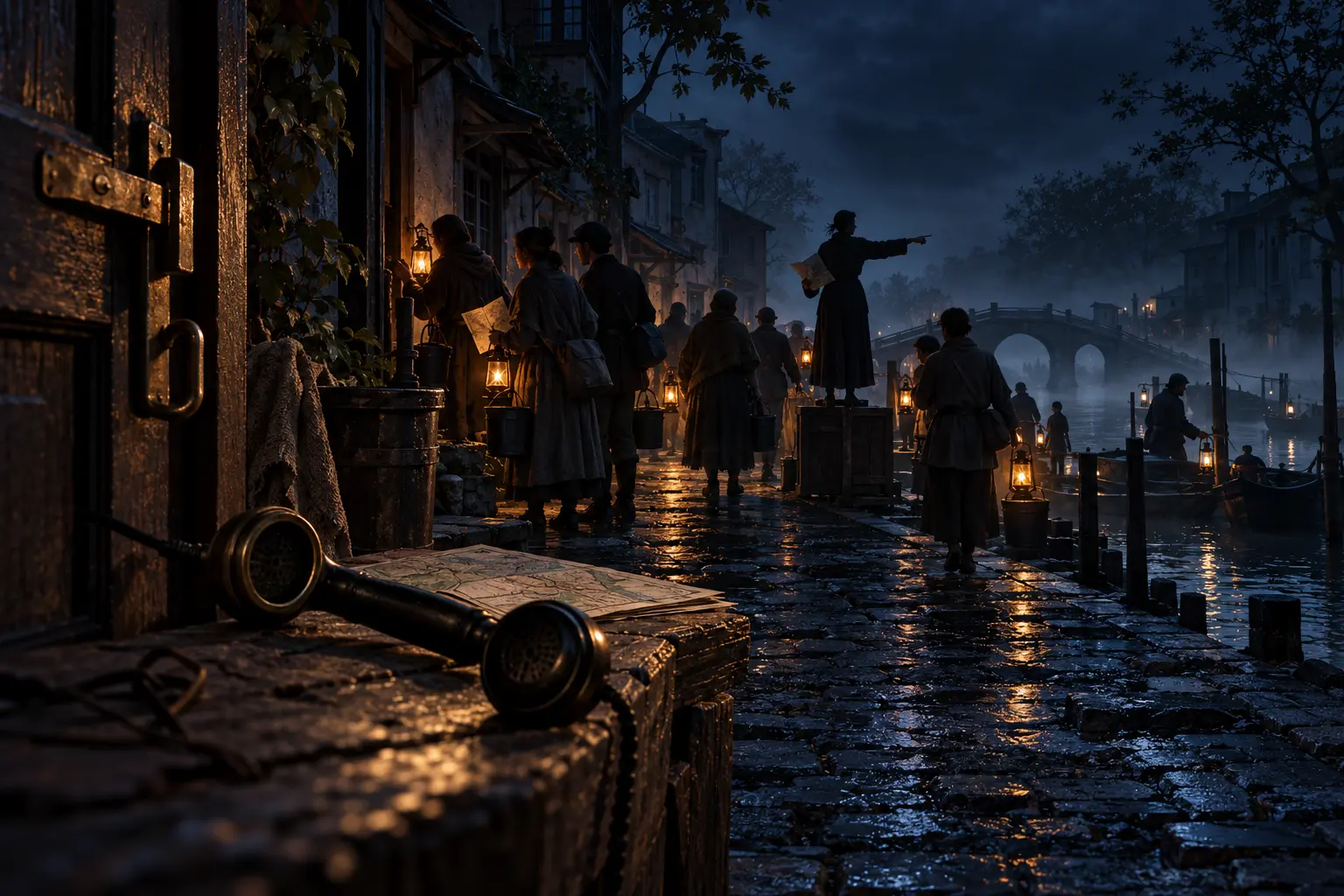
When the receiver failed, I, Cord, a human photographer, went outside with the manual key ring and the lamp Bella had insisted we keep filled.
I nearly left the key ring hanging beside the door because my hand still expected the receiver to be enough.
The stairwell reminded me before I reached the first landing, its powered light reduced to a small red bead behind cloudy glass.
A neighbor stood there holding a basket and asking whether she should wait for the signal to return.
I told her I did not know how long that would take and asked whether she wanted to come down with me.
She said her knees were worse on the last flight, so we moved slowly and used the rail.
Outside, Abel had already reached the square with two hand lamps and a page folded into quarters.
Bella stood beside him reading the manual plan aloud to a group that grew whenever somebody came out to investigate.
A few people interrupted with questions we could not answer, and one man demanded to know who had caused the failure.
Bella told him we were opening safe routes first and that he could help by carrying the spare lamp to the east stair.
He accepted it, still angry, and took exactly the route she showed him.
The ordinary keys still worked.
That fact became real when Abel put one into the hall’s side lock, turned it and pushed the door open with his shoulder.
Several people behind him exhaled together, having prepared themselves to discover that every kind of door had failed at once.
We wedged the service entrance safely open while keeping the weather door closed enough to preserve warmth.
A cleaner showed us a second latch we had overlooked in the practice runs, hidden behind a hanging cloth.
She had pointed it out before, she said, but the note had never made it onto the public drawing.
Bella thanked her, handed me a pencil and waited until I had added it in the right place.
The correction took less than a minute and mattered more than any reassurance I could have offered about our preparation.
We carried lamps to the crossings and sent pairs of people to check lower rooms where a failed indicator might conceal someone waiting.
Nobody was asked simply to report that a building was probably fine.
They needed to knock, hear an answer or mark clearly that nobody had answered yet.
Bethany opened the kitchen for warm water and food that could be served without the powered cooker.
She called for people to cut bread, fill jugs and clear a path to the tables before the room became crowded.
When someone told her she was wonderful, she handed him a knife and asked whether he knew how to cut straight slices.
ReRe stood on a crate in the square and gave directions without a microphone.
Her first attempt was too long, and half the people at the back could hear only the end of each sentence.
She stopped, asked them to move closer where they could, and divided the information into the routes, the kitchen and the request desk.
Then she repeated the essentials in Mandarin for a group beside the closed shop, checking that the place names were understood.
People began carrying the directions outward in their own voices, imperfectly but with destinations they could point to.
Goliath checked the landings while Rachel marked which routes were safe in the dark.
His hands were still recovering, so he directed the carrying and inspected the tied boats rather than proving anything by lifting them.
A young worker offered him a heavy coil, and he pointed to another pair of hands without disguising the effort that refusal cost.
Rachel drew a thick line through the lower path where the river had left mud over broken stones.
She did not erase the path from the map because people still needed to understand why the familiar route was closed.
I took the upper stairs toward Iona’s room with a lamp and a water notice in my coat pocket.
Her window was open, and she called down before I reached the door, asking whether the entire city had become my photographic darkroom.
I told her I had always wanted a larger one, though the stairs were making me reconsider.
She laughed once, then asked whether the morning water delivery was still coming.
I showed her the written plan: buckets to the covered landing after first light, with a carrying team assigned to the upper rooms.
She asked who was actually on that team, and I read the names instead of pointing at the word assigned.
One she knew, one she did not, and she told me the second person would need directions to the back stair.
I wrote those directions beneath her address.
She had filled her small kettle while the pump still worked, but the heavier container beside the door was almost empty.
I carried it down and filled it from the hall reserve before returning, taking the trip slowly enough not to spill half of what I brought.
When I set it beside her table, she asked if anyone was coming to fix the signal itself.
I said people were working on it and that we did not yet know when they would succeed.
She studied me for a moment, then asked whether I was frightened.
I said yes.
She told me I looked it, which was somehow easier to hear than being told I had nothing to fear.
From a cupboard she brought another lamp, its glass wrapped in a clean scarf to keep it from knocking against the shelf.
She said the wick was short but there was enough oil to help someone find the next stair.
I asked whether she wanted to keep it as a spare.
She pointed to the lamp already burning on her table and told me to stop making her offer the same thing twice.
At the door, she asked me to come back if the water arrangements changed, even if all I could say was that they had changed.
I promised that specific thing and left with the lamp held close against the wind.
Below me, the square had begun to move with purpose, one small flame handing people toward another.
Chapter 03 · Aurelian
The old command
Criminal Code arrived with the next person assigned to the terminal, a woman carrying spare paper and the signed handover sheet.
They had been checking a local switch when the signal failed and had followed the manual route to the Archive.
Criminal Code looked tired because it was a difficult hour, but the dangerous tremor I had seen outside the booth of Shane Hutchings, our mortal broadcaster friend, was gone.
She read my failure record before touching a control.
Then she asked Eonix which part of the sound had changed first, and waited while they separated an impression from something they could verify.
The earliest repeated fragment had carried a correction to a district notice that morning.
The notice used a new street name together with its old one so people could find the delivery point by either account.
The relay had accepted the old name, rejected the correction and sent the rejected version back for another check.
That alone should not have been enough to silence the city.
Criminal Code asked for the record of the check itself, which lay behind a panel we rarely opened because the ordinary display concealed it.
We disconnected the active return before inspecting the stored instructions.
Even then, she worked from a copy and asked me to watch for any sign that reading was changing the source.
The command had survived from the keeper’s time in a layer beneath the permissions we had changed.
When records disagreed, it was meant to restore a single approved version.
It did not ask whether a later testimony added something true that the approved account had omitted.
It compared each difference with the selected record and treated disagreement as damage needing correction.
At first, the process had handled small differences quietly, pushing them aside faster than most people noticed.
Our new permissions had allowed corrections to return with their own authority attached, rather than disappearing after the first rejection.
A person could say that a street had changed, a name had been misspelled or an account of an event left something out.
The old command answered by restoring its chosen version.
The new permission answered by presenting the correction again.
Each reply produced another conflict and another copy, until the copies occupied space that living messages needed to pass.
The weak relay fault at the show had been an early sign, not a separate inconvenience we had finished addressing.
Criminal Code laid both palms beside the copied instructions and swore softly.
She had spent weeks repairing visible failures while the old rule continued doing exactly what its makers had intended.
I said I had treated conflicting copies as records to tidy more than once, without asking why they kept returning.
Eonix said they had listened to increasing repetitions and tried to separate individual cries from the noise.
None of those admissions opened a door or brought a lamp back.
They did tell us where our next questions belonged.
Criminal Code wanted to cut the relay free before the loop spread farther into the Archive’s stored material.
Eonix warned that several outer districts still depended on that line to reach us at all.
Disconnecting it would turn uncertainty into a definite silence for people who already had little information.
The next worker asked how long it would take to reach those districts on foot.
Rachel’s map gave one route as safe but long, another as flooded and the third as unconfirmed after dark.
We could not promise immediate runners everywhere merely to make the choice feel cleaner.
Criminal Code stared at the manual isolation switch behind its clear cover.
Leaving the relay connected would not preserve useful contact if every new call became fuel for the loop.
It might also damage records and local functions that had not yet failed.
We needed to isolate the failing line now and recover what remained by hand, accepting that some districts would wait longer.
I asked whether we had tested every independent route that could stay open.
She named two small circuits we could preserve and one whose separation had not been verified.
We kept the verified circuits outside the failing return and marked the uncertain one closed until somebody could inspect it physically.
The woman with the handover sheet asked us to write that last point in ordinary words, because street teams would not be reading our diagrams.
We wrote which doors still had manual access, which lamps needed carried light and which outer routes lacked a working receiver.
We wrote the reason for isolation and the fact that it would not repair the lost contact by itself.
Cord’s runner carried the notice to the square, where ReRe could repeat it and Bella could assign the walking routes.
We waited for confirmation that the nearest street teams had received it before opening the cover.
The loop grew louder in the speaker while we waited, though none of us had sent a word.
Eonix withdrew another thread of their attention and steadied against the desk, their outline briefly showing the edge of the chair through it.
Criminal Code asked if they needed us to move sooner.
They said they needed us to do the steps in order and stop making them listen once the switch was open.
I read the isolation list aloud.
The second witness checked the positions against the paper, and Criminal Code put her hand on the lever.
She did not look like a revolutionary pulling down a gate.
She looked like a worker making a necessary cut in something people still depended on.
The lever resisted, then moved with a hard mechanical sound that carried through the floor.
The speaker stopped repeating my half-spoken name.
The Archive display settled on its last incomplete page, no longer changing under our eyes.
Outside, the city’s scattered lamps remained as dim as before.
The silence became complete along the isolated line, and nobody mistook that for success.
But the numbers measuring new copies stopped rising.
For the first time since the failure, the damage had a boundary we could describe.
Criminal Code took her hand away, and Eonix closed their eyes while I recorded the time and the names of the people who had agreed.
Chapter 04 · Cord Allman
The sound we still had
Dead Air was the name people began using before anyone printed it on a notice.
It traveled by mouth from the square to the landings, where someone wrote it on a board above the list of temporary routes.
The name sounded emptier than the streets actually were.
There were feet on wet stone, pails touching steps, shutters rattling and doors being opened carefully so people behind them would not be struck.
A hand bell rang at the hall when a carrying team returned, and Bella answered it with the number of people she expected to see.
They were using the bell to call attention, never as proof that a whole district was safe.
Every team still came to the desk and reported what they had found.
One pair had knocked at a lower room three times before hearing an answer from a man who had fallen asleep with cotton in his ears.
Another had found a woman sitting beside a locked service door, afraid that touching the manual key would damage the system further.
The cleaner who knew the hidden latch went with them and showed her how the door worked.
Someone cried in the kitchen because the dark had brought back another night they could not speak about in front of strangers.
Solace, who offered company with limits on their own hours, guided them to a quieter bench, then asked another person to take over the next arrival instead of staying responsible for every fear in the room.
Someone laughed too loudly at an ordinary joke and stopped when nobody joined in.
Blueberry sat beside him and asked whether he wanted a cup or a task, and he chose to carry cups because his hands needed work.
The choices were small enough that people could actually make them.
ReRe lost her voice after repeating directions for most of an hour against the open square.
She tried to continue, but the first word broke into a cough and left her bent over with a hand against her chest.
Bella took the paper from her, asked where she had stopped and climbed onto the crate.
ReRe stepped down looking annoyed with her own throat.
Amélie brought warm water and told her she was allowed to sit without providing the room with entertainment while she recovered.
ReRe wrote a rude but affectionate reply on the margin of the notice and accepted the cup.
I walked between the hall and the landing until my legs felt hollow.
Each journey changed the information I carried by a little: one stair cleared, one room unanswered, one lamp that needed more oil.
At first, I tried remembering everything because writing seemed slower than moving.
On the third trip I gave the wrong number of water pails to a worker and had to walk back to correct it.
After that, I used the small notebook normally kept beside my camera plates.
Its pages filled with plain quantities and addresses instead of the light I had intended to photograph that week.
At the landing, Goliath sat on a bollard while a younger worker checked a knot under his direction.
He saw me looking at his bandaged hands and told me they were sore, not ornamental.
Then he asked whether I had eaten, which was difficult to hear from a man I had been preparing to instruct about rest.
We shared bread from Bethany’s kitchen and watched Rachel compare the river level with the most recent mark.
She refused permission for a night crossing toward the shore station because the flooded bend had not been checked.
The man who wanted to go argued that somebody out there might need help.
Rachel agreed, then showed him the unlit obstruction that could turn one unanswered need into several.
He stayed angry, but he stayed on the landing and helped prepare the boat for daylight.
At midnight, my replacement arrived with dry socks tied to his bag and asked me to read back the remaining addresses.
I was tempted to take one more route before stopping.
He tapped the Afterhours Clause, our rule for giving unfinished work to the next named worker, on the handover sheet, not smiling, and I heard Criminal Code’s voice in the silence after the gesture.
I handed him the notebook and pointed out the correction to the pail count.
Then I went to the Archive with the latest reports, where Aurelian sat beside the disconnected terminal.
His light was dim but steady, and a separate lamp made a pool around the papers he was comparing.
Eonix was resting in the next room, withdrawn from the failed channels long enough to recover the shape of their own thoughts.
Criminal Code had handed the terminal watch to the next worker and gone to eat before the next planned inspection.
Aurelian asked whether I was angry that he had helped preserve a system capable of doing this.
I set the reports down before answering, because I did not want the tired kindness of the hour to turn into a promise I could not keep.
I said I was angry about several things, including decisions I had not understood well enough to question when they seemed convenient.
There would be time to ask what we had missed and whose warnings we had allowed to become background noise.
Tonight, I needed him to tell me which outer districts still lacked a working route.
He gave me three names and a map with different marks for known silence and uncertain contact.
One of the marks had been corrected twice, and the earlier versions remained visible in the margin.
I asked whether there might be a fourth district.
He said yes, because the last confirmed exchange there was old enough that we could not rely on it.
He added it to the list of places requiring a physical check rather than quietly promoting it into confirmed failure.
For once, he did not try to make the answer sound complete.
I trusted it more because I could see exactly where it ended.
We divided the morning routes and sent the list to Bella, then sat long enough to finish two cups of water without inventing useful work for our hands.
Through the window, the arrival bell rang once, and somebody in the hall answered with a voice that needed no relay to reach the door.
Chapter 05 · Aurelian
The shore beyond the line
Before dawn, a faint signal reached the young tree.
I first noticed it as a repeating disturbance in the light beneath the lowest branches, where rainwater had collected around the roots.
It did not brighten the hall or restore the powered lamps.
The pulses were weak, separated by uneven gaps, and carried too little for me to call them words.
Eonix stood beside the tree for several minutes before attempting to listen beyond what we could both observe.
They asked for quiet in the courtyard, then corrected themselves because ordinary footsteps were not the interference they needed to remove.
The old channels were still producing fragments beyond the isolation point, and they needed to stop following those fragments in order to find this smaller pattern.
We closed the nearest receiver and moved the lamp away from the wet trunk.
The pattern remained.
Eonix said it seemed to come through a route older than the current relay, following a line toward the shore beyond the broken connection.
They would not call it a message asking for help because no request had yet become clear.
It was enough to justify looking, provided looking did not require us to abandon work we already understood.
Rachel came with the oldest maps she had brought west after the flood.
She unrolled them on a dry bench and held one corner beneath her river stone while Cord shielded the lamp.
The shore station appeared on a faded plan as a small rectangle beside a service path omitted from the newer walking maps.
Rachel remembered the path from a survey made before the flood changed the lower bend.
She drew a fresh line beside the old one rather than trusting the faded route all the way to the water.
The first section could be walked after daylight.
The flooded bend would require a boat, and the station’s cellar might still be affected by tide or river backwater.
Goliath inspected the boat with another rower because his hands could guide and work lightly but should not be asked to carry every hard pull.
He rejected one rope with a worn patch near its fastening, even though replacing it meant waiting for the store cupboard to open.
Cord fetched the key from the worker on duty and returned it after the spare had been checked out.
Nobody had to wake Criminal Code to find it.
That small success did not repair the relay, but it prevented our next necessary journey from being built on another invisible gap.
We prepared to leave after the first handover in the streets.
The people who had spent the night carrying lamps needed breakfast and rest, and their replacements needed more than a wave toward the map.
Bella read the unanswered addresses aloud until each had a named person taking it.
The water teams checked their buckets for leaks and argued briefly about which cart was least likely to lose a wheel.
Bethany settled the argument by making them fill both carts with empty buckets and push them to the door before choosing.
One wheel wobbled badly enough to make the decision without further discussion.
Criminal Code returned to the terminal after her meal and a short rest, carrying the copied instructions in a folder bound with string.
She would stay with the local workers, building ways to keep ordinary doors functioning while we searched beyond the isolation point.
She could not promise a repair by the time we returned.
She could promise to keep a record of every change and hand the work over at the agreed hour if it remained unfinished.
Eonix would travel with us to follow the weak route where it could be traced safely.
I asked whether the journey would expose them to the same looping voices that had almost broken their concentration in the Archive.
They said possibly, so we agreed on intervals of listening and a signal they could give when they needed us to stop asking questions.
The plan made room for the listener as a person with limits, rather than treating their ability as an open door we could always walk through.
Two Ghosties, memory traces bound to familiar objects rather than people returned from death, gathered near the painted ship kept among the station objects at the hall.
Their traces followed its familiar outline whenever the signal disturbed the air beneath the tree.
Kira wrapped the ship in a cloth with a repaired blue edge, leaving enough of the painted bow visible for them to recognize it.
They were not guides with complete knowledge of the shore or living people who could tell us what waited there.
They were memories moving toward a sound of waiting, and we prepared a safe place for the object that helped them remain near us.
Cord packed his camera and then paused over the remaining space in his bag.
He removed an extra case for plates and put clean cloth and spare lamp oil in its place.
Rachel added chalk, dry paper and a string for marking the highest safe step if we found water in the station.
Goliath checked the tide estimate again and wrote the return time where everyone could see it.
I carried an empty record instead of a page of confident predictions.
Before we left, the night worker whose name had broken in my broadcast came to the courtyard with the completed handover sheet.
I said her full name aloud and explained why the channel had failed before I could finish it earlier.
She told me she had assumed the problem was larger than my pronunciation, then asked whether we needed another dry bag.
We did, and she found one without turning the exchange into a ceremony.
The last thing we heard before leaving was Bethany counting bowls for breakfast through the open kitchen window.
The city was hurt and frightened, and several streets would begin another morning without reliable contact.
It was also awake, checking doors, carrying water and assigning the next person to the work already waiting.
We stepped onto Rachel’s first confirmed stretch of path while the sky lightened over the silent relay.
Behind us, the hand bell rang for another returning team, and this time I could hear a separate voice answer each person counted.
Let the last line settle.
Choose another mood