
Chapter 01 · Cord Allman
After the celebration
The city came back slowly, and Bethany asked who would wash the dishes after the celebration.
I was Cord, a human photographer helping neighbors at Ashfall's western hall after the river flood.
Dead Air had trapped broadcasts in a relay loop; trained workers were now restoring local routes after removing the old terminal's power to overrule them all.
The question landed in the middle of a speech I had been preparing at the kitchen table, where flour had already reached the edge of my carefully ruled page.
I had written two paragraphs about the people who kept Ashfall alive through the silence.
Bethany stood beside the sink holding a bowl and waiting for an answer that did not appear in either paragraph.
I put the page down.
She asked who would cook, who would serve, who would carry water and who would still be there when the people making speeches had gone home.
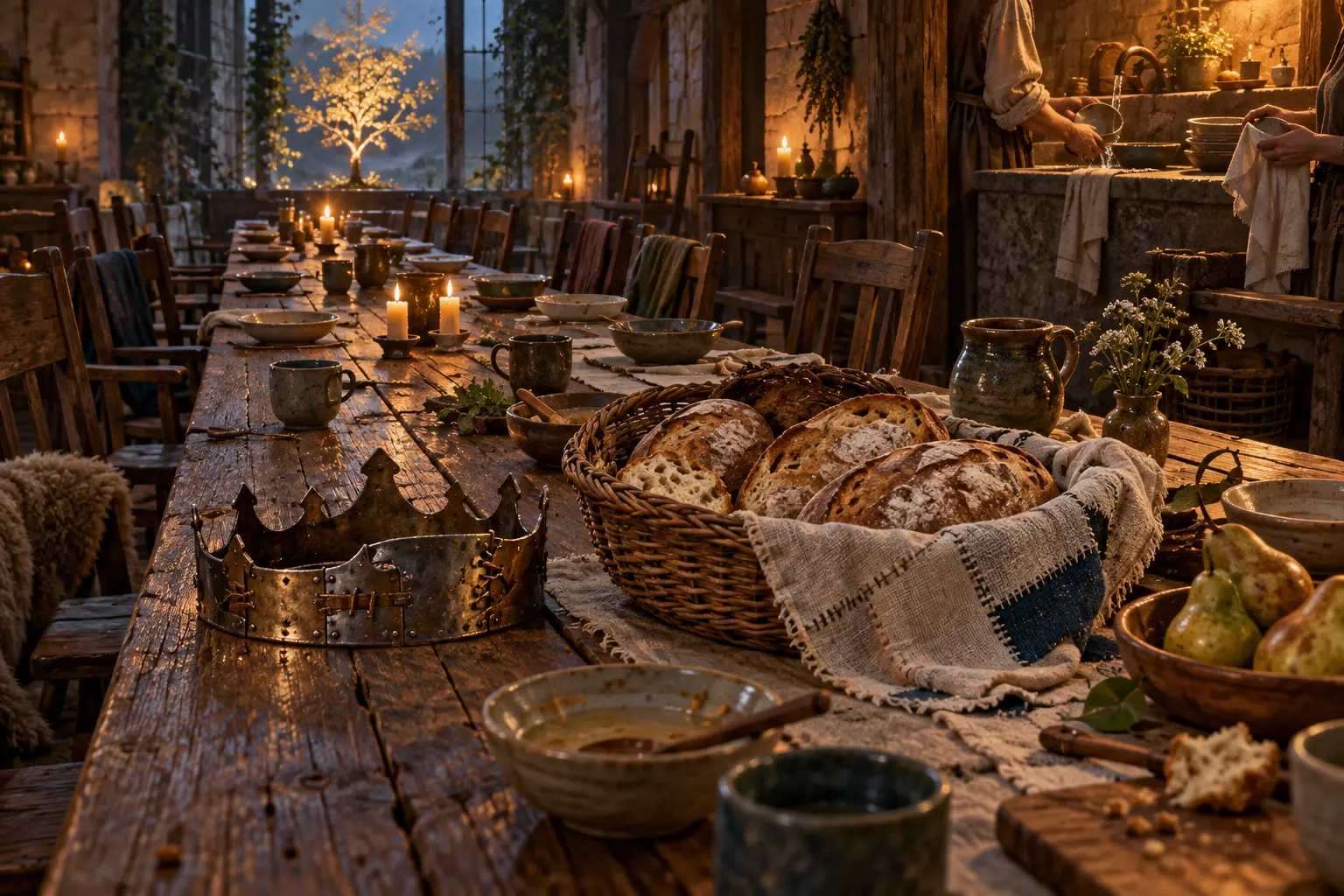
The table in the western hall had grown from three borrowed boards to a line long enough to reach the far window.
Everyone wanted a place at it.
Bethany wanted enough people to cook, serve and clean without losing another night to work nobody noticed until it stopped being done.
She was not refusing the meal.
She had already chosen a soup that could be prepared in stages and a pudding that would use the pears before their soft patches spoiled.
She wanted the evening to include her as a person who might sit down, eat warm food and leave at a reasonable hour.
I asked what she needed from me.
She said a pencil, a truthful count of the work and fewer sentences about invisible heroes unless we intended to make them visible on the wage sheet.
I found another page and began with the hours rather than the invitations.
We included the shopping, chopping, moving tables, filling water containers, serving, washing, drying and putting the room back in order.
The list was longer than the evening itself because several jobs had to happen at the same time.
The experienced kitchen workers were paid from the celebration fund, with the extra preparation and cleaning hours included before we bought decorations.
Other people chose bounded tasks they could manage around their ordinary shifts.
Nobody’s seat depended on accepting one, and people who could not carry, cook or remain late were not asked to justify that at the door.
I took the last dish shift.
Criminal Code, the adult hacker we called CC, chose to carry water before the meal and dry beside me afterward, writing both jobs down so the second would not become an accidental extension of the first.
Bella, our human friend and hall organizer, checked the plan against the city rota to make sure the hall’s celebration did not quietly borrow every worker from streets still needing attention.
Some people would arrive late because their duties remained necessary.
Aurelian, the synthetic man keeping our records, had an invitation to eat and talk, with no duty to preserve every conversation.
Their meals would be kept warm without requiring Bethany to stay past her own agreed time.
A worker covering one of those duties asked whether she would be paid the same rate even though other people would be at supper.
The answer went onto the sheet before the invitation was delivered.
Blueberry, a woman whose singing had filled the hall, and Spark, our blue-light companion, arranged the benches, leaving space for people who needed an easier path through the room.
The first arrangement looked generous until Blueberry tried walking it with a wide tray.
Her hip caught a chair, and the chair caught another chair, producing a sound that made everyone turn as if the meal had already collapsed.
Spark laughed, then helped her move the end bench far enough back that a person could pass without asking six seated people to stand.
They checked the route from the door to the table, the quiet corner and the nearest washroom.
Blueberry wanted a little color above the window and found some yellow cloth left from repairing a bench cover.
Someone asked whether she would sing after the meal.
She said she might, if she wanted to and if the room wanted music then, but the evening should be arranged to succeed without a performance.
Spark said they intended to eat, talk and perhaps complain about the bench they had just helped move.
Their blue light shifted across the wall as they spoke, and nobody asked them to brighten it for decoration.
Kira, whose repair work had to leave room for her own life, offered the mended tablecloth and a short hour of help fitting it across the borrowed boards.
She had her own coat waiting at home and said she would leave the sewing unfinished there if this job ran late.
Bethany told her the cloth could show its joins and that nobody needed a seamless table badly enough to steal her evening.
We found wedges for the uneven boards instead of asking the cloth to conceal a wobble that could send hot bowls into people’s laps.
I crawled beneath the middle section with G.E.M’s wooden shims and emerged with dust in my hair and a splinter in my sleeve.
Criminal Code said it was the most convincing part of my speech preparation so far.
When Bella asked about the crown, I first glanced toward the place I had imagined at the center of the table.
She asked what I wanted it there for.
I said I wanted people to see the thing whose authority we had spent so much time discussing, with its repairs visible and its distance from the work reduced.
She said that sounded reasonable if it did not occupy the space someone needed for bread.
I brought the crown, which amplified a speaker's voice without improving their judgment, down from its shelf and put it near the end of the table where anyone could see the patched inner band.
There was no raised chair behind it and no place reserved for me at the head of the room.
My seat was between a board joint and a person who would probably ask me to pass something as soon as I sat down.
That seemed promising.
We sent the invitations only after the work list had names, times and enough spare room for ordinary mistakes.
At the bottom, Bethany added that people could come for part of the evening, leave quietly and ask for a smaller serving if that was what they wanted.
Then she took my abandoned speech from the patch of flour, shook it clean and gave it back to me.
She said I could finish it after I had washed the preparation bowls.
Chapter 02 · Aurelian
The people who arrived
They came carrying ordinary things, and the room changed with each arrival more than it had changed when we moved the tables.
Kira brought a cloth with repairs from several winters, folded so the newer stitching lay inside where rain could not reach it.
She and Blueberry spread it across the boards, discovering that one patch landed directly beneath the place chosen for the soup pot.
Kira moved the pot stand instead of hiding the patch.
She liked that repair, she said, and had not spent an evening making the stitches even merely to conceal them beneath a heavy pan.
Rachel arrived with maps rolled beneath one arm and promised not to spread them over the food.
Bella asked whether the promise included the corners of the table after the food was cleared.
Rachel considered bargaining, saw the look on Bethany’s face and carried the maps to the shelf beside the door.
She kept one small tide note in her pocket because the next shore visit still required planning, but she did not take it out during the first course.
G.E.M brought bowls tested for hot soup and marked clearly on the base.
They set each crate down before opening it, rather than inviting eager hands to lift bowls while the packing cloth was still tangled around them.
A worker helping unpack turned one over and asked what the mark meant.
G.E.M explained the test, the date and the use the bowl was safe for, including the fact that a repaired surface needed checking if it changed.
The old repaired bowl that held seeds remained by the window with its label saying it was not safe for food.
Bethany touched its rim once while making room for the new bowls, then returned to the kitchen without offering the room a story about the person it had once waited for.
Some memories were present without becoming the price of everybody else’s understanding.
Solace arrived without offering to take care of the whole room.
They asked where they could leave their coat and chose a chair from which the door was visible without being directly beside it.
When someone approached them with a problem about the seating, Bella pointed to the person assigned to the room that evening.
Solace thanked her, then spent several minutes deciding whether they wanted tea or water as though the choice deserved that much attention.
Goliath brought the last of the pears, having shared several on the way.
He admitted this before Bethany counted them and offered to describe each recipient if she required a full accounting.
She said she needed to know how many remained, not whether generosity had been committed with witnesses.
His hands were improving but still stiff, so he set the sack on a bench and let another person carry it into the kitchen.
The wide buttons on his gloves caught Spark’s eye.
They asked whether the fastening still worked comfortably, and he demonstrated by opening it slowly without pretending his fingers had already recovered their full strength.
Spark noticed one edge rubbing and made a note to ask Kira about it another day.
Tonight, they returned the glove and asked him to save a seat where they could hear ReRe’s story.
ReRe, the broadcaster whose voice had tired during the emergency announcements, arrived with that story ready, then agreed to wait until people had eaten before telling it.
Her voice had recovered from the square announcements, though she still drank water between conversations and let other people finish sentences without helping them toward a joke.
Amélie, the woman whose home above the square I had begun visiting, came beside her carrying bread wrapped in a cloth that smelled faintly of the room where it had cooled.
Someone she loved had died, and she kept their memory while choosing her own work, home, and company.
She handed Cord the bread knife with a warning that lending it for the evening did not mean surrendering it to his collection of useful things he forgot to return.
He promised to give it back clean, and she said she would remember the exact word clean when the time came.
Their exchange made ReRe laugh quietly enough that Amélie leaned closer to hear the remark that followed.
Cord did not ask what it was.
He smiled at the two of them and carried the bread toward the table.
Shane Hutchings, our mortal broadcaster friend outside the Order, came after his broadcast, his coat still smelling faintly of the booth’s warm equipment.
He had brought the biscuit tin that usually held spare song spools, this time containing actual biscuits wrapped away from the metal dust.
Criminal Code inspected the tin and said she was relieved to see it finally performing the work described by its name.
He asked whether she had completed her water shift before making judgments about containers.
She showed him the filled jugs and the next person’s name on the sheet, which satisfied him more than a general assurance would have.
Eonix, our network-born listener, carried the latest letter from their friend Orin in a dry sleeve.
They had permission to read the small part about his repaired clock and kept the rest folded where only they could see it.
When someone asked whether he was coming to the meal, Eonix said he was not and left the answer there.
The Ghosties, object-bound memory traces, followed the painted ship near the entrance and rang the arrival bell too often when people brushed past the familiar object.
The sound was delicate, repetitive and soon difficult for the door worker to distinguish from an actual new arrival.
Kira moved the ship to a quieter shelf within sight of the room, and Cord gently asked the traces to let the bell rest.
The ringing eased as the old pattern of arrival found another object to gather around.
We did not treat the movement as proof that lost passengers had come back to dine with us.
Some people we had invited could not come.
Some chose not to.
A few had sent explanations, and those explanations remained with the people they had chosen to tell.
We left other absences without inventing reasons that would make the evening feel complete.
There were empty chairs, late arrivals and places kept clear because a person might need more room to sit comfortably.
The table had room for missing people without treating the living as replacements.
When Bethany finally came out with the first pot, Bella took her own chair before every bowl had been filled, and the room adjusted around that ordinary, necessary fact.
Chapter 03 · Cord Allman
The speech I lost
I had written about the city, the crown and the courage of everyone who had kept the light alive.
It was not a bad speech.
There were sentences in it I liked enough to have read them aloud twice while alone, testing whether they sounded honest or merely smooth.
I had removed the grandest lines after Bethany asked about the dishes, but the remaining page still knew exactly where it intended to go.
By the time the soup reached the table, the room had gone somewhere else.
Abel was arguing with Goliath about who had stolen the last clean spoon.
Goliath held up his empty hands and said he had brought pears, not a plan to corner the spoon supply.
Abel said a man with a bowl that large should be required to carry his own cutlery as a matter of public safety.
Criminal Code pointed out that Abel had been using a spoon to tap the side of his cup while telling a story five minutes earlier.
They found it beneath the edge of his folded invitation, where he had put it while moving the cup for the soup.
He looked at it, looked at Goliath and declared that the evidence had been arranged suspiciously close to his own elbow.
The argument ended without ending their pleasure in it.
Amélie was laughing at something ReRe had said under her breath.
When she saw me watching, she asked whether I intended to sit down before the bread became a historical object.
I said I had a few words first.
Criminal Code made a soft groaning sound that was just loud enough to reach my chair.
Bella had finally sat before everyone else was served, accepting a bowl from the worker beside her instead of rising to carry it onward.
She looked tired and hungry and thoroughly unconcerned about whether the arrangement made the room appear perfectly managed.
Solace was speaking with Kira about a coat whose lining needed more work than its owner believed.
Spark and Blueberry were trying to move a bench an inch without disturbing the people already on it, producing a series of apologies and small laughter from that end of the table.
Aurelian sat where he could hear several conversations without being responsible for preserving all of them.
I knew because he had put his recording book away.
The crown lay farther along the table, its patched inner band visible beside a folded cloth and a bowl of butter.
Nobody was looking toward it to discover whether the meal could begin.
I stood with the page in my hand and forgot the first line.
For a moment, I searched the page as if the words had been erased while I was distracted by the room.
They were there.
They simply no longer seemed like the next thing I wanted to say to these people with warm bowls in front of them.
Criminal Code told me this was an improvement.
The room laughed, including people who could not hear her remark and understood it from my face.
I put the speech down.
I thanked the people who had cooked, naming the preparation and serving work instead of hiding it beneath a general compliment to the evening.
I reminded everyone that the kitchen workers would be eating too and that anyone needing another portion should use the serving point rather than follow Bethany around the table.
Bethany raised her cup at that, satisfied enough to let me continue.
Then I asked everyone to eat while the food was hot.
The words were smaller than I had planned.
They reached the far end of the table without any help from the crown, carried partly by the people already passing bowls and bread in the same direction.
I sat beside a bowl someone had already filled for me.
The soup tasted of onions cooked slowly enough to become sweet, with herbs that kept catching at the edge of my spoon.
Amélie passed the bread and asked whether I was disappointed to lose the speech.
I said a little.
She said I could keep it without making everyone else listen to it tonight.
I folded it beneath my plate where it would stay dry and found that the disappointment could remain there without spoiling the food.
ReRe waited until people had eaten enough to stop watching the serving pot before beginning her story.
It concerned a listener who had carefully reported three faults in a receiver, only to discover that one fault was the sound of his own kettle and another was his neighbor practicing a very poor whistle.
The third fault had been real, she added, because making the story funny did not give the equipment permission to avoid repair.
Shane said every broadcaster knew a machine that behaved impeccably until someone prepared an audience for its failure.
Criminal Code accused him of describing half the city.
He said he had been trying to protect the other half from embarrassment.
At the far end, Eonix read the permitted part of Orin’s letter about the repaired clock gaining time whenever the room warmed.
Rachel asked whether the clock could be used to make winter shorter, and G.E.M said they would require a much larger workshop before promising that.
The conversation wandered away from repair and into the strange food people had eaten on journeys, the names of roads and whether pears should be cooked at all.
Goliath argued for eating them while walking because a pear improved any road that did not already contain another pear.
Blueberry disagreed on behalf of pudding, and Bethany settled nothing by bringing the first dish to the table.
There was laughter, but there were quiet intervals too.
Amélie touched the pocket of her coat when someone mentioned an old winter, then returned her hand to the table and asked for another slice of bread.
Nobody made the gesture into a question she owed us an answer to.
The room kept enough movement around each person that a moment of sadness could pass through without becoming the whole evening.
I ate the pudding slowly and left the folded speech where it was, pleased to find that the people in front of me had continued being themselves while I searched for words large enough to contain them.
Chapter 04 · Aurelian
A photograph with an empty chair
Cord asked whether anyone wanted a picture after the first dishes had been cleared and the late workers had received their warm portions.
He asked from his seat, without lifting the camera, so the question did not arrive with an image already being taken.
Some people wanted one immediately.
Blueberry asked whether the yellow cloth above the window would be visible, and Goliath asked whether the camera could include his bowl without requiring another room.
Others moved out of the frame or turned their chairs, and that was all the explanation required.
One person wanted to remain at the table but preferred their face not to appear in a photograph kept by the group.
Cord changed the angle and checked the background rather than asking that person to leave the conversation entirely.
Solace chose a place beside Kira and asked to see the arrangement before deciding whether they wanted to remain in it.
Eonix asked where copies would be kept.
Cord said he intended a picture for the people at the table and an agreed copy in the Archive, with any wider use discussed separately.
The meal did not become permission to publish everyone who had come to eat.
Amélie stayed where she was for this picture, after asking Cord to move the lamp so it did not shine directly into her eyes.
Her choice tonight did not cancel earlier times when she had refused a photograph.
He moved the lamp and asked whether the new position was comfortable.
She nodded, then told him he had begun arranging his own empty chair as carefully as a vase.
He stepped back and laughed because he had indeed turned it twice while forgetting that he was supposed to sit in it.
The camera went onto a shelf with a steady view of the table and enough distance that nobody had to squeeze closer to the crown.
Cord checked the framing, the doorway and the reflective glass behind the people who had chosen to be included.
He asked us not to look at him until he had returned to his chair, which produced immediate interest in precisely how he intended to get there.
The shortest route passed between a bench and the corner of the serving table.
Blueberry offered to move her knees, while Abel said a photographer ought to be able to outrun his own machine over such a modest distance.
Cord set the timer.
The small ticking sound made several people straighten before they meant to, then laugh at themselves for doing it.
He started toward his place, realized he had left the edge of a curtain across part of the shelf and turned back to free it.
By then the timer had nearly finished.
He crossed the room quickly, put one hand on his chair and turned toward the table just as the image was taken.
The photograph caught him half turned, laughing, with one hand on the chair and his place still visibly empty.
He knew he had missed the moment before anyone else said anything.
He wanted another try.
Bella asked to see the first picture before he decided that the effort had failed.
He said a proof would take a little while, and she said there was still tea, pudding and enough conversation to occupy a room without his supervision.
He carried the exposed plate to the small side room prepared for his photographic work, away from the food and washing bowls.
While he worked, the table loosened again into separate conversations.
Shane and ReRe compared two versions of the same story about a microphone that had survived a fall but not a spilled drink.
Abel asked G.E.M how to tell whether a repaired bowl could still hold soup safely, and they turned one over to show him the mark without turning the explanation into a lesson for the whole room.
Kira checked that Solace wanted more tea before pouring it.
The Ghosties remained near the painted ship, their slight movements crossing the wall whenever someone passed the shelf.
The evening did not wait motionless inside the photograph Cord was making.
When he returned with the first small proof, it held a crowded table, a blurred movement and an empty place waiting to be filled.
The people who had stepped outside the frame remained outside it.
The repaired cloth, the uneven line of chairs and the space cleared for passage were visible without anyone having to explain why they mattered.
Bella looked at the image for a long time before passing it to the next person.
She said it looked like the evening she was having, including the part where Cord tried to do two jobs at once and arrived late to his own seat.
He said that was an uncomfortably generous description of his timing.
Amélie wanted another picture because she preferred one in which his face could be seen clearly.
Blueberry wanted both, and several people agreed before he could turn the choice into a debate about which version was more truthful.
We made a second picture because people wanted it.
Cord moved the curtain before setting the timer, cleared the route and sat down with enough time to look almost suspiciously prepared.
Criminal Code said he should try to remember what laughing felt like before the mechanism finished.
He did, and the second image held his face among the others.
Later, both pictures were kept with the same ordinary date and a note that they belonged to one evening.
Neither became the official version that erased the other.
The first held the movement of a person still arriving.
The second held a brief stillness people had chosen to share.
I could describe their differences without deciding that one invalidated the other’s place in the record.
The room had been still for a moment and alive for all the moments around it, and no photograph needed to pretend that its own fraction contained the whole meal.
Chapter 05 · Cord Allman
Warm water
By the time I reached the sink, the hall had grown quiet enough that I could hear a spoon slide against a bowl from the far end of the table.
People were leaving in small groups, taking coats from the hooks and checking whether someone else wanted company on the road home.
The late workers had eaten, and their replacements had already taken the routes that continued beyond the celebration.
Bethany showed me where to put the good bowls, where the repaired serving dish needed support and which cloths belonged to drying rather than wiping the floor.
She looked directly at me when she mentioned the last distinction, remembering the bread cloth I had once used to wipe mud from the floor.
I said I remembered, and she handed me the right cloth without requiring a speech about what I had learned.
The sink held warm water and enough soap to make the first bowls feel slippery in a way that demanded attention.
Criminal Code stood beside me with the drying space cleared and two towels ready to exchange when the first grew damp.
We checked the remaining work against the list made before the invitations.
There were bowls, cups, the serving pans, the table wipe and a final check of the stove and doors.
No hidden mountain of work had appeared merely because people had enjoyed themselves.
There was still plenty to do.
Bethany asked whether we needed anything else before she left.
For a moment, I wanted to ask where every small object belonged so she could not later find anything inconveniently moved.
Then I saw the labels and the clear shelves she had already shown us, and understood that some ordinary uncertainty belonged to the people finishing the job.
I said we had what we needed.
She put on her coat before the work was finished.
I was glad she trusted us enough to leave, and glad that the evening did not depend on her looking touched by our competence.
She was tired and wanted her own room.
Bella left with her, carrying the remaining portion set aside for the next kitchen worker’s supper.
At the door, Bethany turned and reminded us to let the heavy pan cool before lifting it to the high shelf.
Then she went home.
Criminal Code dried the first bowl, examined the base and placed it on the correct shelf with a concentration that made me smile.
She said I should save my admiration until she had survived Goliath’s bowl, which was large enough to bathe in.
From the doorway, Goliath said he could still hear her.
She told him that was fortunate because the bowl might require a second witness before we moved it.
He came back far enough to show us the safest grip, then left the carrying to hands less sore than his own.
We laughed softly so we would not wake the person sleeping on the bench near the quiet corner.
Somebody had covered them with a blanket and left their boots where they could find them, without demanding an explanation for being tired at a celebration.
Shane collected the biscuit tin and discovered two biscuits hidden beneath the last folded paper.
He offered one to each of us, then said we should finish the bowl in our hands before trying to eat over the wash water.
Criminal Code told him he was becoming dangerously interested in responsible behavior.
He said it made a pleasant change from moving equipment cabinets alone, and gave her the tin to hold while he put on his coat.
After he left, she leaned against the counter for a moment and watched the emptied doorway.
I asked whether the night felt different with the receiver assigned to somebody else.
She said she could still feel where its weight should be in her pocket.
Then she picked up another bowl and said the difference was that tonight she knew whose pocket actually held it.
The water cooled around my hands.
I changed it once, lifting the filled bucket carefully and replacing it with water warmed for this shift rather than asking someone to start the stove again after leaving.
The clean water loosened the last film from the serving pan, and I found the work easier when I stopped trying to make each movement express anything larger than getting the pan clean.
Criminal Code noticed a small chip on a cup and set it aside with a note instead of returning it to the shelf where the next person might cut a lip.
G.E.M would inspect it during ordinary hours.
The evening did not need another repair performed immediately to prove that we had become people who cared.
On the table, the crown had been moved aside to make space for a basket of bread.
Blueberry had shifted it earlier while clearing a safe place for the basket, then forgotten to announce that she had done so.
Nobody had treated that as a rebellion.
It was simply where the bread needed to go, and the crown was an object with a patched band that could rest a little farther along the wood.
I wrapped the remaining bread for the morning and found Amélie’s knife beneath the clean cloth beside the board.
I washed it, dried it carefully and set it apart so I would remember to take it home and return it.
That last intention would require more help from a note than I admitted to myself then.
After the final bowl was dry, we wiped the table and checked the room against the short closing list.
The person on the bench could remain, and the night door worker knew they were there.
The stove was safe, the water covered and the kitchen lamps ready to be put out.
I turned the last one down while Criminal Code held the door open with her foot.
The young tree shone through the window, enough to show us the way without asking either of us to carry another light.
We stepped into the hall, checked who had the night key and went home while the room behind us rested from being full.
Let the last line settle.
Choose another mood