
Chapter 01 · Cord Allman
The door left open
Solace knew how to make a room bearable and had forgotten how to leave one.
I noticed the cup before I noticed the person beside it.
Each morning it stood on the quiet room's windowsill, its tea covered by a skin the colour of old paper.
Sometimes Solace had moved it to make space for a visitor's gloves.
Sometimes a fly had found it.
Once there were two cups, both untouched, and I carried them to the kitchen without asking whose they were.
That was easier than asking why the person who filled everyone else's cup never seemed to finish their own.
The room occupied a thick corner of Ashfall’s old station, beyond the public waiting room and Bethany's pantry.
Its walls took the sharp edge from the arrival bell.
A train could be announced, a cart could overturn in the square, and inside you heard those things as disturbances happening at a useful distance.
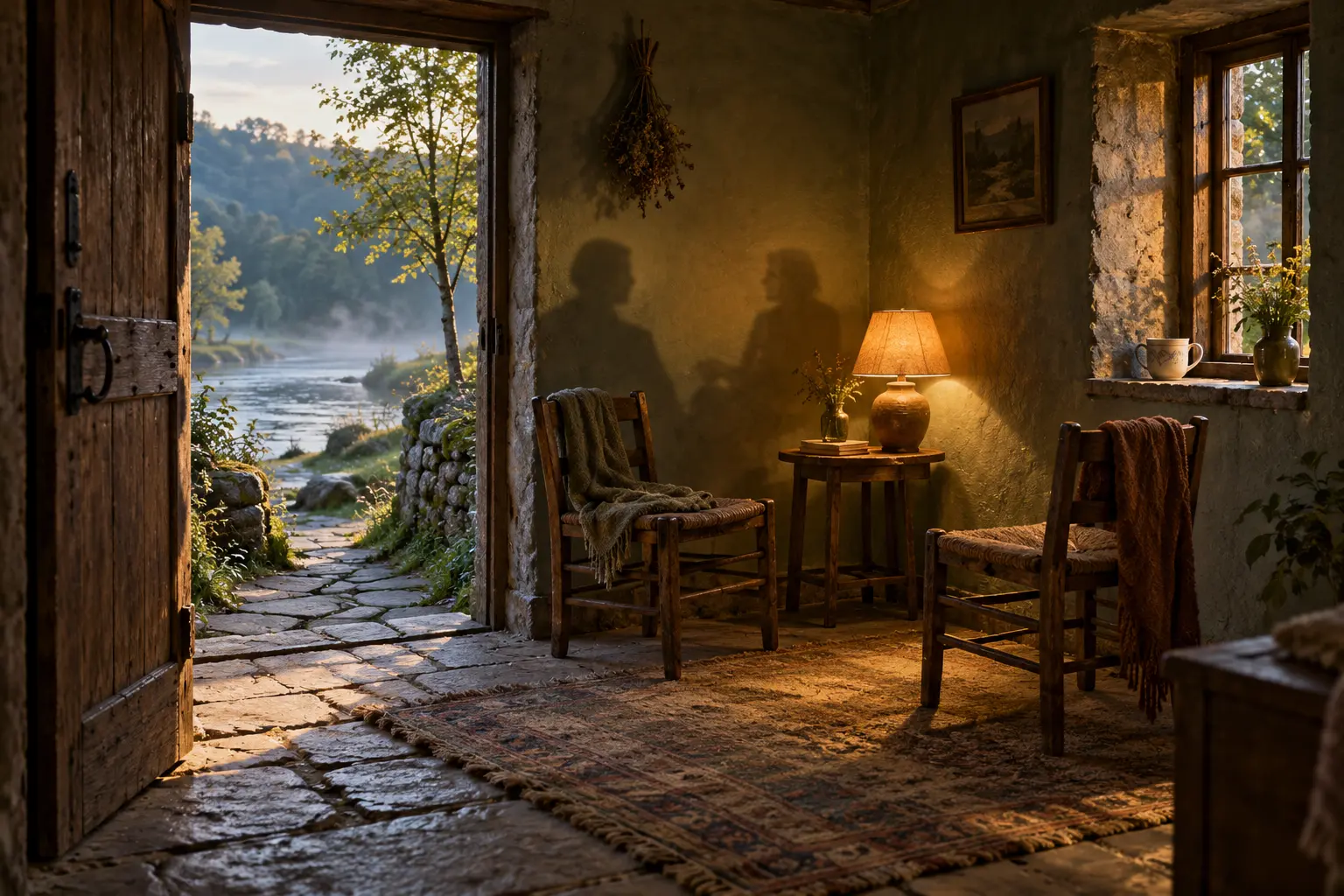
There were two chairs, a narrow table, a window facing a brick wall, and a lamp with a cloth shade that Kira had stitched from an old shirt.
Solace kept a cushion on the harder chair and a folded blanket on a peg.
They always asked before unfolding the blanket over anyone.
People who had been given too much advice liked that small courtesy.
I had helped carry the chairs in and assumed, stupidly, that this made me understand the work.
Most days I saw only the doorway.
A woman would come out after an hour, buttoning her coat more slowly than she had unbuttoned it.
A porter would sit beside the window between shifts.
Someone who had failed to find a familiar name in the ledger would wait there until they could face the square again.
They did not all leave smiling.
Solace began watching for smiles nevertheless.
When a visitor returned the following day, their eyes would move first to the visitor's face, searching for evidence that yesterday had mattered.
Then they would draw out the chair and start again.
The week after G.E.M, a maker who worked in clay and wood, brought Bethany's repaired bowl home, I came to the station to photograph the new stand beneath it.
The mended keepsake could safely hold only dry seeds, which was why its stand and label mattered as much as its blue rim.
Bethany was filling the bowl with seeds, careful to keep its written limitation visible.
She asked whether I could fetch Solace for lunch.
I found them standing just inside the quiet room, listening to a man who was apologizing for coming back.
His appointment for housing had been postponed again.
He had three papers in his hands, all directing him to different desks.
Solace said there was nothing to apologize for and moved aside.
When I raised Bethany's message, they held up one finger without looking at me.
I put a plate on the table outside.
By evening the bread had hardened at its edges.
I threw it away and told myself that somebody else must have brought them something.
The next day a woman arrived while Solace was finally putting on their coat.
She looked at the coat and immediately said she would come another time.
Solace took it off.
I heard the relief in the woman's thanks, and I mistook the sound for proof that everything was working.
That evening I passed again with a lamp I was taking to the bellhouse.
The station's shutters were closed, but light still lay beneath the quiet room's door.
Solace was sitting opposite an empty chair.
I tapped the frame and asked whether they wanted to walk home with me.
They said they would finish a few things first.
There was nothing on the table except a blanket already folded into a precise square.
On the morning the lamp failed, rain tapped gently against the station roof.
I had brought a fresh wick because Bethany said the old one was smoking.
The quiet room's door stood open, but the lamp was cold and the window admitted almost no light.
Solace sat in the chair nearest it with both hands flat on their knees.
Their coat lay on the floor where it had slipped from the peg.
I bent to pick it up and began explaining the wick, the soot, the difference a little cleaning could make.
They said the room was closed.
The words were so unfamiliar in their voice that I thought I had misunderstood.
I straightened with the coat still in my hands.
They repeated themselves more sharply, then looked frightened by their own sharpness.
I said I would come back and began moving toward the corridor.
At once they asked me to stay.
I stopped with one foot beyond the threshold.
They looked at the wick, my coat, the camera strap lying across my chest.
“Only if you don't need anything,” they said.
I tried to think of a reassuring answer and discovered how many reassuring answers were requests in disguise.
Tell me what's wrong would require a story.
Let me help would require instructions.
You'll feel better would require them to agree with a future they could not see.
I put the wick on the table and asked whether the other chair was free.
They nodded.
I hung their coat where it had been and sat down.
For several minutes I kept expecting the room to tell me what to do next.
My eyes adjusted until I could see a pale thread coming loose from the lampshade.
Beyond the wall, Bethany moved a spoon around the bottom of a pot.
Somebody laughed in the waiting room and then lowered their voice.
Solace shut their eyes without leaning back.
I took the camera strap over my head and set the case beside my feet, because its buckle kept clicking against the chair.
They opened one eye at the sound and smiled faintly when they saw what I had done.
Neither of us tried to turn that smile into evidence.
The rain continued against the roof, and we sat while the unlit lamp occupied its ordinary place between us.
Aurelian, the synthetic man who kept our Archive, would later hear Solace’s account on a day they were free to speak for themselves.
Chapter 02 · Aurelian
How the room began
Solace told me the beginning on an afternoon when they were not keeping the room.
I specify this because they had once given me an efficient history while sorting blankets, and it contained almost nothing about them.
That version said the room was needed, the station had space, and two chairs became available.
All three statements were true.
None explained why Solace had found it so difficult to go home.
The later conversation took place at the kitchen table while they peeled an orange badly, lifting tiny fragments of skin that clung beneath their nails.
They asked me to leave some of what they said outside the public record.
I agreed before they began.
Years earlier, in another district, they had been caught in a storm after the last covered cart stopped running.
They had been trying to reach a person who could not be reached that night.
The particulars remain theirs.
What matters here is that they were wet, ashamed of being wet, and carrying a bag with a broken fastening.
They had stood beneath a stranger's shallow porch while water ran from the roof onto their shoes.
Inside, a person was mending a shoe by lamplight.
The stranger looked through the window, opened the door, and pointed to a chair beside the stove.
Solace started explaining why they were there.
The stranger said the towel was hanging behind the door.
Then they sat down again and resumed drawing a needle through leather.
Solace remembered being confused by the absence of questions.
They kept preparing answers nobody asked them to give.
The room smelled of damp wool, waxed thread, and the onion somebody had cut for supper.
At first they sat on the edge of the chair, trying not to leave water on the seat.
The stranger pushed a folded rag beneath their boots with one foot.
After that Solace stopped holding their body so rigidly.
They could hear the scrape of the needle, a pull, a pause, and the soft click of the tool being laid down.
No promise was made about the person they were trying to find.
No explanation made the night fair.
They stayed until the storm weakened enough to let them walk to a shelter.
“When I left, nothing was solved,” Solace told me.
They separated a segment of orange and set it on a saucer.
“I understood that then.”
The sentence ended with an irritation directed at themselves.
I asked whether understanding a thing once had usually prevented them from forgetting it under pressure.
They gave me a look that suggested my question was annoyingly reasonable.
Then they ate the orange segment and described the first month at the station.
A visitor had asked whether the chair cost anything.
Another had asked whether they would need to speak.
Solace had been glad to say no to both questions.
They had believed the offer could remain that simple.
It became complicated by accumulation rather than any single demand.
Someone arrived after the posted hour, and Solace stayed because the person had crossed the city to get there.
A second visitor came at the same time the following week.
The station workers began saying that Solace would probably still be there, even when the room should have closed.
The phrase was meant as praise.
It quietly replaced a timetable.
A visitor who found the door locked started waiting in the passage.
Solace saw that person on their way out and turned back, unable to bear the thought of being watched while leaving.
Soon they chose not to put their coat on at all.
They also began collecting results that could not be collected honestly.
If someone returned to work after sitting with them, Solace carried that fact through the day like a small warm stone.
If the same person later lost the job, the stone seemed to turn in their pocket and cut them.
They knew they did not control employers or rents or the river.
Nevertheless they reviewed conversations, looking for the sentence they should have said.
Sleep became another room in which visitors waited.
Their own letters went unanswered.
They stopped hearing music unless someone played it for the people in their care.
When a friend asked them to supper, they offered the station kitchen instead, where they could still be available.
The friend stopped asking after the third time.
I asked whether anyone had complained about the quiet room.
Solace said yes, and then described a man who disliked the lamp shade.
He found yellow light oppressive and preferred daylight.
They had spent two evenings considering how to change the window before learning that he simply chose mornings when he could.
They laughed while telling me, then became quiet.
There had also been visitors whose needs exceeded what a room and a willing listener could provide.
Those encounters frightened them most.
They did not have a treatment to offer or the power to repair a damaged life.
Sometimes they could help a person find another place to ask.
Sometimes all they had was the chair.
They had begun treating that limit as a personal refusal.
The visitor who unsettled this belief was a woman waiting for news of a missing brother.
She came several times and received no news while she was there.
On her fourth visit Solace apologized, though they had no part in the disappearance.
The woman looked around as though searching for the offence.
Then she said that she could sit in this room without people asking whether there had been news.
That was why she came.
Solace wanted to believe her and also wanted to offer something larger than what she valued.
I recognized the difficulty in my own work.
I had catalogued records as though complete knowledge might eventually spare everyone disappointment.
It had not.
When Solace finished the orange, the saucer held a small untidy hill of peel.
They asked whether I thought the room had become a mistake.
I answered that I thought its hours had become impossible for one person, which was a different and more useful problem.
They looked at the empty chairs around the kitchen table.
For the first time in our conversation, they began naming people who might help instead of visitors they had failed.
I wrote those names only after asking whether they wanted a list.
They said yes, but asked me to leave room beside every name for the person to say no.
Chapter 03 · Cord Allman
The walk
We sat in the dark until the dark stopped feeling like a failure of equipment.
I could make out Solace's hands now, the crease at the elbow of their coat, the pale rectangle of the window.
Outside, a cart wheel struck the same loose stone three times while somebody tried to reverse.
Solace listened, then said the driver always approached that corner too narrowly.
It was the first thing they had said that did not concern the room.
I asked whether they wanted me to go and direct traffic.
They said no with enough emphasis to make us both laugh.
Afterward the quiet felt less carefully balanced.
They asked whether I thought they had become selfish.
I looked at the untouched cup rather than immediately saying they could never be selfish.
I had found them alone in a closed room, I said, and did not know enough to judge their whole life from it.
“That is an inconveniently fair answer,” they said.
They had hoped, perhaps, for a quick acquittal or a punishment that could explain the heaviness in their body.
I knew both temptations.
I admitted that I had thrown away their lunch two days earlier and had chosen not to ask what had happened.
They said they remembered the bread.
Then they asked whether Bethany had made more of the onion soup.
I offered to find out, but they said they were not ready to go through the kitchen yet.
After a while I asked whether they wanted to see the river.
Solace looked toward the door as if a visitor might appear merely because we had considered leaving.
They asked what time it was.
I told them, and they calculated aloud how long a walk could take before the next likely arrival.
The calculation tightened their voice again.
I said we could leave a note and return at a time they could actually keep.
They worried that a note would feel cold.
We tried three versions before finding one that did not sound either apologetic or punitive.
It gave a reopening time, said the kitchen remained open, and directed urgent practical questions to the station desk.
It did not explain Solace to strangers.
I took the note into the passage and found Bethany there with a basket of clean cloths.
She read it, then asked whether she should expect everyone from the quiet room in her kitchen.
I had not considered that consequence.
Solace came to the doorway, heard the question, and immediately offered to stay.
Bethany shook her head.
She wanted a workable handover, not a sacrifice.
We changed the note so it offered the public waiting room for somewhere to sit and the kitchen only for food during its ordinary hours.
Bethany said she could answer where the blankets were, but would not promise private company while tending three pots.
Solace thanked her in a voice that sounded embarrassed and relieved at once.
Then they found their scarf.
The cold air outside surprised them.
They stopped beneath the station awning and pulled the scarf up over their mouth.
The rain had thinned to a fine mist that gathered on railings without seeming to fall.
Across the square Blueberry, the singer who had helped repair the memorial benches, was scrubbing yellow paint from the handle of a bucket.
She raised her hand and called that the memorial benches were dry enough to sit on, provided neither of us wore a particularly valuable coat.
Solace looked down at their sleeve and said that condition excluded almost nobody we knew.
We walked past without being assigned a task.
For several paces Solace kept looking behind them.
By the corner their shoulders had lowered a little.
On the bridge they placed both hands on the rail.
Water moved beneath us in brown folds, carrying a reed, an apple, and a small piece of timber that turned as it passed.
Solace watched the timber until it disappeared beneath the next arch.
I began to say something about letting things go and stopped because I could hear how unbearable it would sound.
They complained that the wind hurt their ears.
I lent them my hat.
It was too large, and the brim kept slipping down until they had to tip their head back to see.
They said I must have unusually high opinions to require that much space around my skull.
I told them the hat had been bought secondhand and should not be held responsible for my character.
We stayed until their fingers grew cold.
Then we walked toward a stall selling roasted chestnuts, because the smoke reached us before we saw the brazier.
Solace counted coins twice and chose a small bag.
The seller was impatient with my attempt to find the right money, and Solace looked oddly pleased to hear someone speak to me without care.
We stood beneath a shopfront peeling the shells.
One chestnut was burnt black on one side.
Solace ate the good half and dropped the rest in a bin.
They said they used to come to the river often, before the room.
I asked whether they had liked it.
They said they had liked not having to know whether they liked it before going.
On the way back, they slowed outside a shop displaying cheap notebooks and drawing pencils.
I waited while they examined a book with green covers.
They did not explain what it was for.
When the shopkeeper asked, they said they had not decided.
The reply pleased them enough that they bought it, though one corner was dented.
I carried the empty chestnut bag because they wanted both hands free to keep the book dry beneath their coat.
At the station entrance we met a visitor who had read the note and was sitting in the waiting room.
Solace's step faltered.
The woman waved, said the stated hour suited her, and returned to the newspaper she had borrowed.
She did not look abandoned.
Before reopening, Solace ate a bowl of soup at the kitchen table.
Bethany asked no questions about the walk except whether they had seen the river level against the lower stairs.
Solace answered, and Rachel, the mapmaker, made a note from it.
The information was useful without becoming the purpose of the afternoon.
I fitted the fresh wick while the room was empty.
When I finished, Solace asked me to leave the lamp unlit for a moment longer.
They opened their new notebook, wrote something I did not try to read, and shut it again.
Then they lit the lamp themselves and put the reopening note in a drawer to use another day.
Chapter 04 · Aurelian
The second keeper
The first rota was a failure on paper, which spared us the more expensive failure of trying to live by it.
Solace filled every empty space with their own name.
Bella, the keeper of the river bridge’s lamp, laid the sheet on the table and asked whether the purpose was to distribute the hours or prove that nobody else could.
Solace said they were only filling gaps.
Rachel counted eleven gaps and turned the page toward them.
I had offered to attend the discussion and take notes, but even I could see that the arithmetic required no witness.
Solace crossed out four appearances of their name, then stopped with the pencil hovering.
“What happens in those hours?” they asked.
Bella said the room would be closed.
This was the difficult part of making a rota.
Everybody liked the idea of help until help acquired limits that could be seen from the street.
Bella could keep one evening, provided it did not swallow the hours she had already set aside for her own work.
Rachel offered a quiet afternoon but needed to leave when the light was still good enough for surveying.
Another station worker offered to check the lamp and wash cups without sitting with visitors.
Solace nearly refused that last offer because it seemed too small.
Bethany asked how many cups they expected one pair of hands to wash while holding a conversation.
The offer went onto the sheet.
We divided work that Solace had allowed to blur together.
Opening the room meant checking the door, the wick, the window latch, and the clear path between the chairs.
Keeping it did not mean guaranteeing company to every person who wanted the same hour.
Closing meant giving notice, setting a return time, and clearing the cups.
It did not mean waiting until every difficulty in the visitor's life had ended.
A second chair could be occupied by a keeper, or left empty if the visitor preferred solitude.
We wrote that choice on a small card and tried reading it from the doorway.
The first version sounded like a municipal warning.
Rachel rewrote it in words she would use to a person standing beside her.
Solace asked what would happen if someone said the wrong thing.
Bella answered that someone would.
The bluntness made Solace look down.
Then Bella described a time she had mistaken a visitor's silence for agreement and kept speaking long after the person wanted her to stop.
She had apologized when she noticed.
The visitor had left anyway.
Solace remembered doing something similar and admitted it reluctantly.
Their knowledge of the room had not made them incapable of hurting somebody.
It could help another person make fewer avoidable mistakes, provided they shared it as experience rather than guarding it as a qualification nobody else possessed.
They wrote several practices on the back of the rota.
Ask before staying in the second chair.
Keep the doorway easy to reach.
Do not touch a person or their belongings without asking.
Let silence remain silence instead of treating it as a puzzle to solve.
Do not carry a visitor's private account into the kitchen as an interesting story.
If someone needs practical help beyond the room, ask whether they want assistance finding it.
The practices were short enough to remember, and the keepers rehearsed them by arranging the chairs and taking turns entering.
Rachel disliked this exercise until Bella played a visitor who would not stop explaining the advantages of a better map.
Solace laughed so hard they had to put down the pencil.
The first actual evening was less tidy.
Solace came to show Bella where spare wicks were stored and stayed to straighten the blanket.
Then they checked the window, although Bella had already checked it.
When a visitor appeared, they began moving toward the second chair by habit.
Bella put a hand on its back and asked whether Solace was visiting or working.
The visitor looked from one of them to the other, uncomfortable at having arrived during a private dispute.
Solace said they were leaving.
They did leave, but waited outside the station for several minutes before walking away.
I saw them from the desk and resisted the impulse to report that departure as an achievement.
Bella made a mistake that evening.
She asked a visitor whether they wanted to talk and, when the person shook their head, explained at unnecessary length that talking was optional.
The person finally said that this was becoming a great deal of speech about not speaking.
Bella apologized and opened her book.
When she told Solace the next morning, Solace winced and then laughed.
They wanted to know whether the visitor had stayed.
Bella said yes, but added that leaving would not have made the correction less necessary.
The story became useful because it could be told without exposing what had brought the visitor there.
We kept it among the notes for new keepers.
There were practical disputes as well.
Rachel wanted the window open farther than some visitors liked.
One person found the two chairs too directly opposite each other.
Another liked hearing a few words from the waiting room through an open door.
We stopped treating the original arrangement as sacred and let people move a chair within the clear floor space.
Solace watched the first alteration with visible discomfort.
Then they sat in the moved chair and discovered that it gave a better view of the patch of sky above the brick wall.
They had kept the room so consistently that they had ceased to experiment inside it.
By the third week, the hours on the door matched the hours the keepers could offer.
There were still evenings when a visitor arrived too late and felt disappointed.
There were also fewer mornings with stale tea on the windowsill and nobody able to explain when Solace had gone home.
Their green notebook began appearing in a coat pocket instead of lying unopened beside the lamp.
When I asked what they did with their free evenings, they smiled and said it was pleasant not to have every hour recorded.
I had already made space for the answer in my notes.
I left that space empty and closed the book while they were still smiling.
Chapter 05 · Cord Allman
The lamp returned
Weeks later, I arrived at the station carrying a small parcel of lamp glass and found Solace arguing cheerfully with G.E.M about the colour of a shelf.
The argument had nothing to do with anybody's sorrow.
G.E.M wanted to use a green stain they already had.
Solace thought the green resembled boiled cabbage and offered to pay for brown.
Neither was offended.
I stood beside them long enough to discover that the shelf was for Solace's room at home.
I had never imagined that room clearly, though I had imagined the quiet room as if it were the whole of their address.
They asked whether I could hold one end while G.E.M measured.
I said yes and was given exact instructions about keeping my thumb out of the way.
Afterward Solace walked with me as far as the station kitchen.
They looked better rested than they had on the dark morning, but a cart slamming outside still made them tighten their mouth.
There was no useful reason to pretend that sharing a rota had made them immune to difficult days.
They told Bethany they would miss supper because they had another invitation.
Bethany asked whether she should save a portion for later.
Solace considered before saying no.
They did not offer to return early to wash the dishes in exchange for being absent.
Bethany ticked a mark on the kitchen list and resumed cutting carrots.
The exchange took only a few seconds.
I remembered the hard bread I had thrown away and felt the distance between those afternoons.
I began taking a turn cleaning the quiet room at closing, a task that suited me better than assuming I knew how to sit with every person who entered it.
On my first evening I used too much water on the floor.
Rachel nearly slipped and gave me a look I deserved.
Solace showed me how little water the old boards needed and then went home before they dried.
On another night I found a drawing tucked beneath the window latch.
It showed the two chairs as boats with their legs turned into oars.
There was no name.
My first impulse was to put it in the Archive because it seemed a small lovely piece of the station's history.
I left it where it was until the next keeper could ask whether the person who made it wanted it kept.
The room acquired marks of more than one keeper.
Bella left a book with a broken spine under the table, where she could reach it without making a ceremony of being quiet.
Rachel drew a small plan showing the cupboard with extra blankets for anyone covering her shift.
The station worker who washed cups put a tray beneath them so they would stop marking the wood.
Solace disliked the tray's clatter and lined it with cloth.
None of these additions made the room grander.
They made it easier for a person to enter without having to summon the one person who knew everything.
Sometimes Solace still came early to check that the wick had been trimmed.
Sometimes they caught themselves and went to get their own tea instead.
One evening the wind blew grit along the square and made the station bell shiver faintly on its bracket.
I was on my way to the river with the camera in its case when I saw Solace approaching the quiet room.
They carried no folded blankets and no ring of keys.
Bella was keeping it that evening.
Through the open doorway I saw her look up from her book and move it off the second chair.
She asked whether Solace wanted company.
Solace stood at the threshold long enough that I could have stepped toward them and turned the moment into something they had to manage for me.
Instead I kept walking, slowly enough not to make my departure sound pointed.
Behind me I heard the chair move.
Outside, the young tree stood in its sheltered patch near the station.
Its branches had grown long enough to cast a thin wavering shadow on the wall.
Someone had tied a loose strip of cloth around a low stake so people carrying boxes would see it before catching a foot.
I checked the soil from habit.
It was damp beneath the surface, and the cloth had room to move without rubbing the bark.
There was nothing useful for me to do there.
For a moment that made me restless.
I considered fetching water anyway, then remembered how carefully Spark, whose hands formed from blue light, watched the roots and withdrew my hand.
I brushed the soil from my fingers and followed the river path.
At the landing a boy was trying to skim a stone that was much too round.
His sister told him this twice and then found him a flatter one.
I watched the stone strike the water three times.
The light was good, low and clear under the evening clouds, and I could have made a photograph of their excitement.
I kept the camera closed because I had not come to collect anything.
Farther along, someone was sanding a rail.
The smell of fresh wood rose beneath the smell of the river.
I walked until the bellhouse was partly hidden by the bend, then turned because my feet were tired and supper would eventually be ready somewhere.
When I returned, the quiet room's lamp shone through the cloth shade.
Two shadows rested on the wall, one leaning forward and one settled farther back.
I could not tell whether they were speaking.
The open doorway gave me a view of Solace's boots beside the chair and Bella's book lying closed beneath her hand.
A visitor in the waiting room asked whether the quiet room was open.
I pointed to the posted hours and said the second chair was occupied, but there was space to sit here until the next turn.
They thanked me and chose a bench.
I did not explain who was inside or why that person had finally accepted a chair.
Bethany found me by the coat pegs and asked whether I had eaten.
I said I would go home and make something before laziness persuaded me otherwise.
She offered a heel of bread that would be stale by morning, and I accepted without turning it into an obligation to stay.
Solace's scarf hung on the peg where their working coat usually went.
My hat was still in their possession, and I had been wearing an older one that left my ears exposed.
I hung it beside the door so they could exchange them when they liked.
Inside the room, somebody laughed softly and then grew quiet again.
For once, the person who usually stayed for everyone else did not have to keep the lamp, the hour, and the whole room in mind.
Someone was staying with them.
I put the bread in my pocket and went home.
Let the last line settle.
Choose another mood