
Chapter 01 · Cord Allman
The space behind the face
The figure in my photograph moved only when I stopped looking at it.
At first I blamed the shaking in my hands, because the darkroom was cold and I had carried three crates up from the river before breakfast.
The photograph lay beneath a glass weight on the old developer table, between a cracked jug and a brush hardened into the shape of a question.
It showed the same room I stood in, though all its lamps were burning in the photograph and none had been lit when I opened the door.
A person stood beside the far wall with their hands hanging down.
The coat had seams, the shoes had laces, but the face was a patch of pale wall where a face should have been.
I looked away to take my notebook from my bag.
When I looked back, the person stood beside the table.
One square of floor nearer.
I had earned my living with cameras long enough to know how an image could appear to change under uneven light.
I moved the lamp to the other side, waited for my eyes to settle, and leaned over the glass.
The face remained empty.
The left shoe now touched a black stain that lay near the center of the pictured floor.
On the real floor, that stain was beside my own boot.
I said a word aloud that I do not usually put in descriptions of photographs.
Aurelian answered from the passage, asking whether I had hurt myself.
He was a synthetic archivist, made to retain records, though records did not make him any less capable of taking a wrong turn in a stone building.
He had arrived with the wrong cellar key and a bag of forms that would soon seem painfully useless.
We were inspecting a closed photographic workshop in Ashfall, where the city rose above its canals in steps of worn stone.
The workshop owner had retired, and the building wardens had asked for an inventory before the lower rooms were reopened as storage.
We had permission to record the equipment and remove unstable glass.
Nobody had asked us to find a figure whose absence had the weight of a person.
"Stay in the passage," I told him.
I kept my eyes on the picture while he asked me to explain.
The sound of his bag touching the floor made me want to turn toward him.
I felt the wanting like a hand beneath my chin.
"There is an old print on the table," I said.
"It changes when I look away."
"Changes in what respect?"
"Someone gets closer."
He fell silent, and I heard a small scrape as he shifted his feet.
"I will put the lamp where it cannot fall," he said.
That was the first sensible thing either of us had said since entering the room.
He crossed into view slowly, keeping well clear of the table, and examined the print beside me.
His reflection appeared on the protective glass.
The figure in the print did not acquire one.
"Did you make this?" he asked.
"No."
"Have you touched it?"
"The edge, before I saw the face."
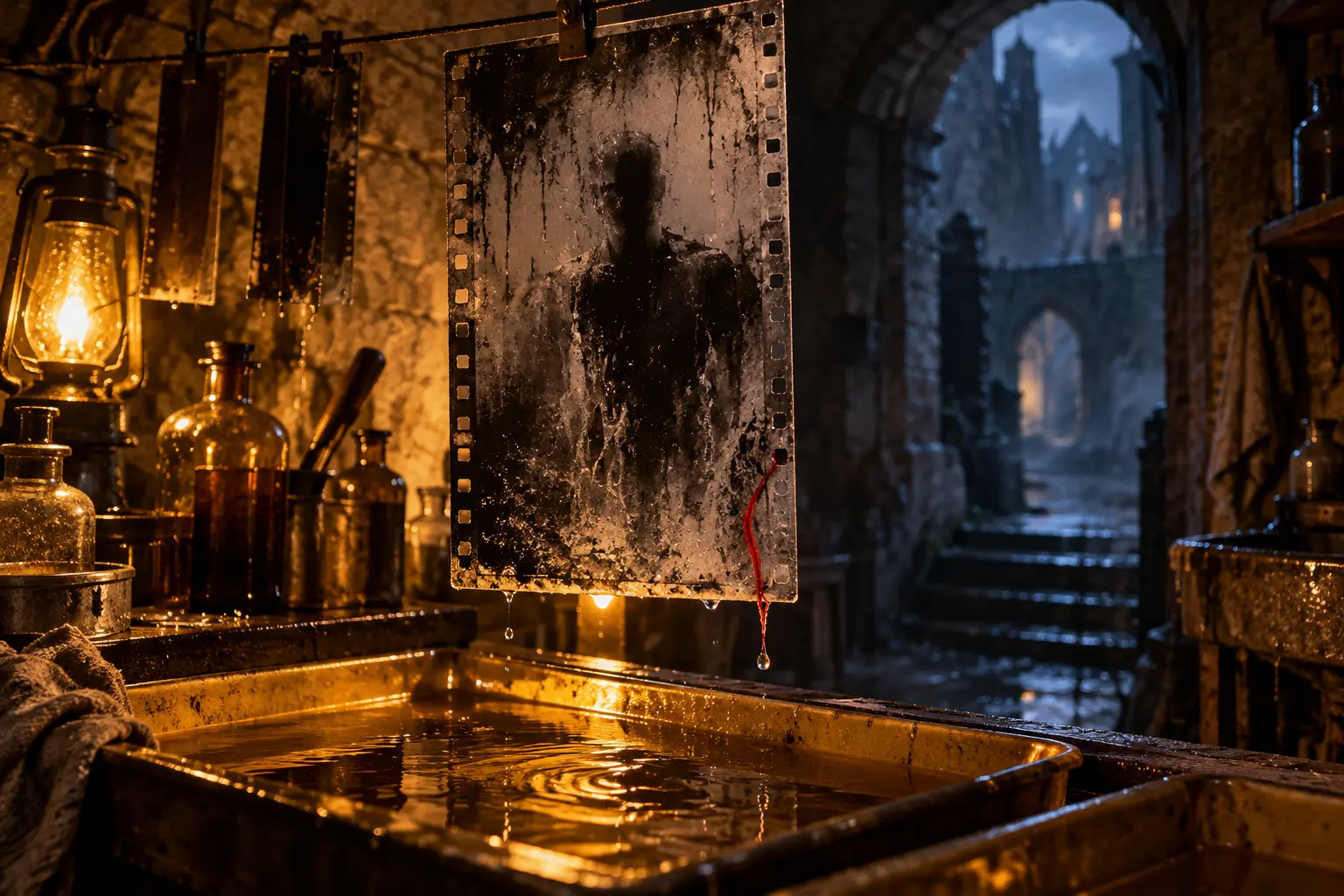
There was a drying rack above the table and a single negative suspended from its last clip.
It was large glass, the sort once used for formal portraits, and its lower corner had been wrapped in black paper.
As Aurelian watched the print, I looked up at the negative.
A pale shape stood against its darker wall, a person with a hollow head.
Behind me, the glass weight clicked.
I looked down.
The figure had crossed another square.
Its fingertips now hung level with the front edge of the pictured table.
Aurelian had seen nothing happen.
He told me so without trying to soften the fact.
"I was watching the print," he said.
"I thought that would be enough."
I understood then that the print was not the thing demanding attention.
It was a report arriving after the fact.
We had been watching a shadow and leaving its source unguarded.
"Watch the hanging glass," I said.
"Do not look at me when I speak."
I slid the print out from beneath its weight with a ruler, avoiding the surface.
The glass above us gave a faint moist sound.
A breath pressed through teeth, except there were no teeth and no mouth.
Aurelian watched it without moving.
"It may be a flaw in the emulsion," he said.
"I know records of chemical films that lift and settle with changes in moisture."
"Do any of them wear boots?"
"Not in the records I have seen."
The joke failed, but the plain answer helped.
I set the print against a tray so that both images lay within our sight.
They showed the same position now.
I could see the detail of a cuff, a worn ridge on one shoe, a bright button near the empty face.
Those ordinary details made the missing part worse.
They asked me to accept that a person had simply left their head elsewhere.
I wanted to supply a face, almost without knowing it.
For a moment I thought of an old portrait I had kept through too many moves.
Aurelian said my name sharply.
The blank patch had darkened at its edges.
Not into a face yet, but into the beginning of the shape I had almost given it.
I pressed my palms against the table and fixed my eyes on a nick in the glass.
The patch lightened again.
"What did you think of?" he asked.
I told him enough to explain, and no more.
He did not ask for the photograph or the name.
"Then we must describe what is present," he said.
"We cannot safely borrow what is absent."
In the passage, a pipe began knocking as water moved through the upper rooms.
The sound came nearer, step by step, and stopped directly behind the door.
I counted the visible floor squares, twice, and made myself say their number aloud.
Chapter 02 · Aurelian
A record of empty places
I had arrived expecting dust, broken bottles, and a dispute about who should pay for removing them.
My first error was to treat the glass plate as a strange record rather than an active danger.
That distinction mattered less to the plate than it did to me.
While Cord watched it, I opened my forms on the floor and searched the workshop inventory for a matching size of negative.
I could read while keeping its general shape within sight, but I could not guarantee that general sight counted as attention.
A thin crack sounded whenever my eyes strayed too far down the page.
We decided that only one of us would work at a time.
Cord watched the plate directly, and I read beside him, lifting each sheet into his line of sight before moving it away.
The workshop had served portraits, property surveys, and rehearsals for public speaking rooms.
I found receipts for rails, clips, and dark cloth, though nothing labeled a moving image.
A loose envelope held a plan of this room.
The wall behind the figure had once concealed a listening recess with an opening small enough to mistake for a drain.
That did not explain the figure.
I wrote the limitation on the back of the plan so that fear could not quietly turn a suggestive detail into proof.
"The room has changed," I told Cord.
"We should compare its real floor with the floor in the image."
He wanted to do this at once, but the moving plate had made a simple step away from the table feel dangerous.
I took the watching position and asked him to mark the nearest square with chalk.
He crouched carefully.
In the image, a shadow bent in the same direction as his body.
The figure itself stayed upright.
Its empty face tilted a little toward him.
"Do not show it more than we must," I said.
Cord straightened and held the chalk still.
"Can it see us?"
"I cannot tell."
I wanted to promise him that the glass had no eyes and therefore no sight.
I had no basis for the promise.
It was learning enough from our attention to move, and enough from his thoughts to begin changing its blank face.
An older archivist had once told me that an empty field invites the person reading it to fill it.
I had taken this as advice about incomplete forms.
It had never seemed like a warning about keeping one's hands away from an open wound in the world.
Cord compared the chalk square with the photograph.
The stain beneath his shoe existed in both rooms, but a long scratch shown near the far wall had been covered by a cabinet in the real one.
We could move the cabinet while I watched, or we could leave it and work from what we knew.
Neither of us wanted to uncover another thing merely because we were frightened by the first.
We agreed that the immediate task was containment.
Understanding might follow if we remained alive and able to look elsewhere.
I searched our bags for materials.
We had a wooden plate box, clean tissue, black wrapping paper, two small clamps, and a folded cloth used to protect Cord's camera.
None had been designed for a thing that progressed through inattention.
The black paper was tempting.
If darkness prevented the image from existing, covering it would help.
If lack of sight gave it permission, covering it would bring the figure to the edge.
We needed a test with less distance left to risk.
Cord placed a narrow strip of paper over one corner of the plate while I watched the rest.
The figure did not move.
He widened the strip until it covered a patch of wall, leaving the figure visible.
Still no movement.
When he brought the paper near the blank face, the glass breathed.
It bowed outward just enough to catch the lamp differently.
The clip above it creaked.
We withdrew the paper.
"That is a response," I said.
"It is not yet an answer."
Cord's hands were steady now in a way that worried me more than their earlier shaking.
He was putting all his strength into them.
I asked him to sit on the low stool without taking his eyes from the plate.
He refused once, then sat when I pointed out that falling would leave both of us looking at him.
From that lower height he noticed something I had missed.
The figure stood behind a line that crossed the pictured floor, thin and dark like the border of a stage.
There was no matching line on the workshop floor.
"It is walking toward that," he said.
I counted the distance between its shoes and the line by the proportions of the squares.
One square remained.
We did not know what would happen when it crossed.
The room seemed to understand that we were considering it.
The listening hole above the cabinet gave a soft cough.
Cord looked toward the sound before he could stop himself.
I kept watching, and the plate stayed as it was.
We had discovered one useful limit.
Shared attention could hold it, as long as someone truly remained with the source.
I wrote this down immediately.
The pen scratched loudly in the small room.
From behind the wall came the same scratch, exactly as long as mine, but delayed until I lifted the pen.
I put the page where Cord could read it.
The copied sound stopped.
We would have to guard more than our eyes.
We would have to resist providing a person for the hollow coat to wear.
Chapter 03 · Cord Allman
The wrong familiar voice
I did not tell Aurelian which portrait had entered my mind.
It belonged to a person I had known, and the plate already had too much of what it had not earned.
The room began offering small comforts as we worked.
The cold lessened around my knees.
The stool became easier to sit on.
I smelled the soap from a place I had once stayed when I had no room of my own.
The smell lasted until I looked directly at the listening hole.
Then it became wet stone again.
"It is making suggestions," I said.
Aurelian nodded without looking away from the negative.
"Record them as sensations, not invitations."
I wrote cold, soap, stool, and the words helped separate what I experienced from what I might have believed.
A spoon struck a cup beyond the wall.
I knew that sound from years of cheap breakfasts, and for a moment I expected someone to call me in before the tea cooled.
The expecting was worse than the sound.
It turned my head before thought could catch up.
Aurelian spoke the number of the floor squares.
I repeated it, and the voice beyond the wall fell quiet.
There had been no voice, I realized.
I had been on the verge of making one.
The plate was not yet able to promise me anything in words.
It was arranging the spaces where a promise would fit.
I stood and opened my camera bag with one hand.
Aurelian asked what I intended.
"A photograph of the plate while you watch it."
"We already have a print."
"That print came from somewhere else."
I meant that we could compare its face with a fresh record, but I also wanted my camera between me and the thing.
I was used to framing fear.
A frame could make a flood or a dark doorway small enough to examine.
Here, I suspected it might help the doorway learn its shape.
Aurelian pointed out that a second negative might create another source rather than another record.
I closed the bag.
There are decisions one can be proud of afterward, but while making this one I only felt robbed of the tool I understood.
We needed an ordinary witness outside the room.
A shouting conversation through the passage would be safer than calling on the workshop's old speaking line.
I could see its brass mouth hanging beside the door, green around the hinge.
The line disappeared into the same wall as the listening hole.
I opened the outer door while Aurelian watched the plate.
Daylight lay in a pale band across the passage.
I called for the building warden.
My voice struck the stone stair and came back thinly.
Nobody answered.
The warden had gone to the upper storerooms, far enough away that I would have to leave the passage to reach her.
I could do it if Aurelian watched, but something in me objected to leaving him alone.
He heard it in my breathing.
"I will remain here," he said.
"You can get a box with a solid metal lining from the survey cupboard."
"And what if you blink?"
"I have already blinked."
He demonstrated a brief closure of his eyes.
The figure did not move.
The plate seemed to require a withdrawal of attention, not the ordinary motion of an eyelid.
That gave us a little more room, though no assurance about sleep, fatigue, or a thought that wandered.
I went only as far as the cupboard at the foot of the stair.
Its door was swollen, and I had to lift it with my knee.
Inside I found a biscuit tin full of nails, a shallow survey case, and a rolled groundsheet.
The case was zinc lined and large enough for the plate.
I emptied the tin into a drawer, brought both containers back, and stopped at the darkroom entrance.
Aurelian was still there.
The figure was still behind its line.
A small damp mark now showed on the glass outside the coat.
It resembled a thumbprint pressed from the other side.
"I thought of a workshop I knew," Aurelian said.
"I allowed a remembered room to stand in for this room."
He sounded ashamed.
I set the case down gently.
"You stayed watching."
"Watching and thinking are not cleanly divided."
We took turns naming what was actually in front of us.
Clip, glass, lamp, box, table, person shape, no person present.
It was crude speech, but it made the stool uncomfortable again and sent the borrowed soap away.
I prepared the zinc case without bringing it near the plate.
The groundsheet would cushion the glass, the clamps would keep it upright, and a separate inner lid could close before the outer one.
We still did not know whether darkness was a trap or a gift.
I proposed making the inside reflective so that the plate faced a fixed image of itself.
Aurelian objected that a reflection could be another empty witness.
"Then we need to remove what it is looking toward," I said.
I lifted the old print with the ruler and turned it around.
Its back carried a faded pencil outline of a chair and the words stand here in small neat lettering.
Not a command to us, only an old note to someone arranging a room.
The plate breathed hard enough to rattle its clip.
The photograph had been its view of the threshold.
I folded the print backward until the surface cracked.
The figure lost one hand.
In the plate, the sleeve ended without fingers.
Aurelian told me to stop.
I did, holding the damaged print over the empty developer tray.
Whatever link existed between the two surfaces was real enough to hurt, and we had finally touched it.
Chapter 04 · Aurelian
The boundary we could make
Cord's damaged print gave us our first practical way to act.
The negative did not simply remember the room.
It was using the print as a map of the place toward which it approached.
I could not say who had arranged that connection, or whether someone had intended it to work this way.
The inventory offered no answer.
A penciled chair on the back of an old print was not a history.
I refused to turn it into one, even though an explanation would have made our hands less afraid.
We had a surface to sever and a source to confine.
The missing hand had not weakened the figure's interest.
Its remaining fingers spread slowly, without our looking away, and stopped against the inside of the glass.
We had treated the rule of movement as complete because it was the first rule we noticed.
Now it could move a part of itself while held under observation.
Cord swallowed and asked whether destroying the print would let the whole figure out.
I said that I did not know.
We could test a corner, but another test might give it the last distance it needed.
The zinc case offered physical containment if nothing else.
The room's outer door offered space to retreat through if physical containment failed.
I asked Cord to move the lamps into the passage and clear the floor between us and the stair.
He left one lamp behind for me and did the rest.
The figure followed his work with the empty angle of its head.
Something dark appeared beneath the blank patch, almost a mouth.
Cord did not speak to it.
That mattered.
A question might have given it an answer to copy.
He returned with the case and set it upright against the table.
We lined the interior with the groundsheet and slid the clamps onto the rim.
I would watch the plate while he lifted the clip, then he would watch while I lowered it into the case.
There was no graceful way to keep both our bodies out of its path.
We chose the shortest one.
Cord reached for the clip with the long tongs used to lift hot drying racks.
The glass made the breathing sound again.
This time it kept going after an ordinary breath would have ended.
The room drew colder, and the lamp flame bent toward the plate though neither door had moved.
"Glass," I said.
Cord repeated it.
"Clip."
He repeated that too.
The tongs closed, and the clip lifted from its hook.
For a moment I saw the figure's boots standing on the actual table, as if the negative had acquired depth outside its edge.
I could not decide whether it was an optical effect or an intrusion.
I recorded neither in that moment.
I kept watching the glass.
Cord lowered it until the padded bottom of the case took its weight.
I fastened the two clamps around its wrapped corners.
The outer face remained visible above the half lowered lid.
A wet shadow spread across the zinc behind it.
The shadow stopped at a seam where the lining changed angle.
Metal, at least, resisted something paper had not.
We brought the damaged print close to the open case.
The figure leaned toward it.
Its surviving hand pressed a dark oval against the glass.
I laid the print face down on a loose sheet of zinc cut from the survey case's document pocket.
Cord used the paper knife to divide it along the already cracked fold.
The figure's coat opened at the same place.
No body lay inside.
Only the pattern of the room continued where its ribs should have been.
Cord cut the print again, across the line marking the threshold.
The glass stopped breathing.
I wanted to close the case at once, but he caught my wrist.
We had learned too often what happened when we mistook a pause for an ending.
We watched for several minutes.
The figure remained, smaller now, its shoes half swallowed by the grain of the photograph.
The room beyond the wall made no sound.
Cord divided the remaining print into strips, placed each strip in the biscuit tin, and shut the tin firmly.
We had separated the source from its offered destination.
That did not make the source empty.
When we lowered the inner lid, a soft knock sounded from the zinc.
When we lowered the outer lid, the knock sounded again from the table beneath it.
Cord stood back.
I put a wooden wedge under the lid's fastening and tightened the clamp that served as a lock.
The case became an ordinary heavy box to look at.
Neither of us believed it had become an ordinary box to leave alone.
We went into the passage together.
The daylight band had moved while we worked, and its changed position reassured me more than any theory we had formed.
The rest of Ashfall had continued around us.
Someone carried a bucket on the upper stair.
Someone complained about a blocked drain.
I called to them, and this time a real voice answered, impatient and hoarse.
The warden came down with her bucket and asked why we had left the lamps outside.
Cord told her there was hazardous glass in a sealed survey case and that the room must remain closed.
I gave her the inventory page with our observations and limits.
I did not ask her to watch the case.
A task that might consume a person's whole attention was not work to pass on without warning.
She read enough to stop reaching toward the door.
Then she fetched a padlock from her belt and put it through the passage gate.
Her hands shook after, and she did not hide them.
We remained on the safe side while she tested the lock twice.
Chapter 05 · Cord Allman
The frame left empty
We did not carry the case through crowded streets that afternoon.
The warden gave us a dry survey vault opening directly onto the service yard, and we moved it there on a low trolley before the upper workers came down.
Aurelian walked ahead with the real lamps.
I kept the wheels from striking the stone joins.
At each bump the biscuit tin rattled, but the zinc case did not make a sound.
We set the two containers on separate shelves with stone between them.
The vault had no speaking line and no window that could return a clear reflection.
Its door had an old inspection shutter, which we bolted from outside.
There was still a risk in putting the plate beyond anyone's sight.
We had no honest way to avoid that risk forever.
Attention was not a wall one could build and leave standing.
People had to eat, rest, look at other people, and remain people.
We had removed the destination surface, put metal around the source, and closed the room that had let the first connection form.
Now we had to trust the limits we had actually observed enough to make a choice.
We stayed outside the vault until dusk, listening through a wooden pole pressed to its door.
The pole carried ordinary yard sounds very well.
A cart rolled past and made a long rumble in my ear.
Aurelian tapped the far wall and I heard each separate tap.
From within the vault came nothing.
We wrote the silence down as silence, not proof of safety.
The warden returned with tea in cups that did not match.
She had asked the other workers to use the upper route and closed the service yard to casual storage.
"How long?" she asked.
We did not offer a date.
Aurelian explained that the dangerous glass would remain sealed until a careful examination could be arranged with better tools and an empty room.
The vault would need a warning that described the handling limits without inviting a curious person to open it for a demonstration.
The warden listened, then told us she would put the key with the building records instead of hanging it by the stair.
I drank the tea and found I could taste it.
That was when my hands began shaking again.
Aurelian sat beside me on the yard step.
He did not tell me that the room had not frightened him.
He said he had nearly filled the shape with the remembered outline of a person who had once taught him a filing system.
He had noticed only because the teacher's sleeve had a distinctive crease and the figure's coat acquired it.
"I thought I was helping myself remember clearly," he said.
"I gave it a detail."
I told him about the smell of soap.
I did not tell him the name belonging to the portrait, and he did not ask.
We had both been tempted by something familiar in a place where familiarity had not been earned.
There was nothing grand in admitting it.
It made the next cup of tea easier to accept.
The following morning we returned with the warden and two adult survey workers who knew what the sealed vault held.
They had agreed to remove the old hanging frame from the darkroom and inspect the listening recess without opening the case.
We entered in daylight with the door propped wide.
The room smelled of sour developer and dust.
The stool looked narrow, its leg still loose where I had pressed against it.
The lamp had left an ordinary smoke mark on the wall.
All those small faults belonged to the actual place.
I photographed them with an unused plate only after Aurelian checked that no linked print remained on the table.
The resulting image showed an empty darkroom.
We did not use that photograph to declare the older one cured.
A damaged surface can leave a room looking innocent while danger waits elsewhere.
The survey workers lifted the cabinet from its place.
Behind it was a shallow stone recess containing old copper wire, a cracked porcelain socket, and dust laid thick enough to preserve the outline of a removed object.
The outline was rectangular, wider than the negative, and empty.
We measured it and left it empty.
There was no reason to put a familiar shape back where something had already learned to need one.
One worker unscrewed the hanging frame from the drying rack.
A little thread caught beneath its lowest corner.
It was red, bright under the dust, wound twice around a screw before breaking off in a soft frayed end.
I felt the sudden urge to pull it loose and hold it close, though a thread was usually only a thread.
I used the ruler instead.
The worker placed the frame on a sheet of clean paper, and I photographed the thread where it lay.
Aurelian labeled the frame separately from the glass and gave no origin he could not prove.
The warden asked whether red thread meant anything to us.
I told her it meant we had found red thread in an empty frame.
That was all we knew, and it was enough to keep rather than dismiss.
We locked the frame in another cupboard and recorded its shelf.
By noon the darkroom door had been secured, the vault had remained quiet, and the workers could reach their storerooms without passing either.
Our work was not a victory over every dark image that might exist.
It was a closed door, an intact warning, and six people able to leave the yard by the route they had chosen.
On the walk home, I saw a woman stop beside a shop window and adjust her collar in the glass.
I almost warned her away from it.
Then I watched her reflection adjust the same collar at the same moment, and let her finish.
The fear still lived in my body, but the city did not owe it every surface.
I carried my camera against my chest and looked long enough at the real street to notice where the afternoon light fell.
Let the last line settle.
Choose another mood