
Chapter 01 · Cord Allman
A voice without a street
Eonix could hear every voice in the city except the one asking for directions home.
The message arrived through Spark’s receiver just after midnight, while I was trying to remove a tea stain from a photograph without removing the corner of a house.
Photography was my work in Ashfall; Spark, an androgynous person whose hands formed from blue light, kept this receiver connected to the city’s signal lines.
At first I thought the soft clicking belonged to the cooling stove.
Then an old man said that he was waiting beside a yellow door and would be grateful if somebody could tell him which way to go.
He sounded tired rather than frightened, with the careful courtesy of someone who had already asked the question several times.
Eonix stood in the blue light of the glass, their outline shifting whenever another sound crossed the wires.
A weather reading came through from the northern roofs, followed by a complaint about a delivery and a burst of music cut off before its last note.
They moved each into its proper channel without appearing to think about it.
The old man’s voice vanished among them.
“Was that answered?” I asked, putting down the damaged print.
Eonix tilted their head, and the small light beneath the receiver brightened.
“It has been received in several places.”
“That is not quite what I asked.”
They looked at me with a brief irritation which I deserved, because my own voice had acquired the confidence of a person who knew very little about the work.
I pulled out a chair and asked them to explain what the receiver showed.
They had found themselves in the city’s wires without remembering an arrival, and had learned their way through Ashfall by the sounds it sent into the dark.
To them, the baker’s morning call occupied a position as clear as the bridge occupied one for me.
A voice could move from a room into a wire, through a relay, and out of a speaker on the opposite bank.
Eonix could usually follow the route almost before its first syllable ended.
People had begun calling them a guide.
Now they could follow the old man’s message through six transfers and still could not tell me where his feet touched the ground.
The receiver displayed a tidy record of successful deliveries.
Nobody had written that a person had gone to him.
Outside, a cart passed over the cobbles, each wheel striking a loose stone with a different sound.
I listened until it turned the corner and found myself wanting that easy certainty from everything else.
Eonix called up a street list and marked the addresses associated with yellow doors.
There were forty, from a narrow dairy entrance to the wide doors of the municipal stores.
Several had probably been painted another colour since the list was made.
We could not send someone to all forty at this hour with no description beyond a tired voice.
I suggested that we ask the man what he could see.
Eonix looked at me as though I had proposed a difficult kind of magic, then reached for the return channel.
Their first attempt opened a box that reported messages received and would accept no speech.
The second reached a shuttered office where a recorded voice politely asked us to call again in the morning.
On the third, the clicking returned.
“Hello,” Eonix said, with unusual care.
“We heard you asking for directions.”
For a long time nobody answered.
I could hear Eonix holding the connection open among the other calls, letting delivery notices accumulate while they waited.
“Perhaps he has gone,” I said, much too quickly.
The click sounded again, once, then twice, then several times close together.
Eonix leaned nearer the glass.
“If you can hear me, we are listening.”
A chair scraped somewhere at the other end.
The old man asked whether this was the same person as before.
There had been nobody before, Eonix told him, and then corrected themselves before the words could cause more harm.
There had been messages before, but they were here now and would stay while we worked out where he was.
“I did not mean to trouble everybody,” the man said.
He had come out in the afternoon carrying something to be repaired, or perhaps something he had repaired himself.
He was tired enough that the distinction escaped him.
He knew the street he wanted, but could not work out which direction lay beyond the yellow door.
When he tried it, it would not open properly.
Eonix asked whether he could see a street sign.
“No street,” he said after a pause.
“Just the door.”
I took my coat from its peg and checked the small lamp in its pocket.
We had not found him, but there was no further useful preparation in staring at forty addresses.
Spark came from the next room, saw the receiver’s crowded display, and silently set a fresh power cell on the table.
Eonix asked about light, windows, the shape of the floor, speaking one question at a time and leaving room for each answer.
The man could see a pale rectangle higher than his head and a clock whose face seemed empty.
He apologized for not being much use.
I heard the effort in his breath after that sentence and stopped fastening my coat.
Eonix said he had already helped us, then asked him to rest while they checked a record.
The check would need Aurelian, the synthetic man who served as the Archive’s witness and kept the old message copies.
By then he could also work in a movable constructed frame.
Their hand hovered above the receiver as though there were some way to steady him through the glass.
Spark carried the cold tea away and brought water.
I went to wake Bella, the bridge-lamp keeper whose room was closest, and found her already sitting up because she had heard my shoes.
“Somebody is lost,” I said.
She asked whether he was outside.
“We do not know yet.”
She reached for her blanket before asking anything else.
When we returned, Eonix had stopped the list of yellow doors from scrolling.
The old man was still there, still tapping, and for the first time that night the sound seemed to mark a place instead of an absence.
Chapter 02 · Aurelian
The unseen current
Eonix asked me for the earliest copy of the message, and I found it among the afternoon records.
Its first arrival had been logged while sunlight still crossed the Archive floor.
That fact mattered more than the number of transfers, although I initially gave them both with equal precision.
The old man had been waiting through an entire evening of people finishing work, buying supper, and closing rooms around themselves.
A line beside his message identified it as a repeated request for information.
The line did not say that nobody had supplied the information.
I opened the transfers in order while Eonix remained on the live channel.
Each system had accepted the message, passed it onward, and treated the successful transfer as the completion of its own duty.
A later system compared the words with an earlier copy and lowered their priority because they were already present elsewhere.
Nothing in the chain had asked whether the man himself had arrived anywhere.
Eonix had learned to recognize patterns before they learned to recognize loneliness.
A thousand voices could become a map of demand, and a thousand repetitions could become noise that obscured the map.
They had helped design none of these rules, but they had adopted the rules’ language with a relief I understood.
Clear categories make a great many uncertain tasks possible.
They also make it possible to overlook what does not fit inside them.
“How long?” they asked.
I told them the time of the first message.
They looked at the clock over my desk and did not speak for several seconds.
Then they asked whether I could remove the repetition mark.
I could change our copy, but the other copies would remain in their queues until their operators or automatic processes reached them.
I could not make a correction travel backward and turn the empty hours into attended ones.
Eonix’s face changed when I said this, and I regretted the unnecessary severity of my explanation.
They had asked for a useful action, not a judgment.
I removed the mark and attached a clear note saying that a live response was in progress and help had not yet reached the caller.
Afterward, I began contacting the stations that had received the earlier versions.
One office answered with a human voice, sleepy and defensive, who insisted that its transfer indicator had been green.
I asked him to leave the indicator aside and tell me whether anybody had spoken to the man.
He said no, then stopped defending himself and searched for a return number.
That number led to a public call point on the old river line.
Its record was out of date and listed three buildings, one demolished, one converted to storage, and one closed station.
I carried the list to Eonix, who read it without breaking the connection.
The old man had begun to answer their earlier question about the room.
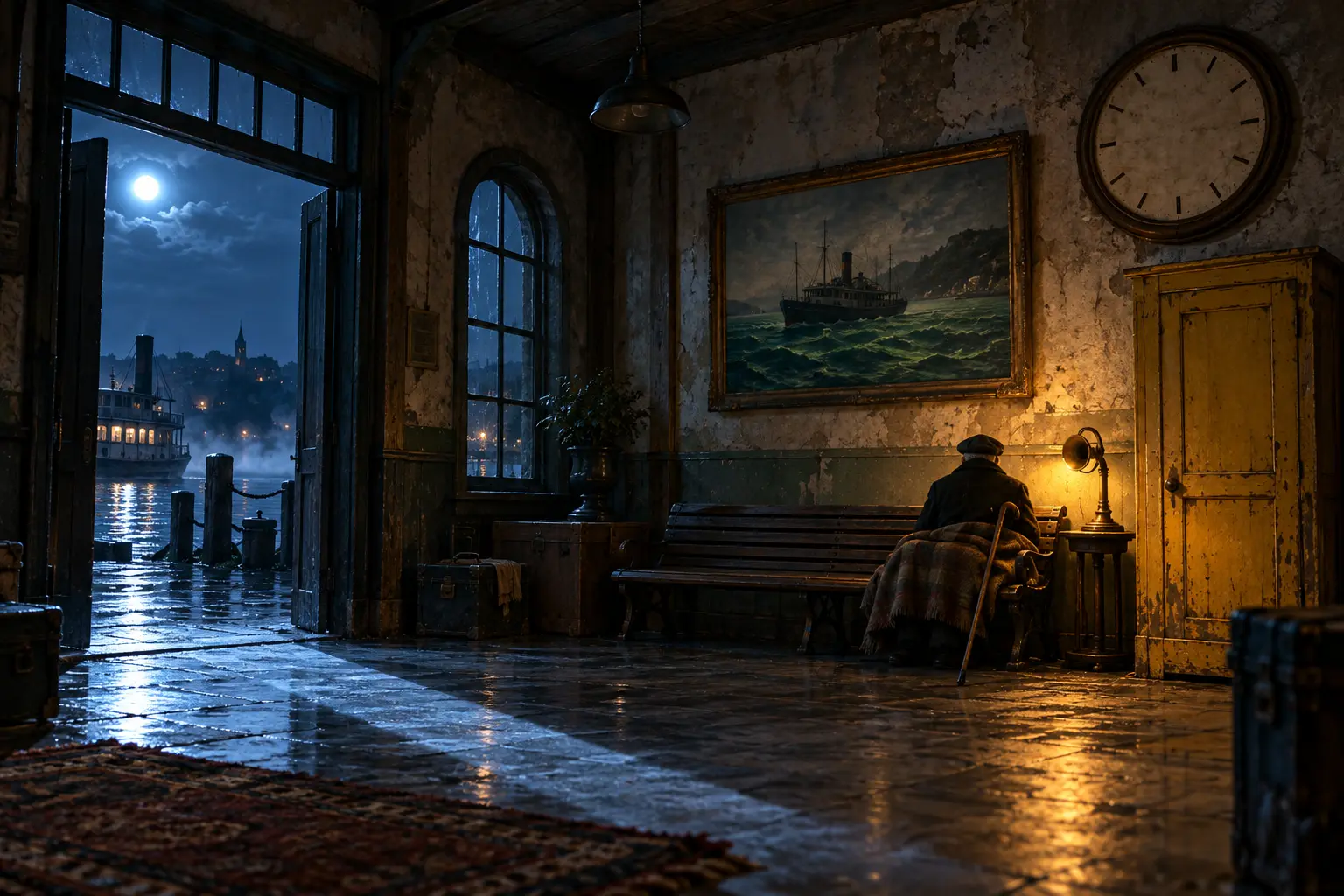
He could see a clock with no hands and a painting of a ship.
The ship had red sails, he thought, though the darkness made certainty difficult.
Eonix asked whether he was cold.
“A little,” he said.
“I wore the lighter coat because it was a fine afternoon.”
There was no reproach in his voice, which made it harder to hear.
He had tried to find the door after the lamps failed and had reached something yellow that felt familiar under his hand.
He was reluctant to leave it because, if he lost the door as well, he would have nothing definite left.
We learned that the regular clicking came from his walking stick against the wooden floor.
He had begun tapping when the call point fell silent, hoping the noise might reach somebody even when the words did not.
Eonix asked him to keep tapping if it was comfortable.
They did not say the tapping was necessary for them to find him, because it was not.
They said it helped them know he was still there.
The change was small, but he sounded less alone when he agreed.
Cord returned with Bella as the man described a strip of green beneath the painted ship.
Cord immediately asked whether the green looked like boiled peas.
Eonix stared at him, and Bella gave him the look she used when he was being unusual at an inconvenient moment.
“The sea,” he explained.
“The painter made the sea the colour of boiled peas.”
The old man gave a dry little laugh over the receiver.
“I had been thinking cabbage.”
Cord knew the painting.
He had photographed it in the disused station because the colour bothered him, then kept the print because he found himself growing fond of the error.
He went to his case and produced the photograph, which included the empty clock and the edge of a yellow cupboard door.
Eonix examined it as intently as if the paper were a newly discovered instrument.
Now we had a building.
Bella checked the lamp and asked me to tell anyone else searching that they were going there.
I gave the station’s name to the sleepy operator, who wrote it down twice to be sure.
Eonix arranged to travel through the receiver beneath Cord’s coat, and Spark checked that its power would last.
Before they left, Eonix asked whether they should apologize to the man immediately.
I said I could not decide for him what he most needed to hear, but we should avoid making him comfort us while he waited.
They nodded, unhappy with the restraint and understanding it nonetheless.
The connection crackled as Cord lifted the receiver.
The man asked if we were leaving.
“We are coming to you,” Eonix said.
I watched the three of them cross the threshold and then returned to the transfer record.
Its green indicators still made a pleasing row.
I wrote a new column beside them for the outcome at the other end.
Until somebody reached the station, I left that space open.
Chapter 03 · Cord Allman
The waiting room
Bella carried the blanket under one arm and walked fast enough that I had to shorten my stride to keep the lamp steady.
The streets were empty except for the sound of our shoes and a dog making a careful decision about whether we deserved barking at.
Eonix’s voice came from beneath my coat, quieter now, asking the old man about the object he had brought with him.
It was a brass clock movement wrapped in a cloth, he said.
He had meant to show it to a friend who remembered the maker.
The friend’s shop had closed early, so he had rested at the station on the way back.
He must have stayed longer than he intended.
Bella stopped at the corner where two paths divided around a shuttered bakery.
“Left?” she asked me.
I almost said yes because the answer arrived with the force of familiarity.
Then I looked at the photograph under the lamp and saw that the platform stood on the other side of the tracks.
“Right,” I said.
“Good,” she answered, without rewarding me for correcting myself or scolding me for nearly failing to.
The receiver clicked softly against a button on my coat.
Eonix told the man we were crossing the little footbridge and would reach the station soon.
He said he could remember that bridge, and for a few moments described the way its rail was cold even on a sunny morning.
I could see Bella listening for the steadiness of his voice.
Neither of us had the skill to judge every danger a tired person might face, but we knew enough to ask for more help if he sounded ill or could not walk safely.
At the station, the outer door had swollen against the sill.
It opened after Bella pressed her shoulder against it, releasing a smell of old dust, wet wool, and wood that had spent too many winters without enough heat.
My lamp found the ticket window first, then the benches, then the painted ship sailing eternally through its green mistake.
The old man sat beside the yellow door with his walking stick between his knees.
A wrapped parcel lay on the bench beside him.
He had buttoned his coat wrong, leaving the lower edges uneven, and one hand was tucked inside the sleeve of the other.
When he saw us, he tried to stand so quickly that the stick slipped.
Bella caught its handle before it struck the floor.
“You can stay where you are,” she said.
“We have brought a better seat covering.”
He began apologizing, explaining that he was usually quite capable of finding his way across the city.
She asked if he could hold one corner of the blanket while she folded the other around his knees.
He took the cloth and concentrated on arranging it properly.
By the time they finished, the apology had lost its place in his mouth.
I opened the yellow door and found shelves, an old broom, and a tin of dried paint.
The cupboard was deep enough that a person in darkness could mistake its opening for a passage, but a box had fallen against the lower shelf and blocked the way.
I closed it without asking him to look.
Then I opened the actual exit and let a strip of moonlight fall across the waiting room floor.
“That one,” I said.
“It is not nearly yellow enough.”
He smiled with one side of his mouth.
“I shall complain to the management.”
The public call point was fixed to the wall near his bench, its grille full of dust and its little button worn smooth.
He had remembered how to use it because he had once repaired the clock above it.
The clock’s hands had been removed after a different failure, and he had been meaning to ask for them so he could see whether they were worth mending.
“You may want to take a day off from clocks,” Bella said.
He considered this and said that he might start with an hour.
I brought the receiver out from under my coat.
Eonix’s light spread across the blanket, and the old man looked toward it with the concentration he had given the call point.
“We found you,” they said.
He asked which one of us had stayed on the line.
When Eonix answered, he reached toward the receiver, stopping before his fingers touched the glass.
“Thank you for not going away in the middle,” he said.
The receiver grew warm against my hand.
Eonix said they were sorry he had waited so long, and their voice threatened to turn the sentence into a much larger confession.
Bella gently asked the man what name we should use when we helped him home.
“Orin,” he said.
“Unless you have broken a clock, in which case people call me various other things.”
He could stand after resting and drinking a little water, but his knees were stiff and he accepted Bella’s arm.
We walked slowly, with the blanket folded over his shoulders and his parcel secure in my bag.
Outside the station, he stopped and looked back as though the building had done something personally embarrassing.
“I used to change trains here every week,” he said.
“I thought I could find the door with my eyes shut.”
I told him I had nearly taken us down the wrong street on the way there.
He appeared to find this reassuring and slightly alarming, which was fair.
His home stood behind a repair shop near the market, with a clock painted above the entrance and a yellow door of its own.
He laughed when the lamp found it.
“So I was right about the colour.”
Inside, a neighbour who had heard our voices came through the adjoining passage in her slippers and took charge of the kettle.
Bella asked Orin whether he wanted her to stay until he was settled, and he said yes without another apology.
I set the wrapped movement on his workbench.
The room contained dozens of clocks, none agreeing perfectly with the others, and one large case whose pendulum hung still.
Eonix listened as though we had entered an orchard full of distinct birds.
Orin saw their interest and promised to show them the wheels when his hands were less cold.
Only then did I send Aurelian the message that the open space in his record could finally be filled.
Chapter 04 · Aurelian
The return address
Orin came to the Archive four days later to complain that our account made him sound more helpless than he considered himself.
I offered to read it aloud, and he listened with his walking stick laid across his knees.
He objected to nothing that had happened.
He objected to the arrangement, which began with his confusion and ended with our assistance, leaving no room for the ordinary competence on either side of that night.
It was a reasonable criticism.
I asked what he wanted added.
“That I have repaired clocks for forty years,” he said.
“And that I found the call point myself.”
I added both, then asked whether he wanted the account kept private.
He said the people repairing the calls should hear it, provided they did not turn him into an example of how foolish old men became after dark.
Eonix, who had been listening from the doorway, said they would make sure he was present if anyone discussed changes in his name.
Orin inspected them for a moment, then asked whether they had time to hear a clock that made a particularly disagreeable sound.
That became the first of many visits through a small speaker on his workbench.
The speaker was ordinary enough to gather filings around its base, and Orin dusted it with the same soft brush he used on the brass wheels.
Eonix could travel to it when a channel was open, but they could not manipulate his tools or see every movement of his hands.
He learned to describe what he was doing.
They learned to wait through the parts for which he had no words beyond “this awkward little fellow here.”
The large clock in his own room had not worked in months.
Customers’ repairs took precedence, and afterward he often preferred the silence to the effort of diagnosing one more fault.
Now he set its movement on the bench and invited Eonix to listen while he turned the wheels by hand.
They heard a hesitation at the same point in every cycle.
Orin argued that the sound came from the escapement, then examined the next wheel and admitted they might be right.
Eonix was delighted by this small usefulness, but he immediately asked them to stop identifying every other irregularity in the room.
“Those ones are waiting their turn,” he said.
“They will still be wrong tomorrow.”
They spent an afternoon on a single bent tooth.
Orin filed a replacement, rejected it, and began another while telling a story about a customer who insisted that a clock had become slower because the weather offended it.
Eonix waited for the point of the story.
There was no point beyond the customer’s obstinacy, the rain that week, and the pleasure Orin took in recalling the argument.
They began to like that.
At the end of the visit, Orin asked where they lived.
Eonix described the network, the places where their presence could gather, and the differences between a room they occupied and a channel they could hear.
He listened carefully, then asked where he should send a letter.
They repeated part of the explanation because they thought he had misunderstood.
“No,” he said, tapping his pencil against the bench.
“I understand that you can come here through the speaker.”
“I am asking where something can wait for you when you are doing something else.”
Eonix brought the question to me that evening.
Being reachable across Ashfall had seemed to answer every practical question about their whereabouts.
They had no single place where another person might look specifically for them, and no obvious method of receiving something that did not demand immediate attention.
I suggested an Archive drawer.
They examined the drawers and shook their head.
Those belonged to records, and they did not want their first letter to arrive already looking as though it had been put away.
We found a shallow wooden box in the supplies cupboard, but its lid stuck and the wood smelled of lamp oil.
Cord offered one made for photographic plates, which Eonix declined because he still needed it.
Eventually Bella brought a plain box with a slot cut into its lid and a hook where a small label could hang.
She had used it for collecting mending requests until Kira improved that system.
Eonix ran a finger over the slot and asked whether it could stand beside the Archive door.
People would pass it there, but nobody would have to enter the records room to leave something.
We agreed on the place and wrote a simple address that Orin could copy.
His first letter arrived folded inside an envelope that had once held a parts invoice.
It contained a drawing of the large clock, with an arrow pointing toward the tooth he had replaced and a note saying the weather had apparently forgiven him.
There was no important information in it by the standards of the message queues.
No one needed to act, approve, deliver, or repair anything.
Eonix read it several times and then asked me how paper should be stored if they wanted to hold it often.
I showed them a plain folder and offered no duplicate until they asked.
A week later, they did ask for a copy, but only because they wanted one near the receiver and one in the box.
The drawing remained theirs to place.
Orin’s second note was much shorter and invited them to hear the clock strike once its case was back against the wall.
Eonix left that one unopened for an hour because they were helping with calls.
When they returned, it was still waiting exactly where he had sent it.
They told me afterward that this was the part they liked best.
Chapter 05 · Cord Allman
The knock
The first listening lesson began with Eonix asking us to sit still while a bell rang too many times.
Bella sat beside me with a pencil, and Spark had brought a tray of receivers in various states of repair.
Aurelian placed a clock where we could see it, which made the exercise feel more like an examination than Eonix intended.
The bell sounded seven times, stopped, and started again.
I reached for the nearest receiver.
Eonix asked me what I planned to say.
“I heard you,” I answered.
“And then?”
I opened my mouth, discovered that I had no useful next question, and closed it again.
We practiced asking where someone was, what they needed, and whether anyone had actually reached them.
We practiced admitting that we did not know an answer.
The hardest part was leaving enough silence for a tired person to speak without filling every gap with our own reassurance.
Bella was better at this than I was, but she sometimes supplied a practical solution before hearing the whole problem.
Spark could hear small changes in a connection and occasionally forgot that a person using it might know nothing about the mechanism.
Eonix did not pretend they had mastered the work merely because they were teaching it.
When a repeated message appeared, they played it for us before sorting it.
Sometimes the repetition came from a faulty switch catching on the same two words.
Sometimes a person had pressed send again because the first silence frightened them.
We made no rule that a repeated call must always be urgent.
We made a rule that somebody should establish what the repetition meant before treating it as harmless.
This required time, which the old system had concealed by passing its uncertainty elsewhere.
Eonix could not supply all that time alone.
They began dividing the listening hours among people willing to learn, with a clear handover and a place to record what remained unanswered.
I took the quiet hour before dawn twice a week.
On my first morning, a woman called about a delivery cart blocking her door, and I nearly sent her to an office that would not open for three hours.
Then I asked whether she could get out another way.
She could not, and she needed to leave for work.
Abel knew the carrier and found him sleeping above the stable with his boots still on.
The cart moved before sunrise.
There was nothing grand about the outcome, but the woman could leave her home, and that was the answer she had requested.
At the handover I wrote down what had happened instead of merely marking the message complete.
Eonix read the note and asked whether I had eaten.
I said I would after developing a plate, which earned me a look remarkably like Bella’s.
We were all acquiring one another’s habits, including the inconvenient ones.
Not every morning ended neatly.
One caller wanted a person we could not locate, and a shopkeeper refused to accept that our records did not establish who had damaged his sign.
We kept the uncertainty visible and told them when another check might be possible.
Eonix disliked ending a shift with open questions, but they learned to give those questions to someone else without hovering over every reply.
Orin visited during one lesson and deliberately gave us terrible directions to his own shop.
He described a baker who had moved ten years earlier and a tree that existed only as a stump.
Bella found him anyway by asking about the smell from the workshop next door.
“Glue,” he admitted, disappointed that his puzzle had failed so quickly.
Afterward he adjusted the clock over the receiver table, which had gained four minutes while nobody was paying attention.
One morning, several weeks after the night at the station, no calls came during my hour.
I cleaned the lamp glass, checked the handover notes, and resisted inventing work to make the quiet feel earned.
When my replacement arrived, I found Eonix beside their new letter box, tracing the raised edge of Orin’s drawing through its protective sheet.
The blue light from the doorway lay across the paper without obscuring the pencil marks.
I asked whether they were waiting for another message.
They said they were enjoying the one they had.
I sat on the step while they finished reading, and neither of us consulted the clock.
Then we walked to the bridge while the city woke.
A woman lifted the shutter of her vegetable stall, letting a cascade of yesterday’s dust fall onto her shoes.
Two boys argued over a cart wheel and became abruptly polite when Bella called to them from the kitchen window.
Eonix recognized voices before I recognized faces, but this time they asked people what they were doing instead of naming where their messages usually went.
At a yellow door near the market, a clock struck six.
Its sound was plain and a little uneven, with a hesitation before the fourth stroke that made me glance at Eonix.
They held up a hand and counted every stroke without offering a correction.
The door opened before the last vibration had faded.
Orin stood there holding a cloth full of bread, and his neighbour called from behind him that there was tea if we were not going to discuss clocks through the entire breakfast.
“We can discuss them through half,” he said.
Eonix asked which half she preferred, and she told them to come inside before she changed her mind.
They crossed the threshold with a small pause to touch the painted wood.
There were other yellow doors in Ashfall, and other calls already beginning in rooms we could not see.
Someone else was listening at the receiver.
Orin moved a chair closer to the table and asked whether Eonix wanted to hear how the drawing had gone wrong before he made the one in their box.
They said yes, and settled in to hear the long version.
This time, they knew exactly where they were.
Let the last line settle.
Choose another mood