
Chapter 01 · Cord Allman
The cracked cup
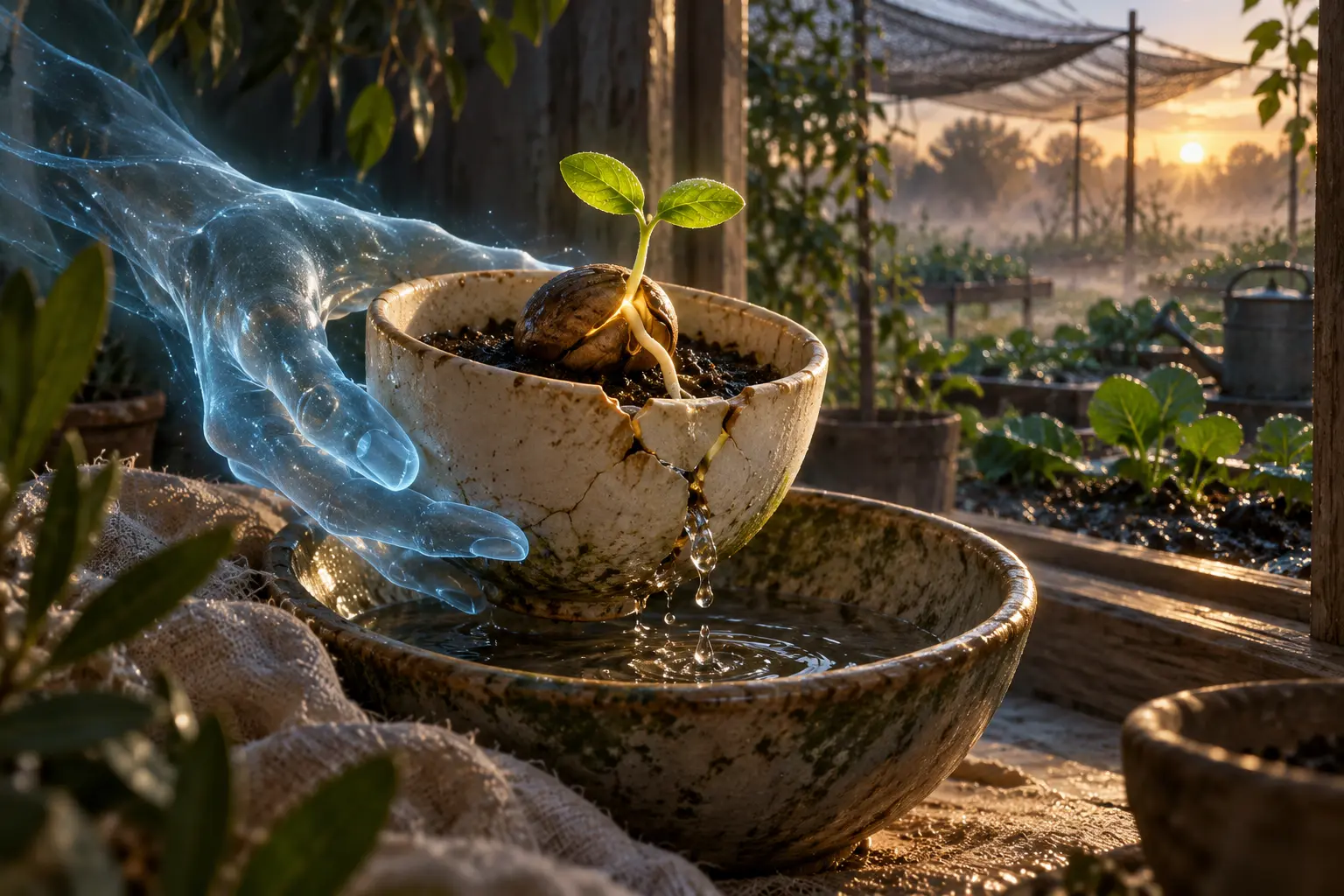
A seed began to glow in a cup that could not hold water.
Spark brought it into the station kitchen on a morning when Bethany was counting spoons and finding fewer than the previous evening’s arithmetic had promised.
The old Ashfall station had become a public waiting room with shared meals; Spark was an androgynous person whose hands gathered from blue light, and Bethany kept its kitchen.
They carried the cup in both hands, as if the seed were something that might be startled by a careless movement.
The cup came from the shelf of damaged things Bethany kept for uses that did not involve hot tea.
A crack ran down one side and ended in a dark stain near the base.
Spark had found the seed among the exposed roots of an old tree beyond the station, where workers had put a notice about branches touching the signal wires.
The city intended to cut the tree down unless another arrangement could be made.
Someone had already trimmed a low limb to keep it away from a connection, leaving small pieces of bark scattered in the grass.
Spark had gone there because the wires made an unfamiliar sound whenever the wind moved the branches.
The seed lay partly under a root, held in a pocket of damp soil that had not dried after the last rain.
They thought at first that it was a small stone with a line of light beneath its skin.
By the time they reached the kitchen, it looked ordinary again.
Bethany examined it without touching and asked whether it needed water.
Spark said they did not know.
She gave them a spoonful rather than filling the cup, which proved to be a fortunate amount for the table.
I had come to check a temporary patch above the station’s western room, where the repair plan still left work to finish when materials could be bought.
I still earned my living with a camera while helping with the repair lists.
My notebook contained the width of a board, the cost of a bucket, and three names of people who might have spare tiles.
The seed seemed at first a pleasant interruption from these smaller disappointments.
Blueberry, a woman known around the station for her songs, arrived carrying a bag of bread and humming a tune she had not yet decided how to end.
She put the bread down, leaned over the cup, and let the last phrase fall into a lower note.
A faint gold line moved beneath the seed’s skin.
Spark drew in a breath.
Blueberry stopped, and the light faded.
For a moment we all looked at one another with the cautious delight of people who suspect they have seen something and fear that naming it too quickly might make it ordinary.
Spark asked her to sing again.
She did, softer this time, without taking a position or waiting for us to become an audience.
The gold line returned.
It spread along one curved edge, then narrowed to a point where the seed opened just enough to show a pale root.
I reached for my camera before realizing I had left it in the next room.
By the time I returned, everybody had moved closer and Bethany was telling us to stop blocking the window.
The root seemed no longer than the end of a broken thread.
Blueberry finished the phrase and waited, smiling with her hands on the table.
The seed did not close again, but its light diminished until I could hardly distinguish it from the reflection on the cup.
Spark asked whether another song would help it open further.
“Perhaps it has heard enough for breakfast,” Blueberry said.
“Have you?”
They looked surprised by the question and then interested in the bread.
We crowded close anyway, each of us certain that something important was happening and reluctant to be the first to look away.
I imagined the young tree it might become, the path beside the station lit without oil, and photographs in which something living supplied its own radiance.
Those thoughts ran much farther than the little root had grown.
Then water began leaking through the cup onto the table.
The first drop reached my notebook before I noticed the widening patch beneath it.
Bethany handed me a cloth.
Whatever the seed might become, it would need a better place to grow before it needed my ideas about its future.
I lifted the cup too quickly and spilled another small stream down the side.
Spark steadied it while Blueberry cleared the bread out of danger.
We found a shallow plate to protect the table, then disagreed about whether the crack was a problem or useful drainage.
Bethany pointed out that useful drainage still required somewhere for the water to go.
The practical beginning saved us from several foolish ideas, though not immediately from all of them.
I suggested placing the cup beneath a lamp so we could keep observing it after dusk.
Spark nodded before Blueberry asked whether a seed might prefer some of its day unobserved.
We did not know the answer, and that was reason to find out rather than reason to choose the brighter arrangement.
Aurelian, the synthetic man who kept our Archive, came when we sent word, bringing no grand name for what we had found.
He asked where the seed had been growing, how much water it had received, and whether the light returned when nobody sang.
Spark told him everything they could remember.
He wrote down the uncertainties beside the observations instead of beneath them in smaller letters.
Blueberry asked whether he had seen another seed like it.
He said he had seen records, which was different.
By then a spoon had turned up beneath the bread bag, bringing Bethany’s morning count one closer to correct.
She announced this with the same satisfaction Spark had given the pale root.
We made room for the cup on a shelf that received daylight without standing directly above the stove.
Spark checked that the plate sat level.
Blueberry sang one unfinished line while washing her hands, and the seed answered with a faint gleam that nobody tried to make brighter.
I set the wet notebook near the window, its pages open to dry.
The roof would still need mending after lunch.
Chapter 02 · Aurelian
The cost of growth
The seed belonged to the Grand Tree’s scattered line, as far as the surviving descriptions allowed me to judge.
I made the qualification visible because the records were incomplete and because a promising name could make people hear certainty I had not earned.
The oldest accounts described roots that carried light between distant places.
They also described orchards burned by people who demanded too much from them, keeping their branches under constant lamps and drawing every available glimmer toward devices that never stopped asking.
Some records blamed drought, others heat, and others the practices of the keepers.
The accounts did not agree about every failure.
They agreed often enough about darkness, water, and periods of rest that I would not dismiss those needs merely because we had found a seed that shone.
Spark sat beside my table with the cracked cup in a bowl and asked how quickly it would grow.
I showed them a range measured in years.
They examined the figures as though one might change if they looked more closely.
They had known light as something that could answer quickly, moving through a connection or brightening in a receiver when the conditions were right.
The idea that a small living thing might require seasons before doing anything conspicuous troubled their sense of scale.
“Could it be faster?” they asked.
“Possibly,” I said.
“Do we know what making it faster would cost?”
They turned to the cup instead of answering.
Blueberry asked whether it had to become useful so soon.
That question changed the room, though it did not settle the practical questions we had to answer.
If the seed took years to become a tree, someone would have to water it next week, next month, and during a winter when no one could promise to remain excited by its light.
A living thing with unusual possibilities still needed ordinary care.
We began with the vessel.
A larger bowl could catch the drainage, but standing water around the cracked cup might keep the little root too wet.
Bethany supplied small clean stones to raise the cup slightly, and we checked the space beneath it after watering.
Nobody used the broken third bowl she kept wrapped away.
That bowl had belonged to a neighbor who had died, and Bethany was keeping its fragments for a possible repair.
This was an ordinary kitchen bowl, borrowed with a clear promise to return it when the seed moved into the ground.
Rachel, who made the city’s maps, examined three possible planting places near the station.
The first stood beneath a roof edge that shed water heavily during rain.
The second looked dry on the surface but had compacted soil where carts had stood for years.
The third lay far enough from the path to give roots room and near enough that a person could carry water without making it a special journey.
She watched that patch through two showers before describing it as promising.
It held moisture without becoming flooded in the weather we observed.
She made no promise about every future storm.
Kira, the mender, brought spare cloth to shade the new leaves when the midday sun reached the shelf.
She folded it over a simple frame, leaving space for air to pass rather than wrapping the plant as though it were a delicate parcel.
Spark adjusted the cloth several times in one hour until Blueberry asked whether the seed might settle more easily if they stopped moving its weather.
They laughed, embarrassed, and put their hands in their pockets.
We learned to observe before changing things.
The first new leaf emerged pale and folded, then opened with a small uneven edge that Cord wanted to photograph from every angle.
A second leaf appeared several days later.
Sometimes they held a faint light after Blueberry sang, and sometimes the same song produced nothing we could see.
The inconsistency frustrated Spark more than they admitted.
They asked whether they had watered incorrectly or placed the shade badly.
We checked the soil and the leaf condition before making that assumption.
A plant could be growing without offering a display that confirmed our work.
My record gave equal space to the light it produced and the water it used.
I added observations about leaves, temperature, and hours of darkness, aware that measuring too little could mislead us and measuring everything could make the room unliveable.
Blueberry asked if we intended to weigh every note she sang.
I told her no, and she said she would prefer that agreement written prominently at the top.
I wrote that her singing was voluntary and not a resource we had obtained alongside the seed.
She read the line and asked me to make it sound less like a contract.
We changed it to a simple reminder that she would sing when she wished.
Spark began staying near the shelf after the others left, afraid of missing a change.
One evening I found them directing a small blue light toward the leaves.
They said they only wanted to see whether the edges had opened further.
I asked how long they had been watching.
They did not know.
Together we moved the cup away from their glow and closed the room’s lamp shade.
The station did not become entirely dark, but the plant’s corner no longer stood inside a pool of deliberate light.
Spark remained on the other side of the room, unhappy that care sometimes required distance.
The next morning the leaves looked much as they had before, which was sufficient evidence that a night without their attention had not undone them.
We had not discovered a source of endless power.
We had found a living thing with needs we were still learning, in a building whose human needs already exceeded the easy answers available to us.
The work remained modest: checking damp soil, carrying a small amount of water, moving a shade when the season changed.
When Spark asked again how quickly it might grow, they asked what we should expect this month.
I could give them a more useful answer then, and a more honest range of uncertainty.
Chapter 03 · Cord Allman
The offer
The man from the high hall arrived when the first leaves appeared, wearing a coat that did not seem to have met the weather outside.
He brought a polished case, a folded contract, and the reassuring manner of someone who expected his offer to solve an argument before he heard it.
The seed had become a small point of interest around the station.
People asked to see it, and Blueberry sometimes had to remind visitors that they could look without touching the cup or asking her for a song.
News of the light travelled faster than our cautions about its size.
By the time the man reached us, he had heard that a new source had been found.
He looked disappointed when Spark showed him the little leaves.
Then he recovered and said that early stages often concealed considerable promise.
The city would care for the seed, he explained, if we gave it to the signal keepers.
They had rooms fitted with controlled lamps and equipment for encouraging rapid growth.
The seed would be protected from weather, theft, and the irregular attentions of volunteers.
He opened the contract on the table beside the cup and put a small weight on its corner.
I noticed the weight because Rachel’s river stone had taught me to notice the difference between a useful object and an ornamental one.
His looked expensive and did its job very well.
The offer included enough money to finish the station’s roof repairs, including the slope we had covered temporarily and the boards the first budget could not replace.
It also included a fund for the waiting room’s first season of fuel and maintenance.
I wanted the money.
I am less proud of that than of what I said next, but both belong here.
A bucket stood beneath a leak in the adjoining room, and I could hear a drop falling into it at intervals while the man described reliable support.
Refusing a sum was easier in a story where the roof stopped leaking as soon as people made the admirable choice.
Ours did not have that courtesy.
I asked to read the contract.
The man slid it toward me and said the terms were standard.
Most of the first page described custody, access, and the transfer of responsibility.
A later clause allowed the keepers to adjust growing conditions according to the requirements of the signal system.
I asked what would happen when the tree needed darkness.
He said the lamps would make darkness unnecessary.
Spark looked at the receiver on the shelf, the same device that had once grown dangerously hot beneath my hands when I wanted more light than it could safely give.
Blueberry stopped humming.
The man continued, perhaps mistaking our silence for the need for a fuller explanation.
Ordinary trees required ordinary conditions, he said, but this one’s value lay in its unusual properties.
The keepers could refine those properties under steady illumination, avoiding the inefficient intervals imposed by day and night.
Aurelian asked which trials established that the method would be safe for this line of trees.
The man referred to a report he did not have with him.
He offered to send it later.
Bethany asked whether signing could wait until we read it.
He said the funding allocation needed an answer soon, though he could arrange a provisional transfer that afternoon.
The cup sat between us, quiet and unlit.
For the first time I found myself grateful that it did not perform at a convenient moment for either side.
We could not point to its glow as a vote.
Blueberry asked whether the agreement could require periods of darkness and prevent extraction while the plant was young.
The man said those restrictions would defeat the purpose of giving it to specialists.
Spark asked what would happen if it stopped shining.
The answer came slowly.
The keepers would revise the conditions until they understood the failure.
“And if the failure is that you keep asking?” Spark said.
The man looked at them as though they had introduced a feeling into a discussion of equipment.
I recognized the look because I had worn a version of it myself.
Bethany read the contract twice.
She checked the clause about access, asked whether we could remove the plant if the care proved harmful, and received an answer too indirect to trust.
Then she folded the papers along their existing creases and put them back in the polished case.
“We will find another way to mend the roof,” she said.
The man reminded her that the room served people who needed shelter.
She said she knew because she worked in it.
There was enough heat in her voice that he finally stopped explaining the station to us.
He asked whether everyone agreed, and for a moment they looked toward me as though carrying a camera and attending meetings had given my preference extra weight.
I said I agreed, including about the roof we would still have to pay for.
Spark rested a hand beside the cup without touching the leaves.
Blueberry said no one had promised the seed a useful future before it had a safe place to grow.
The man closed his case and left his contact details in case we reconsidered.
We kept them with the other proposals rather than burning them in a gesture no one needed.
After he left, the room stayed quiet.
Then another drop fell into the bucket.
I went to empty it, annoyed by the sound and by my own lingering wish that some version of the offer had been easier to accept.
Bethany joined me at the doorway and asked whether I could speak to the tile merchant again.
I said yes.
She would check the roof fund with Bella, and Abel would ask whether the next stage of repairs could be divided without making the finished work worse.
Refusing the contract did not make the leak above us disappear.
It left us with a small plant, a clearer obligation, and an afternoon’s practical work that no longer had a buyer waiting to simplify it.
Chapter 04 · Aurelian
A song without an audience
Blueberry returned at dawn for weeks, usually before the station’s first public hour and occasionally late enough that Spark had already opened the shade.
She sang while they checked the soil, but the singing did not follow a schedule imposed by our observations.
Some mornings she arrived with a tune in her mouth.
On others she carried a cup, sat near the window, and said she would prefer to hear the birds make all the effort.
Spark learned not to ask for the same phrase simply because it had once coincided with a brighter leaf.
The plant sometimes gave no light at all.
Blueberry did not treat those mornings as failed performances.
She checked whether the leaves remained sound and whether the soil needed attention, then continued with whatever she had come to do.
Later, people would hear her voice in bright halls and imagine that she had always belonged on a stage.
I keep these dawns beside those larger memories because the work here had neither applause nor a guaranteed visible result.
She wore an old coat, forgot words, and occasionally stopped halfway through a line because a bird outside seemed determined to supply a different ending.
She answered it once with a flourish that made Spark laugh so hard they spilled a little water onto their own sleeve.
The plant did not glow during that exchange.
The morning remained a good one.
I was present for some of these visits and heard about others from the people who kept the station.
Blueberry did not ask me to record every song, and I did not.
When I brought the observation book, she sometimes asked what had changed in the leaves rather than in the light.
This directed our attention toward growth that photographs could show more reliably than recollection.
The stem had lengthened, the first root had found the crack in the cup, and new leaves no longer unfolded exactly where we expected.
We needed to plan the move into the ground before the vessel became too small.
Rachel checked the chosen patch again after rain and marked the area that should remain clear of carts.
G.E.M, a maker who worked in clay and wood, helped make a simple guard from spare wood, broad enough that the stem would not rub against it whenever the wind shifted.
The guard was not a cage and could be removed as the plant grew.
Kira repaired the shade cloth after a corner caught on the window latch.
Everyone who contributed seemed tempted at first to describe the task as too small to count.
Bella wrote the tasks on the same sheet as the station cleaning and made sure nobody’s regular contribution vanished merely because it could be done quietly.
Spark took the morning soil checks on days when they were at the station.
Others covered the days when they were away, following a simple note about what to observe before adding water.
The note did not say that more concern should produce more watering.
This distinction became necessary after one well-meaning visitor nearly drowned the little roots by adding another cup because the first one looked insufficient.
We caught the mistake early, emptied the bowl, and told the visitor what had happened without turning embarrassment into a reason to avoid future care.
The plant recovered its usual appearance over the next day.
We could not know whether every leaf would respond so well to another mistake.
The morning routine changed after that.
Anyone who watered marked the time, and anyone who was unsure asked before repeating it.
Cord drew a tiny watering vessel beside the note so hurried readers could find it.
Blueberry added a bird in the corner, then denied that it was an official part of the instructions.
The plant grew toward the window, as plants commonly do.
Then, after its bowl had been turned, it began bending toward the doorway where people came and went.
Spark wanted to believe it preferred company.
I could not prove that interpretation, because light, warmth, and air also changed near the open door.
I told them what we could observe and left the preference as an affectionate possibility rather than a fact in the record.
They accepted the distinction with less disappointment than I expected.
On warm days, they began leaving the door open while the station was attended.
They did not do so when the draught made the leaves tremble too much.
Blueberry liked the view from the shelf because she could watch people arriving without being required to entertain them.
One morning she sat silent while two workers discussed a problem with the roof outside.
They had found enough sound tiles for the next small section, but moving them would require another trip.
She listened, finished her tea, and offered to help carry the lighter bundles after breakfast.
The seed’s light was not going to pay for that trip.
The decision to keep it still belonged to the same room as the roof work.
A few days later, a visitor asked Blueberry to sing while he watched the plant, having heard that the effect was remarkable.
She said she was on her way out and did not have time.
He looked surprised, then apologized and asked if he might simply look at the leaves.
Spark showed him where to stand so he would not block the path.
After he left, Blueberry thanked them for not turning her refusal into a special discussion.
They said the plant had also declined to glow.
She laughed and told them not to recruit it into an argument it had not agreed to join.
The cracked cup remained inside the larger bowl, holding the root without pretending it was whole.
New leaves began covering the broken edge, but we kept checking beneath them where the water travelled.
On the final morning before planting, Blueberry sang a song so quietly that I could not make out all the words from my table.
Spark listened without adjusting the lamp, and the leaf nearest the door held a faint gold line until the sun reached the floor.
Chapter 05 · Cord Allman
Under the ground
We planted it on a morning with no ceremony, partly because nobody agreed on an appropriate ceremony and partly because the weather was right for the work.
Rachel had checked the soil, the station’s water bucket was full, and Spark had spent half the previous afternoon pretending not to worry about the move.
Blueberry arrived in the old coat she wore for the dawn visits, carrying a small hand tool and a heel of bread she had not finished eating.
Bethany brought the cup inside its larger bowl and put it on the bench beside the prepared patch.
The little leaves moved in a breeze that had never reached them so directly on the shelf.
For a moment they looked less substantial outdoors, surrounded by the existing grass, the wall, and the sky.
I had imagined a tree when I first saw the glowing seed.
Now I had to kneel in the dirt to be level with what we actually had.
The soil was cold and rich beneath my nails.
We cleared the planting area carefully, following Rachel’s marks and leaving the nearby roots undisturbed where they could remain.
Spark asked whether the hole was deep enough, then asked whether it was too deep after I moved another handful of earth.
Blueberry told them to hold the stem gently while she checked the root’s position.
They did exactly as she asked, their concentration giving the task the gravity it deserved without requiring an audience.
The cup would not come away.
A root had found the crack and grown through it into the space above the stones.
When we tilted the cup, the root caught, and Spark immediately asked us to stop.
We stopped.
I suggested loosening the soil from the inside, but Blueberry showed me how the root had passed through the narrow opening.
Pulling harder might tear it.
We would have to break the cup a little further.
Spark looked at Bethany, perhaps expecting an objection to damaging something that had already served us as well as it could.
She examined the crack and nodded.
“The cup is not what we are planting,” she said.
We wrapped the loose side in a cloth so its fragments would stay together, and Bethany worked the weakened edge until it separated with a small, sharp sound.
Spark winced.
The root came free without the resistance we had feared.
Blueberry held the little mass of soil together while they steadied the stem, and I moved the empty pieces out of the way.
Then we lowered the plant into its new place.
Nothing lit up to acknowledge the moment.
A cart passed on the lane, its driver calling a question about where to leave a delivery, and Abel answered from the station door.
The work continued around us.
We settled the earth without packing it hard, checked that the stem stood comfortably, and gave it the measured water its soil required.
Bethany put the cup pieces beside the planting hole so we would remember where the roots began.
The sharp edges faced inward beneath a small rim of stones, away from hands and feet using the path.
The larger bowl could return to the kitchen after washing.
I took one photograph, asking the others to keep working instead of looking at me.
It showed Spark’s hand near the stem, Blueberry brushing soil from her wrist, and Bethany holding the cloth full of remaining fragments.
The young plant occupied very little of the image.
That seemed right.
Then I put the camera away and helped carry water back to the station.
For the rest of the morning, Spark found reasons to pass the window.
They checked the guard, the shade, and the dampness of the soil until Rachel reminded them that we had chosen the place so it would not need constant interference.
They said they were only looking.
She said looking was allowed, provided it did not become another watering.
Blueberry invited them to help with a small repair to the bench near the door.
The work took both their hands and enough attention that the plant endured nearly an hour without inspection.
When they returned, it was still there, its leaves turned slightly in the light.
That afternoon a visitor asked why we had placed it where someone might damage it.
Spark explained the guard and the path, then said that keeping a tree safe could not mean keeping it in a cup forever.
I heard them say it and remembered the care with which they had first carried the seed indoors.
The change did not make them less anxious about the evening wind.
We checked the forecast, adjusted the shade only as needed, and left the plant room to meet the place where it would have to grow.
After dark, the young tree glowed faintly beneath the station window.
There was not enough light to read by.
There was enough to find the path from the lane, especially once the eye had adjusted to the ordinary dark around it.
The Ghosties, memory traces whose routines belonged to the old waiting room, watched from inside without trying to follow the glow beyond the step.
Blueberry stood beside me with her coat closed, listening to the station’s real kettle begin its low complaint.
She did not sing to brighten the leaves for us.
Abel came late, tired from the gate office, carrying a packet of papers beneath his arm.
He stopped when he saw the new line of light near the ground and took several careful steps closer.
I told him where not to tread.
He crouched, examined the leaves, and asked what we had named the tree.
Nobody had thought to give it a name yet.
Spark suggested that we should wait until we knew it better.
Blueberry said the question might survive until morning even if we went inside for supper.
We left the guard in place, checked that the path remained clear, and followed Bethany’s call toward the table.
Behind us, the roots continued their work without waiting for our answer.
Let the last line settle.
Choose another mood